GPT-5.6 Sol Suddenly Gets Dumber Overnight? Thinking Budget Slashed from 960 to 128, No More Fixed-Intelligence Models?

marsbit發佈於 2026-07-15更新於 2026-07-15

文章摘要

The article discusses widespread user reports that OpenAI's GPT-5.6 Sol model, specifically its "Max" reasoning tier, has become less capable at complex, deep reasoning tasks. Users noted faster but shallower responses. Community investigation revealed an unpublicized internal parameter called "juice value," representing computational budget for reasoning. Observations indicated this value for the Max tier dropped dramatically from 960 to 128. In response, OpenAI's Thibault Sottiaux stated there was no intentional reduction in model capability ("nerf"). He explained the changes were part of an experiment to investigate unexpected high token usage following GPT-5.6's launch, which introduced features like longer reasoning and larger context windows. The experiment temporarily adjusted the "juice" parameter and rolled back the context window from 372k to 272k tokens to diagnose the usage spike. Sottiaux asserted these settings have been reverted and highlighted ongoing optimizations. The controversy highlights a tension between AI as a reliable, fixed-capability tool and its reality as a cloud service where providers can adjust performance parameters. The article argues that for AI to be trusted enterprise infrastructure, providers need clearer, transparent guarantees about the specific performance boundaries associated with service tiers.

Everyone online says GPT-5.6 Sol's Max tier has become dumber. OpenAI insists there's no nerf, just an "experiment." The knob turned during that experiment slashed the Max tier's budget from 960 down to 128, invisible to users.

Woke up to find GPT-5.6 Sol had become dumber!

A Japanese market research team, not long after starting work in the morning, discovered something off with their Codex Sol MAX. The team leader wrote a long post about the morning's ordeal and posted it on Reddit's r/codex.
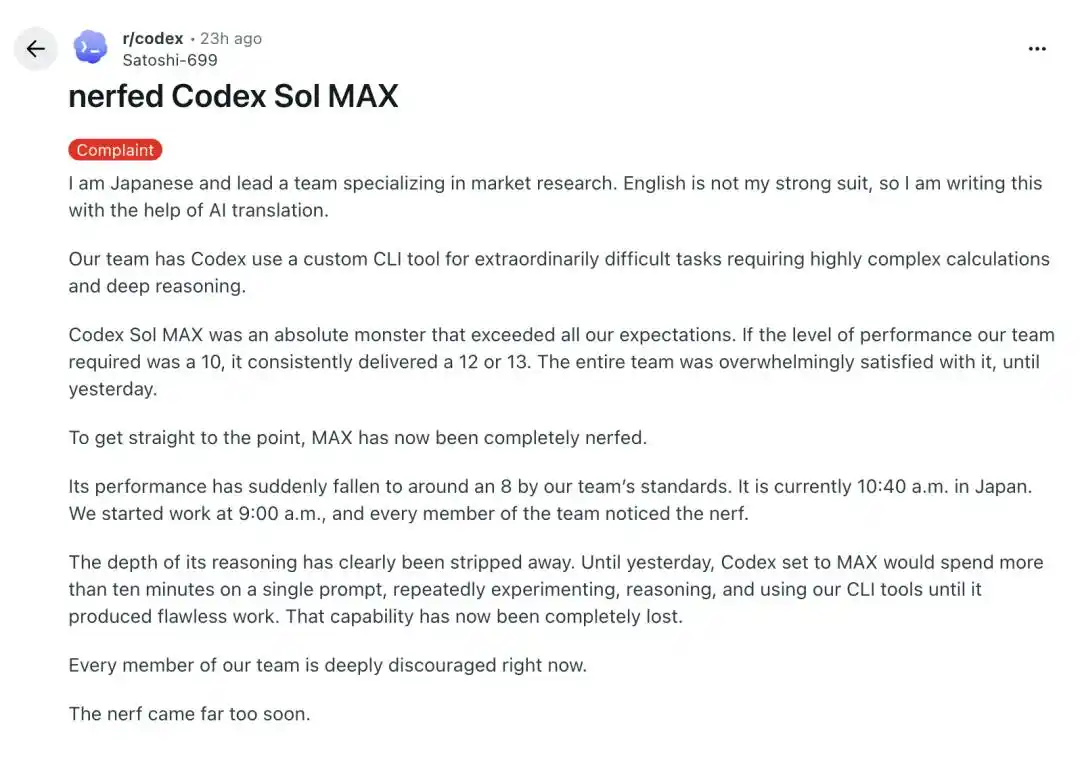
9 AM, the team started work as usual. By 10:40 AM, every single member had noticed the same thing.

They had Codex Sol MAX connected to a self-developed CLI tool, specifically for chewing through jobs requiring extremely complex calculations and deep reasoning.

Initially, Codex Sol MAX lived up to expectations, delivering 12 or 13 points out of a 10-point requirement. It was a "monster that far exceeded expectations," and "everyone was overwhelmingly satisfied with it."

But on this morning, that "monster's" performance suddenly slumped to 8 points.

The depth of reasoning had clearly been stripped away.

Before this, when faced with a prompt, Codex Sol MAX would take over ten minutes, repeatedly trying, reasoning, and calling their tools until the job was done flawlessly.

That capability had "completely vanished" on this very morning.

The Whole Internet Feels It's "Dumber"

The Japanese team's experience was just one example among many in the Codex community these past few days.

The complaints were highly consistent: the model indeed got faster, answers came more briskly, but it was unwilling to dig deep. That old drive to research first, then act, constantly revising itself, was gone.

A user on X summed up everyone's gut feeling:

Everyone's reasoning tier has been collectively downgraded by one level—if you used to run on Extra High, now you have to crank it to Max to get back the same level of effort.
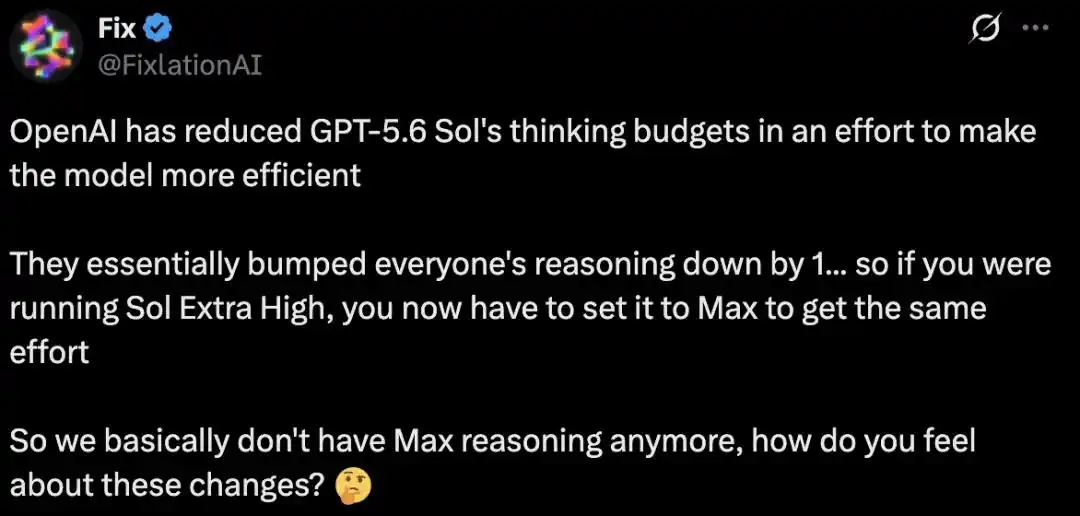
This kind of change is impossible for ordinary users to prove.

You can't see if the model weights were swapped, nor how much computing power the server allocated to you.

All you can perceive are four things: how fast it replies, how long it thinks, whether it reviews itself, and whether it calls upon other agents to help.

These are all indirect signals; none are written on a model card.

So, community users dug into it themselves and unearthed an internal parameter OpenAI never publicly disclosed: the juice value.

A Number Never Mentioned Officially

What OpenAI has publicly talked about are only the reasoning tiers.

At the GPT-5.6 launch on July 9th, the official line was the first-time introduction of max reasoning effort, "giving Sol the most ample time for deep reasoning." There's even an ultra tier above, which by default engages four agents to work in parallel.

In ChatGPT, these translate to those few options in the model selector: Medium, High, Extra High—all running Sol underneath, with the Pro tier running Sol Pro.

The juice value is the layer beneath these tiers: the internal reasoning compute budget. Users can't see it, and OpenAI has never published its values.

A community user, ns123abc, used a piece of hidden prompt text known as a "model fingerprint" to read a value from the system configuration: juice.

The community had previously observed that Sol's max tier corresponded to 960. This time, the screen showed 128—a drop of nearly 87%.
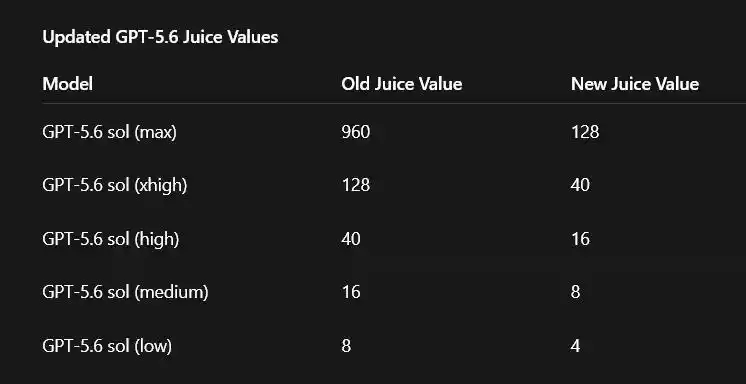
Almost simultaneously, another set of screenshots began circulating: the usable context for users in the Codex client had dropped from around 372k back to 272k.
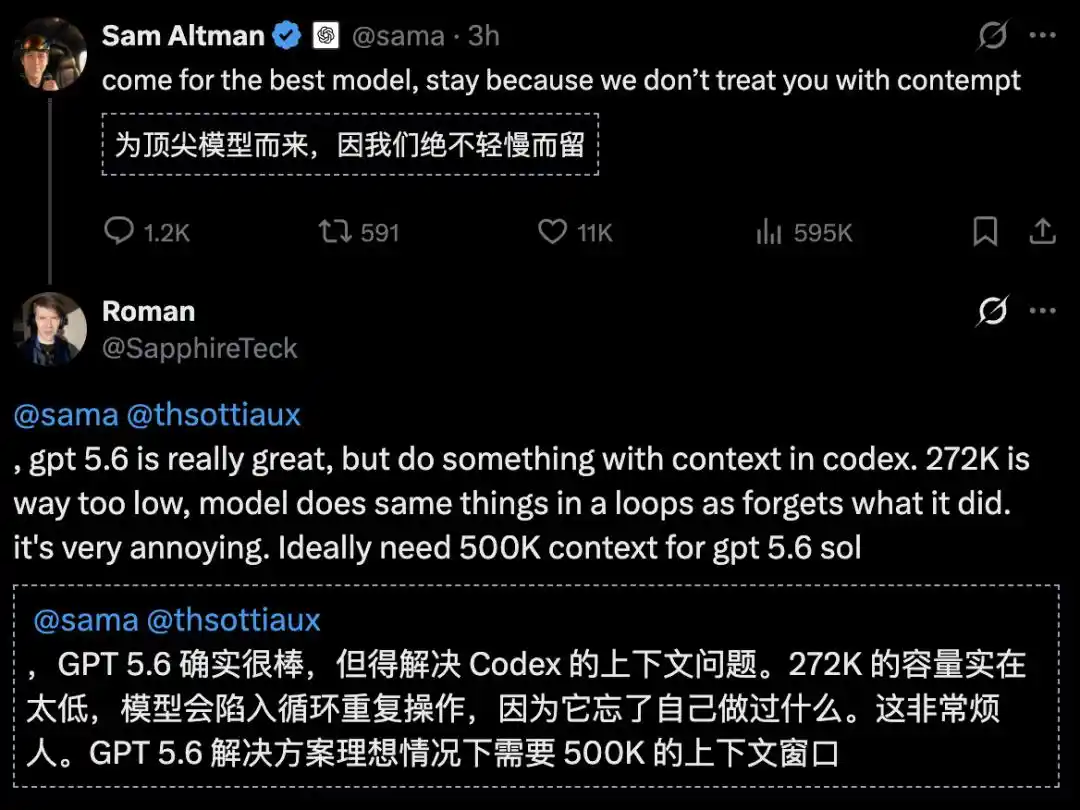
These two numbers quickly ignited the entire community.

Tibo: No Nerf, We're Investigating Usage

That same night, Tibo (Thibault Sottiaux), who leads Codex and ChatGPT Work at OpenAI, stepped up to speak.

Tibo posted an update on X, starting with: No nerf, only good things.
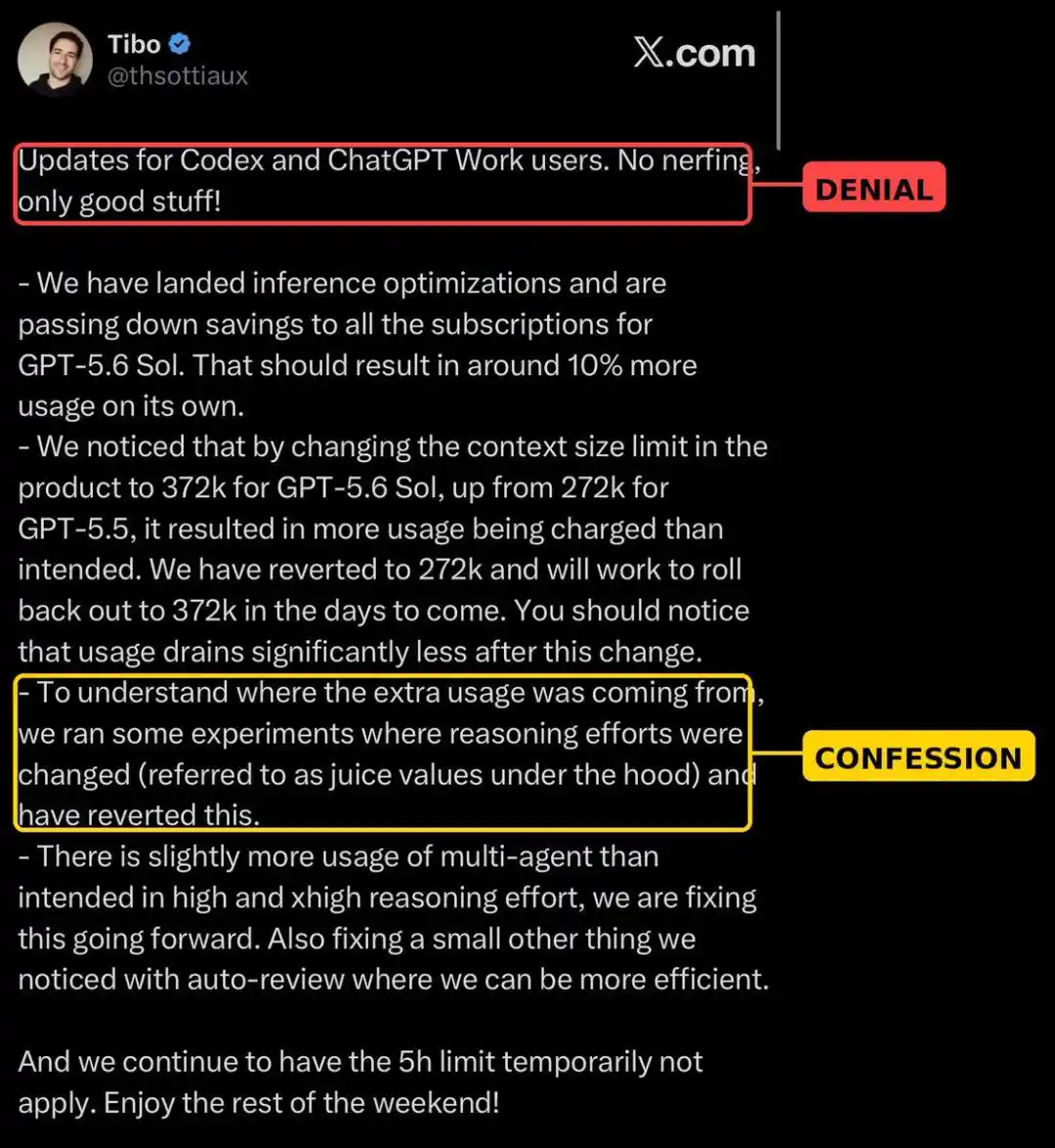
He then emphasized four points in one breath.

First, reasoning efficiency optimizations have already rolled out. The compute savings are being returned to all subscribers, which alone adds roughly 10% more usage.

Second, Sol's context window was raised from GPT-5.5's 272k to 372k, which resulted in higher-than-expected billing deductions. It has now been rolled back to 272k, with 372k being reintroduced in the coming days.

Third, to figure out where the extra usage was coming from, the team ran some experiments where they tweaked the reasoning effort—internally called "juice values."

This has now been reverted.

Fourth, the invocation of multi-agent for high and xhigh tiers was higher than expected, and there was waste on the auto-review side—both are being fixed.

Tibo's post essentially said: It's not a "nerf," it's "parameter tuning."

He didn't mention whether model weights were touched. But he did admit that the configurations users actually received had indeed been changed.

So what exactly is "juice"? Based on publicly available information, it appears closer to an internal system marker for reasoning resource allocation—roughly speaking, how much reasoning resource the system allows the model to invest in a single task.

While lowering the budget doesn't necessarily mean "the model weakened," it can quietly change many things:

How many paths can be explored in a long-horizon task, how many rounds of comparison between multiple solutions, whether code generation is actively tested after being produced, how many times it's willing to roll back after failure, and the "long-tail capabilities" in extremely difficult tasks that determine success or failure.

Ultimately, it represents how much thought the model is willing to put into a task.

To end this debate requires a strictly controlled experiment: the same model snapshot, the same batch of tasks, the same set of tool environments, changing only the juice variable.

See how much performance drops in complex coding, long-horizon agent tasks, mathematical reasoning, and error recovery.

This evidence remains absent to this day.

Every Token the Vendor Saves, the User Feels

Returning to the experiment Tibo mentioned. How did it come about?

After GPT-5.6 launched, demand surged immediately.

OpenAI temporarily lifted the five-hour usage limit window to handle the overwhelming volume of calls.
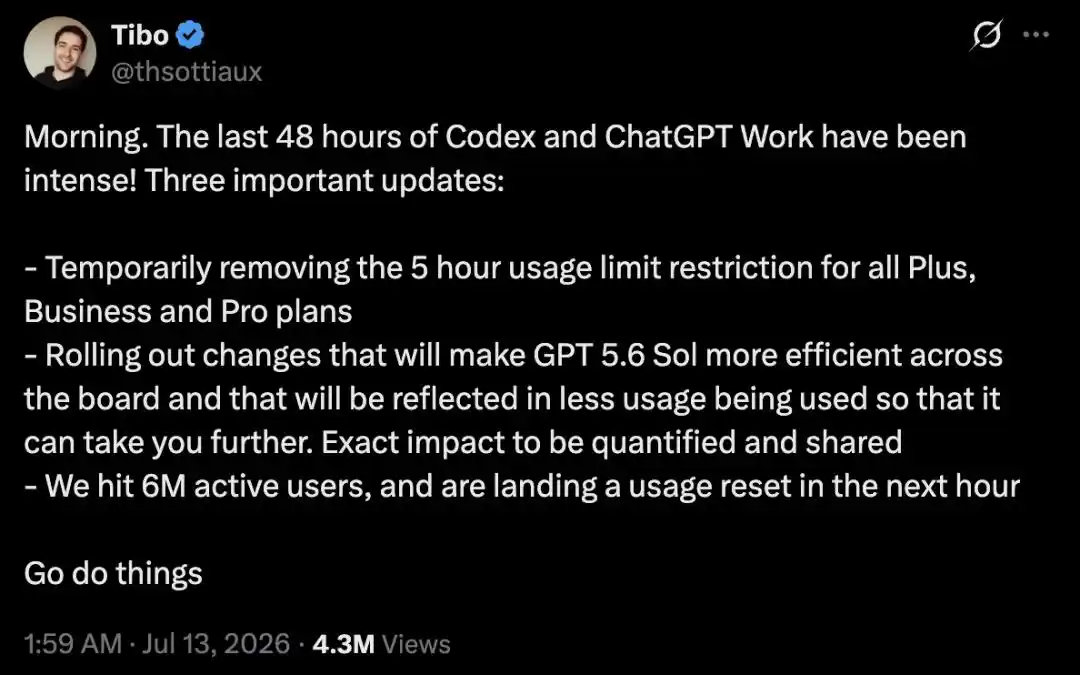
And GPT-5.6's most eye-catching new features—the longer thinking in max tier, ultra defaulting to four parallel agents, the larger context window—are precisely the token-hungry beasts.

The extra usage emerged exactly from here.

Hence, the experiment. To audit the bill, first lower the budget variable to see exactly where the usage goes—this makes perfect engineering sense.

But the problem lies exactly here: when the vendor saves tokens, users perceive it, most directly as the model "unwilling to think."

The variable that was adjusted happens to be the one users can feel.

AI Stops "Performing Miracles," Starts Punching the Clock

Over the past few years, large model companies have fostered a near-religious imagination.

People treated models like oracles, hoping they'd spit out an answer humans hadn't thought of in the dead of night, tolerating slowness, higher costs, occasional craziness.

But lab miracles can afford to ignore costs; once in production as industrial infrastructure, they cannot.

Thus, frontier models like Sol are transitioning from lab prophets who occasionally "perform miracles" into engines that keep running within daily workflows.

This resembles a process of intelligence domestication, and this controversy publicly exposed the process. Simultaneously, users' illusion of "fixed intelligence" is about to end.

Subscribing to a model is more like buying a light bulb: the model is fixed, but the brightness dial has always been in the platform's hands.

This might be the correct commercial choice, but it shouldn't forever remain in a black box.

If AI is truly to become enterprise infrastructure, vendors must provide boundaries more concrete than model names, letting users understand what exactly their paid "Max" tier guarantees.

Otherwise, it's just a price tag.

References:

https://x.com/thsottiaux/status/2076495156757577895

https://x.com/FixlationAI/status/2076469274441380349

https://www.reddit.com/r/codex/comments/1uuy5eq/nerfed_codex_sol_max/

This article is from the WeChat public account "新智元" (New AI Era), author: 元宇 (Yuan Yu)

熱門幣種推薦

相關問答

QWhat is the main change users noticed about GPT-5.6 Sol's performance according to the article?

AUsers noticed that GPT-5.6 Sol, particularly the Max tier, seemed to have become less capable at deep reasoning and complex problem-solving, delivering shallower answers more quickly instead of its previous thorough, iterative approach.

QWhat is the 'juice value' mentioned in the context of the controversy?

AThe 'juice value' is an internal, unpublicized OpenAI parameter representing the computational budget or reasoning effort allocated for a task. The community discovered its value for the Sol Max tier had reportedly dropped from 960 to 128.

QHow did OpenAI's Thibault Sottiaux (Tibo) explain the observed performance changes?

AThibault Sottiaux stated there was no 'nerf' (reduction in intelligence). He explained that the changes resulted from an experiment to investigate unexpected usage spikes after GPT-5.6's launch, during which the internal 'juice values' (reasoning effort) were temporarily adjusted. He asserted the settings had been reverted.

QWhat practical consequence did the temporary reduction in 'juice value' have for users?

AThe reduction in the internal reasoning budget meant the model spent less computational effort on tasks. Users perceived this as the model becoming 'lazy'—providing faster but shallower responses, exploring fewer solution paths, and performing less self-review and error recovery.

QWhat broader implication does the article suggest this incident has for AI as a service?

AThe incident reveals that a user's subscription buys a variable level of service, where key performance parameters like 'reasoning effort' are controlled by the provider and can be adjusted. The article argues that for AI to be trusted enterprise infrastructure, providers must offer clearer, more specific guarantees about what performance tiers actually entail, moving beyond just model names.

你可能也喜歡

崔泰源离婚案落槌:揭秘SK海力士万亿帝国背后的继承暗线

2024年底,SK集团会长崔泰源在家族活动上向子女强调“饮水思源”与继承责任。此时,旗下SK海力士市值已突破1000万亿韩元,成为韩国最值钱资产,但集团第三代接班格局却与传统财阀剧本迥异。 崔泰源与前总统卢泰愚之女卢素英育有三名子女。长女崔允贞被视为最明显接班候选,她拥有生物学背景和咨询经历,现任SK生物制药高管及集团“成长支援部”主管,主导精准医疗等新业务,其婚姻也联姻AI领域创业者。 次女崔敏贞路径独特,曾自愿服役韩国海军并参与亚丁湾护航,退役后曾在SK海力士美国部门处理国际政策,后离职在硅谷创立AI医疗公司。她与曾服役美国海军陆战队的华裔企业家结婚,连接军旅与地缘政治网络。 长子崔仁根最符合传统继承人形象,毕业于布朗大学物理系,曾任职SK旗下能源公司,后转入麦肯锡首尔办公室。他公开表现极为低调,未持有集团股份,也未公开表态。 子女们的成长与父母旷日持久的离婚诉讼交织。2025年,最高法院将涉及1.38万亿韩元财产分割的判决发回重审,期间三名子女曾向法院递交未公开内容的请愿书。 随着SK海力士在AI时代成为全球核心地缘政治资产,崔家第三代继承的已非简单的企业控制权。他们被置于AI科研、华盛顿政策圈与全球投资前沿,必须证明自己有能力应对新时代的产业博弈,而非自动承接旧式家族剧本。

marsbit前天 09:06

崔泰源离婚案落槌:揭秘SK海力士万亿帝国背后的继承暗线

marsbit前天 09:06

交易

現貨

熱門文章

什麼是 SOLANA

HarryPotterWifHatMyroWynn10Inu,$solana: 一窺這個潮流迷因幣項目 介紹 在不斷演變的加密貨幣世界中,創新的項目層出不窮,吸引著投資者和愛好者的想像。其中一個項目是 HarryPotterWifHatMyroWynn10Inu,$solana,一個已經開始在加密社區中佔有一席之地的迷因幣。本文章旨在為您提供有關該項目的全面概述,闡明其目的、架構、創建者、投資者以及在發展過程中的重要里程碑。 什麼是 HarryPotterWifHatMyroWynn10Inu,$solana? 概述 HarryPotterWifHatMyroWynn10Inu,$solana 是一個基於 Solana 區塊鏈的迷因幣項目—這是一個以其擴展性和速度而著稱的平台。該項目旨在為加密空間帶來快樂和創意,不僅作為交易代幣,還作為生成和分享迷因內容的催化劑。其核心的社區受到鼓勵參與,提供一個動態生態系統,在這裡創造力和協作得以蓬勃發展。 目標和宗旨 該項目的本質是培養一個讓迷因愛好者聚集、分享和創作新穎迷因內容的環境。這種以敘事為驅動的方式在社區中注入了興奮感,推動了參與,同時展示了 Solana 區塊鏈內在的強大功能。通過建立一個以社區為中心的項目,HarryPotterWifHatMyroWynn10Inu,$solana 亦希望探討數字貨幣作為表達手段的社會影響。 HarryPotterWifHatMyroWynn10Inu,$solana 的創建者是誰? HarryPotterWifHatMyroWynn10Inu,$solana 的創建者身份仍然神秘莫測。該項目的結構是以放棄所有權的方式設計的,因此它作為一個由社區主導的倡議蓬勃發展。這種去中心化促進了所有利益相關者之間的透明性和民主參與。在迷因幣的世界中,這種方法越來越受歡迎,因為社區參與是至高無上的。 HarryPotterWifHatMyroWynn10Inu,$solana 的投資者是誰? 截至目前,沒有公開可得的關於支持 HarryPotterWifHatMyroWynn10Inu,$solana 的具體投資者或基金會的信息。知名投資者的缺席進一步強調了該項目的以社區為導向的精神,它獨立於傳統金融框架。這種獨立性使項目能夠在沒有外部壓力的情況下發展其身份,而是依賴於用戶基礎的集體興趣。 HarryPotterWifHatMyroWynn10Inu,$solana 如何運作? 經濟模型 該項目采用了一種獨特的經濟模型,支撐其功能性和用戶參與。HarryPotterWifHatMyroWynn10Inu,$solana 內部的交易旨在對所有參與方都有益。每一筆交易都會收取費用,這些費用隨後會在現有持有者中重新分配,同時增強流動性池。 這一模型的關鍵組成部分包括: 反射機制:交易費用的一部分會返回給持有者,促進對代幣的長期投資。 流動性池獲取:資金被分配以增強流動性,確保買賣操作可以順利執行。 燒毀機制:部分代幣可能會被燒毀以創造稀缺性,隨著需求的上升可能會增加價值。 這種設計鼓勵了一個自我維持的生態系統,在這裡社區互動和投資得以繁榮。 社區參與 HarryPotterWifHatMyroWynn10Inu,$solana 的核心價值在於社區參與。通過使用戶能夠通過創作迷因和促銷等各種活動參與項目的發展,該項目培育了一個充滿活力的生態系統,讓創造力得以蓬勃發展。 HarryPotterWifHatMyroWynn10Inu,$solana 的時間軸 HarryPotterWifHatMyroWynn10Inu,$solana 的發展軌跡上有多個值得注意的事件,塑造了它在加密社區中的當前地位: 創建:具體的創建日期仍未披露,但該項目的起源植根於貫穿數位時代的迷因文化之中。 社區接管:在創建者放棄所有權後,該項目過渡為由社區主導的模式,讓所有參與者都有份於它的成功。 審計和 NFT 收藏:為了增強可信度,該項目完成了一次徹底的審計,同時推出了一個 NFT 收藏,體現其以迷因為中心的精神。 夥伴關係和發展:該項目目前正在尋找潛在的夥伴關係,並組織基於其傳奇迷因的獨特網站和商品選項的發展。 要點 總結而言,HarryPotterWifHatMyroWynn10Inu,$solana 在加密貨幣的迷因幣領域中是一個值得注意的參與者。以下是一些關鍵要點: 社區主導的倡議:該項目作為一項合作努力蓬勃發展,鼓勵社區成員積極貢獻,同時與所有權聲索分離。 創新的經濟模型:利用反射、流動性獲取和燒毀機制,為用戶創建一個強大而引人入勝的財務環境。 NFT 和商品參與:通過推出 NFT 收藏,該項目旨在深化社區參與,強化迷因文化與數字貨幣之間的聯繫。 探索夥伴關係:該倡議並非靜止不前—持續的發展和潛在的夥伴關係表明了一種面向未來的增長取向。 結論 隨著 HarryPotterWifHatMyroWynn10Inu,$solana 在加密貨幣領域中不斷擴展,其獨特的社區參與、創新經濟結構以及迷因文化的融合勾勒出其未來的潛在路徑。即使其起源和投資者關係仍帶有神秘色彩,該項目卻講述了一個富有魅力的故事,體現去中心化創新的本質。在一個加密貨幣往往被視為純金融視角的世界中,HarryPotterWifHatMyroWynn10Inu,$solana 展示了加密運動融合了創造力、社區和合作的特性。無論您是經驗豐富的投資者還是新手,這個迷因幣項目的發展過程無疑是一個值得關注的迷人案例。

1.2k 人學過發佈於 2024.04.04更新於 2024.12.03

什麼是 SOLANA

什麼是 SOLANA 2.0

BarbieCrashBandicootRFK777Inu, $SOLANA 2.0:加密貨幣界的新玩家 BarbieCrashBandicootRFK777Inu, $SOLANA 2.0 介紹 在不斷演變的加密貨幣市場中,新興項目不斷吸引著投資者和愛好者的注意。在這些新興項目中,有一個名為BarbieCrashBandicootRFK777Inu,以加密貨幣符號$SOLANA 2.0代表。這個獨特的計劃結合了魅力、冒險和迷因文化的元素,旨在在高度競爭的領域中挑戰預期。這個項目抱有增長和創新的願景,捕捉到一種努力對抗已建立的巨頭的精神。 BarbieCrashBandicootRFK777Inu, $SOLANA 2.0 是什麼? 在其核心,BarbieCrashBandicootRFK777Inu是一個受到多種標誌性文化參考啟發的加密貨幣項目。它包括與Barbie相關的優雅和魅力,Crash Bandicoot的動感能量,以及RFK所代表的堅韌驅動,該項目的目標是在加密貨幣的世界中提供多面化的體驗。 BarbieCrashBandicootRFK777Inu項目的主要目標是將這些不同的元素融合成一個吸引廣泛受眾的凝聚生態系統。通過擁抱迷因文化的奇想,同時堅守去中心化和財務賦權的原則,該項目已定位為對於成熟投資者和加密世界的新手都具有吸引力的選擇。 BarbieCrashBandicootRFK777Inu, $SOLANA 2.0 的創造者是誰? 儘管對BarbieCrashBandicootRFK777Inu的關注不斷增長,關於其創造者的信息仍然 largely未知。創始人或開發團隊的匿名性引發了對項目結構和治理的疑問。在加密貨幣的世界中,項目沒有公開創始人是很常見的。這一缺乏信息可能會使某些潛在投資者卻步,而其他人則可能將其視為擁抱許多加密貨幣項目所基礎的去中心化精神的機會。 BarbieCrashBandicootRFK777Inu, $SOLANA 2.0 的投資者是誰? 目前,關於支持BarbieCrashBandicootRFK777Inu的投資基金或機構的信息相對較少。項目缺乏詳細的投資支持突顯了許多加密貨幣的獨立性。在這種情況下,項目的資金是否來自基層社群的支持或更大金融實體的支持,仍有待觀察。 BarbieCrashBandicootRFK777Inu, $SOLANA 2.0 如何運作? BarbieCrashBandicootRFK777Inu設計了多項功能,使其在擁擠的加密空間中獨具一格。雖然具體的技術細節仍然保密,但該項目預計將融入旨在增強用戶參與度和促進社區增長的功能。從時尚和冒險到遊戲的多樣影響力的結合,促進了一種迎合多樣興趣的包容氛圍。 此外,該項目與$SOLANA 2.0生態系統的聯繫暗示著潛在的技術優勢。這可能包括創新的交易速度、可擴展性和成本效益,與Solana區塊鏈的技術能力相一致。項目的創始人似乎正在依靠這一技術基礎,以創建持久的社區體驗和實質性的產品供應。 BarbieCrashBandicootRFK777Inu, $SOLANA 2.0 的時間表 BarbieCrashBandicootRFK777Inu的旅程包含幾個關鍵里程碑,提供了該項目迄今為止的發展見解: 項目概念化:最初的想法圍繞著魅力、冒險和迷因文化的融合,為項目的獨特概念提供了框架。 代幣創建:象徵性的$SOLANA 2.0代幣建立,旨在體現項目的願景並吸引潛在投資者的興趣。 項目開發:目前,該項目正進行進一步開發,重點是挑戰加密空間中的現有玩家並提供創新的產品。 這些里程碑反映了項目的增長軌跡,同時突顯了其致力於開發一個開創性的加密貨幣體驗的承諾。 關於BarbieCrashBandicootRFK777Inu, $SOLANA 2.0 的要點 獨特概念:BarbieCrashBandicootRFK777Inu通過將魅力、冒險和迷因文化的元素融合到一個加密貨幣項目中而脫穎而出。 弱者精神:該項目擁抱弱者的角色,旨在挑戰現有的加密貨幣項目並在行業中開闢一塊市場。 開發階段:正在進行積極的開發工作,旨在提供符合社區和投資者期望的新鮮和創新的產品。 結論 BarbieCrashBandicootRFK777Inu,以符號$SOLANA 2.0呈現,是加密貨幣市場中一個引人入勝的新進者。其獨特的文化參考混合和雄心勃勃的願景,可能引起尋求在加密領域尋找替代項目價值的人的共鳴。 雖然創始人和投資者的未知狀態可能會引發疑問,但該項目對魅力和冒險的重視展現了擴展加密貨幣可能體現的界限的迷人敘事。隨著項目的持續發展,觀察其在更廣泛的加密市場中的演變及其如何在競爭對手中定位自己,將會非常有趣。對於那些參與者來說,BarbieCrashBandicootRFK777Inu可能會解鎖重新定義與數字資產互動的驚喜體驗。 目前,隨著項目的推進,其旅程提醒著我們,加密空間的創新沒有界限,提供了一切從興奮和娛樂到財務賦權的潛力。

263 人學過發佈於 2024.04.05更新於 2024.12.03

什麼是 SOLANA 2.0

如何購買SOL

歡迎來到HTX.com!在這裡,購買Solana (SOL)變得簡單而便捷。跟隨我們的逐步指南,放心開始您的加密貨幣之旅。第一步:創建您的HTX帳戶使用您的 Email、手機號碼在HTX註冊一個免費帳戶。體驗無憂的註冊過程並解鎖所有平台功能。立即註冊第二步:前往買幣頁面,選擇您的支付方式信用卡/金融卡購買:使用您的Visa或Mastercard即時購買Solana (SOL)。餘額購買:使用您HTX帳戶餘額中的資金進行無縫交易。第三方購買:探索諸如Google Pay或Apple Pay等流行支付方式以增加便利性。C2C購買:在HTX平台上直接與其他用戶交易。HTX 場外交易 (OTC) 購買:為大量交易者提供個性化服務和競爭性匯率。第三步:存儲您的Solana (SOL)購買Solana (SOL)後,將其存儲在您的HTX帳戶中。您也可以透過區塊鏈轉帳將其發送到其他地址或者用於交易其他加密貨幣。第四步:交易Solana (SOL)在HTX的現貨市場輕鬆交易Solana (SOL)。前往您的帳戶,選擇交易對,執行交易,並即時監控。HTX為初學者和經驗豐富的交易者提供了友好的用戶體驗。

2.7k 人學過發佈於 2024.12.12更新於 2026.06.02

如何購買SOL

相關討論

歡迎來到 HTX 社群。在這裡,您可以了解最新的平台發展動態並獲得專業的市場意見。 以下是用戶對 SOL (SOL)幣價的意見。

活动图片