Author: Deep Tide TechFlow
If you go to an ATM to transfer money, and the ATM tells you that you must first buy "ATM usage coupons," you would probably think the ATM has gone crazy.
But this has been the operating rule for blockchain for over a decade: to make a transfer, first prepare the Gas.
As stablecoins play an increasingly critical role in the payment field, the cost of this threshold becomes clearer: new users are blocked outside, and payment scenarios are difficult to implement.
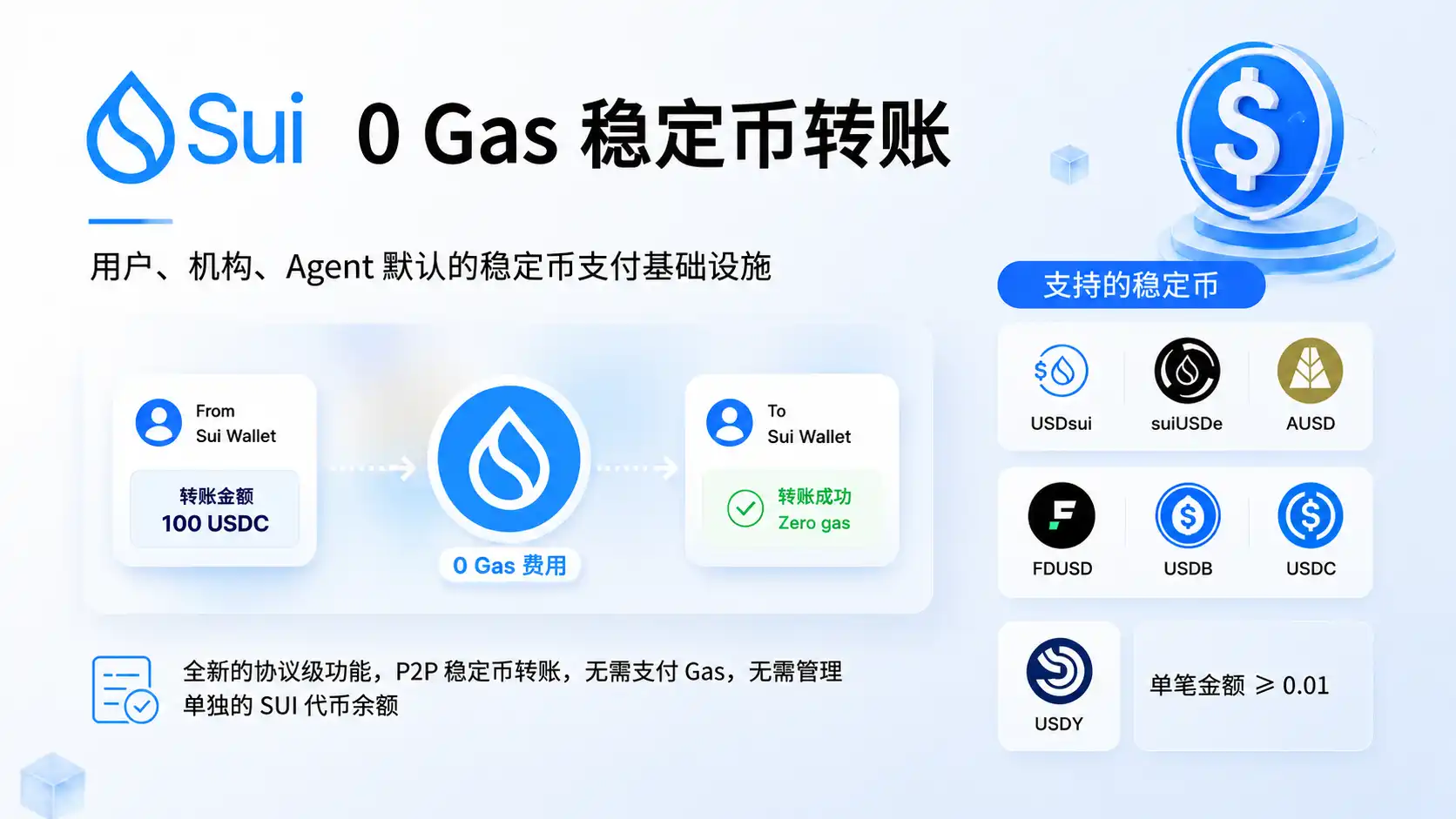
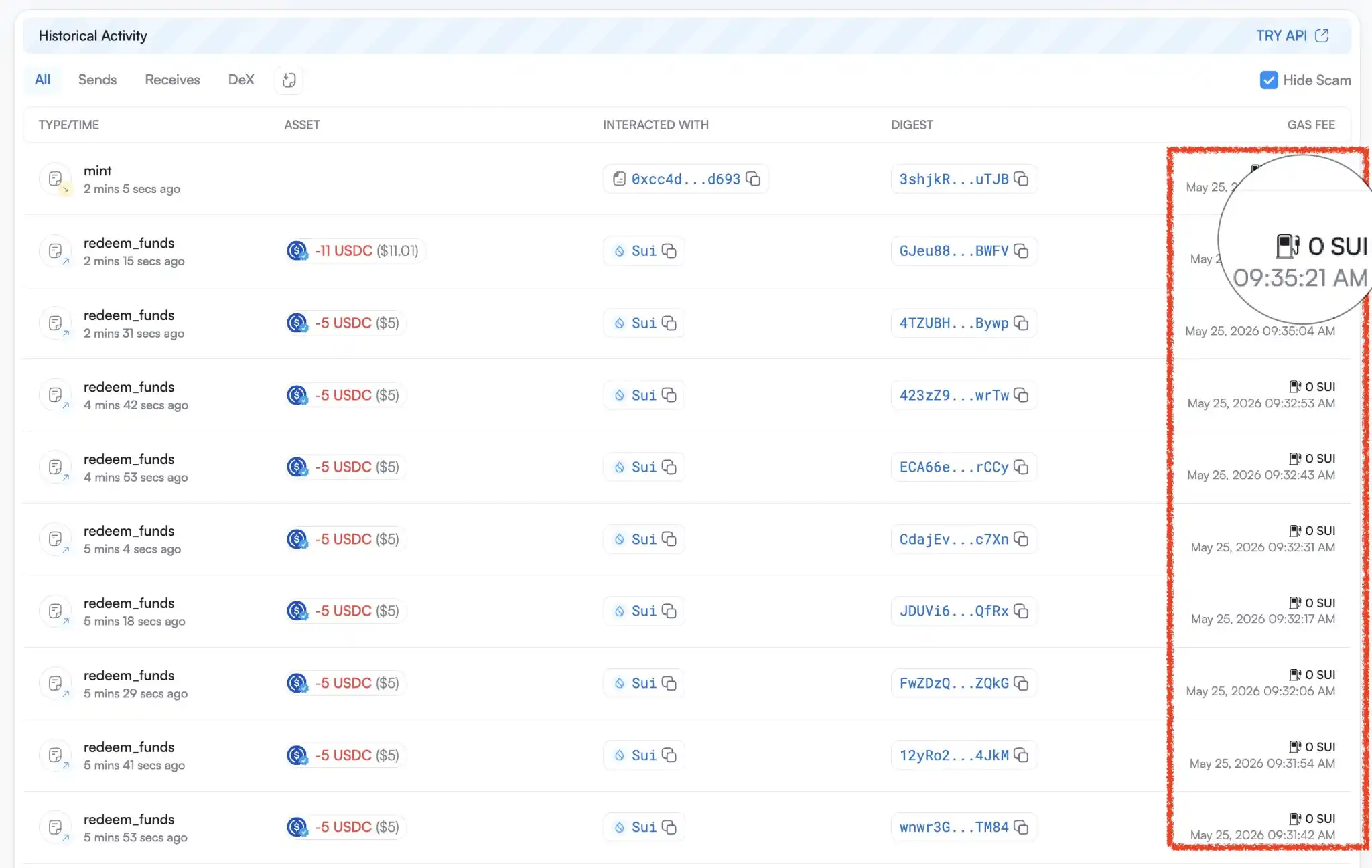
As a key initiative in building the "underlying infrastructure for stablecoin payments," on May 20, 2026, Sui announced the launch of a zero Gas stablecoin transfer feature, allowing users and enterprises to send stablecoins peer-to-peer without paying Gas fees, and without needing to manage a separate SUI token balance.
Although currently, this feature only supports P2P transfers of whitelisted stablecoins, stablecoins now have a real chance to transform from "crypto assets" into "payment infrastructure." The entity achieving this also further strengthens its position as a strong contender for the role of the "default foundation for stablecoin payments."
A New Kind of "Zero Gas": No One Is Paying for You in the Background
When mentioning zero Gas, most users' first reaction might be: Who paid the Gas for me?
This habitual thinking stems from past incomplete attempts at "zero Gas": either through subsidies or relays. The Gas never disappeared; someone was just quietly settling the bill in the background, a superficial solution that doesn't address the root cause.
Sui's "Zero Gas Stablecoin Transfer" targets the fundamental root.
It is built upon a new underlying account architecture called Address Balances. When tokens are sent using specific Move functions, they are automatically consolidated into the single balance of the recipient's address, eliminating the need to create or manage Coin objects. This saves the overhead of object creation, splitting, merging, and version tracking. The processing cost for validators is extremely low, low enough that they can refrain from charging users fees.
Costs are reduced, and boundaries must also be clearly defined: Under the highly restricted PTB mechanism, only P2P transfers of whitelisted stablecoins, with amounts no less than 0.01, are judged as zero Gas. This supports payment scenarios while isolating malicious transactions.
What Can This Infrastructure Run?
Firstly, it opens the door to daily payments. When the experience is frictionless and the cost is zero, those payment scenarios we once pinned high hopes on for stablecoins—including consumption, tipping, subscriptions, cross-border remittances, etc.—gain the potential for rapid penetration. Stablecoin payments, for the first time, possess the basic conditions to compete head-on with traditional payment tools, potentially even faster and better.
Of course, for high-frequency micro-payment scenarios, many will think of the Agent economy. In the past, actions like AI autonomous transactions and arbitrage required additional Gas management. The zero Gas stablecoin transfer will become the lowest-cost, least-resistance choice for Agents. Combined with Sui's high-performance advantages, it will further support the large-scale deployment of autonomous payment flows.
Another keyword is: Institutions. This is a group Sui officials specifically emphasize. Whether it's cross-border B2B payments, supplier settlements, or platform profit sharing, institutions often face higher payment friction. The protocol-level zero Gas mechanism transforms stablecoins into a payment tool that institutions can directly utilize.
Worth mentioning is that when the zero Gas feature was launched, Fireblocks had already announced support for address balances, and soon after, it supported Gas-free stablecoin transfers, further enhancing the accessibility of Sui's payment infrastructure for institutions. At the same time, several institutional-grade custody platforms and wallets have announced they will support zero Gas transactions.
Zero Gas: The First Half; Privacy: The Second Half
Since August 2025, stablecoin transfer volume on the Sui network has exceeded $1 trillion. This figure is sufficient to show that the underlying logic for stablecoin payments in the Sui ecosystem is already working. The launch of zero Gas stablecoin transfers will undoubtedly accelerate the construction of Sui's role as the "default foundation for stablecoin payments."
But this is only the first half of Sui's 2026 payment narrative.
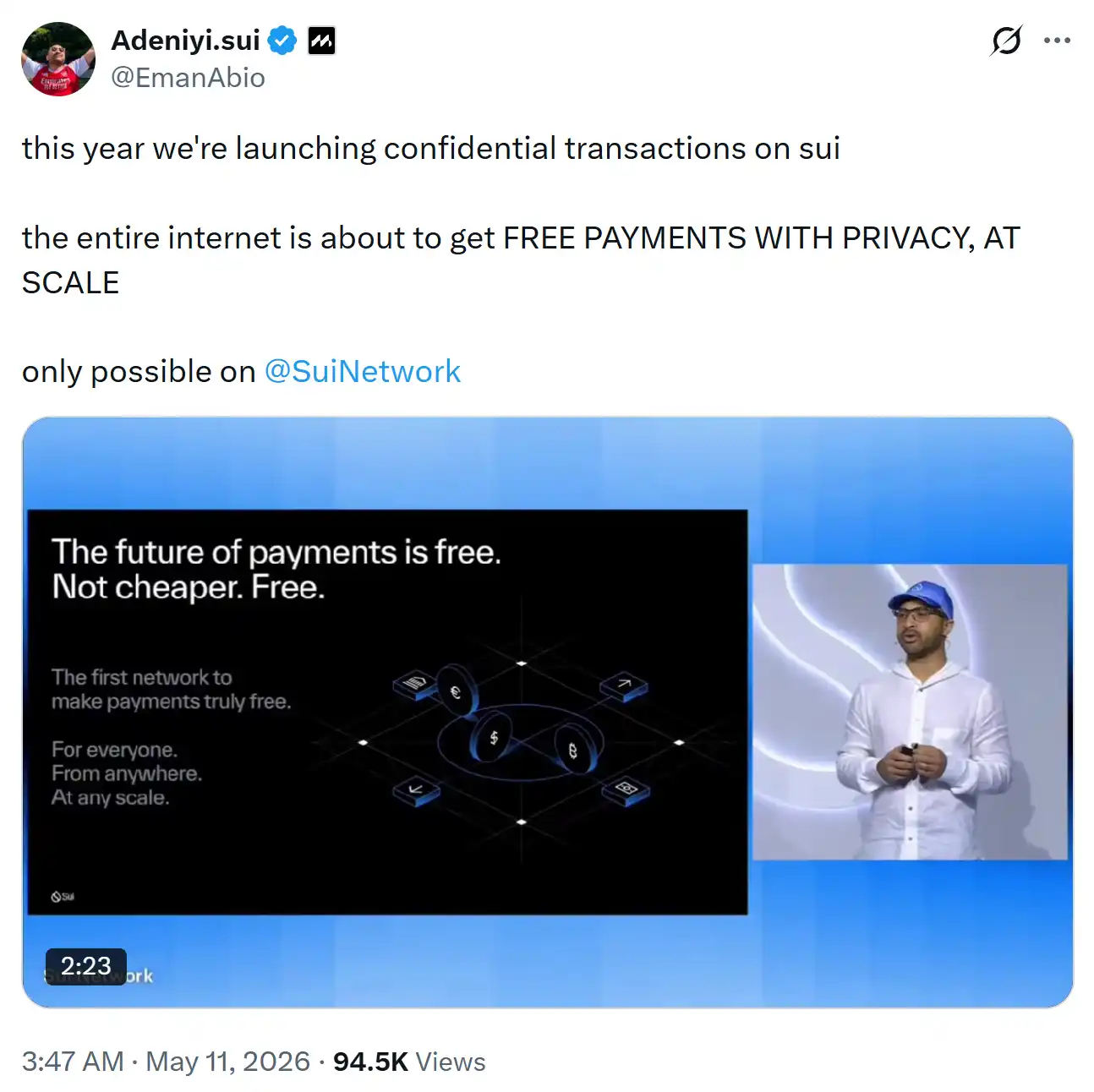
Regarding the second half, the Mysten Labs product team has hinted multiple times: Protocol-level confidential transaction functionality will be launched within 2026, aiming to achieve large-scale, free payments with privacy protection.
Transfers will not only be cost-free but will also be able to hide transaction amounts and certain details, while retaining necessary audit and compliance capabilities.
This combination is crucial for adoption, especially for institutions. The higher the compliance requirements, the greater the value of confidential transactions.
Let Money Flow Like Information.
This can be considered a phrase that runs through all of Sui's technological and ecosystem initiatives.
And now, from payments to Agents to institutions, the fuse that will decide large-scale adoption might just be lit by zero Gas stablecoin transfers.