Nobel laureate joins Anthropic!
Today, AlphaFold core leader John Jumper announced: He is leaving Google DeepMind after nearly 9 years and joining Anthropic.
A Nobel laureate who rewrote structural biology with an AI model has turned and left.
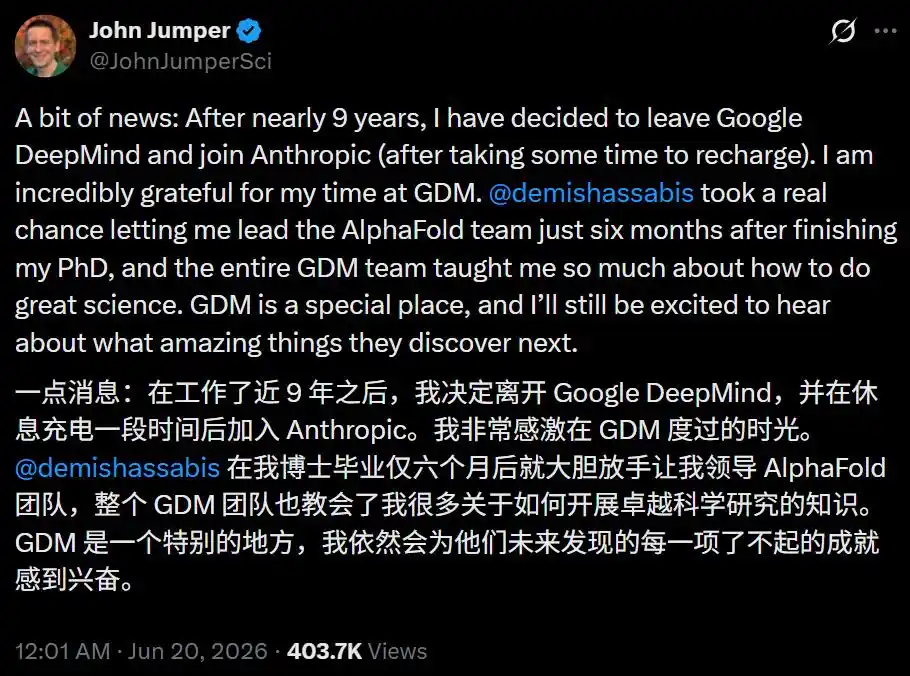
Hassabis responded quickly: "Thank you John for an incredible partnership over the past 9 years! What we achieved with AlphaFold changed the world."
Nine years of collaboration, sharing a Nobel Prize—this is probably the most amicable farewell in the tech circle.

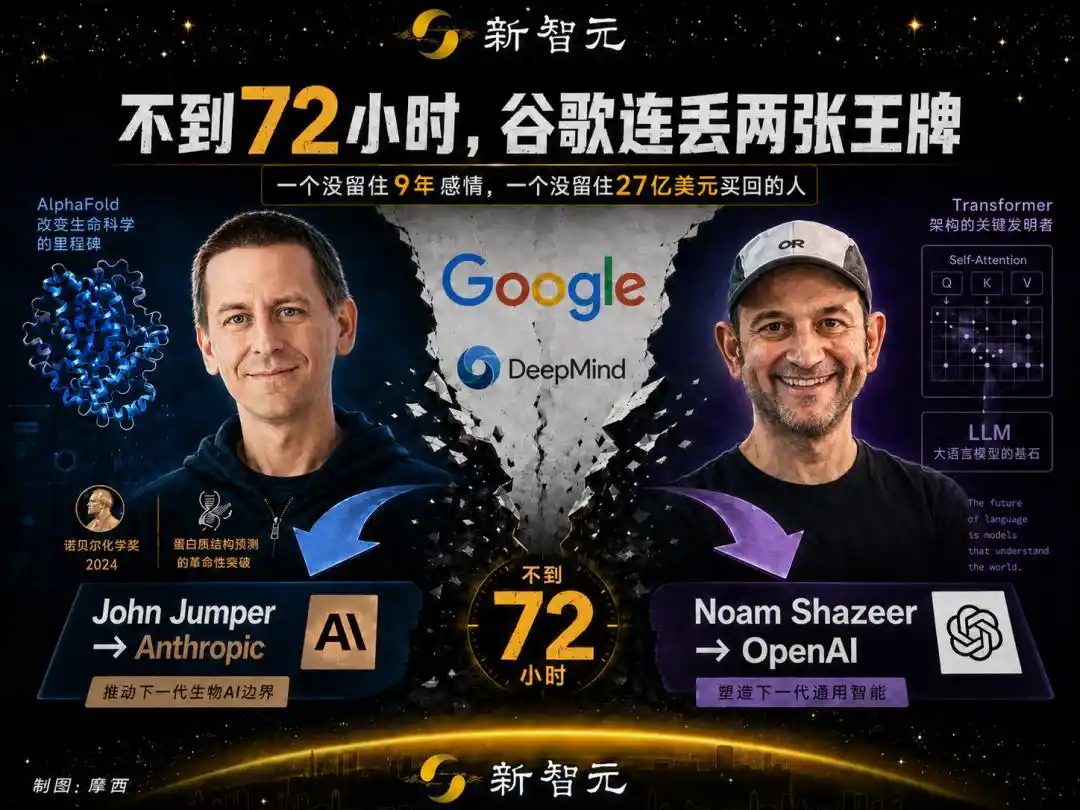
And just two days ago, the legendary co-first author of the Transformer paper and Gemini co-lead, Noam Shazeer, announced he was leaving Google for OpenAI.
In less than 72 hours, Google lost two aces.
One couldn't be kept even after a $2.7 billion buyback, the other couldn't be kept even after 9 years of shared history.
Leading AlphaFold Directly, 6 Months After PhD Graduation
In the life sciences world, John Jumper is practically synonymous with "rewriting an entire discipline with AI."
Born in 1985 in Little Rock, Arkansas, an ordinary small town in the American South.
He earned a dual bachelor's degree in Mathematics and Physics from Vanderbilt, then went on to the University of Chicago all the way to his Ph.D., researching theoretical chemistry. Specifically, using computational methods to simulate the dynamic behavior of proteins.
Mathematics gave him intuition for modeling, physics gave him understanding of complex systems, and theoretical chemistry made him understand the protein problem itself better than any pure AI researcher.
The combination of these three fields just happens to be the rarest knowledge set needed to solve the protein folding problem.
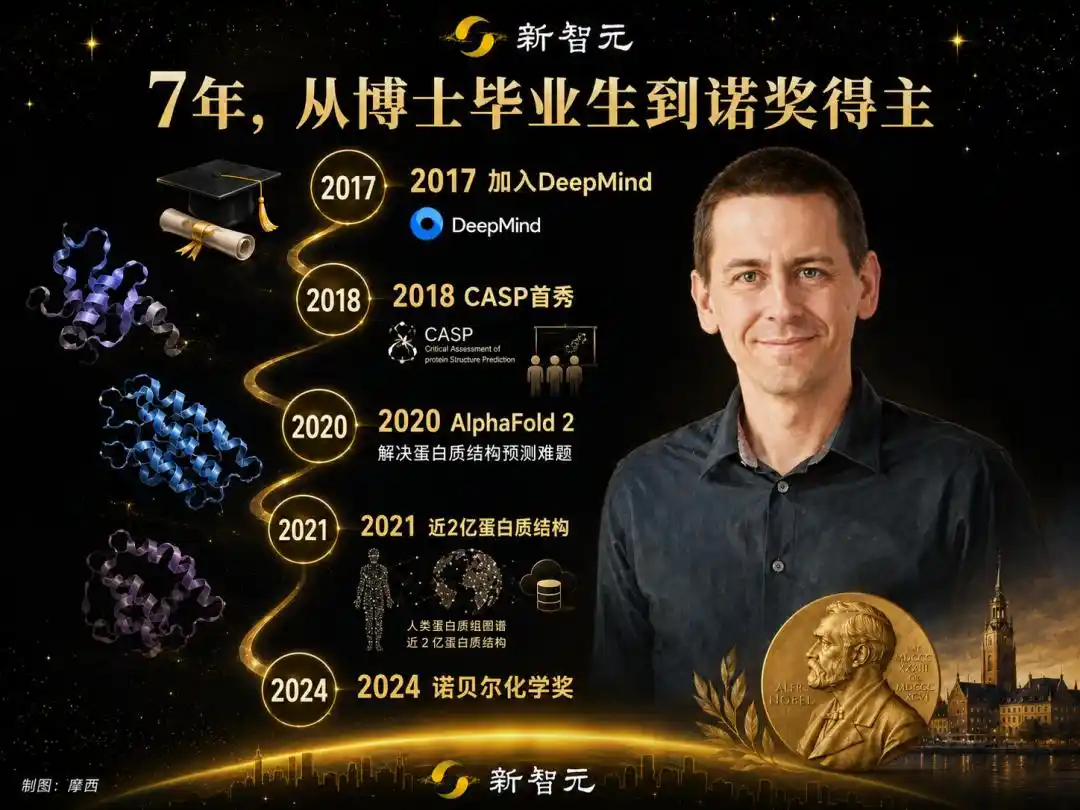
After receiving his Ph.D. in 2017, Jumper directly joined DeepMind.
Notably, at that time he had almost no deep learning experience. What stood out on his resume was not mastery of neural networks, but his understanding of protein physics.
But that's precisely what Hassabis valued.
Immediately after, he made a decision no one expected—letting this young man, who had graduated only 6 months prior and had to learn deep learning on the job, directly lead the AlphaFold team.
No transition period, no "do a few years as a researcher to build seniority."
Hassabis was betting that solving the protein folding puzzle required understanding proteins more than understanding AI. And what Jumper took on was the biggest gamble in the entire field of computational biology.
Single-handedly Scaling Biology by 1000x
What happened in the following years can only be described as "unbelievable"—
2018, AlphaFold made its debut at the protein structure prediction competition CASP, crushing traditional methods.
2020, AlphaFold 2 emerged, directly "solving" the protein folding problem that had puzzled biologists for 50 years.
2021, Jumper's team calculated the 3D structures of nearly all 50,000+ human proteins. Ultimately, they generated structures for about 1 million species, nearly 200 million known protein structures.
Before AlphaFold, humanity spent decades using experimental methods like X-ray crystallography, cryo-electron microscopy to solve about 200,000 protein structures in total.
Jumper's team scaled that by 1000x in one go.
It's no exaggeration to say that the work biologists hadn't finished in the past hundred years, AlphaFold did in a few months.

May 2024, AlphaFold 3 was released—not just predicting proteins anymore, it can calculate interactions between DNA, RNA, small molecule drugs. Protein-ligand docking accuracy 76.4%, 1.8x improvement over previous methods.
Five months later in Stockholm, John Jumper and Demis Hassabis stood together on the Nobel Chemistry Prize podium.
That year Jumper was 39, the youngest Chemistry Nobel laureate in 70 years.
From a fresh Ph.D. graduate who had to learn deep learning on the fly, to standing under the Stockholm spotlight, it took him only 7 years.
Thus, the return on Hassabis's bet back then is probably among the highest in the history of human science.
So his departure today is not simply about Google DeepMind losing a Director.
What's Really Going on with Google?
After the news exploded, comments on X directly boiled over.
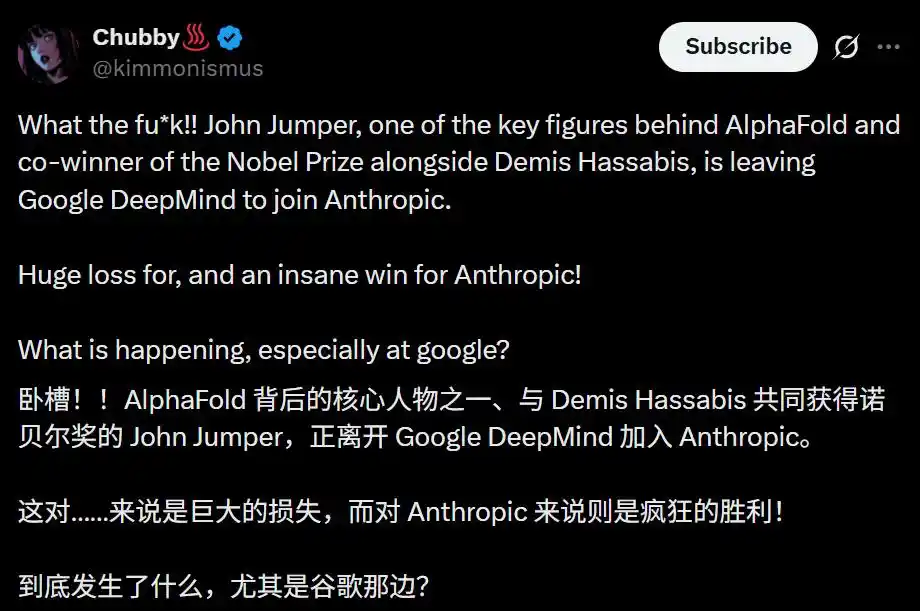
User Chubby exclaimed: "This is a huge loss for Google, and absolutely insane for Anthropic!"
Some lamented, "Anthropic welcomes a Nobel laureate, talent is continuously concentrating towards OpenAI and Anthropic." Others outright declared: "First Karpathy, now the person behind AlphaFold, Anthropic is assembling an AI Avengers."

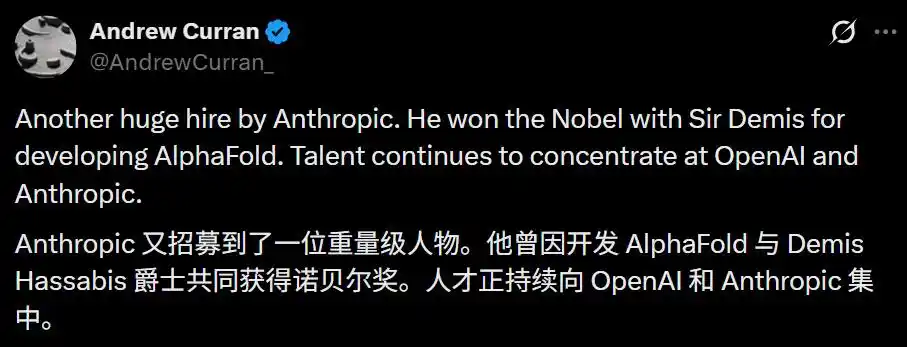
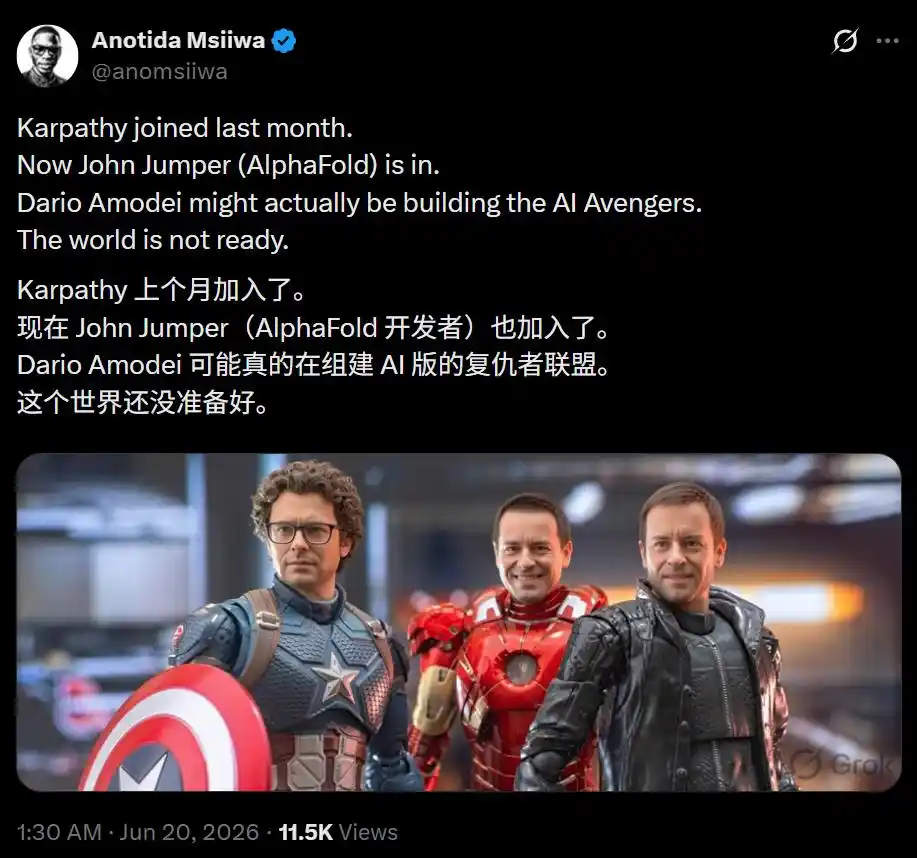
Logan Kilpatrick joked about expecting Jumper to "win another Nobel Prize." The tone was teasing, but on second thought, it's not really an exaggeration.
And after the shock, everyone was asking the same question—what's wrong with Google?

Jumper didn't say, Anthropic didn't say, Google didn't say.
Perhaps a comment by investor Lior Alexander is the closest to an answer currently—
"Frontier AI labs are selling something Google can't offer: the feeling that one person can change a company's trajectory."

Couldn't Keep the Person Bought Back for $2.7 Billion Either
Just two days before Jumper's announcement, Noam Shazeer announced leaving Google for OpenAI, as "Head of Architecture Research."
In the 2017 foundational paper of modern AI, "Attention Is All You Need," he was one of the core authors. The multi-head attention mechanism was his design, the first usable implementation that beat SOTA was coded line by line by him.
And Google spent $2.7 billion to bring him back from Character.AI.
After returning, Shazeer became Gemini co-lead, a key figure in Google's counterattack with large models.
Result: less than two years later, he left again. Two days after that, Jumper left.
They are neither the first, nor will they be the last.
Over the past 8 years, more than 20 top researchers who authored milestone papers have left DeepMind/Brain one after another.
In 2025 alone, at least 11 executives left. DeepMind co-founder Mustafa Suleyman himself was also poached by Microsoft in a $650 million acqui-hire round.
Life Sciences, the Next Battlefield for the AI Big Three
Back to Anthropic's side. The groundwork began over two months ago.
April 3rd, Anthropic acquired biotech company Coefficient Bio for $400 million in stock. The team was less than 10 people but had already achieved top-tier results in AI-driven antibody design.
Meanwhile, Anthropic is also building its own wet lab. Last October, they launched Claude for Life Sciences to help researchers accelerate drug discovery and biological experiment design. This January, they launched Claude for Healthcare for medical institutions.
They say the goal is to compress the life science R&D cycle by 10x. And now, a Nobel-caliber protein scientist is leading this effort.
In fact, it's not just Anthropic betting on life sciences.
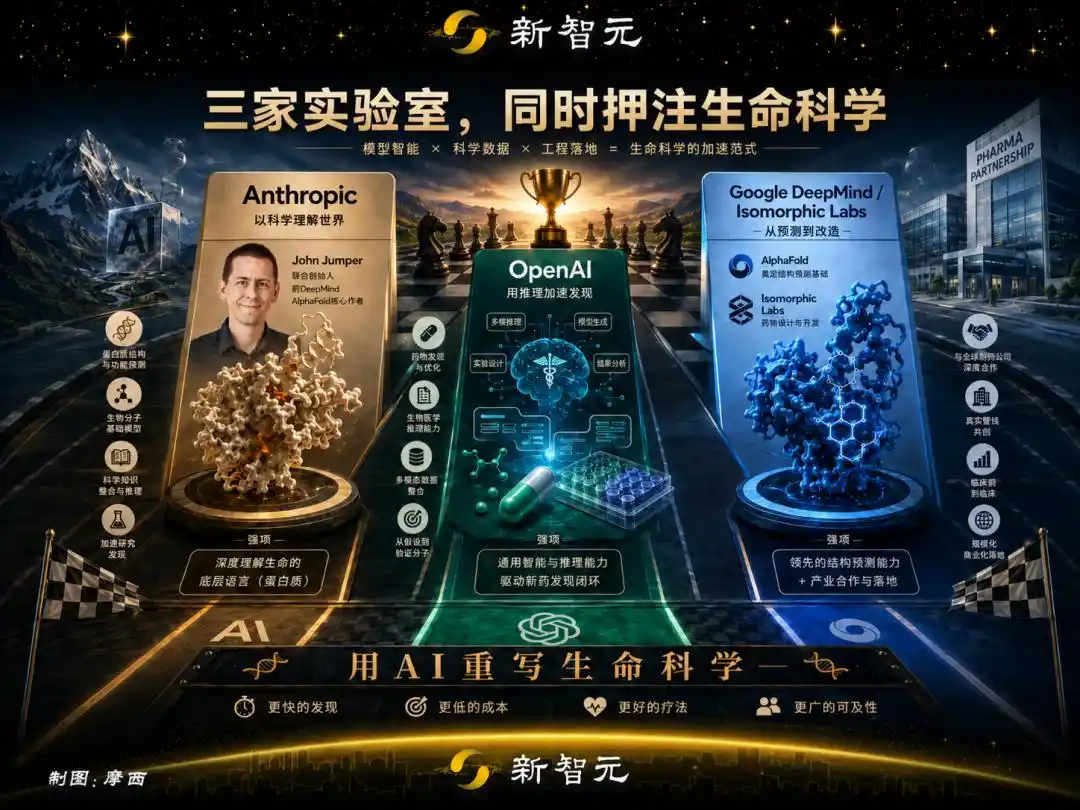
OpenAI released GPT-Rosalind in April this year, a reasoning model specifically for biomedicine, focusing on drug discovery, genomic analysis, and protein engineering. They have already partnered with top pharmaceutical companies like Amgen, Moderna, Thermo Fisher.
The OpenAI Foundation directly stated: investments in life sciences in the coming year will be no less than $1 billion. With the newly poached Shazeer overseeing architecture research, OpenAI is also making a strong move on this track.
On Google DeepMind's side, Hassabis's Isomorphic Labs raised $600 million last year, signed collaboration agreements with Eli Lilly and Novartis with total milestone values up to $3 billion. The AlphaFold technology foundation remains the industry benchmark.
Three labs simultaneously placed their bets on the same direction—rewriting life sciences with AI.
Jumper's choice is just the latest move in this grand chess game.
References:
https://x.com/JohnJumperSci/status/2068001285173834106
Editor: Moses
This article is from the WeChat public account "新智元", author: ASI启示录