A staged fake-delivery encounter in San Francisco’s Mission Dolores district escalated into one of the city’s largest known individual crypto thefts, after a disguised assailant subdued a resident and escaped with assets worth $11 million, alongside the victim’s phone and laptop.
Mission Dolores Hit By $11M Crypto Robbery
According to a police report obtained by the San Francisco Chronicle, the Saturday evening robbery unfolded in broad daylight on the unit block of Dorland Street, only steps from Mission Dolores Park—a neighborhood where tech proximity and high-value assets have increasingly intersected with targeted crime.
Home-security footage posted by Y Combinator CEO Garry Tan captured the moments leading up to the heist. In the video, the suspect approaches the residence wearing dark clothing, a hooded sweatshirt, gloves and sunglasses, and holding a white package while deliberately turning his head away from the camera.
He rings the doorbell and asks for “Joshua,” claiming the box is addressed to him. The ruse continues when the resident opens the door and confirms his name. The man posing as a courier asks whether the victim can “sign for this,” pats his own pocket as though searching for a pen, and then asks the resident if he has one.
The moment the victim steps inside to retrieve a pen, the intruder follows him into the home and moves out of frame. A loud noise is heard. Police later confirmed that the suspect brandished a firearm and bound the victim with duct tape before fleeing with his belongings. Officers arrived at approximately 6:45 p.m. and found the victim with non-life-threatening injuries. No arrests had been made as of Monday morning, and authorities have not disclosed details about how the $11 million in cryptocurrency was accessed or transferred.
Tan publicly acknowledged the incident on X, describing the victim as a friend and community member. He urged anyone in the neighborhood with security footage from 4:30 to 6 p.m. to contact the San Francisco Police Department. “We have to find the perpetrator,” Tan wrote. “Time is of the essence.”
The Big Risk Of Self-Custody
In a follow-up post referencing the crypto theft, Tan added a pointed observation about crypto asset security: “Self custody of crypto seems like a good idea until it isn’t. Vault storage (at Coinbase or elsewhere) for long term holding is safest.” His comments drew immediate attention from both the tech and crypto communities, highlighting the tension between self-custody principles and the physical-security risks of storing large private-key access at home.
Thus, the incident has reignites a longstanding debate about personal-security practices among high-net-worth crypto holders in urban settings. While hacks, phishing attacks, SIM swaps and insider compromise have dominated crypto asset crime over the past decade, physical-world robberies—once rare—have become increasingly sophisticated.
The San Francisco case stands out due to the scale of assets stolen, the execution of the ruse and the direct commentary from one of Silicon Valley’s most visible figures.
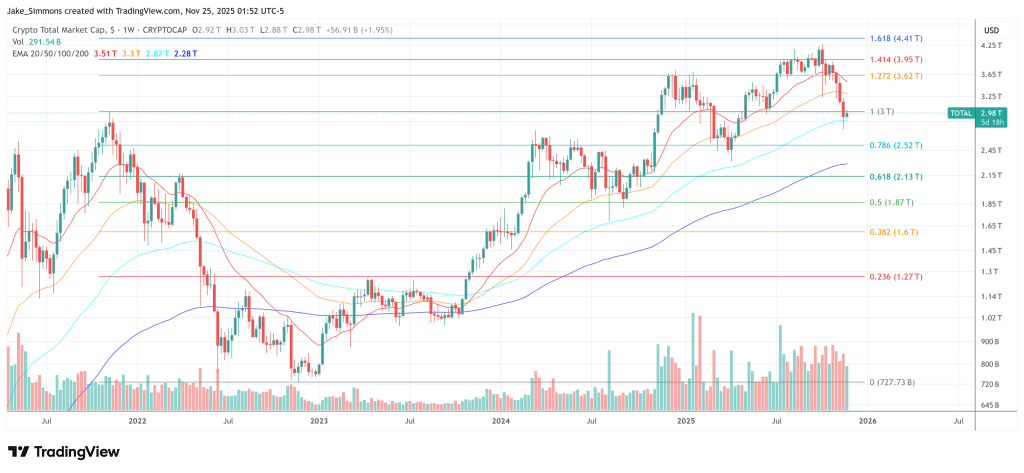
At press time, the total crypto market cap stood at $2.98 trillion.

Related Posts