PayPal’s stablecoin PYUSD is now available on nine more blockchains, thanks to integration with LayerZero’s interoperability protocol.
PayPal’s Stablecoin Now On Tron, Avalanche, & Seven Other Networks
As announced by LayerZero in a blog post, PayPal USD (PYUSD) is getting a major expansion through integration with its Stargate Hydra system, allowing users to move the stablecoin to blockchains on which it is natively unavailable. This is made possible with PYUSD0, a new permissionless token that’s fully fungible with the original PYUSD.
Currently, PayPal’s stablecoin is natively issued by Paxos on Abritrum, Solana, Ethereum, and Stellar. With PYUSD0, it will now also be transferable to Abstract, Aptos, Avalanche, Ink, Sei, Stable, and Tron. According to LayerZero, more networks beyond these are also set to come.
Previously, PYUSD was already bridged to two other networks, Berachain (BYUSD) and Flow (USDF), and both will now be receiving upgrades to PYUSD0. This makes a total of nine networks on which the new token will be accessible.
“As the stablecoin market continues its rapid growth beyond $270 billion, innovations like this are essential for creating the seamless, interoperable financial infrastructure that users and developers demand,” says David Weber, Head of Ecosystem, PayPal USD.
PayPal launched its stablecoin back in 2023, becoming one of the first payment processing giants to embrace fiat-tied tokens. Since then, the firm has been taking measures to increase the reach of its coin, most recently with the Stellar version launch on Thursday.
Now, with the LayerZero integration, the company has taken another step toward its goal. “By working together, we will enable PYUSD to reach new markets faster while maintaining compliance and composability from day one,” notes Weber.
The PYUSD0 system is built on three pieces of infrastructure: PayPal’s stablecoin itself, Stargate Hydra, and LayerZero. Stargate, which was acquired by LayerZero last month, acts as the transfer interface, while LayerZero handles minting, burning, and deployment of PYUSD0 to the new blockchains.
“With PYUSD0, PayPal USD expands its reach and flexibility to work across today’s networks and tomorrow’s,” says Bryan Pellegrino, Co-Founder and CEO at LayerZero Labs. “Launches like this make it obvious that we are at the start of a global financial market that breaks down borders and works around the clock.”
Besides its stablecoin, PayPal has also been making developments in its cryptocurrency payments ecosystem lately. In late July, the payments processor firm unveiled a “Pay with Crypto” service to help merchants receive digital asset payments, and earlier this week, it also announced cryptocurrency integration into its peer-to-peer (P2P) payments system.
Bitcoin Has Seen A Pullback During The Past Day
Bitcoin recovered to $117,900 on Thursday, but the asset has since gone down as its price is back at $116,400. The below chart shows how the coin’s recent trajectory has looked.
The price of the asset seems to have overall moved sideways over the last five days | Source: BTCUSDT on TradingView
The pullback in Bitcoin and other digital assets has induced $133 million in long liquidations over the last 24 hours, according to data from CoinGlass.
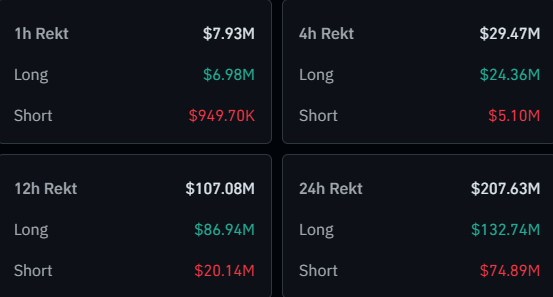
The data for the cryptocurrency liquidations during the past day | Source: CoinGlass

Related Posts