As the US Congress continues to work on crypto-related legislation, some industry leaders disagree on which version of the market structure bill will provide the much-needed clarity to the sector.
Paradigm Champions Senate’s Crypto Bill
On Thursday, several industry players discussed the differences between the US Congress’s versions of one of the landmark crypto bills. Following the passage of the GENIUS Act, the sector is now focused on the key market structure legislation, which is expected to offer the long-awaited clarity and protection for the industry.
Notably, the House of Representatives introduced and already passed the Digital Asset Market Clarity (CLARITY) Act of 2025, which seeks to establish a regulatory framework for crypto assets in the US, facilitate the growth of crypto projects, and protect customers.
In June, the US Senate started working on principles for its version of the market structure legislation, looking to draft a comprehensive set of rules. As reported by Bitcoinist, the Senate Banking Committee released a draft of its “framework of principles,” outlining six key principles for the upcoming crypto bill, which were allegedly “very well received” by the Decentralized Finance (DeFi) sector.
Today, Paradigm’s General Partner, Dan Robinson, shared the firm’s response to the Senate Banking Committee’s discussion draft on the bill, suggesting that this version is the best approach. Chainlink Labs, Galaxy Digital, Tribe Capital, Multicoin Capital, Electric Capital, and Ribbit Capital co-signed the letter.
Robinson argued that while both bills are an “improvement on the Howey-based regime (…), the Senate draft is significantly simpler, and avoids forcing decentralized tokens and protocols to fit themselves into an inflexible legislative framework.”
The lawyer explained that the Senate’s draft focuses on the concept of ancillary assets, which “distinguishes the typical crypto asset from securities due to its innate nature.” To the firms, this is the “cleanest test” that protects decentralized crypto assets while preventing traditional securities issuers from improperly exploiting this framework.
Paradigm’s VP of Regulatory Affairs added that if regulatory clarity involves replacing the current “inscrutable regime that no one can register under or operate in with another complex regime that requires a phalanx of lawyers & millions of dollars to comprehend, this exercise will have failed.”
Industry Players Divided Over Legislation
In an X post, journalist Eleanor Terret noted that most of the major crypto Venture Capital (VC) firms, except a16z crypto, “aligned on market structure and token classification for the first time.”
Nonetheless, a16z crypto’s Head of Policy and General Counsel, Miles Jennings, disagreed, stating “most major crypto hedge funds is more accurate. Most major crypto VCs supported CLARITY’s token maturity framework.”
Jennings highlighted the Decentralization Research Center’s (DRC) summary chart comparing the Senate and House’s versions, arguing that “the undermining of CLARITY’s transfer restriction framework creates short-term incentives to circumvent decentralization and dump on retail. That’s not good for innovation.”
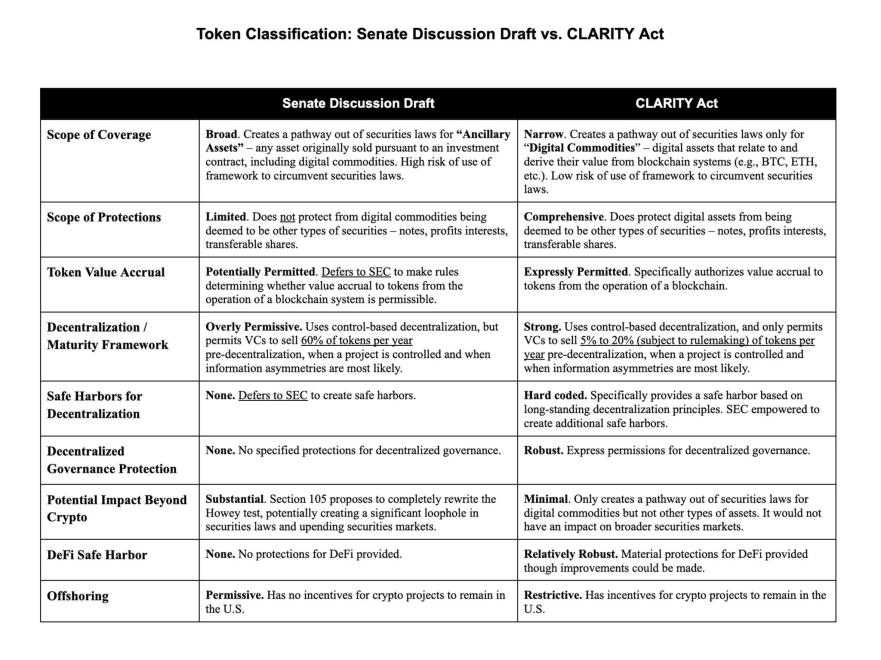
Difference between the Senate's discussion draft and the House's CLARITY Act. Source: The DRC on X
Earlier this week, the DCR also submitted its response to the Senate Banking Committee’s discussion draft, underscoring the importance of “building on the strong foundation established by the CLARITY Act.” The non-profit organization considers that while the Senate’s version is still evolving, the House’s “robust, control-based decentralization test” is the better approach.
Last month, the DCR and 50 other leading industry players sent a joint letter to Congress leaders supporting the CLARITY Act, the largest coalition of organizations in agreement on a particular test for decentralization, as the post noted.
Additionally, the non-profit affirmed that “sound market structure legislation must be grounded in control” and regulatory attention must focus on where it is warranted, while “preserving space for innovation and open systems.”
Similarly, attorney Gabriel Shapiro concurred that “the House approach is far superior.” To him, the Senate’s test is a “pure race to the bottom” with “stuff that makes no sense from a policy perspective.”
The fewer rights people have, the less regulated something is? it should be the opposite–if they have more rights, they are more protected under general contract law and there is less need for regulation. . . this is how you get pure memecoin mania forever, equity/token conflict of interest forever, etc. . .
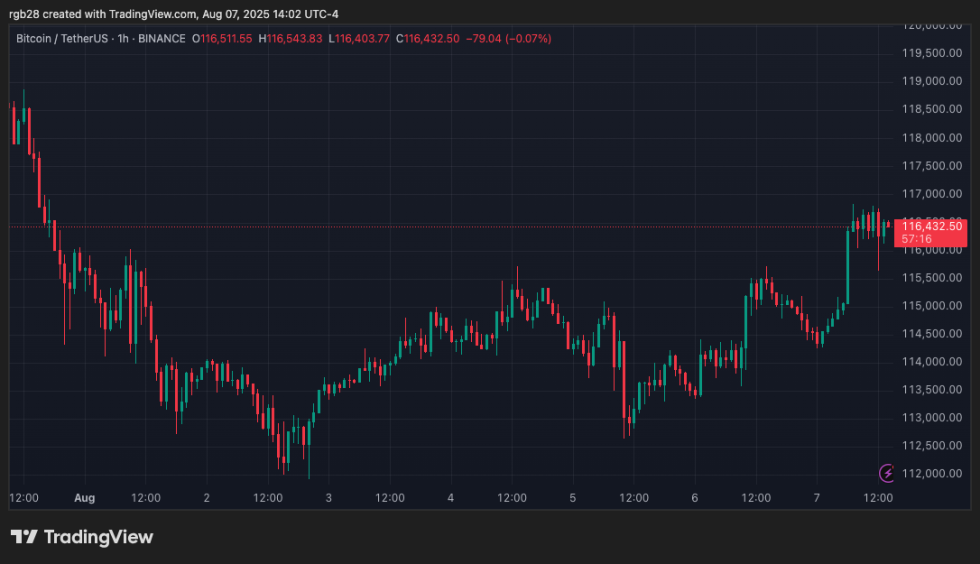
Bitcoin (BTC) traders at $116,432 in the one-week chart. Source: BTCUSDT on TradingView

Related Posts