A US court of Appeals has sent Yuga Labs, the creator of the Bored Ape Yacht Club (BAYC) non-fungible token (NFT) collection, back to the district court for its lawsuit against artist Ryder Ripps and business partner Jeremy Cahen.
Yuga Labs Sent Back To District Court
On Wednesday, the Ninth Circuit Court of Appeals partially overturned the judgment in Yuga Labs’ lawsuit against Ripps and Cahen’s NFT collection, ruling that the company had yet to prove its claims of trademark infringement and cybersquatting.
In 2022, Ripps and Cahen launched the Ryder Ripps Bored Ape Yacht Club (RR/BAYC) collection with identical copies of Yuga Lab’s NFT collection and similar marketing tactics. The duo argued that their collection was a satirical and critical response to the original NFTs, which they claimed have racist imagery and neo-Nazi, alt-right references.

The Court of Appeals partially overturns Yuga Labs' case judgment. Source: Ninth Distric Court of Appeals
That same year, Yuga Labs filed a trademark infringement lawsuit against Ripps and Cahen, alleging that the duo had deceived buyers by offering NFTs falsely equivalent to the BAYC collection under the pretext of satire. Additionally, the company claimed that Ripps and Cahen had damaged their reputation with their accusations.
Yuga Labs claimed victory in 2023, when the District Court in California ruled that the company was the rightful owner of the BAYC trademarks and determined that Ripps and Cahen utilized these trademarks without consent, likely confusing potential buyers who wanted to purchase an authentic Bored Ape NFT. At the time, Yuga Labs called the ruling “a win for the entire Web3 industry.”
Initially, a judge declared that the plaintiff was entitled to $1.6 million in damages from the duo. However, it was later raised to $9 million after Ripps and Cahen lost their counterclaim.
Notably, Ripps and Cahen countersued Yuga Labs under the Digital Millennium Copyright Act (DMCA), seeking declaratory relief that the company had no copyright protection over the Bored Apes.
The defendant’s counterclaims were dismissed by the district court for a “lack of subject-matter jurisdiction,” granting summary judgment for the company on its two claims and the defendant’s DMCA counterclaim.
A Key Win For NFT Holders
According to the Wednesday ruling, the three-judge panel affirmed in part and reversed in part the district court’s judgment and remanded the case. The panel held that an NFT can be trademarked under the Lanham Act, which protects marks used with “any goods or services.”
Based on this, they concluded that defendants’ NFTs were “goods”, but determined that Yuga Labs had the trademark priority as it was the first to use the Bored Ape Yacht Club marks in commerce.
Nonetheless, they reversed the district court’s grant of summary judgment on the company’s trademark infringement and cybersquatting claims, arguing that Yuga Labs “did not prove as a matter of law that the defendants’ actions were likely to cause consumer confusion.”
Meanwhile, the ruling determined that the duo’s use of Yuga Labs’ marks did not “constitute nominative fair use” and was not “expressive work” protected by the First Amendment.
“As to the trademark claim, (…) the panel could not conclude as a matter of law that a reasonably prudent consumer in the marketplace was likely to be confused as to the origin of the goods bearing Yuga’s marks,” the court document reads.
Yuga Labs co-founder Greg Solano affirmed on X that BAYC NFTs being protectable trademarks is “an important win for every NFT holder,” adding that the company will “now finish the fight in the district court, where the judge already fined the RR BAYC founders $9m+ in damages. We’ll win in the district just like we won before.”
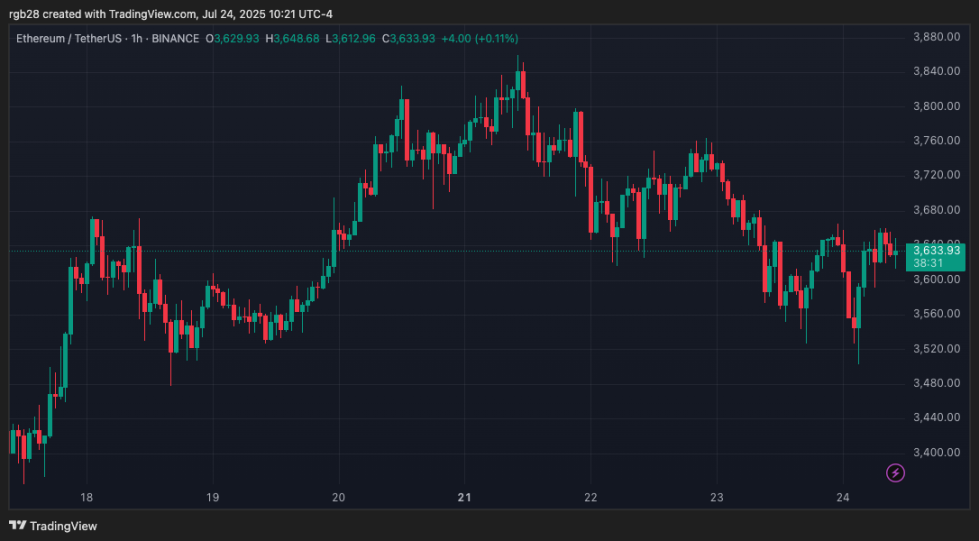
Ethereum (ETH) is trading at $3,633 in the one-week chart. Source: ETHUSDT on TradingView

Related Posts