XRP Price Can Still Cross $3, But It Needs To Hold This Level Against Bears

bitcoinist發佈於 2025-07-03更新於 2025-07-04

文章摘要

XRP’s recent rally to $2.30 has been followed by a cooling-off period, with the price falling back to $2.18 after...

Trusted Editorial content, reviewed by leading industry experts and seasoned editors. Ad Disclosure

XRP’s recent rally to $2.30 has been followed by a cooling-off period, with the price falling back to $2.18 after slipping below the short-lived $2.25 support. Although this pullback might raise concern, it comes on the back of a week-long steady increase that took XRP from $1.93 early last week back to the $2.33 resistance level that has held firm in the past 30 days.

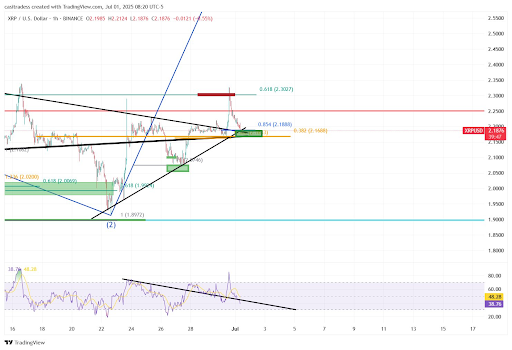
Crypto analyst CasiTrades shared an updated outlook with a chart to show how a test of the consolidation zone between $2.18 and $2.16 could determine whether XRP reclaims its bullish momentum to $3 or enters into a deeper reset.

$2.16–$2.18 Zone Determines XRP’s Direction

According to CasiTrades, who posted her technical analysis on the social media platform X, XRP’s recent retest around $2.16–$2.18 is not yet a breakdown, but it marks a defining moment. After reaching $2.30 resistance, the price wasn’t able to hold the $2.25 support level. Instead, it pulled back to retest. 

Notably, this zone was previously the top of a major consolidation structure, and holding above it would suggest that XRP is a simple backfill structure after a breakout.  This is a very common pattern where a crypto price rejects a key resistance, retests the initial breakout zone, and resumes the trend if momentum holds.
XRP
Source: CasiTrades on X

In the analyst’s view, the market needs to respect this range to confirm that XRP is still in breakout mode. The importance of this level is also echoed in the chart shared by the analyst, where a rising wedge intersects with the highlighted horizontal support at $2.1688 around the 0.382 Fibonacci retracement level. 

On the other hand, a failure to hold would shift the outlook drastically from a bullish perspective. As noted by the analyst, if the altcoin fails to hold above $2.16, it could initiate a pullback toward $1.90 and potentially invalidate the bullish setup that has been building over the past week.

RSI Divergence Points To Higher Chance Of Rebound

One of the early encouraging signs for XRP bulls is in the Relative Strength Index (RSI), which has been diverging from price. This is an excellent signal of seller exhaustion, which supports the analyst’s claim that the current move could be more of a cooldown than another crash to $1.90.

CasiTrades believes XRP would be ready for its next extension wave if bulls can defend the $2.16 to $2.18 range and reclaim $2.25. The price targets in view are $2.69 and $3.04, both based on Fibonacci levels. The first resistance level is at $2.3027 around the 0.618 Fibonacci extension. This price level is also a milestone for confirming the strength of the rally before a broader move to $3 and possibly above.

Interestingly, the altcoin’s price action in the past 12 hours has seen it already reclaiming bullish momentum after bouncing off an intraday low of $2.17. At the time of writing, XRP is trading at $2.27, up by 3.7% in the past 24 hours. This shows that buyers are already working to flip the $2.25 price level.

XRP
XRP trading at $02.28 on the 1D chart | Source: XRPUSDT on Tradingview.com
Featured image from Getty Images, chart from Tradingview.com
Editorial Process for bitcoinist is centered on delivering thoroughly researched, accurate, and unbiased content. We uphold strict sourcing standards, and each page undergoes diligent review by our team of top technology experts and seasoned editors. This process ensures the integrity, relevance, and value of our content for our readers.

Scott Matherson is a leading crypto writer at Bitcoinist, who possesses a sharp analytical mind and a deep understanding of the digital currency landscape. Scott has earned a reputation for delivering thought-provoking and well-researched articles that resonate with both newcomers and seasoned crypto enthusiasts. Outside of his writing, Scott is passionate about promoting crypto literacy and often works to educate the public on the potential of blockchain.

你可能也喜歡

IOSG:Q-Day倒计时,量子计算会终结加密货币吗?

量子计算常被视为悬在区块链头顶的“末日之剑”。其核心威胁在于Shor算法能高效破解当前主流的公钥密码体系(如椭圆曲线密码),这直接动摇了区块链“账本公开、资产不可逆、私钥自管”的根基。一旦具备实用规模的容错量子计算机(CRQC)问世,攻击者可能从链上已暴露的公钥逆推出私钥,窃取资产。 “Q-Day”(量子计算机能实际破解密码的时点)预计可能在2035-2045年间到来。根据Mosca不等式,考虑到数据保密周期和系统迁移所需时间,抗量子迁移必须提前启动。 应对之道在于后量子密码学(PQC)。美国国家标准技术研究院(NIST)已发布基于格密码的ML-KEM、ML-DSA等核心标准。然而,迁移面临巨大挑战:PQC签名体积庞大(可达现有签名的数十倍),会显著增加链上负担;更关键的是,这需要整个生态(协议、钱包、交易平台等)协同升级,并涉及复杂的社会共识。 对于比特币,风险集中于链上公钥已暴露的遗留UTXO(如早期地址)。迁移路径可能通过软分叉引入新地址格式,但如何处理长期不迁移的“休眠币”将引发“代码即法律”与资产保护之间的价值观冲突。以太坊则正通过提升“密码敏捷性”来规划全栈迁移,包括利用账户抽象缓冲用户端风险,以及在共识层探索能压缩签名数据的方案。 结论是,量子计算不会瞬间终结加密货币,但构成了必须偿还的“安全债务”。真正的瓶颈并非技术,而是生态协调与治理博弈。行业需在仅剩的5-8年“工程舒适窗口”内,完成这场与时间赛跑的全链路升级。市场对加密资产安全模型的重新定价,可能会早于Q-Day本身。

marsbit19 分鐘前

IOSG:Q-Day倒计时,量子计算会终结加密货币吗?

marsbit19 分鐘前

2026年或将如何重新定义以太坊、Solana、Base和Avalanche

2026年,区块链基础设施正经历重大转型,重点从散户采用转向满足日益增长的机构需求。目前,公有链上承载着超过300亿美元的代币化现实世界资产(RWA),暴露出现有网络在处理能力、结算速度、合规性和可靠性方面的不足。因此,以太坊、Solana、Base和Avalanche等主要区块链正在从协议层面进行根本性重构,旨在为机构级金融活动提供支持。 以太坊通过“Glamsterdam”升级,将大幅提高Gas限制并引入新的核心功能,为并行执行做准备。Solana的“Alpenglow”升级则着重重构共识机制,将最终确认时间从12.8秒大幅缩短至约100-150毫秒,并减少网络资源消耗。Base正在开发“Beryl”,旨在通过B20代币标准提供更好的合规资产发行框架。Avalanche的“Octane”升级则在提升交易处理速度的同时,降低企业应用部署成本。 这些升级显示,竞争焦点正从单纯追求速度,转向基础设施的长期可靠性、监管合规性和机构适用性。随着升级在2026至2027年陆续部署并投入生产,能够持续提供稳定结算、合规兼容且抗压能力强的网络,将最有可能吸引未来的大规模代币化资本。技术升级本身不会决定最终赢家,已被验证的实际执行能力和现有生态系统优势(如以太坊在合规标准和流动性上的领先地位)将是关键。

ambcrypto57 分鐘前

2026年或将如何重新定义以太坊、Solana、Base和Avalanche

ambcrypto57 分鐘前

Tiger Research:先把 RWA 代币化搬到海外去

文章探讨了在监管尚不完善的地区,金融机构如何通过海外扩张推进实物资产(RWA)代币化。当前RWA市场增长迅速,但监管滞后阻碍了发展。金融机构面临等待立法、使用监管沙盒或进入海外市场的战略选择。文章建议,鉴于RWA的全球性,优先考虑在监管成熟的海外市场积累经验是抢占先机的关键。 跨境RWA业务要求精细规划,涉及六个核心准备领域:选择海外基地与路径(如香港、新加坡、美国)、获取必要牌照、定义代币化资产类型、明确目标投资者范围、设计结算币种与支付流程,以及安排好托管、区块链选择等运营细节。 具体进入路径主要有两种: 1. **直接进入成熟司法管辖区**:例如香港、新加坡或美国。这些地区监管框架相对清晰,并存在可加速落地的成熟平台(如香港的HSBC Orion、美国的Securitize)。机构可利用现有海外实体或与本地平台合作,以降低入场门槛和缩短时间。 2. **采用链上原生路径**:通过与Ondo Global、Plume Nest等具备内建合规能力的链上平台合作,直接设计链上发行与流通结构。这种方式可以绕过在特定地区建立实体存在的复杂程序,实现更快的市场进入和更广泛的流动性对接,但结构设计复杂且监管指引较少。 文章最后通过一个假设案例,说明一家中型券商如何分步骤(评估现有基地与牌照、选择平台、合规与产品设计、搭建托管与运营结构、最终发行验证)在香港完成一次债券代币化发行的完整流程。 核心结论是:在监管空窗期,等待并非最佳策略。金融机构应主动评估并选择适合自身的海外或链上路径,尽快通过实际运营积累经验,因为市场的竞争不会等待监管完全就绪。实现成功销售,完成从结构设计到投资者到位的全流程,才是代币化业务落地的实质。

marsbit1 小時前

Tiger Research:先把 RWA 代币化搬到海外去

marsbit1 小時前

交易

現貨
活动图片