Non-fungible Tokens (NFTs) is Collins Dictionary’s Word of Year for 2021, and is not without a good reason. NFTs saw a meteoric rise in mid-2021 that ushered in a storm of interest, even from outside the cryptoverse. Total trading volume of NFTs hit over $5 BILLION at its height in August 2022, kickstarting what is now known as “NFT Summer”. Since then, the market has tapered off slightly but NFT is still one of the hottest buzzwords in town, and continues to grace headlines, both within and outside of the cryptoverse.
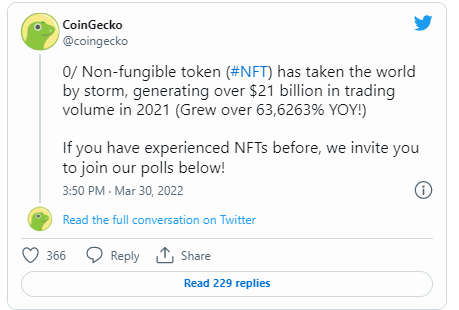
NFT are polarizing – there's a small group of people pledging beliefs in the underlying technology, a good deal more opportunists attempting to capitalize on its financial upside, while others cry foul at this new age digital “skem”. So, how do people really feel about NFTs?
Here at CoinGecko, we conducted a poll on Twitter to take a deeper look at the demographic of NFT owners, their behavior, motivation, tendencies, preferences, knowledge , and perception related to NFTs.
Disclaimer: We acknowledge that the Twitter poll is not optimal to conduct the survey. Hence, kindly treat the survey results as a proxy to the crypto Twitter community usage and attitude towards NFTs.
Here are our 5 key findings:
Majority of the respondents are from the APAC region, aged 18-30 and 30-50. 72% of these own NFTs, with more than half of them having 5 or more NFTs
Metaverse / gaming NFTs are the most common type of NFTs owned, with half of the respondents having participated in metaverse(s) before
Flippers top NFT ownership at 42%, majority of crypto portfolios (70%) assign only 0-25% to NFTs and less than half of the respondents have profited from trading
PC is the preferred choice for trading and minting NFTs, while most of the respondents hunt for new projects on Discord/Twitter and track their portfolio via marketplace wallet UI
Most respondents are interested in floor price when trading NFTs, with over half motivated by current & future utility to HODL
Majority of the respondents are from the APAC region, aged 18-30 and 30-50. 72% of these own NFTs, with more than half of them having 5 or more NFTs.
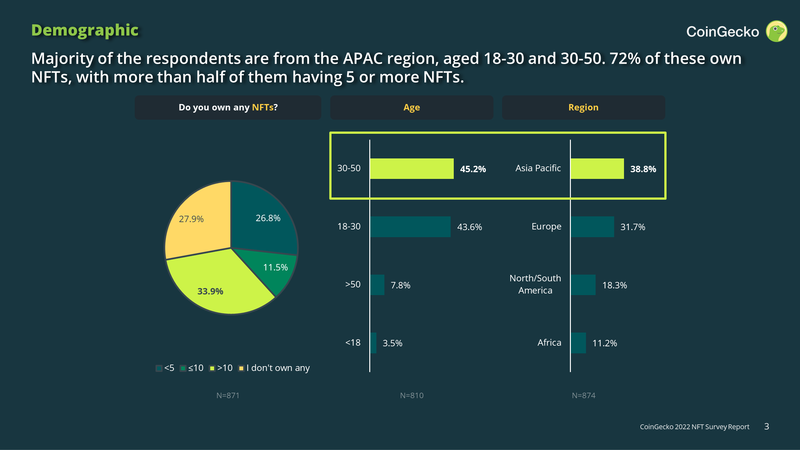
Out of the 871 respondents, ~72% of them are owners of NFT(s), with more than half of them having 5 or more NFTs.
There’s a relatively even split for age brackets 18-30 and 30-50, with most of the respondents belonging to the latter group (45.2%), followed closely by 43.6% in the former.
Interestingly, the APAC region leads NFT adoption among survey respondents at 38.8%, similar to the findings from our previous Axie Infinity survey. Another independent survey corroborates this, which also found Philippines, Thailand and Malaysia as the 3 leading countries for NFT adoption.
Europe followed closely as the second largest region (31.7%) of respondents, with North/South America a distant third (18.3%).
Metaverse / gaming NFTs are the most common type of NFTs owned, with half of the respondents having participated in metaverse(s) before
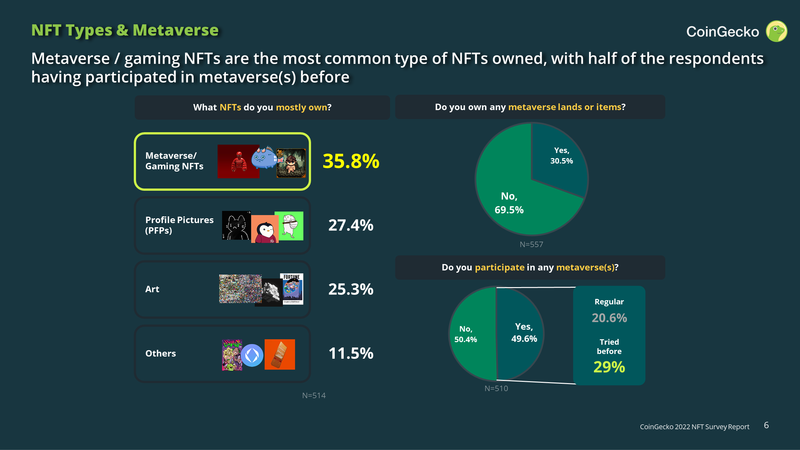
NFT ownership congregates around metaverse/gaming type NFTs (35.8%), followed by a relatively even split between PFPs (27.4%) and Art (25.3%). With most of our respondents/NFT owners residing in the APAC region, the outcome is unsurprising considering the dominance of GameFi NFTs in Asia.
When it comes to ownership of metaverse lands or items, the results (30.5%) mirror the numbers from metaverse/gaming NFT ownership (35.8%) – highlighting the common overlap between GameFi and Metaverse NFTs/projects, and how the former frequently incorporates elements from the latter, vice versa.
Only about half of the respondents had participated in metaverse(s) before, with only 20% of them being classified as “regulars”.
Metaverse is projected to be an $800B market in the next 2 years, and games look like the most likely NFT-point-of-entry for most people, particularly crypto folks.
Flippers top NFT ownership at 42%, majority of crypto portfolios (70%) assign only 0-25% to NFTs and less than half of the respondents have profited from trading
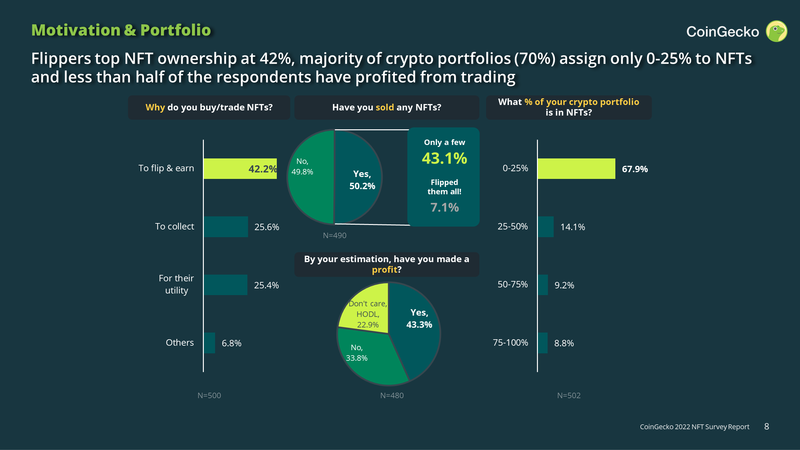
“Buy low, sell high” tops as the driving force behind NFT purchase at 42.2%.
On the other hand, the HODL mentality of “to collect” and “for their utility” feature a combined dominance of around 50%. This is consistent with the question “have you sold any NFTs” where only half of them responded “Yes”.
Less than half of the respondents (43%) have profited from NFT trading, while 23% are HODLers by choice with no regard for profiteering off NFTs.
Suppose we only consider the ratio between “Yes” and “No”, roughly 57% of the non-HODLing traders turned a profit in NFTs, possibly a sign of trading proficiency among respondents, who are most NFT veterans.
Interestingly, NFTs constitute only a small portion of most crypto portfolios, with close to 70% of them only featuring 0-25% of NFTs.
PC is the preferred choice for trading and minting NFTs, while most of the respondents hunt for new projects on Discord/Twitter and track their portfolio via marketplace wallet UI
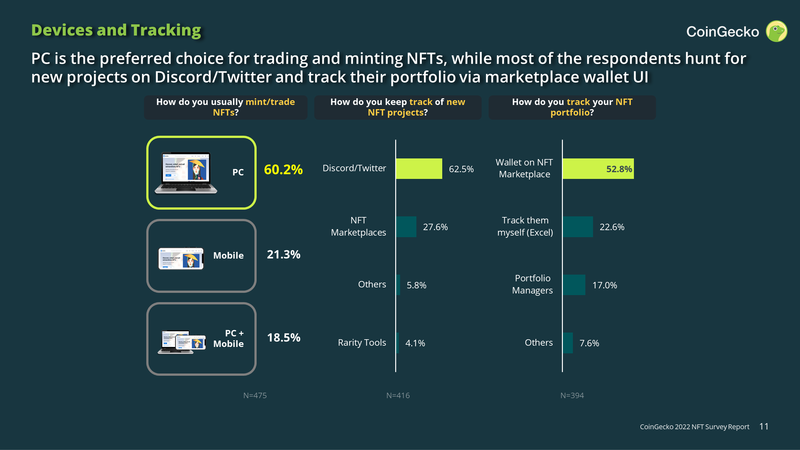
60% of NFT owners prefer to mint / trade NFTs solely on PC, with only 21% using mobile devices. The dominance of PC could be owed to its superiority in manoeuvring the time-sensitive nature of NFT mints / trades, especially when wallet mobile apps are still largely unwieldy compared to their PC counterpart.
Over 60% of users track new, upcoming NFT projects via Discord and Twitter, where information is fragmented and often scattered among other noises. That said, they still seem to be the best option to stumble across fresh-out-of-the-oven projects. Aggregator platforms such as Rarity Tools exist but usage is low (4.1%), perhaps due to the lag time in updates (which could be the difference for early access whitelists), or imperfect coverage.
Over half of the users track NFT portfolio via marketplaces as opposed to more structured approaches (e.g. portfolio managers, Excel)
Close to 40% of respondents are mostly interested in floor price when trading NFTs, with half of them citing current/future utility as the primary reason to HODL.
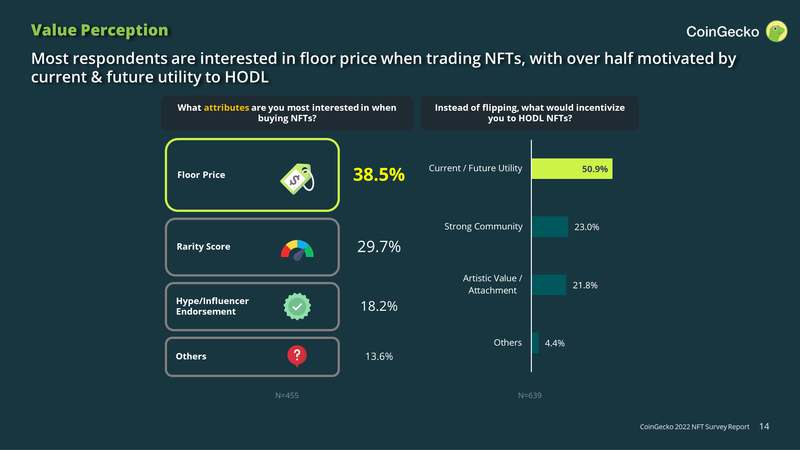
When questioned about the attribute that drives their NFT trades/purchases, 38.5% respondents cite “Floor Price” as the most important. Again, this is in line with our earlier question about the motivation for trading NFTs which saw ~40% selecting “flip & earn”. The floor price is a common metric used to gauge affordability and potential upside of a collection/piece.
Rarity score and hype/influencer endorsement on the other hand sit at ~30% and ~18% respectively.
Outside of flipping for profit, half of the respondents (50.9%) think that current or future utility of NFTs is the main incentive for them to HODL, with only 23% and 21.8% selecting “strong community” and “artistic value/attachment”. Based on our survey, it seems that NFT owners value NFTs that are perceived to deliver the most ‘practical’ value, rather than intangible qualities such as its aesthetics. Recent NFT projects are also trending towards having some form of utility (e.g. exclusive access, future airdrops), instead of being just “onchain JPEGs”.
Conclusion
It’s been interesting to peek behind the curtains of NFTs and see what makes the owners tick. Gaming and metaverse NFTs, propelled into the spotlight by Axie Infinity the hooha surrounding Metaverses, tops the spot as the most popular type of NFT to be owned. Most respondents self-identified as flippers who are in to make a quick buck out of NFTs but at the same time, the combined majority (51%) still expressed interest in hodling either to collect, or for the underlying utility. All in all, it’s not exactly a pure speculation market as perpetrated by common beliefs.
NFT trading volume has dipped over the course of Q1 2022, but at the same time, it’s also made leaps and bounds evident in the mega-partnerships struck up by RTFKT and Bored Ape Yacht Club. Where NFTs will ultimately be is still anyone’s guess at this point. But the fact is, just as crypto in general, the world of NFTs is still rife with scams and volatile prices. For those who are considering dipping your toes into NFTs, we urge that you always, always DYOR.