Cardano’s first full‐cycle ecosystem budget has reached its finish line. On August 19, 2025, Intersect—Cardano’s member-based organization that facilitated the process—announced: “Our ecosystem budget and withdrawal process has now reached its conclusion… DReps have approved ₳264m in ecosystem funding.” In the same statement, Intersect said the pipeline began with 194 proposals submitted through GovTool and the Ekklesia poll, was refined off-chain to 40, and ultimately produced 39 on-chain treasury withdrawals—37 of which cleared the required thresholds.
First Cardano Budget Cycle Closes
Intersect added that “more than 30 vendors have now signed contracts,” with those agreements being published for public review. The live “Intersect Administered Contracts” ledger confirms a growing roster of counterparties and amounts—ranging from the ₳64.3 million “Catalyst 2025” program to infrastructure and tooling efforts such as a ZK bridge and maintenance of key developer libraries. Intersect says additional contracts will be posted in the days ahead “together with the funding of related smart contracts.”
The conclusion caps a months-long governance sequence that combined off-chain deliberation and on-chain ratification. In July, Intersect submitted 39 Treasury Withdrawal governance actions for DRep and Constitutional Committee scrutiny; throughout late July and early August, proposals began surpassing the 67% DRep supermajority threshold that marks passage under CIP-1694’s current regime. Intersect’s development updates documented the first wave of supermajorities and directed participants to follow each proposal’s progression epoch by epoch.
With votes cast and thresholds met, Intersect has outlined what happens next. After a proposal passes, it is ratified at the epoch boundary, then enacted one epoch later, moving funds from the Treasury to designated smart-contract holding addresses. Intersect’s administration team finalizes legal agreements, deploys vendor-specific contracts with milestone schedules, and co-signs them alongside an oversight committee. Intersect’s August guidance emphasized the three-stage sequence—ratification, enactment, administration—and pledged status updates as each vendor’s contract goes live on-chain.
The mechanics behind those disbursements have been built for transparency. Intersect’s knowledge base details an end-to-end flow: withdrawals fund partitioned “Treasury Contracts”; vendors sign written agreements; “Vendor Contracts” encode milestones and payment dates; the oversight committee holds keys to provide checks and balances; and vendors withdraw only as milestones mature. Funds sit effectively in escrow, are auditable on-chain, and unclaimed balances time out back to the Treasury.
To monitor the delivery phase, Intersect points the community to two public dashboards. A Smart Contract dashboard exposes milestone breakdowns, dates, and payment events for each funded project, while a Cardano Treasury dashboard tracks flows from the Treasury into the reserve and project contracts.
The now-published contract catalog provides a first look at how the approved ₳264 million will be administered across core infrastructure, governance tooling, developer experience, and ecosystem programs. Entries include continued development for the AdaStat explorer, ongoing maintenance of PyCardano, and a ZK bridge prototype—illustrating the mix of large-scale programs and targeted technical workstreams that made it through the final on-chain filters.
IOG Takes The Lead
Cardano’s single largest allocation goes to Input Output’s core protocol program. Intersect’s contract ledger lists ₳96,817,080 for the “2025 Input Output Engineering Core Development” proposal, dedicated to “engineering, maintenance, and development services to enhance and secure the Cardano protocol and its core infrastructure,” explicitly framed as delivery of the community-endorsed technical roadmap. A companion research track, “Input Output Research (IOR): Cardano Vision – Work Program 2025,” adds ₳26,840,000 for multi-year research and technology validation.
Intersect also shows two further IOG-administered items—₳5,159,000 to overhaul Project Catalyst’s technical stack and ₳1,300,000 to decentralize the Blockfrost API via a gateway and “Icebreaker” network—bringing Input Output–family contracts to roughly ₳130.1 million, just under half of the approved ₳264 million budget.
Input Output characterizes the engineering mandate as the first community-authorized core development program in Cardano’s history, approved with 73.93% support. In its newsroom statement, IOE says the funded roadmap will advance scalability, developer experience, and interoperability through initiatives including Ouroboros Leios, Hydra, Mithril enhancements, nested transactions, and Project Acropolis—a modular re-architecture of the node—with “faster sync times, lower RAM usage, and reduced operational costs for stake pool operators.”
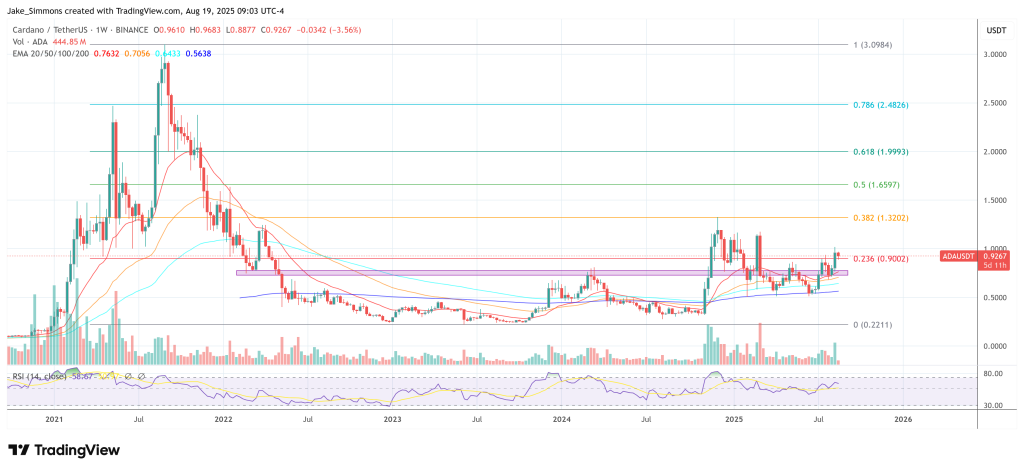
At press time, ADA traded at $0.92.

Related Posts