When Breakpoint Becomes a 'Festival': Why Solana Still Puts Builders Center Stage

marsbitXuất bản vào 2025-12-16Cập nhật gần nhất vào 2025-12-16

Tóm tắt

Breakpoint 2025 in Abu Dhabi marked a significant evolution for the Solana ecosystem—from a developer-focused gathering into a global “festival” of builders, capital, and cultural energy. Authored by Abhitej, a long-time Solana builder, the piece reflects on whether the event has retained its builder-first ethos amid rapid scaling and institutional interest. Unlike traditional conferences, Breakpoint felt open, decentralized, and intentionally designed to reduce hierarchy. It balanced the presence of developers, founders, creators, and investors without letting any group dominate. The agenda emphasized short, high-signal talks and demos, giving more people visibility. Solana’s culture stands out for rejecting elitism—anyone building something meaningful, no matter how small, gets a platform. The ecosystem embraces what works, from DeFi and infrastructure innovation to memecoins, learning from both successes and failures. Despite market turbulence, Breakpoint 2025 felt grounded in product-building, with mature discussions on scalability, cost, and real-world use cases. The energy was optimistic yet pragmatic—a celebration of creation, not extraction. While some insular “Solana-only” attitudes persist, the overall vibe was collaborative and forward-moving. Abu Dhabi’s setting contributed to the event’s inclusive, international atmosphere. Breakpoint has outgrown the conference model—it’s now a cultural festival embodying the open, builder-centric spirit of the next internet...

In December 2025, after Solana Breakpoint 2025 concluded in Abu Dhabi, Abhitej, an entrepreneur long entrenched in the Solana ecosystem, wrote this article. As a co-founder of Filament Finance and now a core builder at Bento.fun, he reflects, based on firsthand experience from multiple Breakpoints, on whether builders are still truly placed at the center as the conference has scaled.

The title may seem sharp, but it is not a negation of the grand event; rather, it's a reminder from within the ecosystem: as Breakpoint evolved from an early developer-led gathering into a global spectacle sharing the city with the F1 Grand Prix and Bitcoin MENA, with institutions, capital, and grand narratives flooding in, are the true "heads-down coders" getting diluted in the mix.

Unlike macro judgments from an external perspective, Abhitej focuses on those hard-to-quantify factors that determine the ecosystem's direction—whether the culture remains open, whether the stage still belongs to the builders, whether participation remains low-barrier. The article does not attempt to provide a standard answer, but it reminds us: Solana's vitality has never been on the stage or in the narratives, but in the developers around the globe who are persistently, quietly, yet truly building products.

Below is the original text:

I attended the first Breakpoint in Lisbon, and four years later, came to Abu Dhabi for the latest edition. In between, industry giants have fallen, the price of SOL has completed roller-coaster rides more than once, and Memecoin mania has repeatedly tested the resilience of the entire ecosystem.

But as the Solana ecosystem began preparing for Breakpoint 2025, it had already established its position:

Leading in multiple core metrics such as transaction count, application revenue, and DEX trading volume

Possessing the most culturally perceptive, user-close ecosystem atmosphere

Being the strongest, or at least one of the strongest, builder ecosystems

@joeljohn's article "Most used chain based on what?" also well pointed out Solana's dominance in multiple recent dimensions.
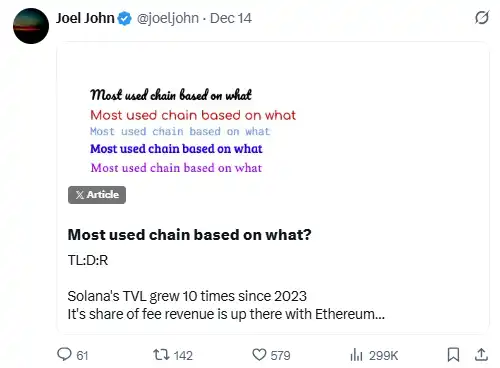
All of this has happened against the backdrop of an extremely brutal cycle for retail. Arbitrageurs have squeezed value to near its limits, altcoins have underperformed the market overall, and net developer inflow has dropped to a low. What this industry truly lacks is a spark of optimism, something that reminds people: the crypto world itself is still beautiful.

I believe Breakpoint lit that match.

When I walked into the Solana Breakpoint venue in Abu Dhabi, the first thing I felt wasn't excitement, but a movement in progress.

Not the kind of noisy, chaotic bustle. More like an undercurrent. A force in flow.

It didn't feel like entering a conference. There was no tension, no forced social pressure, no anxiety of "I must be in the right room at the right time." It felt more like a festival, a place where people weren't there to "extract value" from each other, but to genuinely celebrate "creation."

People were smiling, talking, moving around freely. Developers, creators, founders, institutions—everyone had their place, and overall, it wasn't unbalanced.

This sense of harmony was obvious from the start. No single group was overly amplified: institutions didn't dominate the narrative; creators weren't treated as mascots; founders weren't elevated to unreachable statuses. Everyone seemed approachable.

And that, in itself, is very rare.

The longer I stayed at Breakpoint, the more I felt that all this was not accidental, but deliberately designed.

The agenda wasn't like top-down information infusion: five-minute lightning talks, debates, product demos, conversations. Short, sharp, high information density. Letting more people be seen, rather than having a few repeatedly occupy the stage. You could clearly feel that this wasn't a one-time inspiration, but the result of long-term iteration.

Breakpoint wasn't achieved overnight, but gradually figured out "what really works" through years of practice.

A brief exchange I had with @paarugsethi from Superteam India was enough to make one realize how deeply the Solana ecosystem thinks about culture and the founder community.

Dissolving Elitism

But if there's one thing Solana does better than most ecosystems, it's this: it successfully dissolves elitism.

There's no invisible hierarchy here where "only a few voices matter." As long as you've genuinely built something valuable, even if it's small, you can get a platform to showcase it.

This openness changes everything: it reduces fear, invites more participation, and ultimately creates momentum. And momentum compounds.

After talking to more and more people, another characteristic became clear: within the Solana ecosystem, there is a shared sense of direction. Not a dogmatic consensus, but a state of "moving forward together." There are navigators, signal sources, and people who are seen as directional coordinates by others. Because of this, the ecosystem doesn't easily fragment.

In many ecosystems, people fight their own battles, narratives conflict, gaps keep widening, and everyone endlessly argues about "what should be," unwilling to accept "what is working."

Solana does it differently. If speculation works, it's accepted. If it fits the behavior of the new generation, it's studied, not shamed. There's no moral superiority, no whitewashing. Even memecoins, despite that phase being chaotic and predatory, were seen as an acceleration experiment, a stress test of internet capital markets.

The system crashed, some profited from it, and lessons were truly absorbed. Solana didn't pretend it never happened, but distilled the cognition as an "entire ecosystem." This acceptance, instead, made space for innovation, rather than accumulating resentment.

The most prominent feeling this year was Breakpoint's extreme builder-first nature. The market has cooled, prices are no longer狂热, the "100x overnight" crowd has noticeably decreased. But it's precisely at times like these that the real builders begin to shine.

DeFi appears more mature; infrastructure discussions return to reality: predictability of block space, latency optimization, how to make app execution cheaper and more reliable.

You can see this change in specific products: Kalshi choosing Solana as tokenization infrastructure; Phantom supporting consumer-facing interface experiences; Phoenix perps, Prop AMM, new market designs; experiments in AI, bots, privacy; hackathons, Superteam projects, those still rough but real early ideas. People come to listen to shares to learn, not to ask "how to pump this token."

This energy shift is extremely important. It makes the entire conference feel solid, honest, and product-centric.

If there's one discomfort, it's that some narrow-minded attitudes still exist in the ecosystem—"if it's not Solana-only, it's not worth attention."

This mindset isn't unique to Solana, but it shrinks the pie. The real opportunity isn't winning a public chain war, but reshaping the entire tech stack. And that can only be achieved through collaboration, not posturing.

The irony is: Solana doesn't need to proclaim loudly. Anyone walking into Breakpoint can feel it directly. This ecosystem doesn't need to mock each other online. The products, the culture, the builders, the momentum—they are loud enough.

A "Festival"

This brings me back to the initial conclusion: Solana has outgrown "holding conferences." Conferences are one-way, static, bounded. What Solana is doing now aligns more with the native form of the new generation: a festival, a celebration that exists for builders. A space where culture, capital, experimental spirit, and belief collide.

And these "festivals" will only continue to grow: more vibrant, more immersive, more diverse. Every corner adds new flavor to this internet that is taking shape.

Breakpoint 2025 is one of the best conferences I've ever attended, and it clearly shows where Solana is heading.

P.S.: In my view, choosing Abu Dhabi as the host city was an important reason why Breakpoint 2025 could be so special.


Câu hỏi Liên quan

QWhat is the main concern raised by Abhitej about the evolution of Solana Breakpoint?

AAbhitej is concerned about whether builders, the core developers who code and create, remain at the center of the event as Breakpoint has scaled up from an early developer-led gathering into a large global conference with significant institutional and capital presence.

QAccording to the article, what makes Solana's ecosystem culture different from others?

ASolana's ecosystem culture is described as open, non-elitist, and builder-first. It successfully消解 (dissolves) elitism, where anyone who builds something valuable, even on a small scale, can get a platform. It lacks a hidden hierarchy and moral superiority, accepting what works—like投机 (speculation) or memecoins—as part of its experimental nature.

QWhat key change in energy or focus was observed at Breakpoint 2025 compared to more狂热 (frenzied) market times?

AThe energy at Breakpoint 2025 was more builder-first and product-centered. With the cooling market and fewer people seeking 'overnight 100x' gains, discussions shifted to mature DeFi, realistic infrastructure improvements (like predictable block space and lower costs), and genuine learning, rather than questions about token pumps.

QHow does the author describe the overall atmosphere and structure of Breakpoint?

AThe author describes Breakpoint not as a traditional conference but more like a '节日' (festival or celebration)—a dynamic, immersive space that feels like a movement. It lacks the pressure of traditional networking, is intentionally designed to be inclusive with short, high-density talks, and allows different groups (developers, creators, founders, institutions) to coexist harmoniously without any one dominating.

QWhat is one potential weakness or狭隘 (narrow-minded) attitude the author points out within the Solana ecosystem?

AThe author points out a narrow-minded attitude where some in the ecosystem believe that 'if it's not Solana-only, it's not worth paying attention to.' This mentality can limit collaboration and the larger opportunity to reshape the entire tech stack, which requires working together rather than engaging in tribal '公链战争' (public chain wars).

Nội dung Liên quan

Polymarket Bị Kẹt: Bài Kiểm Tra Thực Sự Sau Khi Vượt Qua Giai Đoạn Lưu Lượng Tăng Đột Biến

Polymarket, nền tảng dự đoán thị trường hàng đầu, đang đối mặt với thách thức lớn khi trải nghiệm giao dịch xuống cấp do hạ tầng không theo kịp đà tăng trưởng. Phó chủ tịch kỹ thuật Josh Stevens thừa nhận vấn đề và công bố kế hoạch cải tổ toàn diện, bao gồm: giảm độ trễ dữ liệu, sửa lỗi hủy lệnh, xây dựng lại hệ thống order book (CLOB), nâng cao hiệu suất website, và quan trọng nhất là di chuyển chain (chain migration). Nguyên nhân sâu xa nằm ở việc Polymarket không còn là ứng dụng dự đoán đơn thuần mà đã phát triển thành một nền tảng giao dịch tần suất cao. Polygon, từng là lựa chọn chi phí thấp hoàn hảo, giờ đây trở thành rào cản kỹ thuật. Động thái này ngay lập tức thu hút sự quan tâm của các blockchain khác như Solana, Sui, Algorand... trong khi Polygon nỗ lực giữ chân ứng dụng quan trọng này - nguồn đóng góp phí giao dịch đáng kể cho hệ sinh thái của họ. Bài kiểm tra thực sự của Polymarket không chỉ là chọn chain mới, mà là xây dựng một hệ thống giao dịch đủ mạnh và ổn định để giữ chân người dùng trong giai đoạn tăng trưởng mới, nơi độ tin cậy quan trọng hơn bao giờ hết.

Odaily星球日报04/27 03:21

Polymarket Bị Kẹt: Bài Kiểm Tra Thực Sự Sau Khi Vượt Qua Giai Đoạn Lưu Lượng Tăng Đột Biến

Odaily星球日报04/27 03:21

Điều chỉnh kỳ vọng giảm cho chu kỳ tăng giá tiếp theo của BTC

Tác giả Alex Xu, một nhà đầu tư Bitcoin lâu năm, đã chia sẻ quyết định giảm dần tỷ trọng BTC trong danh mục đầu tư của mình, từ vị thế lớn nhất xuống còn khoảng 30%, và giải thích lý do cho việc điều chỉnh kỳ vọng về đỉnh giá trong chu kỳ bull market tiếp theo. Các lý do chính bao gồm: 1. **Năng lượng tăng trưởng tiềm năng giảm:** Các chu kỳ trước được thúc đẩy bởi việc mở rộng đối tượng đầu tư theo cấp số nhân (từ cá nhân đến tổ chức). Chu kỳ tới cần sự chấp nhận từ các quỹ đầu tư quốc gia hoặc ngân hàng trung ương, điều này khó xảy ra trong 2-3 năm tới. 2. **Chi phí cơ hội cá nhân:** Tìm thấy nhiều cơ hội đầu tư hấp dẫn khác (cổ phiếu công ty) với mức giá hợp lý. 3. **Tác động tiêu cực từ sự thu hẹp của ngành crypto:** Nhiều mô hình Web3 (SocialFi, GameFi...) không thành công, dẫn đến sự thu hẹp của toàn ngành và làm chậm tốc độ tăng trưởng số người nắm giữ BTC. 4. **Áp lực từ nhà mua lớn nhất (MicroStrategy):** Chi phí huy động vốn của MicroStrategy tiếp tục tăng cao (lãi suất 11.5%), có thể làm giảm tốc độ mua vào và gây áp lực bán. 5. **Sự cạnh tranh từ Vàng được token hóa:** Sản phẩm vàng token hóa (tokenized gold) đã thu hẹp khoảng cách về tính dễ chia nhỏ, dễ mang theo và dễ xác minh so với BTC. 6. **Vấn đề ngân sách bảo mật:** Phần thưởng khối giảm sau mỗi lần halving làm trầm trọng thêm vấn đề ngân sách cho bảo mật mạng lưới. Tác giả vẫn giữ một phần BTC đáng kể và sẵn sàng mua lại nếu các lý kiến trên được giải quyết hoặc xuất hiện các yếu tố tích cực mới, với điều kiện giá cả phù hợp.

marsbit04/27 02:46

Điều chỉnh kỳ vọng giảm cho chu kỳ tăng giá tiếp theo của BTC

marsbit04/27 02:46

Giao dịch

Giao ngay
Hợp đồng Tương lai

Bài viết Nổi bật

Làm thế nào để Mua OPG

Chào mừng bạn đến với HTX.com! Chúng tôi đã làm cho mua OpenGradient (OPG) trở nên đơn giản và thuận tiện. Làm theo hướng dẫn từng bước của chúng tôi để bắt đầu hành trình tiền kỹ thuật số của bạn.Bước 1: Tạo Tài khoản HTX của BạnSử dụng email hoặc số điện thoại của bạn để đăng ký tài khoản miễn phí trên HTX. Trải nghiệm hành trình đăng ký không rắc rối và mở khóa tất cả tính năng. Nhận Tài khoản của tôiBước 2: Truy cập Mua Crypto và Chọn Phương thức Thanh toán của BạnThẻ Tín dụng/Ghi nợ: Sử dụng Visa hoặc Mastercard của bạn để mua OpenGradient (OPG) ngay lập tức.Số dư: Sử dụng tiền từ số dư tài khoản HTX của bạn để giao dịch liền mạch.Bên thứ ba: Chúng tôi đã thêm những phương thức thanh toán phổ biến như Google Pay và Apple Pay để nâng cao sự tiện lợi.P2P: Giao dịch trực tiếp với người dùng khác trên HTX.Thị trường mua bán phi tập trung (OTC): Chúng tôi cung cấp những dịch vụ được thiết kế riêng và tỷ giá hối đoái cạnh tranh cho nhà giao dịch.Bước 3: Lưu trữ OpenGradient (OPG) của BạnSau khi mua OpenGradient (OPG), lưu trữ trong tài khoản HTX của bạn. Ngoài ra, bạn có thể gửi đi nơi khác qua chuyển khoản blockchain hoặc sử dụng để giao dịch những tiền kỹ thuật số khác.Bước 4: Giao dịch OpenGradient (OPG)Giao dịch OpenGradient (OPG) dễ dàng trên thị trường giao ngay của HTX. Chỉ cần truy cập vào tài khoản của bạn, chọn cặp giao dịch, thực hiện giao dịch và theo dõi trong thời gian thực. Chúng tôi cung cấp trải nghiệm thân thiện với người dùng cho cả người mới bắt đầu và người giao dịch dày dạn kinh nghiệm.

Tổng lượt xem 186Xuất bản vào 2026.04.20Cập nhật vào 2026.04.20

Làm thế nào để Mua OPG

Làm thế nào để Mua CHIP

Chào mừng bạn đến với HTX.com! Chúng tôi đã làm cho mua USD.AI (CHIP) trở nên đơn giản và thuận tiện. Làm theo hướng dẫn từng bước của chúng tôi để bắt đầu hành trình tiền kỹ thuật số của bạn.Bước 1: Tạo Tài khoản HTX của BạnSử dụng email hoặc số điện thoại của bạn để đăng ký tài khoản miễn phí trên HTX. Trải nghiệm hành trình đăng ký không rắc rối và mở khóa tất cả tính năng. Nhận Tài khoản của tôiBước 2: Truy cập Mua Crypto và Chọn Phương thức Thanh toán của BạnThẻ Tín dụng/Ghi nợ: Sử dụng Visa hoặc Mastercard của bạn để mua USD.AI (CHIP) ngay lập tức.Số dư: Sử dụng tiền từ số dư tài khoản HTX của bạn để giao dịch liền mạch.Bên thứ ba: Chúng tôi đã thêm những phương thức thanh toán phổ biến như Google Pay và Apple Pay để nâng cao sự tiện lợi.P2P: Giao dịch trực tiếp với người dùng khác trên HTX.Thị trường mua bán phi tập trung (OTC): Chúng tôi cung cấp những dịch vụ được thiết kế riêng và tỷ giá hối đoái cạnh tranh cho nhà giao dịch.Bước 3: Lưu trữ USD.AI (CHIP) của BạnSau khi mua USD.AI (CHIP), lưu trữ trong tài khoản HTX của bạn. Ngoài ra, bạn có thể gửi đi nơi khác qua chuyển khoản blockchain hoặc sử dụng để giao dịch những tiền kỹ thuật số khác.Bước 4: Giao dịch USD.AI (CHIP)Giao dịch USD.AI (CHIP) dễ dàng trên thị trường giao ngay của HTX. Chỉ cần truy cập vào tài khoản của bạn, chọn cặp giao dịch, thực hiện giao dịch và theo dõi trong thời gian thực. Chúng tôi cung cấp trải nghiệm thân thiện với người dùng cho cả người mới bắt đầu và người giao dịch dày dạn kinh nghiệm.

Tổng lượt xem 216Xuất bản vào 2026.04.21Cập nhật vào 2026.04.21

Làm thế nào để Mua CHIP

Làm thế nào để Mua CC

Chào mừng bạn đến với HTX.com! Chúng tôi đã làm cho mua CC(Canton) (CC) trở nên đơn giản và thuận tiện. Làm theo hướng dẫn từng bước của chúng tôi để bắt đầu hành trình tiền kỹ thuật số của bạn.Bước 1: Tạo Tài khoản HTX của BạnSử dụng email hoặc số điện thoại của bạn để đăng ký tài khoản miễn phí trên HTX. Trải nghiệm hành trình đăng ký không rắc rối và mở khóa tất cả tính năng. Nhận Tài khoản của tôiBước 2: Truy cập Mua Crypto và Chọn Phương thức Thanh toán của BạnThẻ Tín dụng/Ghi nợ: Sử dụng Visa hoặc Mastercard của bạn để mua CC(Canton) (CC) ngay lập tức.Số dư: Sử dụng tiền từ số dư tài khoản HTX của bạn để giao dịch liền mạch.Bên thứ ba: Chúng tôi đã thêm những phương thức thanh toán phổ biến như Google Pay và Apple Pay để nâng cao sự tiện lợi.P2P: Giao dịch trực tiếp với người dùng khác trên HTX.Thị trường mua bán phi tập trung (OTC): Chúng tôi cung cấp những dịch vụ được thiết kế riêng và tỷ giá hối đoái cạnh tranh cho nhà giao dịch.Bước 3: Lưu trữ CC(Canton) (CC) của BạnSau khi mua CC(Canton) (CC), lưu trữ trong tài khoản HTX của bạn. Ngoài ra, bạn có thể gửi đi nơi khác qua chuyển khoản blockchain hoặc sử dụng để giao dịch những tiền kỹ thuật số khác.Bước 4: Giao dịch CC(Canton) (CC)Giao dịch CC(Canton) (CC) dễ dàng trên thị trường giao ngay của HTX. Chỉ cần truy cập vào tài khoản của bạn, chọn cặp giao dịch, thực hiện giao dịch và theo dõi trong thời gian thực. Chúng tôi cung cấp trải nghiệm thân thiện với người dùng cho cả người mới bắt đầu và người giao dịch dày dạn kinh nghiệm.

Tổng lượt xem 129Xuất bản vào 2026.04.21Cập nhật vào 2026.04.21

Làm thế nào để Mua CC

Thảo luận

Chào mừng đến với Cộng đồng HTX. Tại đây, bạn có thể được thông báo về những phát triển nền tảng mới nhất và có quyền truy cập vào thông tin chuyên sâu về thị trường. Ý kiến ​​của người dùng về giá của A (A) được trình bày dưới đây.

活动图片













