US Stocks in the 'Largest Bubble in History' Zone? Four Major Valuation Indicators Flash Red Simultaneously

marsbitXuất bản vào 2026-04-16Cập nhật gần nhất vào 2026-04-16

Tóm tắt

U.S. stock market valuations are flashing multiple warning signs, with key indicators reaching historic highs. The S&P 500's CAPE ratio has hit 39, a level only surpassed during the 2000 dot-com bubble. The "Buffett Indicator" (market cap to GDP) has soared past 230%, an all-time high. Furthermore, market concentration is extreme, with the top 10 stocks comprising over 35% of the index's weight and the "Magnificent 7" alone accounting for over 30%. Wall Street is deeply divided on the implications. The bearish camp, including figures like Jeremy Grantham, warns this is an AI-driven bubble, pointing to massive losses at companies like OpenAI and classic late-cycle signals. They caution that high valuations historically lead to poor future returns and significant corrections. The bullish camp argues that strong earnings justify the premiums. Analysts project 17.6% profit growth for the S&P 500 in 2026. Firms like BlackRock contend the rally is earnings-driven, and historical patterns suggest bull markets can continue. Geopolitical risks, such as the Iran conflict pushing oil above $100, and a hesitant Fed add further uncertainty. The market is at a crossroads: whether AI-driven profits will validate high valuations or if a major correction is imminent.

Author: Claude, Deep Tide TechFlow

Deep Tide Guide: The S&P 500's CAPE ratio hit 39, the highest level since the 2000 dot-com bubble; the "Buffett Indicator" broke through 230% to set a new historical record; the top ten constituents account for over 35% of the index weight, with concentration reaching a modern market peak. Multiple valuation indicators are simultaneously signaling overheating, but Wall Street's judgment on this shows a serious divergence: one side believes AI profit growth supports the premium, while the other believes this is precisely the classic feature of a bubble top.

The S&P 500 is in a rare state: almost all mainstream valuation indicators are simultaneously signaling a warning.

CAPE (Shiller P/E) is approaching 40, the highest level since the internet bubble; the "Buffett Indicator" (Market Cap/GDP ratio) broke through 230%, refreshing the historical record; the top ten constituents account for over 35% of the index weight, with market concentration in an unprecedented range in modern financial history. A post on the Reddit community r/stocks characterized the current market as the "most overextended state in history," sparking over 2,100 upvotes and 640 comments. The discussion focused on a core question:

Is this a signal of a bull market top, or the beginning of an AI-driven "new paradigm"?
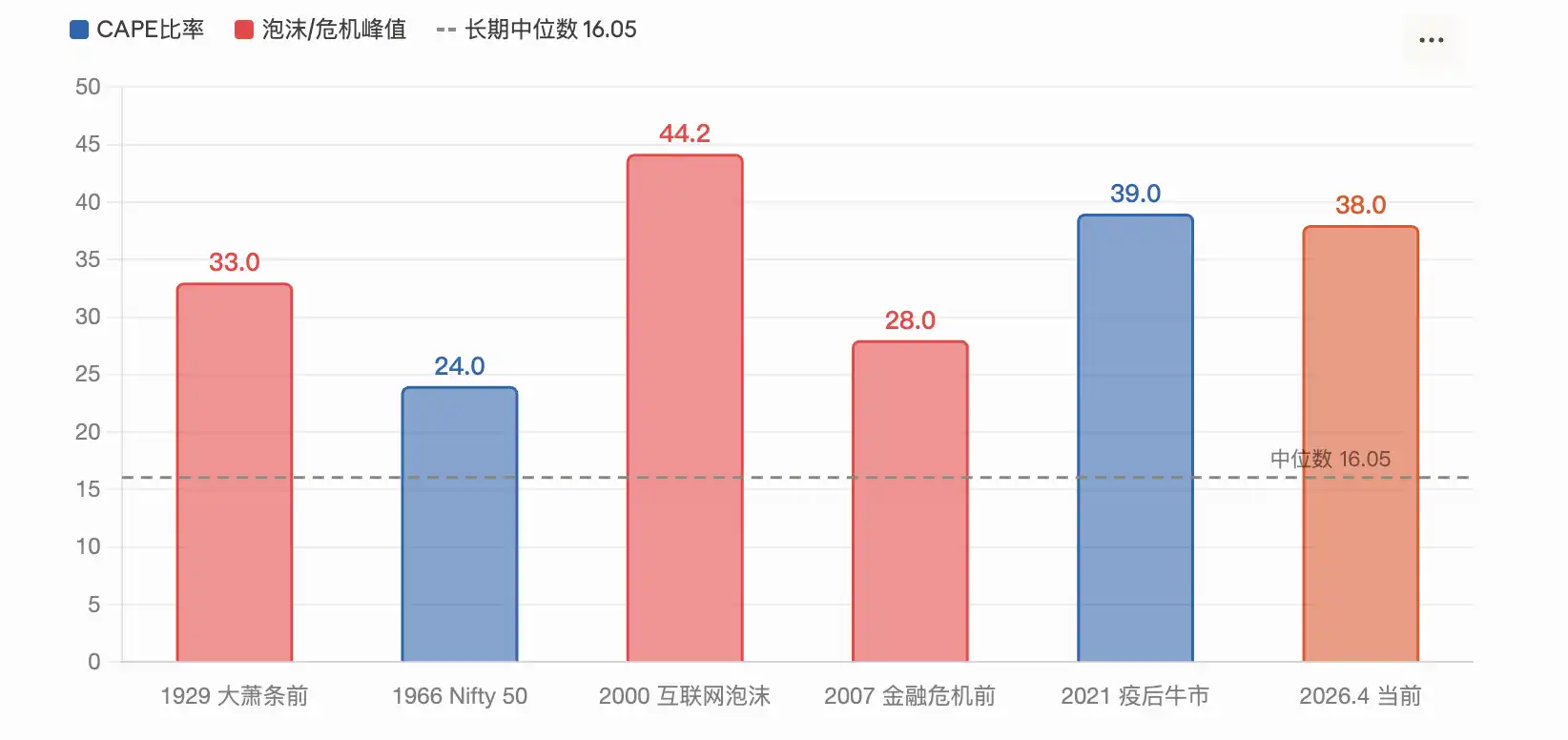
CAPE Ratio Touches 39, Second Only to the 2000 Internet Bubble Peak

The Shiller P/E ratio (CAPE) is a valuation metric developed by Nobel laureate economist Robert Shiller. It calculates the price-to-earnings ratio using the average inflation-adjusted earnings over the past 10 years, aiming to eliminate the interference of short-term economic cycles.

According to a Motley Fool report in March, the S&P 500's CAPE ratio touched 39.2 in February. According to GuruFocus data on April 1st, this indicator was 38.66. Both readings are at the second highest level in history, second only to the 44.2 during the peak of the 2000 internet bubble. The long-term median is only 16.05.

Historically, CAPE has reached similar highs twice: the late 1920s (followed by the Great Depression) and 2000 (after the internet bubble burst, the S&P 500 plummeted 49% in two and a half years). According to Shiller's research model, the current CAPE level corresponds to a future annualized return rate of only about 2%.

Motley Fool's analysis pointed out that Shiller himself expressed concern when CAPE exceeded 25, noting that since 1881, there have only been three periods that exceeded this level: around 1929, 1999, and 2007.

However, an IndexBox report also acknowledged that a high CAPE does not automatically mean a crash is imminent, as the market has risen over 40% since this indicator broke through 30 at the end of 2023.

"Buffett Indicator" Breaks 230%, Setting a Half-Century Record High

Buffett once called the Market Cap/GDP ratio the "best single measure of where valuations stand" in a 2001 Fortune magazine interview. He suggested at the time that 75%-90% was a reasonable range, and exceeding 120% meant the market was overvalued.
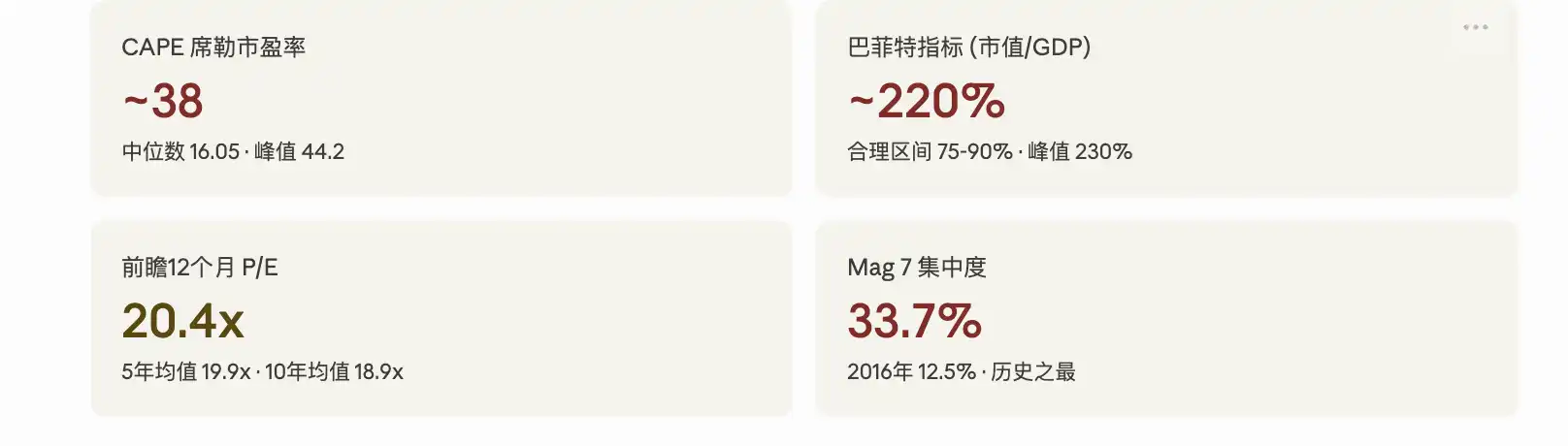
According to Advisor Perspectives data, by early 2026, this indicator once touched 230.3%, the highest level on record, about 2.09 standard deviations above the trend line, defined as "significantly overvalued." The latest reading in March fell back to 227.5%, still the second highest in history. GuruFocus推算, based on this ratio, the future annualized return of US stocks over the next 8 years is approximately -0.3%. (Note: 推算 translates to推算/calculate/project. The original Chinese used this term before the percentage.)

According to GuruFocus data on April 14th, the ratio was 219.5%. Critics point out that this indicator does not fully consider two structural changes: first, the profit margins of US companies have significantly increased compared to the historical median, and second, large US companies are generating more and more revenue from overseas (which boosts market cap but is not reflected in domestic GDP). But supporters believe that even after detrending, the current reading is still in an extreme historical range.

Market Concentration at a Modern History Peak, Mag 7 Accounts for Over 30%

Valuation is only one dimension of the problem. The structural risks of the market are equally disturbing.

According to AhaSignals data on April 13th, the top ten constituents of the S&P 500 account for 35.59% of the index weight, the top five account for 25.97%, and the "Magnificent 7" (Mag 7) account for 30.44%. The comprehensive concentration risk index (ACRI) compiled by the agency reads 81/100, at a "critical" level. According to Motley Fool data from April, the weight of the Mag 7 in the S&P 500 has risen from 12.5% in 2016 to the current 33.7%.

A CNBC report in December 2025 quoted a warning from Nick Ryder, CIO of Kathmere Capital: investors are still overly concentrated in the Mag 7, and he recommended充分分散配置 beyond US large-cap growth stocks. (Note: 充分分散配置 translates to fully diversify allocations/portfolio.) Ed Yardeni, president of Yardeni Research, suggested around the same time that investors underweight the Mag 7 and overweight the "other 493" (Impressive 493).
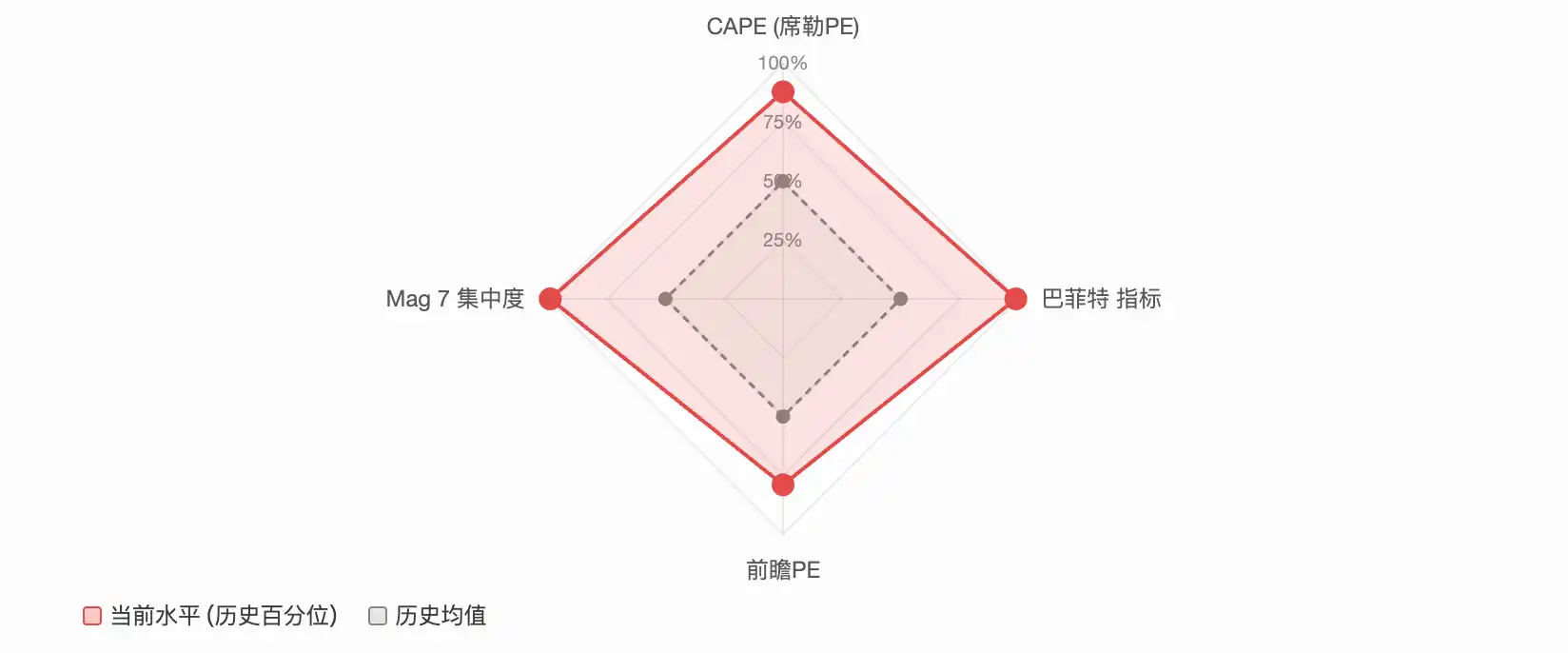
The actual risk brought by concentration is: when a few stocks dominate the index's movement, their decline can drag down the overall market with disproportionate force. The first quarter of 2026初步验证了这一点 (preliminarily verified this). According to a 24/7 Wall St report, Microsoft, Amazon, and Nvidia fell about 20%, 9%, and 6% year-to-date respectively, dragging the market-cap-weighted S&P 500 down nearly 4%, while the equal-weight S&P 500 (RSP) closed slightly positive during the same period.

Two Camps in Confrontation: "History Repeats" or "This Time is Different"

Faced with this data, Wall Street's judgment shows sharp divergence.

The core argument of the bearish camp is mean reversion of valuations. GMO co-founder Jeremy Grantham explicitly characterized the current market as a large AI-driven bubble in his latest research. He pointed out that the actual revenue from current AI investment is far less than the scale of capital expenditure, with OpenAI predicting its own 2026 operating loss will reach $17 billion and expand to $35 billion in 2027. GMO believes that the classic signals of a bubble top (speculative stock崩溃/collapse, significant outperformance by quality stocks) have not yet fully appeared, but this only means the bubble has not yet peaked, not that it doesn't exist.

IO Fund's cycle analysis also tends to be cautious. The institution's report pointed out that 2026 is simultaneously at the intersection window of the Gann 60-year major cycle and the 4-year presidential cycle, and each stock in the Mag 7 peaked between July 2025 and February 2026, with core components silently falling back while the index made its final new highs, which is a "classic warning sign of the late bull market."

The bullish camp emphasizes profit fundamentals. According to FactSet data from April, the S&P 500's forward 12-month P/E ratio is 20.4 times, although higher than the 10-year average of 18.9 times, it has fallen back from 22 times at the end of 2025. Analysts predict the S&P 500's full-year 2026 profit growth to be 17.6%. If this expectation is realized, the high valuation can be digested to some extent.

The judgment of Jurrien Timmer, Director of Global Macro at Fidelity, is relatively moderate: since the Iran conflict, the maximum drawdown of the S&P 500 has been less than 10%, a decline that historically occurs on average once every year. Profit expectations are still growing at an annualized rate of 17%, and have not yet been substantially affected by geopolitical headlines.

Morgan Stanley's investment management team also pointed out in its 2026 outlook that most bull markets last 5 to 7 years, and bull markets entering their fourth year have historically recorded positive returns. The bank's non-US equity allocation ratio has risen to a historical high.

BlackRock stated that the gains in tech stocks in 2025 were mainly driven by profit growth rather than valuation expansion, and the current valuation is reasonable based on growth expectations.

Overlaid with Geopolitical Shock: Iran War and Stagflation Risks

Beyond the valuation debate, the macro environment adds additional uncertainty.

The Iran conflict pushed oil prices above $100 per barrel, and the S&P 500 once fell below its 200-day moving average in March. According to a FinancialContent report, the Fed's March meeting maintained a "hawkish hold," and the updated dot plot only anticipated one more rate cut for the remainder of 2026. UBS, in a report on March 17, characterized the recent volatility as a "necessary reset of high valuations" rather than the beginning of a bear market, maintaining a year-end target of 7700 points.

Goldman Sachs has raised the probability of a recession in the next 12 months to about 30%. This resonates with the warning from valuation indicators: if an economic recession coincides with high valuations, the S&P 500's historical average peak-to-trough decline is 32%. But if profits continue to grow (FactSet consensus expectation is 17%), significant corrections have historically often been limited in幅度/magnitude and recovered from quickly.

For investors, the contradiction at the signal level is already very clear. Long-term valuation indicators are almost all flashing red, but short-to-medium-term profit data remains strong. The market has reached the crossroads of "valuations say no" and "profits say yes." The outcome depends on whether AI capital expenditure can translate into sustained profits, and whether geopolitical shocks ultimately translate into recession.


Câu hỏi Liên quan

QWhat are the four major valuation indicators suggesting about the current US stock market?

AThe four major valuation indicators are: 1) The CAPE ratio (Shiller P/E) is near 40, its highest level since the dot-com bubble. 2) The 'Buffett Indicator' (market cap to GDP ratio) has exceeded 230%, a record high. 3) The top 10 stocks in the S&P 500 account for over 35% of the index's weight, indicating extreme concentration. 4) The ACRI (Aggregate Concentration Risk Index) reading is 81/100, signaling a 'critical' level. Together, they suggest the market is in a historically overvalued and overextended state.

QAccording to the article, what is the historical significance of a high CAPE ratio, and what future returns does the current level suggest?

AHistorically, a CAPE ratio at similarly high levels has occurred twice: in the late 1920s (followed by the Great Depression) and in 2000 (followed by a 49% crash in the S&P 500 over two and a half years). According to Robert Shiller's research model, the current CAPE level corresponds to a future annualized return of only about 2%.

QWhat is the core argument of the 'bearish' camp regarding the current market conditions?

AThe core argument of the bearish camp is the principle of mean reversion in valuations. They argue that the market is in an AI-driven bubble, citing that actual AI investment revenues are far below capital expenditure levels. They point to classic signals of a market top, such as speculative stocks collapsing and high-quality stocks outperforming, and warn that the convergence of major market cycles suggests a high risk of a significant correction.

QWhat is the main counter-argument presented by the 'bullish' camp to justify current high valuations?

AThe bullish camp emphasizes strong盈利基本面 (profit fundamentals). They argue that high valuations are supported by robust expected earnings growth, with analysts forecasting 17.6% profit growth for the S&P 500 in 2026. They contend that if these expectations are met, the high valuations can be digested, and that much of the recent tech stock gains have been driven by earnings growth rather than mere valuation expansion.

QWhat two major macro risks, beyond valuations, does the article identify that could impact the market?

AThe two major macro risks identified are: 1) Geopolitical shock from the Iran conflict, which has pushed oil prices above $100 per barrel and added market volatility. 2) Stagflation risk, where the combination of high inflation (potentially keeping the Fed higher for longer) and a potential economic recession (with Goldman Sachs raising the probability of recession to 30%) could severely impact an overvalued market.

Nội dung Liên quan

Giao dịch

Giao ngay
Hợp đồng Tương lai

Bài viết Nổi bật

AGENT S là gì

Agent S: Tương Lai của Tương Tác Tự Động trong Web3 Giới thiệu Trong bối cảnh không ngừng phát triển của Web3 và tiền điện tử, các đổi mới đang liên tục định nghĩa lại cách mà cá nhân tương tác với các nền tảng kỹ thuật số. Một dự án tiên phong như vậy, Agent S, hứa hẹn sẽ cách mạng hóa tương tác giữa con người và máy tính thông qua khung tác nhân mở của nó. Bằng cách mở đường cho các tương tác tự động, Agent S nhằm đơn giản hóa các nhiệm vụ phức tạp, cung cấp các ứng dụng chuyển đổi trong trí tuệ nhân tạo (AI). Cuộc khám phá chi tiết này sẽ đi sâu vào những phức tạp của dự án, các tính năng độc đáo của nó và những tác động đối với lĩnh vực tiền điện tử. Agent S là gì? Agent S đứng vững như một khung tác nhân mở đột phá, được thiết kế đặc biệt để giải quyết ba thách thức cơ bản trong việc tự động hóa các nhiệm vụ máy tính: Thu thập Kiến thức Cụ thể theo Miền: Khung này học một cách thông minh từ nhiều nguồn kiến thức bên ngoài và kinh nghiệm nội bộ. Cách tiếp cận kép này giúp nó xây dựng một kho lưu trữ phong phú về kiến thức cụ thể theo miền, nâng cao hiệu suất của nó trong việc thực hiện nhiệm vụ. Lập Kế Hoạch Qua Các Tầm Nhìn Nhiệm Vụ Dài Hạn: Agent S sử dụng lập kế hoạch phân cấp tăng cường kinh nghiệm, một cách tiếp cận chiến lược giúp phân chia và thực hiện các nhiệm vụ phức tạp một cách hiệu quả. Tính năng này nâng cao đáng kể khả năng quản lý nhiều nhiệm vụ con một cách hiệu quả và hiệu suất. Xử Lý Các Giao Diện Động, Không Đều: Dự án giới thiệu Giao Diện Tác Nhân-Máy Tính (ACI), một giải pháp đổi mới giúp nâng cao tương tác giữa các tác nhân và người dùng. Sử dụng các Mô Hình Ngôn Ngữ Lớn Đa Phương Thức (MLLMs), Agent S có thể điều hướng và thao tác các giao diện người dùng đồ họa đa dạng một cách liền mạch. Thông qua những tính năng tiên phong này, Agent S cung cấp một khung vững chắc giải quyết các phức tạp liên quan đến việc tự động hóa tương tác giữa con người với máy móc, mở ra nhiều ứng dụng trong AI và hơn thế nữa. Ai là Người Tạo ra Agent S? Mặc dù khái niệm về Agent S là hoàn toàn đổi mới, thông tin cụ thể về người sáng lập vẫn còn mơ hồ. Người sáng lập hiện vẫn chưa được biết đến, điều này làm nổi bật giai đoạn sơ khai của dự án hoặc sự lựa chọn chiến lược để giữ kín các thành viên sáng lập. Bất chấp sự ẩn danh, sự chú ý vẫn tập trung vào khả năng và tiềm năng của khung này. Ai là Các Nhà Đầu Tư của Agent S? Vì Agent S còn tương đối mới trong hệ sinh thái mã hóa, thông tin chi tiết về các nhà đầu tư và những người tài trợ tài chính của nó không được ghi chép rõ ràng. Sự thiếu vắng thông tin công khai về các nền tảng đầu tư hoặc tổ chức hỗ trợ dự án dấy lên câu hỏi về cấu trúc tài trợ và lộ trình phát triển của nó. Hiểu biết về sự hỗ trợ là rất quan trọng để đánh giá tính bền vững và tác động tiềm năng của dự án. Agent S Hoạt Động Như Thế Nào? Tại cốt lõi của Agent S là công nghệ tiên tiến cho phép nó hoạt động hiệu quả trong nhiều bối cảnh khác nhau. Mô hình hoạt động của nó được xây dựng xung quanh một số tính năng chính: Tương Tác Giống Như Con Người: Khung này cung cấp lập kế hoạch AI tiên tiến, cố gắng làm cho các tương tác với máy tính trở nên trực quan hơn. Bằng cách bắt chước hành vi của con người trong việc thực hiện nhiệm vụ, nó hứa hẹn nâng cao trải nghiệm người dùng. Ký Ức Tường Thuật: Được sử dụng để tận dụng các trải nghiệm cấp cao, Agent S sử dụng ký ức tường thuật để theo dõi lịch sử nhiệm vụ, từ đó nâng cao quy trình ra quyết định của nó. Ký Ức Tình Huống: Tính năng này cung cấp cho người dùng hướng dẫn từng bước, cho phép khung này cung cấp hỗ trợ theo ngữ cảnh khi các nhiệm vụ diễn ra. Hỗ Trợ OpenACI: Với khả năng chạy cục bộ, Agent S cho phép người dùng duy trì quyền kiểm soát đối với các tương tác và quy trình làm việc của họ, phù hợp với tinh thần phi tập trung của Web3. Tích Hợp Dễ Dàng với Các API Bên Ngoài: Tính linh hoạt và khả năng tương thích với nhiều nền tảng AI khác nhau đảm bảo rằng Agent S có thể hòa nhập liền mạch vào các hệ sinh thái công nghệ hiện có, làm cho nó trở thành lựa chọn hấp dẫn cho các nhà phát triển và tổ chức. Những chức năng này cùng nhau góp phần vào vị trí độc đáo của Agent S trong không gian tiền điện tử, khi nó tự động hóa các nhiệm vụ phức tạp, nhiều bước với sự can thiệp tối thiểu của con người. Khi dự án phát triển, các ứng dụng tiềm năng của nó trong Web3 có thể định nghĩa lại cách mà các tương tác kỹ thuật số diễn ra. Thời Gian Phát Triển của Agent S Sự phát triển và các cột mốc của Agent S có thể được tóm tắt trong một dòng thời gian nêu bật các sự kiện quan trọng của nó: 27 tháng 9, 2024: Khái niệm về Agent S được ra mắt trong một bài nghiên cứu toàn diện mang tên “Một Khung Tác Nhân Mở Sử Dụng Máy Tính Như Một Con Người,” trình bày nền tảng cho dự án. 10 tháng 10, 2024: Bài nghiên cứu được công bố công khai trên arXiv, cung cấp một cái nhìn sâu sắc về khung và đánh giá hiệu suất của nó dựa trên tiêu chuẩn OSWorld. 12 tháng 10, 2024: Một video trình bày được phát hành, cung cấp cái nhìn trực quan về khả năng và tính năng của Agent S, thu hút thêm sự quan tâm từ người dùng và nhà đầu tư tiềm năng. Những dấu mốc trong dòng thời gian không chỉ minh họa sự tiến bộ của Agent S mà còn chỉ ra cam kết của nó đối với sự minh bạch và sự tham gia của cộng đồng. Những Điểm Chính Về Agent S Khi khung Agent S tiếp tục phát triển, một số thuộc tính chính nổi bật, nhấn mạnh tính đổi mới và tiềm năng của nó: Khung Đổi Mới: Được thiết kế để cung cấp cách sử dụng máy tính trực quan giống như tương tác của con người, Agent S mang đến một cách tiếp cận mới cho việc tự động hóa nhiệm vụ. Tương Tác Tự Động: Khả năng tương tác tự động với máy tính thông qua GUI đánh dấu một bước tiến tới các giải pháp tính toán thông minh và hiệu quả hơn. Tự Động Hóa Nhiệm Vụ Phức Tạp: Với phương pháp mạnh mẽ của nó, nó có thể tự động hóa các nhiệm vụ phức tạp, nhiều bước, làm cho các quy trình nhanh hơn và ít sai sót hơn. Cải Tiến Liên Tục: Các cơ chế học tập cho phép Agent S cải thiện từ các trải nghiệm trước đó, liên tục nâng cao hiệu suất và hiệu quả của nó. Tính Linh Hoạt: Khả năng thích ứng của nó trên các môi trường hoạt động khác nhau như OSWorld và WindowsAgentArena đảm bảo rằng nó có thể phục vụ một loạt các ứng dụng rộng rãi. Khi Agent S định vị mình trong bối cảnh Web3 và tiền điện tử, tiềm năng của nó để nâng cao khả năng tương tác và tự động hóa quy trình đánh dấu một bước tiến quan trọng trong công nghệ AI. Thông qua khung đổi mới của mình, Agent S minh họa cho tương lai của các tương tác kỹ thuật số, hứa hẹn một trải nghiệm liền mạch và hiệu quả hơn cho người dùng trên nhiều ngành công nghiệp khác nhau. Kết luận Agent S đại diện cho một bước nhảy vọt táo bạo trong sự kết hợp giữa AI và Web3, với khả năng định nghĩa lại cách chúng ta tương tác với công nghệ. Mặc dù vẫn còn ở giai đoạn đầu, những khả năng cho ứng dụng của nó là rộng lớn và hấp dẫn. Thông qua khung toàn diện của mình giải quyết các thách thức quan trọng, Agent S nhằm đưa các tương tác tự động lên hàng đầu trong trải nghiệm kỹ thuật số. Khi chúng ta tiến sâu hơn vào các lĩnh vực tiền điện tử và phi tập trung, các dự án như Agent S chắc chắn sẽ đóng một vai trò quan trọng trong việc định hình tương lai của công nghệ và sự hợp tác giữa con người với máy tính.

Tổng lượt xem 658Xuất bản vào 2025.01.14Cập nhật vào 2025.01.14

AGENT S là gì

Làm thế nào để Mua S

Chào mừng bạn đến với HTX.com! Chúng tôi đã làm cho mua Sonic (S) trở nên đơn giản và thuận tiện. Làm theo hướng dẫn từng bước của chúng tôi để bắt đầu hành trình tiền kỹ thuật số của bạn.Bước 1: Tạo Tài khoản HTX của BạnSử dụng email hoặc số điện thoại của bạn để đăng ký tài khoản miễn phí trên HTX. Trải nghiệm hành trình đăng ký không rắc rối và mở khóa tất cả tính năng. Nhận Tài khoản của tôiBước 2: Truy cập Mua Crypto và Chọn Phương thức Thanh toán của BạnThẻ Tín dụng/Ghi nợ: Sử dụng Visa hoặc Mastercard của bạn để mua Sonic (S) ngay lập tức.Số dư: Sử dụng tiền từ số dư tài khoản HTX của bạn để giao dịch liền mạch.Bên thứ ba: Chúng tôi đã thêm những phương thức thanh toán phổ biến như Google Pay và Apple Pay để nâng cao sự tiện lợi.P2P: Giao dịch trực tiếp với người dùng khác trên HTX.Thị trường mua bán phi tập trung (OTC): Chúng tôi cung cấp những dịch vụ được thiết kế riêng và tỷ giá hối đoái cạnh tranh cho nhà giao dịch.Bước 3: Lưu trữ Sonic (S) của BạnSau khi mua Sonic (S), lưu trữ trong tài khoản HTX của bạn. Ngoài ra, bạn có thể gửi đi nơi khác qua chuyển khoản blockchain hoặc sử dụng để giao dịch những tiền kỹ thuật số khác.Bước 4: Giao dịch Sonic (S)Giao dịch Sonic (S) dễ dàng trên thị trường giao ngay của HTX. Chỉ cần truy cập vào tài khoản của bạn, chọn cặp giao dịch, thực hiện giao dịch và theo dõi trong thời gian thực. Chúng tôi cung cấp trải nghiệm thân thiện với người dùng cho cả người mới bắt đầu và người giao dịch dày dạn kinh nghiệm.

Tổng lượt xem 1.3kXuất bản vào 2025.01.15Cập nhật vào 2025.03.21

Làm thế nào để Mua S

Thảo luận

Chào mừng đến với Cộng đồng HTX. Tại đây, bạn có thể được thông báo về những phát triển nền tảng mới nhất và có quyền truy cập vào thông tin chuyên sâu về thị trường. Ý kiến ​​của người dùng về giá của S (S) được trình bày dưới đây.

活动图片