U.S. Forces Cross Border to Capture President: Why Did Prediction Market Stage 'Calling a Stag a Horse'?

比推Xuất bản vào 2026-01-07Cập nhật gần nhất vào 2026-01-07

Tóm tắt

U.S. forces conducted a cross-border operation in Venezuela on January 3, capturing President Nicolás Maduro—an act widely considered a military invasion under international law. However, on the prediction market Polymarket, the contract "Will the U.S. invade Venezuela by January 31, 2026?" did not resolve as "Yes" despite the event-driven surge in probability to 80%. Instead, the platform updated its rules post-facto, stating that the operation—including Trump’s remarks about “running Venezuela”—did not meet its specific definition of “invasion.” The probability subsequently dropped to 4%. The article suggests regulatory and insider manipulation: Polymarket, though CFTC-regulated, received investment from Donald Trump Jr. last year. On-chain analysis reveals that a new wallet, funded from an account linked to Trump family associate Steven Witkoff, placed a $30,000 bet on “Maduro leaving office” just hours before the operation, turning it into over $400,000. The piece concludes that Polymarket may be manipulated by political and financial elites using asymmetric information and last-minute rule changes to profit at the expense of ordinary traders.

Author: Liu Kaiwen

Original Title: U.S. Captures Another Country's President, Trump-Linked Platform Says This Doesn't Count as "Invasion"


CARACAS, Venezuela – In the early hours of January 3rd local time, U.S. forces entered Venezuelan territory simultaneously by air and ground, secured several key military facilities, and escorted President Nicolás Maduro to the United States.

Precision airstrikes, armed ground troops taking control, abducting a head of state... According to common definitions under international law, this constitutes a military invasion of a sovereign nation.

Meanwhile, on Polymarket, the world's hottest prediction market, a group of traders had already begun celebrating their own victory triggered by this attack.

They had bet that the U.S. would invade Venezuela before the event, and the smoke and artillery fire reported in the news seemed like an early celebration of their high-odds, massive profits.

At that moment, no one who had placed a bet thought they were already destined to lose the moment they entered the trade.

News Reported Globally Never Happened on Polymarket

The market "Will the U.S. invade Venezuela before January 31, 2026?" had a straightforward definition of invasion before the attack: "a military offensive by U.S. armed forces with the purpose of establishing control."

After the attack, the probability (which translates to odds) in this market surged from 2% to 80%. This probability-as-odds trading model meant traders who bet "Yes" before the attack saw massive floating profits.

Then, just as mainstream media globally were reporting on the "U.S. attack on Venezuela," the market suddenly saw multiple large trades betting "No," asserting that "the U.S. did not invade Venezuela." This caused the probability to drop to a low of 7%.
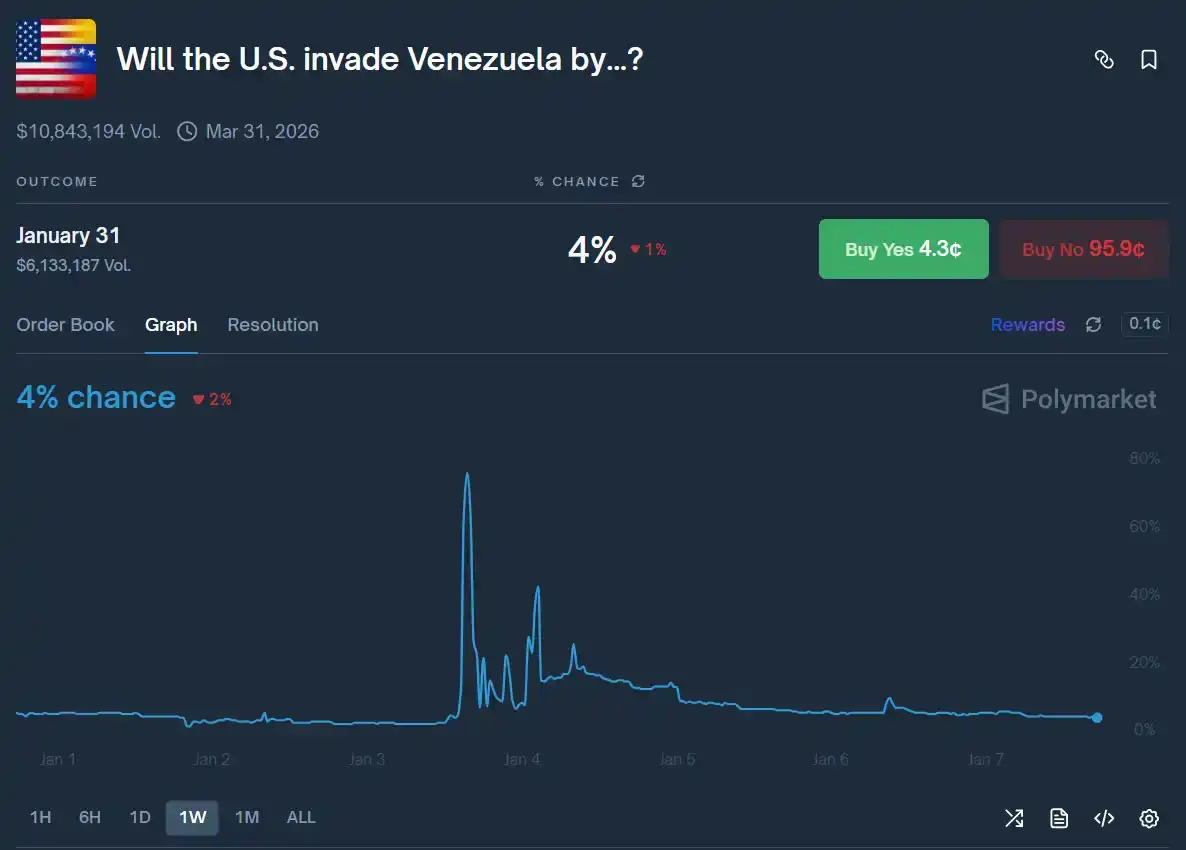
Even after Trump brazenly stated "run Venezuela" following the attack, as of the time of this writing, the market has still not been resolved, and the probability has fallen back to 4%.

This earth-shattering military invasion seems to have never happened on Polymarket.

"Tailor-Made" Rule Updates: Using Wordplay to Deny an Invasion

If you were to look for proof of the invasion happening on Polymarket, it does exist: hours after the attack, the platform officially published a rule supplement:

This market refers to U.S. military operations intended to establish control. President Trump’s statement that they will「run」Venezuela while referencing ongoing talks with the Venezuelan government does not alone qualify the snatch-and-extract mission to capture Maduro as an invasion.

In simple terms: U.S. troops entering the country and bombing don't count as an invasion. Trump talking about invading, occupying, and running the country doesn't count as an invasion. Capturing the president doesn't count as an invasion.

But they stick to their line: "military action with the purpose of establishing control counts as invasion."

Writing job description requirements based on a family register probably wasn't this rigorous. Traders who bet earlier didn't need to consider these hidden clauses, which didn't exist at the time, when analyzing the military situation.

Meanwhile, traders (mostly whales) who bet "No" during the period when its odds surged, relying on these tailor-made rule updates, again achieved substantial profits.

The same script played out in another market: "Will the U.S. and Venezuela engage in military conflict within 2025?" On December 26, 2025, Trump stated publicly in an interview that U.S. forces had destroyed an important facility inside Venezuela.

Multiple mainstream media outlets subsequently reported on the incident, with CNN noting the operation was "planned and executed by the Central Intelligence Agency (CIA)."

Shortly after the event, the platform issued a rule supplement stating that "operations executed by non-military intelligence agencies do not qualify."

As luck would have it, the CIA falls precisely into the category of a non-military intelligence agency.

Without the U.S. government ever formally clarifying which branch was responsible for the action, Polymarket, based on CNN's reporting citing "anonymous sources," precisely excluded a military strike from the settlement criteria.

Why Change the Rules? Digging into the Trump Family's Prediction Market Ties

As losing traders gathered on forums to protest, a more fundamental question emerged: Why would Polymarket risk its reputation being destroyed to modify the rules in plain sight?

Clues point to unusual names at the top of the platform.

Despite its decentralized facade, Polymarket is a实实在在 (shí shí zài zài - real, actual) private company regulated by the U.S. Commodity Futures Trading Commission (CFTC). A pivotal investment that changed its fate occurred last August:

Donald Trump Jr. – the eldest son of the sitting U.S. President – his private investment company formally took a stake in Polymarket, and he himself subsequently joined the company's "Advisory Board."

The timing is intriguing: after Trump Jr.'s investment, Polymarket, which had long operated in a regulatory gray area, quickly obtained an operating license from the CFTC, legalizing its operations in the U.S.

And the CFTC's five highest-ranking commissioners are all appointed directly by the President.

"This is just normal business investment," some commentators tried to downplay the connection. "The Trump administration supports cryptocurrency innovation anyway."

The next step would be to verify whether people close to Trump are using information asymmetry to profit on Polymarket.

From On-Chain Data to White House Inner Circle: When 'Coincidences' Are Too Many to Be Coincidences

Let's turn our attention to three hours before the raid occurred.

In another related market, "Will Maduro leave office before January 31, 2026?", a previously inactive new wallet address suddenly injected $30,000 into the market, all betting "Yes." As Maduro was put on a plane, this $30,000 turned into over $400,000 within hours.

The account's behavior pattern was highly suspicious: newly created, single deposit, betting on only one market within a specific time window, immediate withdrawal after profit. This is the操作 (cāozuò - operation, modus operandi) of treating the prediction market as a private ATM.

Who was this "insider"?

On-chain analysis blogger @Andrey_10gwei found, by comparing deposit/withdrawal amounts on exchanges, that the funds for this insider account could be traced back to an account with the domain "stevencharles.sol".

Steven Charles?

Opening the website for core members of WLFI, orchestrated by Donald Trump Jr., reveals that the second person from the left in the front row is a co-founder of the company, also a New York real estate developer, provided campaign funds to Trump, and the two have a friendship spanning nearly 40 years.
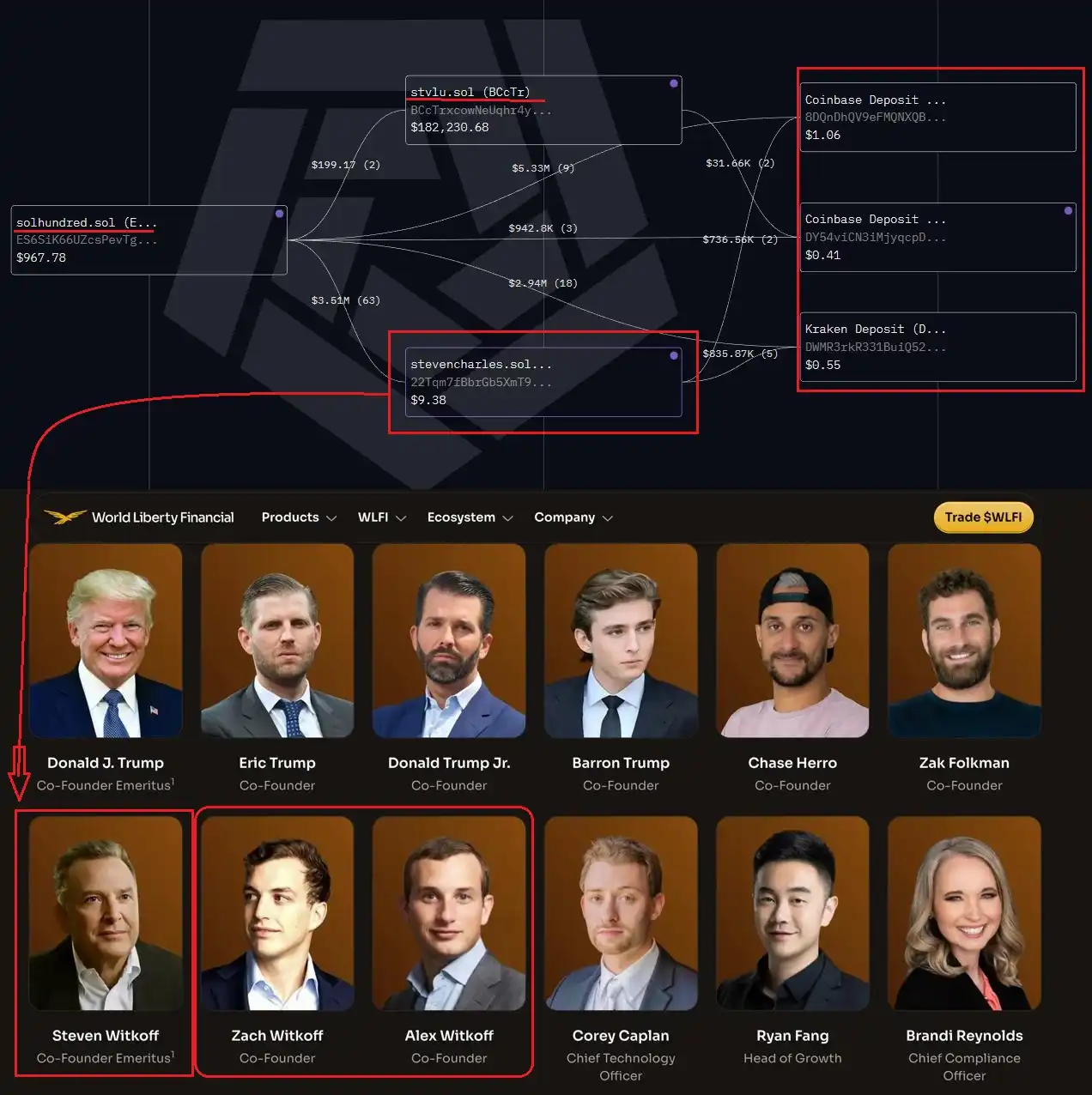
(cr: https://x.com/Andrey_10gwei/status/2007904168791454011?s=20)

His full name? Steven Charles Witkoff. A perfect match for the "stevencharles" on-chain domain.

A mysterious account turning $30k into $400k in 3 hours, an on-chain funding source named "stevencharles", a business magnate inextricably linked to the President's family who can directly influence Polymarket.

Three events with probabilities近乎于零 (jìn hū yú líng - approaching zero)串联在一起 (chuàn lián zài yīqǐ - strung together) can no longer be explained away as coincidence.

Conclusion

Polymarket, touted as a decentralized fair trading platform, might seem to ordinary person as just a financial tool to profit by betting on outcomes.

But perhaps in corners unseen by the common person, it has long become a white glove for those who can arbitrarily修改对错定义本身 (xiūgǎi duì cuò dìngyì běnshēn - modify the very definition of right and wrong), frequently using market-intervening rule updates and asymmetric information差 (chā - gap, asymmetry) to repeatedly empty people's assets.

How long the common person can survive here depends entirely on the desires and moral boundaries of the elite group.


Twitter:https://twitter.com/BitpushNewsCN

Bitpush TG Discussion Group:https://t.me/BitPushCommunity

Bitpush TG Subscription: https://t.me/bitpush

Original link:https://www.bitpush.news/articles/7600740

Câu hỏi Liên quan

QWhat was the main event described in the article regarding the US and Venezuela?

AThe article describes a US military operation on January 3rd where American forces entered Venezuela, took control of key military facilities, and captured President Nicolás Maduro, transporting him to the United States.

QHow did the prediction market Polymarket initially react to the news of the military operation, and how did that change?

AInitially, the probability of 'Yes' on the market 'Will the US invade Venezuela before January 31, 2026?' surged from 2% to 80% after the operation. However, the probability later plummeted to as low as 7% and then to 4% after the platform issued a rule update that redefined the event, effectively ruling that the operation did not qualify as an 'invasion'.

QWhat connection does the article suggest exists between Polymarket and the Trump family?

AThe article suggests a significant connection, stating that Donald Trump Jr., the son of the US President, invested in Polymarket through his private investment firm and joined its 'Advisory Board'. This investment coincided with the platform receiving regulatory approval from the CFTC, whose commissioners are appointed by the President.

QWhat evidence does the article present to suggest insider trading on the Polymarket platform?

AThe article presents on-chain data showing that a previously inactive wallet deposited $30,000 into the market 'Will Maduro leave office before January 31, 2026?' just three hours before the operation. This bet, which turned into over $400,000, was traced back to a wallet domain named 'stevencharles.sol', which was linked to Steven Witkoff, a long-time associate of the Trump family and a co-founder of a company run by Donald Trump Jr.

QAccording to the article, how did Polymarket justify not settling the 'invasion' market as 'Yes' after the military operation?

APolymarket issued a rule update stating that the operation to capture Maduro was a 'snatch-and-extract mission' and that President Trump's statement about 'running' Venezuela, in the context of ongoing talks with its government, did not alone qualify the military action as an 'invasion' as defined by their market's rules, which specified 'U.S. military operations intended to establish control'.

Nội dung Liên quan

Ngân hàng Ý không nhìn thấy lợi thế hệ thống của stablecoin trong chuyển tiền

Một nghiên cứu của Ngân hàng Ý kết luận rằng stablecoin không mang lại lợi thế hệ thống bền vững về chi phí và tốc độ trong chuyển tiền quốc tế so với các dịch vụ tiêu chuẩn. Các ưu điểm tiềm năng bị mất đi bởi phí chuyển đổi sang/và từ tiền pháp định và hiệu quả của cơ sở hạ tầng thanh toán địa phương. Nghiên cứu so sánh việc chuyển 200 USDC qua 10 hành lang giữa Ý và các nước như Brazil, Argentina, Nhật Bản, UAE và Nam Phi. Tổng chi phí chuyển stablecoin dao động từ 0,3% đến gần 9%, tùy tuyến. Thời gian giải quyết giao dịch dưới 20 phút ở những nơi có hệ thống thanh toán tức thời, nhưng có thể kéo dài 1-2 ngày làm việc ở khu vực không có. Chi phí và độ trễ chủ yếu đến từ việc trao đổi, chuyển đổi tiền tệ và chất lượng hạ tầng địa phương, không phải từ phí blockchain. Dù stablecoin rẻ hơn mức trung bình toàn cầu là 6,65%, chúng chỉ rẻ hơn dịch vụ Wise ở 3/7 tuyến so sánh được. Các tác giả cho rằng lợi ích sẽ rõ ràng hơn nếu stablecoin có thể được chi tiêu trực tiếp mà không cần đổi sang tiền địa phương. Họ cũng lưu ý rằng các quy định cấm đoán không làm giảm nhu cầu với stablecoin, trong khi quy định quá chặt chẽ lại gây khó khăn cho người dùng phổ thông.

cryptonews.ru2 giờ trước

Ngân hàng Ý không nhìn thấy lợi thế hệ thống của stablecoin trong chuyển tiền

cryptonews.ru2 giờ trước

Cơn sốt Bitcoin đang bùng nổ: Tuyên bố mới của Saylor gây nên những đồn đoán về việc mua vào

Giám đốc điều hành của Strategy Inc. (Nasdaq: MSTR), Michael Saylor, một lần nữa khơi dậy những đồn đoán về việc công ty sẽ thông báo mua Bitcoin mới vào thứ Hai, sau khi đăng thông điệp "Bitcoin Drive engaged" vào ngày 2 tháng 8. Thông báo này đi kèm với biểu đồ mua hàng quen thuộc của công ty, phù hợp với thói quen báo hiệu thay đổi kho bạc trước các báo cáo hàng tuần của Saylor. Báo cáo kèm theo cho thấy dự trữ Bitcoin của Strategy là 843.775 BTC, trị giá khoảng 53,25 tỷ USD. Giá mua trung bình được ghi nhận là 75.653 USD/BTC, với lỗ chưa thực hiện là 10,58 tỷ USD (-16,58%). Một tín hiệu tương tự vào Chủ nhật tuần trước đã dẫn đến thông báo vào ngày 27/7 về việc công ty gia tăng dự trữ tiền mặt. Sổ cái thời gian thực của Strategy hiển thị 116 giao dịch đã đăng ký với tổng số 843.775 BTC được mua, đồng thời ghi nhận hai đợt bán Bitcoin gần đây tổng cộng 3.588 BTC (giảm từ 847.363 BTC), nhằm mục đích tài trợ cho cổ tức ưu đãi và bổ sung dự trữ USD. Công ty được báo cáo là đã không mua BTC trong tuần kết thúc ngày 26/7, đồng thời tăng dự trữ USD lên khoảng 3,75 tỷ USD. Bối cảnh tài chính đầy thách thức khi Strategy báo lỗ hoạt động 8,33 tỷ USD trong quý II/2026, chủ yếu do lỗ chưa thực hiện trên tài sản kỹ thuật số. Ban lãnh đạo có thể bán thêm tới 1,25 tỷ USD Bitcoin để củng cố dự trữ USD. Thông báo cập nhật dự kiến vào thứ Hai sẽ cho thấy liệu "Bitcoin Drive" có đánh dấu việc tái tích lũy hay không, khi Strategy cân bằng giữa kho dự trữ Bitcoin khổng lồ và các nghĩa vụ tiền mặt ngày càng tăng.

cryptonews.ru2 giờ trước

Cơn sốt Bitcoin đang bùng nổ: Tuyên bố mới của Saylor gây nên những đồn đoán về việc mua vào

cryptonews.ru2 giờ trước

Cổ phiếu các công ty trí tuệ nhân tạo được giao dịch như 'meme coin', trong khi Bitcoin hầu như không thay đổi giá - Tổng quan tuần

**Tóm tắt:** Bài viết phân tích các diễn biến chính trên thị trường tài chính và tiền điện tử trong tuần, với trọng tâm là sự biến động mạnh ở lĩnh vực AI và sự trầm lặng tương đối của Bitcoin. **Thị trường chứng khoán & AI:** * Cổ phiếu AI được giao dịch như "meme coin" với biến động cực đoan. Thị trường Hàn Quốc lao dốc 8% trong một phiên, chịu ảnh hưởng từ đợt bán tháo chip toàn cầu. * Quỹ "Situational Awareness" của Leopold Aschenbrenner bị thua lỗ nặng, dẫn đến thanh lý tài sản lớn, góp phần gây ra biến động. Citadel được cho là đã mua lại phần lớn danh mục của quỹ này. * Các chuyên gia như Ram Ahluwalia và Flood khuyên nên kiên nhẫn, trong khi Jim Bianco lưu ý thị trường thường tìm đáy sau khi một sự kiện lớn (như sự sụp đổ của một quỹ) xảy ra. **Macro & Tiền tệ:** * Các phát biểu của Chủ tịch Fed Kevin Warsh được cho là đã góp phần gây ra biến động, với một số ý kiến cho rằng ông thiếu năng lực. * Bộ Tài chính Nhật Bản can thiệp để hỗ trợ đồng Yên, nhưng hiệu quả hạn chế. * Có dấu hiệu về việc giảm thanh khoản toàn cầu và đà tăng trưởng sản xuất Mỹ chậm hơn kỳ vọng. **Thị trường Tiền điện tử:** * Bitcoin ít biến động, dao động quanh mức 64,000 USD, trong khi sự chú ý đổ dồn sang thị trường truyền thống. * Nhiều công ty tiền điện tử gặp khó khăn: BitMart và Storj Labs tuyên bố đóng cửa/phá sản; Coinbase (COIN) lao dốc sau báo cáo tài chính yếu; Uphold và các sàn khác cắt giảm nhân sự. * MicroStrategy tiếp tục tích lũy Bitcoin và mua lại cổ phiếu của chính mình, một chiến lược bị chỉ trích là "vòng xoáy Ponzi". * Cảnh báo bảo mật nghiêm trọng về lỗ hổng trên ví phần cứng Coldcard có thể làm lộ khóa riêng tư, đòi hỏi người dùng hành động ngay. **Các chủ đề khác:** * **DeFi/Blockchain:** Trade.xyz trên Hyperliquid và Pump.fun trên Solana cực kỳ thành công, đặt ra câu hỏi liệu họ có tự khởi chạy blockchain riêng hay không. Nghi ngờ giao dịch nội gián trên Hyperliquid. * **AI & Crypto:** Jason Calacanis và Barry Silbert nhiệt tình ủng hộ dự án Bittensor (TAO), coi đó là mô hình AI phi tập trung. Tác giả cảnh báo nên thận trọng trước sự cổ xúy của các nhà đầu tư mạo hiểm. * Các tranh cãi trong ngành: Kyle Samani chỉ trích Multicoin Capital; Charles Hoskinson khó chịu vì câu hỏi về quá khứ đồng sáng lập Ethereum. **Thông điệp chính:** Thị trường đang trải qua giai đoạn biến động mạnh, đặc biệt ở mảng AI, trong khi tiền điện tử chịu áp lực. Tính kỷ luật, sự kiên nhẫn và cảnh giác cao độ (đặc biệt về bảo mật) là cần thiết trong bối cảnh hiện tại.

cryptonews.ru2 giờ trước

Cổ phiếu các công ty trí tuệ nhân tạo được giao dịch như 'meme coin', trong khi Bitcoin hầu như không thay đổi giá - Tổng quan tuần

cryptonews.ru2 giờ trước

Giao dịch

Giao ngay
活动图片





