"Uninvestable" U.S. Treasuries Might Be the Highest-Returning Asset of 2026

marsbitXuất bản vào 2026-01-20Cập nhật gần nhất vào 2026-01-20

Tóm tắt

Amidst a shifting macroeconomic landscape in 2026, long-term U.S. Treasuries, particularly ETFs like TLT and TMF, are positioned to outperform equities. Key arguments include: gold's 200% rise signaling deflationary risks rather than sustained inflation; unsustainable U.S. interest expenses nearing $1.2 trillion annually; heavy short-term Treasury issuance increasing refinancing risks; and extreme short interest in long bonds creating potential for a squeeze. Additionally, cooling inflation, weak consumer sentiment, and rising trade tensions suggest a deflationary shock. Policy interventions, such as yield curve control or QE, are likely if long yields threaten growth or fiscal stability. With long-duration assets offering convexity and a 4.4–4.7% yield, a 100–200 bps decline in long-term rates could drive 15–45%+ returns, making long bonds a high-upside, asymmetric bet for 2026.

Author: Common Sense Investor (CSI)

Compiled by: Deep Tide TechFlow

Deep Tide Guide: With the dramatic changes in the macro environment in 2026, market logic is undergoing a profound shift. Veteran macro trader Common Sense Investor (CSI) presents a contrarian view: 2026 will be the year bonds outperform stocks.

Based on the U.S. government's heavy interest payment pressure, the deflationary signals released by gold, extremely crowded bond short positions, and imminent trade conflicts, the author believes that long-duration U.S. Treasuries (such as TLT) are at an inflection point with an "asymmetric game" advantage.

At a time when the market generally considers bonds "uninvestable," this article, through rigorous macro-mathematical deduction, reveals why long bonds could become the highest-returning asset of 2026.

Full article below:

Why I'm Overweight TLT and TMF — And Why Stocks Will Underperform in 2026

I do not write these words lightly: 2026 is destined to be the year bonds outperform stocks. This is not because bonds are "safe," but because macro mathematics, positioning, and policy constraints are converging in an unprecedented way—and this situation rarely ends with "Higher for Longer."

I have put my money where my mouth is.

TLT (20+ Year Treasury ETF) and TMF (3x Leveraged 20+ Year Treasury ETF) currently make up about 60% of my investment portfolio. This article compiles data from my recent posts, adds new macro context, and outlines a bullish upside scenario for long-duration bonds, particularly TLT.

Core Arguments at a Glance:

  • Gold's Movement: Gold's historical performance does not预示持续通胀—it预示通缩/deflation risk.
  • Fiscal Deficit: U.S. fiscal math is breaking down: ~$1.2 trillion in annual interest支出, and rising.
  • Issuance Structure: Treasury issuance is skewed short-term, quietly increasing systemic refinancing risk.
  • Short Squeeze: Long bonds are one of the most crowded short positions in the market.
  • Economic Indicators: Inflation data is cooling, sentiment is weak, labor market pressures are rising.
  • Geopolitics: Geopolitical and trade headlines are turning "Risk-off," not "Reflationary."
  • Policy Intervention: Policy always turns towards lowering long-end rates when something cracks.

This combination has historically been rocket fuel for TLT.

Gold Is Not Always an Inflation Alarm

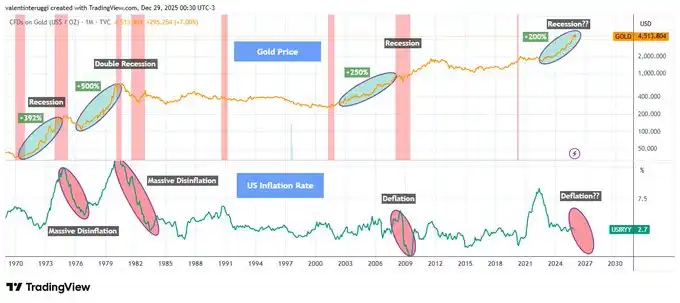
Whenever gold rallies over 200% in a short period, it signals not runaway inflation, but economic stress, recession, and falling real rates (see Chart 1 below).

Historical experience shows:

  • The 1970s gold surge was followed by recession + disinflation.
  • The early 1980s surge was followed by a double-dip recession; inflation was broken.
  • The early 2000s gold rise预示了 the 2001 recession.
  • The 2008 breakout was followed by a deflationary shock.

Since 2020, gold has again risen about 200%. This pattern has never ended in lasting inflation.

When growth flips, gold acts more like a safe-haven asset.
U.S. Interest支出 Is Compounding Explosively

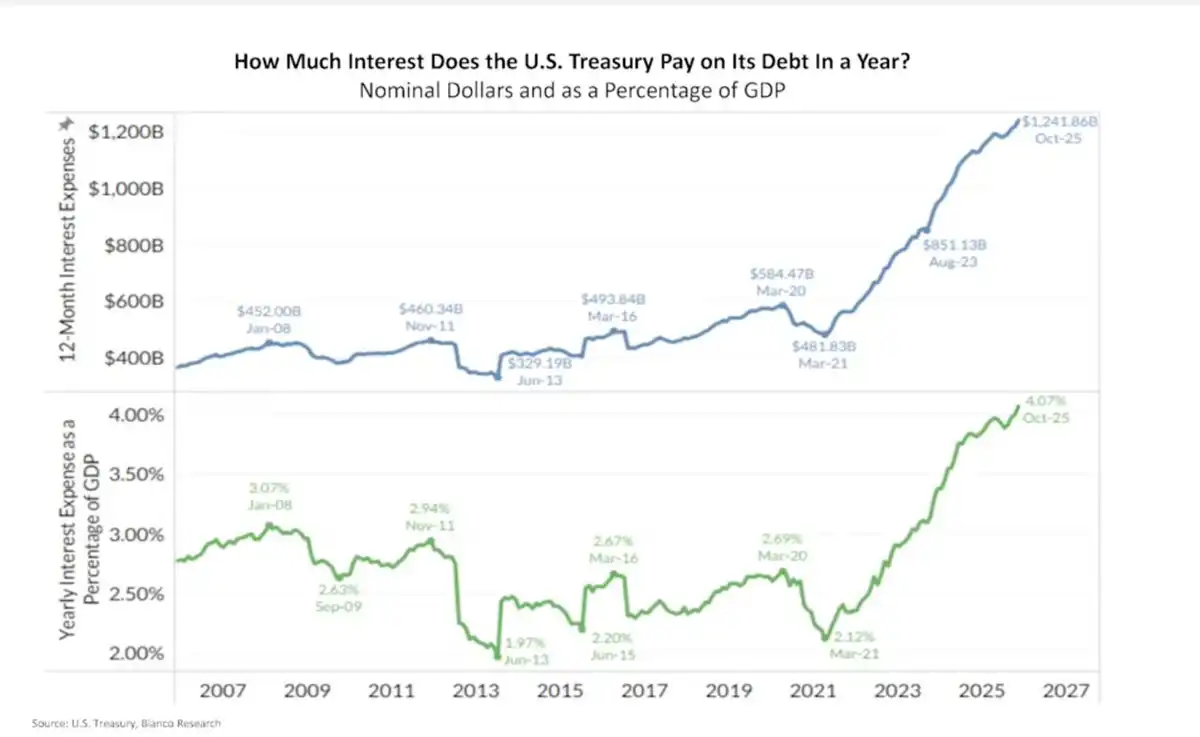
The U.S. currently has annual interest支出 of about $1.2 trillion, roughly 4% of GDP (see Chart 2 below).

This is no longer a theoretical issue. This is real money flowing out—interest compounds rapidly when long-term yields stay high.
This is so-called 「Fiscal Dominance」:

  • High rates mean higher deficits
  • Higher deficits mean more debt issuance
  • More issuance leads to higher Term Premium
  • Higher Term Premium leads to higher interest支出!

This doom loop won't resolve itself with "Higher for Longer." It must be resolved through policy intervention!

Treasury's Short-Term Trap

To alleviate immediate pain, the Treasury has drastically cut long-bond issuance:

  • 20/30-year bonds now make up only ~1.7% of total issuance (see Chart 3 below).
  • The rest has been pushed into short-term Bills.
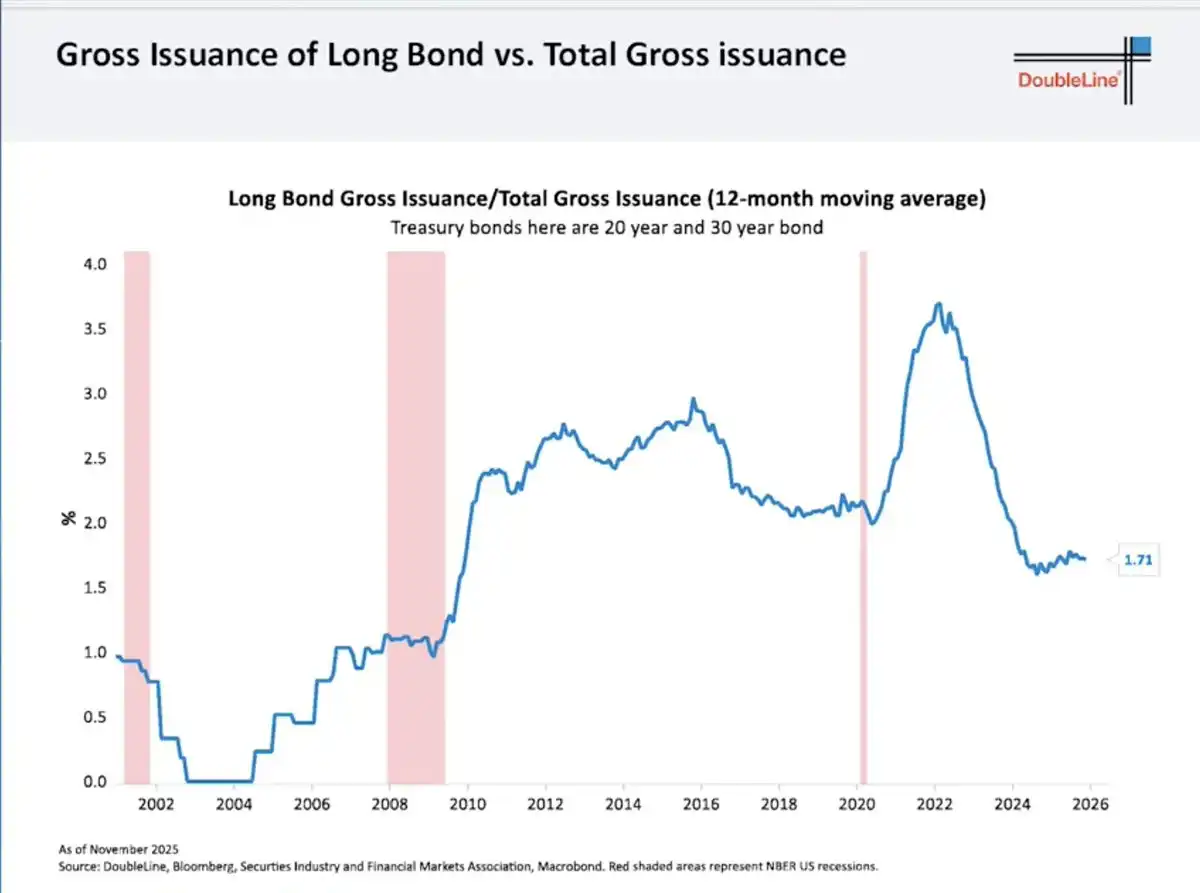
This doesn't solve the problem—it just kicks it down the road:

  • Short-term debt constantly rolls over.
  • Refinancing will happen at future rates.
  • The market sees the risk and demands a higher Term Premium.

Ironically, this is why long-end yields stay high... and why they will collapse violently if growth cracks.

The Fed's Trump Card: Yield Curve Control

The Fed controls the short end, not the long end. When long-end yields:

  1. Threaten economic growth
  2. Trigger explosive fiscal costs
  3. Disrupt asset markets

...the Fed has historically only done two things:

  1. Buy long bonds (QE)
  2. Cap yields (Yield Curve Control)

They won't act preemptively. They only act after stress appears.

Historical references:

  • 2008–2014: 30-year yield fell from ~4.5% to ~2.2% → TLT surged +70%
  • 2020: 30-year yield fell from ~2.4% to ~1.2% → TLT surged +40% in under 12 months

This isn't just theory—this has happened!

Inflation Is Cooling, Economic Cracks Appearing

Recent data shows core inflation falling back to 2021 levels (see Chart 4).

  • CPI momentum is fading.
  • Consumer confidence is at a decade low.
  • Credit pressures are building.
  • The labor market is starting to crack.
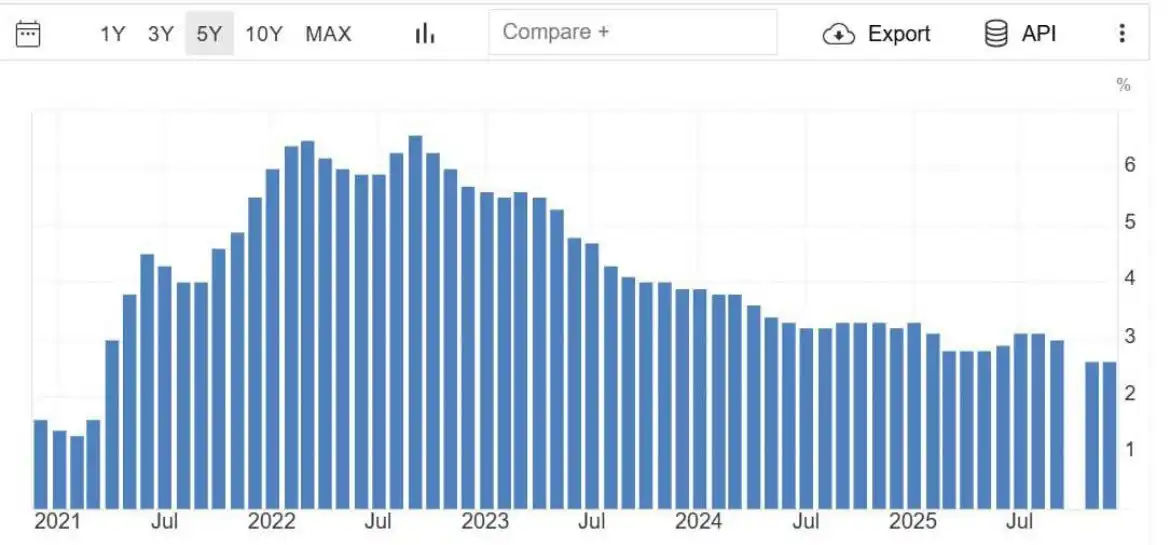
Markets are forward-looking. The bond market is already starting to smell this.

Extremely Crowded Short Position

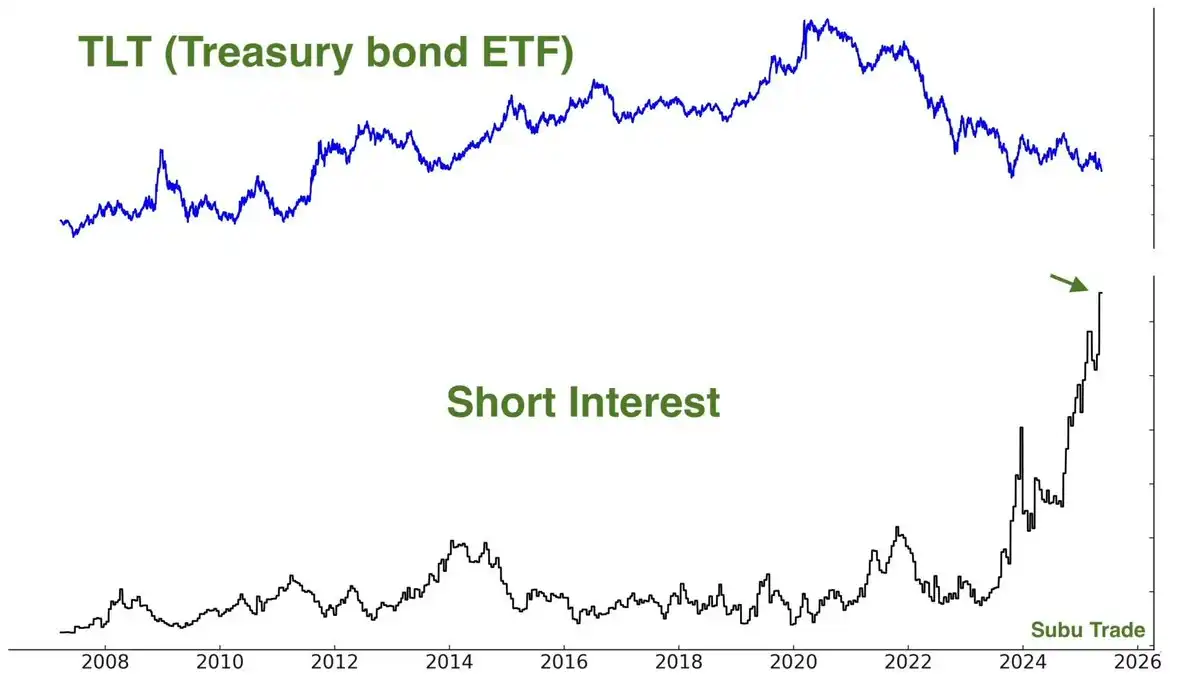
TLT short interest is extremely high:

  • ~144 million shares sold short.
  • Days to cover exceeds 4 days.

Crowded trades don't unwind slowly. They reverse violently—especially when the market narrative shifts.

And importantly:

"Shorts pile in AFTER the move, not before."

This is classic late-cycle behavior!

Smart Money Is Moving In

Recent widely circulated 13F institutional holding reports showed a large fund's quarterly increase list featured significant TLT call options.

Whoever it's attributed to, the message is simple: Sophisticated capital is starting to reposition for duration. Even George Soros's fund held TLT call options in its latest 13F disclosure.
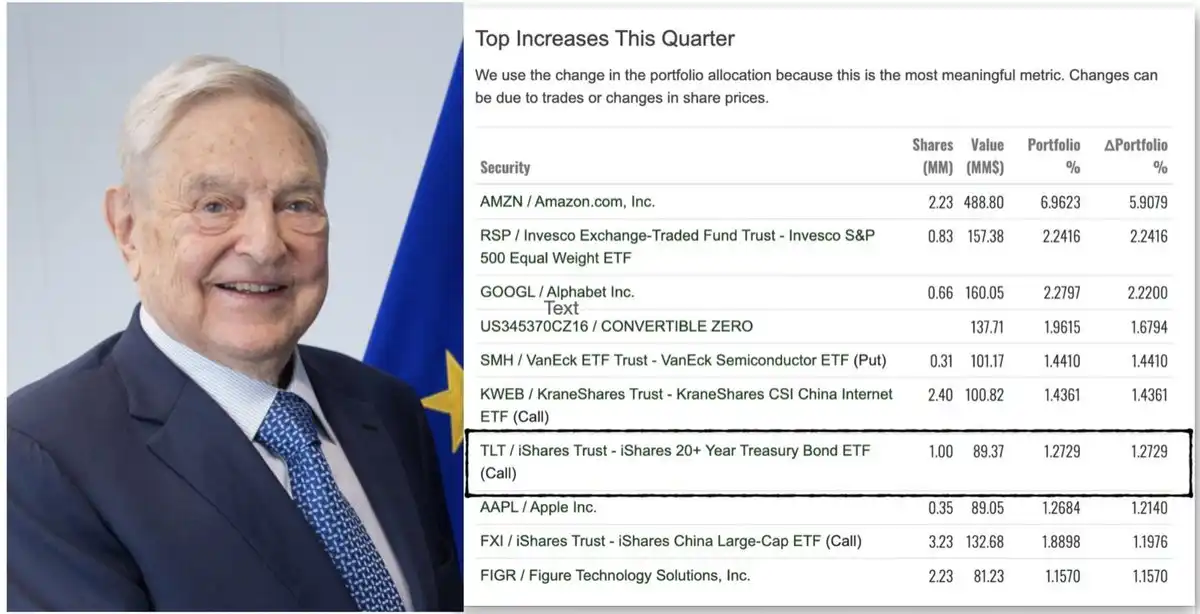
Deflationary Shock from Tariff Friction

Recent news is reinforcing the "risk-off" logic. President Trump announced new tariff threats regarding the Denmark/Greenland dispute, and European officials are now openly discussing freezing or suspending participation in the EU-US tariff agreement in response.

Trade friction will:

  • Hit growth
  • Squeeze margins
  • Reduce demand
  • Push capital into bonds over stocks

This is not an inflationary impulse; it's a deflationary shock.

Valuation Mismatch: Stocks vs. Bonds

Today's stock pricing reflects:

  • Strong growth
  • Stable margins
  • Benign financing conditions

While bond pricing reflects:

  • Fiscal stress
  • Sticky inflation worries
  • Permanently high yields

If either of these narratives is wrong, returns will diverge violently.

Long-duration bonds have "convexity"; stocks do not.

$TLT Upside Case Analysis

TLT has:

  • ~15.5 years effective duration
  • You earn ~4.4–4.7% yield while you wait

Scenario Analysis:

  • If long-end yields fall 100 basis points (bps), TLT price return is +15–18%.
  • Fall 150 bps, TLT return is +25–30%.
  • Fall 200 bps (not extreme historically),意味着 it will surge +35–45% or more!

This doesn't include interest income, convexity bonuses, or the accelerating effect of short covering. This is why I see "asymmetric upside."

Conclusion

Honestly: After the惨状 of 2022, I swore I'd never touch long bonds again. Watching duration assets get crushed was a frustrating experience.

But the market doesn't care about your psychological trauma—it only cares about probabilities and price.

When everyone agrees bonds are "uninvestable," when sentiment bottoms, when shorts pile up, when yields are high and growth risks are rising...

That's when I start buying!

  • TLT + TMF are currently ~60% of my portfolio. I made 75% returns in the 2025 stock market and redeployed most of it into bond ETFs in November 2025.
  • I'm "getting paid to wait" (earning over 4% yield).
  • My position is based on policy and growth shifts, not虚无的 narrative.

2026 will finally be the "Year of the Bond."

Câu hỏi Liên quan

QAccording to the article, why does the author believe long-duration U.S. Treasuries (like TLT) could be the highest-returning asset in 2026?

AThe author believes a combination of factors creates an 'asymmetric bet' for long bonds: unsustainable U.S. interest expenses, gold price signaling deflationary risks, extremely crowded short positions in bonds, cooling inflation, emerging economic weaknesses, and the high probability of policy intervention (like QE or Yield Curve Control) to lower long-term rates, which would cause their prices to surge.

QWhat historical pattern does the author cite regarding gold's performance and what it has typically preceded?

AThe author states that historically, whenever gold has risen over 200% in a short period, it has not signaled persistent inflation but instead preceded economic stress, recession, and falling real interest rates (disinflation/deflation). Examples given are the 1970s, early 1980s, 2000s, and 2008.

QWhat is 'Fiscal Dominance' as described in the article, and why is it a problem for the U.S.?

A'Fiscal Dominance' is described as a vicious cycle where high interest rates lead to higher budget deficits, which require more government debt issuance. This increased issuance leads to a higher term premium (the extra yield investors demand for holding long-term bonds), which in turn leads to even higher interest expenses, creating a self-reinforcing loop that is unsustainable.

QHow does the current structure of U.S. Treasury debt issuance create a 'short-term trap'?

AThe Treasury has drastically reduced the issuance of long-term bonds (20/30-year) to about 1.7% of total issuance, pushing most of the borrowing into short-term bills. This doesn't solve the debt problem; it merely kicks it down the road. These short-term bills must be constantly refinanced at future (potentially higher) rates, increasing systemic refinancing risk and keeping long-term yields high due to the market's perceived risk.

QWhat specific market positioning factor does the author highlight as a potential catalyst for a rapid price increase in long-term bond ETFs like TLT?

AThe author highlights the extremely crowded short interest in TLT, with approximately 144 million shares sold short and a high 'days to cover' ratio. This creates the conditions for a violent short squeeze, where a shift in market narrative would force short sellers to buy back shares rapidly, accelerating any upward price move.

Nội dung Liên quan

Zcash Chứng Kiến Sự Sụp Đổ Lịch Sử Khi Hàng Tỷ Đô La Biến Mất Khỏi Giá Trị Thị Trường

Thị trường tiền điện tử chấn động bởi sự sụp đổ mạnh mẽ của Zcash (ZEC), đồng tiền tập trung vào quyền riêng tư đã mất hơn một nửa giá trị chỉ trong 24 giờ. Sự sụt giảm đột ngột này xóa sổ khoảng 5 tỷ USD từ vốn hóa thị trường của nó. Nguyên nhân chính được cho là do lo ngại xung quanh một lỗ hổng bảo mật vừa được tiết lộ ảnh hưởng đến cơ sở hạ tầng riêng tư của mạng lưới. Lỗ hổng này, ẩn trong nhóm giao dịch riêng tư Orchard của Zcash từ tháng 5/2022, cho phép tạo ra ZEC giả mạo trong thử nghiệm. Mặc dù đã được vá vào ngày 2/6, thiết kế bảo mật của Zcash khiến không thể xác minh liệu có đồng ZEC giả nào đã được tạo ra trước đó hay không, dẫn đến sự hoang mang và bán tháo. Tình huống này làm nổi bật sự đánh đổi giữa tính riêng tư và minh bạch. Để khôi phục niềm tin, Shielded Labs đang xem xét một đề xuất nâng cấp mạng lưới cho phép xác minh tính toàn vẹn của tổng nguồn cung Zcash. Cộng đồng Zcash nhấn mạnh rằng việc phát hiện lỗ hổng là kết quả của quy trình nghiên cứu bảo mật đẳng cấp và chủ động, một dấu hiệu tích cực cho thấy mạng lưới liên tục được củng cố.

bitcoinist6 giờ trước

Zcash Chứng Kiến Sự Sụp Đổ Lịch Sử Khi Hàng Tỷ Đô La Biến Mất Khỏi Giá Trị Thị Trường

bitcoinist6 giờ trước

Câu chuyện về Bitcoin "Vàng Kỹ Thuật Số" có thất bại hay không?

**TÓM TẮT** Bài viết phân tích Bitcoin từ góc nhìn của Jason, tập trung vào ba vấn đề chính: bản chất của Bitcoin, nguyên nhân đợt giảm giá gần đây và triển vọng dài hạn. **1. Cách nhìn nhận tài sản Bitcoin:** Tác giả vẫn coi Bitcoin là một lớp tài sản mới, ưu việt hơn vàng về tính chất "vàng kỹ thuật số" nhờ: nguồn cung cố định (21 triệu BTC), khả năng chuyển giao vượt trội và tính minh bạch có thể kiểm chứng. Dù vẫn còn sớm (tỷ lệ thâm nhập toàn cầu ~3-4%) và biến động mạnh, quá trình hợp pháp hóa đang đẩy lùi các hoạt động phi chính thức. **2. Nguyên nhân đợt giảm giá 2025-2026:** Đợt giảm khoảng 50% từ đỉnh 12.6万美元 xuống dưới 6.1万美元 là một đợt bán theo chu kỳ có tính đồng thuận cao, phù hợp với mô hình lịch sử sau mỗi lần giảm một nửa phần thưởng. Sự kiện ETF Bitcoin năm 2024 đã mở đường cho dòng tiền tổ chức mua vào, đồng thời tạo cơ hội cho các nhà đầu tư sớm (có giá gốc rất thấp) chốt lời, dẫn đến một đợt "chuyển giao lịch sử" từ những người tin tưởng ban đầu sang các tổ chức đầu tư dài hạn. Một điểm đáng chú ý là biên độ các đợt sụt giảm trong lịch sử đang thu hẹp dần (từ 93% xuống còn ~50%), cho thấy tài sản đang trưởng thành và biến động giảm bớt. **3. Triển vọng dài hạn:** Về dài hạn, nếu tin vào luận điểm "vàng kỹ thuật số", giá trị Bitcoin nên được định giá theo vàng vật chất. Với vốn hóa hiện tại (~1.4 nghìn tỷ USD) chỉ bằng 7% vốn hóa vàng (~20 nghìn tỷ USD), tiềm năng tăng trưởng vẫn còn rất lớn nếu luận điểm này được hiện thực hóa một phần. Tuy nhiên, tác giả cảnh báo rủi ro thực sự không nằm ở bản thân Bitcoin (xác suất về 0 thấp hơn xác suất tăng trưởng), mà ở hai yếu tố: **cơ cấu danh mục đầu tư** (không all-in, vay mượn) và **độ hiểu biết sâu sắc về tài sản**. Chỉ khi hiểu rõ logic cốt lõi, nhà đầu tư mới có thể giữ vững lập trường qua các đợt biến động mạnh. Bài học từ Amazon (sụt 95% năm 2000 rồi tăng 42 lần) cho thấy điều quan trọng là "sống sót" được đến lúc tiềm năng được giải phóng. Câu hỏi cuối cùng được đặt ra: Liệu đợt giảm giá này chứng minh luận điểm "vàng kỹ thuật số" đã thất bại, hay chỉ đơn giản là quá trình chuyển giao chưa kết thúc? Câu trả lời phụ thuộc vào niềm tin nền tảng của mỗi người vào loại tài sản này.

marsbit7 giờ trước

Câu chuyện về Bitcoin "Vàng Kỹ Thuật Số" có thất bại hay không?

marsbit7 giờ trước

Chủ đề “Vàng kỹ thuật số” của BTC có thất bại không?

Tác giả, qua góc nhìn của Jason, phân tích về Bitcoin dưới ba khía cạnh chính: bản chất của tài sản Bitcoin, nguyên nhân đợt giảm giá gần đây và triển vọng dài hạn. **1. Bản chất của Bitcoin:** Tác giả coi Bitcoin là một loại tài sản mới, một phiên bản "vàng kỹ thuật số" ưu việt hơn nhờ tính chất: nguồn cung cố định (21 triệu), khả năng chuyển giao và kiểm toán vượt trội. Dù còn sớm với tỷ lệ thâm nhập toàn cầu khoảng 3-4% và biến động cao, Bitcoin đang dần được hợp thức hóa. **2. Nguyên nhân đợt giảm giá:** Đợt điều chỉnh từ đỉnh ~126k USD (10/2025) xuống ~61k USD (2/2026) được xem là một đợt bán theo chu kỳ 4 năm (sau sự kiện giảm một nửa phần thưởng) và là quá trình "chuyển giao lịch sử" từ các nhà đầu tư sớm sang các tổ chức dài hạn thông qua ETF. Đáng chú ý, mức độ sụt giảm qua các chu kỳ đang thu hẹp (từ 93% xuống ~50%), phản ánh sự trưởng thành của tài sản. **3. Triển vọng dài hạn:** Với vai trò "vàng kỹ thuật số", vốn hóa Bitcoin hiện chỉ bằng ~7% vốn hóa vàng vật chất. Nếu đạt 30-50% vốn hóa vàng, tiềm năng tăng trưởng vẫn rất lớn. Tuy nhiên, tác giả không đưa ra lời khuyên mua ngay và nhấn mạnh hai rủi ro thực sự: **cấu trúc danh mục đầu tư** (không nên all-in, dùng đòn bẩy hoặc tiền không nên dùng) và **độ hiểu biết về tài sản** - yếu tố then chốt để giữ vững tâm lý qua các đợt biến động mạnh. Câu hỏi then chốt là liệu bạn có thể "sống sót" để chứng kiến tiềm năng dài hạn, giống như cổ phiếu Amazon đã vượt qua đợt sụt giảm 95% năm 2000. Bài viết kết luận bằng một câu hỏi mở: Liệu việc vàng tăng 60% trong khi Bitcoin giảm 50% có nghĩa là câu chuyện "vàng kỹ thuật số" đã thất bại, hay đơn giản phản ánh quá trình chuyển giao chưa kết thúc và sự tiến hóa từ tài sản đầu cơ sang tài sản được định vị? Câu trả lời phụ thuộc vào niềm tin cốt lõi của mỗi người vào loại tài sản này.

链捕手7 giờ trước

Chủ đề “Vàng kỹ thuật số” của BTC có thất bại không?

链捕手7 giờ trước

Từ Mã đến Nhận Thức: Hướng Dẫn Nghìn Chữ về Sự Tiến Hóa của Bộ Não Robot

Từ nhiều thập kỷ trước, robot chủ yếu được điều khiển bằng mã lập trình truyền thống, với các lớp như cảm nhận, ước tính trạng thái, lập kế hoạch và điều khiển được xây dựng thủ công. Chúng hoạt động tốt trong môi trường được thiết kế trước nhưng thiếu khả năng tổng quát hóa. Sự xuất hiện của học sâu (deep learning) đã cách mạng hóa lớp cảm nhận, trong khi học tăng cường (reinforcement learning) và học bắt chước (imitation learning) bắt đầu cải thiện lớp điều khiển. Tuy nhiên, mỗi chính sách học được vẫn còn hẹp và thiếu linh hoạt. Sự bùng nổ của các mô hình ngôn ngữ lớn (LLM) như ChatGPT đã mang lại bước nhảy vọt: LLM đóng vai trò như một bộ lập kế hoạch thông minh, dịch chỉ dẫn ngôn ngữ tự nhiên thành chuỗi hành động để hệ thống robot (như ROS2) thực thi. Dù vậy, LLM vẫn chỉ nằm ở lớp lập kế hoạch. Bước tiến quan trọng tiếp theo là các Mô hình Thị giác-Ngôn ngữ-Hành động (VLA). Các mô hình như RT-2 của Google hay OpenVLA hợp nhất lý luận và hành động trong một mạng thần kinh duy nhất, nhận đầu vào là hình ảnh và lệnh, rồi trực tiếp xuất ra các chỉ thị chuyển động, giúp robot linh hoạt và có khả năng tổng quát hóa hơn. Kiến trúc tiên tiến nhất hiện nay cho robot hình người là "hệ thống kép" (System 1/System 2), lấy cảm hứng từ tâm lý học. System 2 (chậm) là một VLA lớn, xử lý cảnh quan và lý luận ở tần số thấp. System 1 (nhanh) là một mạng nhỏ, tốc độ cao, nhận ý định từ System 2 và xuất ra các lệnh chuyển động liên tục. Một số hệ thống còn có System 0 như một lớp phản xạ để giữ thăng bằng. Việc tính toán được chia sẻ: các vòng lặp điều khiển an toàn quan trọng chạy cục bộ trên bo mạch (ví dụ: NVIDIA Jetson) để đảm bảo độ trễ thấp và độ tin cậy, trong khi các tác vụ như giao diện hội thoại hay học tập nhóm có thể chạy trên đám mây. Các mô hình mã nguồn mở như OpenVLA, NVIDIA Isaac GR00T, và Physical Intelligence π0 đang thúc đẩy lĩnh vực này, cho phép các công ty khởi nghiệp tinh chỉnh chúng với dữ liệu riêng thay vì đào tạo từ đầu. Dù đã có tiến bộ lớn, robot VLA hiện tại vẫn có hạn chế: khó khăn trong phục hồi sau lỗi, hiệu quả mẫu thấp, khó khăn với nhiệm vụ dài hạn và thiếu "hiểu biết vật lý" thực sự. Để giải quyết những hạn chế này, lĩnh vực đang tập trung vào "Mô hình Thế giới" (World Model). Đây là các mạng thần kinh có thể dự đoán hệ quả của hành động dựa trên trạng thái hiện tại. Bằng cách mô phỏng nhiều tương lai khả thi trước khi hành động, robot có thể lập kế hoạch tốt hơn, phục hồi tốt hơn và cải thiện khả năng tổng quát hóa. Các kiến trúc chính gồm: mô hình khuếch tán pixel (Cosmos/Sora), Kiến trúc Dự đoán Nhúng Chung (JEPA của LeCun) và Mô hình Thế giới Hành động Tiềm ẩn (Genie/Dreamer). Tương lai, robot tiên tiến có thể kết hợp VLA với Mô hình Thế giới để lập kế hoạch và kiểm tra hành động trong mô phỏng trước khi thực thi, đồng thời tạo ra lượng dữ liệu tổng hợp khổng lồ cho đào tạo. Yếu tố then chốt hiện nay là dữ liệu, với việc điều khiển từ xa (teleoperation) là phương pháp thu thập chính. Mô phỏng (simulation) cũng đóng vai trò ngày càng quan trọng. Về kinh tế, chi phí phần cứng robot hình người đang giảm nhanh, mở ra thị trường rộng lớn hơn. Tuy nhiên, lĩnh vực này vẫn đang ở giai đoạn phát triển, tương tự "thời kỳ GPT-2" của AI vật lý, với tiềm năng to lớn nhưng cần thêm thời gian để trưởng thành hoàn toàn và triển khai một cách tự chủ, an toàn.

marsbit7 giờ trước

Từ Mã đến Nhận Thức: Hướng Dẫn Nghìn Chữ về Sự Tiến Hóa của Bộ Não Robot

marsbit7 giờ trước

Giao dịch

Giao ngay
Hợp đồng Tương lai
活动图片