Three-Year Valuation Reaches $2 Billion: How Does RedotPay Play?

marsbitXuất bản vào 2026-01-27Cập nhật gần nhất vào 2026-01-27

Tóm tắt

RedotPay, a Hong Kong-based crypto payment company, achieved a $1.07 billion Series B funding round in late 2025, led by Goodwater Capital, with participation from Sequoia China, Pantera Capital, and Circle Ventures. Valued at $2 billion within three years, the platform has over 10 million registered users and processes over $10 billion in annual payments across 100+ countries. The company employs a Visa-linked debit card system, allowing users to spend cryptocurrencies like USDT and BTC globally. Its services include Global Payout (local currency withdrawals), P2P trading, and Earn & Credit financial products for yield and lending. RedotPay initially targeted emerging markets with volatile currencies, such as Nigeria and Brazil, using an offline "ground force" distribution model with high fee incentives for local promoters. Despite its rapid growth, RedotPay faces challenges in maintaining high fee structures and regulatory compliance. Its "puzzle-style" regulatory approach—holding licenses like MSO in Hong Kong and VASP registrations elsewhere—does not fully cover all its financial services, particularly around Earn products and crypto-backed lending, which may face securities law scrutiny. Competitors like Rain are also advancing, with a $2.5 billion Series C at a $19.5 billion valuation. RedotPay’s future depends on strengthening compliance to transition from a payment tool to a sustainable NeoBank.

Author: Zhou, ChainCatcher

By the end of 2025, Hong Kong-based crypto payment company RedotPay completed a $107 million Series B funding round led by Goodwater Capital, with top-tier institutions such as Sequoia China, Pantera Capital, and Circle Ventures also appearing on the list of co-investors.
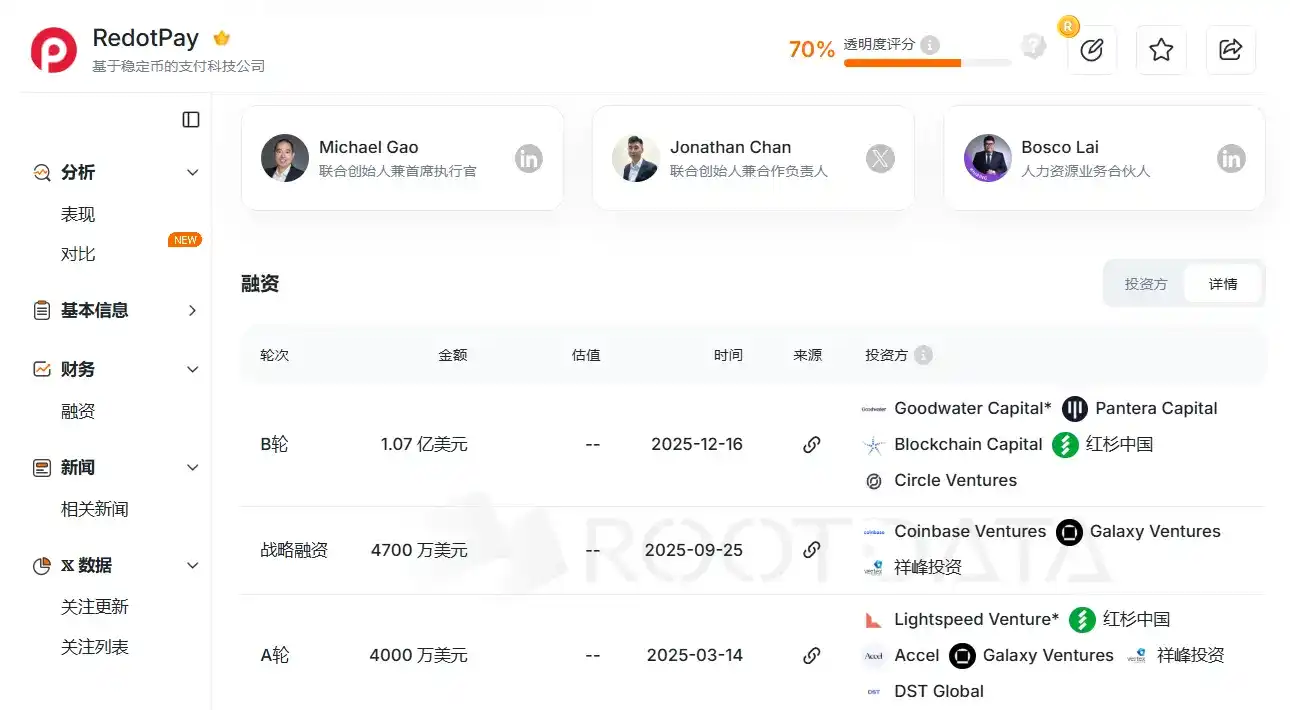
Image from RootData

Why Did It Become a Dark Horse in the Payment Track?

RedotPay's story began in early 2023. Its co-founder and CEO, Michael Gao, had worked for top banks such as HSBC and DBS, and was also a core member of加密技术服务商 ChainUp. Additionally, the company's COO Troy Yao and CTO Xinman Fang both have years of experience in the crypto industry or software development, coming from platforms like Huobi or VCB.

According to informed sources, RedotPay was initially invested in and incubated by Yuan Dawei, who began researching Bitcoin as early as 2010. He was one of the early co-founders of Huobi and the founder of库神钱包, wielding significant influence and trust within the early Bitcoin investor community and miner groups. He is also one of the behind-the-scenes operators of several hot tokens in recent years, well-versed in early user growth and narrative logic in the crypto industry.

The team background determined that RedotPay follows a typical Chinese internet playbook: first, seize market share regardless of cost, then raise连续融资 after scale effects form, and finally monetize through diversified financial services.

Specifically, RedotPay's core business is driven by a Visa co-branded debit card. Users top up cryptocurrencies like USDT and BTC into the App, and can then use the card for instant settlement through the global Visa payment network, including offline ATM withdrawals, supermarket刷卡, online subscriptions, and Apple Pay/Google Pay, with the system automatically handling the清算 of cryptocurrency to fiat.

On this basis, RedotPay further衍生出 Global Payout (local fiat代付), P2P fiat trading zone, and the Earn & Credit financial module with interest-earning and lending functions.

  • Visa payment card: Supports direct stablecoin settlement, covering over 100 countries globally.
  • Global Payout: Supports direct withdrawal of local fiat (e.g., BRL, NGN).
  • OTC and P2P market: By introducing local OTC merchants, users can directly buy or sell cryptocurrencies with local currency.
  • Earn生息: Increases资金停留时长 through financial products.
  • Crypto Credit: Provides credit lines collateralized by coins.

Image from RedotPay APP

RedotPay's early landscape was highly focused on emerging markets with剧烈 fluctuating fiat exchange rates, such as Nigeria, Brazil, and Southeast Asia.

  • May 2023: RedotPay officially launched in Hong Kong and quickly obtained an MSO license.
  • October 2023: Officially launched virtual Visa cards and physical cards, supporting Apple Pay and Google Pay.
  • August 2024: User base surpassed 5 million.
  • March 2025: Completed a $40 million Series A funding round led by Lightspeed.
  • June 2025: Officially launched the Global Payout (global代付) function.
  • September 2025: Received $47 million in strategic investment,引入 Coinbase Ventures and other capital, valuation reaching the $1 billion mark.
  • October 2025: Announced that the P2P market supports trading in over 50 local fiat currencies.
  • December 2025: Completed a $107 million Series B funding round, introducing top institutions like Sequoia China, Pantera Capital, and Circle Ventures. Meanwhile, the company disclosed that its global registered users exceeded 6 million, annualized payment volume exceeded $10 billion, covering over 100 countries, and it had already achieved profitability.

According to informed sources, its global registered real users have now exceeded 10 million, with the latest valuation potentially reaching $2 billion. From its official start in 2023 to achieving stable profitability now, RedotPay took less than three years, which is rare in the illiquid crypto market.

Its growth logic is a combat model called the "Army System." Simply put, it abandons high-cost online user acquisition and instead builds an offline distribution network.

An anonymous crypto card entrepreneur emphasized that RedotPay initially relied almost entirely on this ground promotion system, maintaining high card issuance fees and transaction fees to leave significant profit margins for the offline promotion teams. Currently, its virtual card issuance fee is $10, the physical card is $100, and each transaction includes about a 1% handling fee.

The high profit-sharing mechanism makes every local KOL, OTC merchant, community leader, and even micro-loan intermediary a promoter of RedotPay.

An industry observer stated that RedotPay's traffic experienced a step-change growth in early 2025, and almost all of it came from user主动搜索, which means it formed word-of-mouth diffusion among scenario-specific populations, making its user acquisition efficiency top-tier in the early stages.

According to official data, as of November 2025, RedotPay added over 3 million new users in that year alone, with annual payment volume growing nearly three times year-on-year. Industry insiders said that among RedotPay's users, there might be a group of core users with high consumption capacity and frequency, contributing a significant proportion of revenue.

Valuation Premium Behind the NeoBank Closed Loop

However, how far can a strategy relying on high fees to maintain incentives go?

Although users are willing to pay high costs at this stage, relying on high fees to 'feed' offline agents is essentially trading financial spreads for growth speed.

In the highly competitive environment of crypto payments in 2026, RedotPay seems to be caught in a paradox: to maintain agent loyalty, it must maintain high profit-sharing; but to cope with erosion by licensed giants, it must lower fees.

The high valuation given by the capital market is clearly not just paying for the bid-ask spread (Spread). In fact, what capital values is who can make users leave their money behind, and the market is currently paying a premium for this potential banking attribute.

The真正值钱的地方 of RedotPay lies in the high degree of completion in their transition from a payment tool to a crypto-native bank (NeoBank).

Pure payment channels have extremely low毛利 and are极易被替代, while RedotPay, through the Earn interest-earning and Crypto Credit lending functions, builds a complete资金闭环 of "top-up - earn interest - borrow - consume," preventing users from topping up and leaving immediately.

Under this logic, users top up USDT into the App, retain funds through the Earn (interest-earning) function, and then use Credit (collateralized lending) to obtain fiat credit for consumption. As an industry observer said, even if only 10% of the $10 billion transaction volume is converted into retained沉淀, the interest spread and financial derivative income generated will make its profit margin far exceed that of traditional payments.

BKJ market负责人伯言 believes that the key to RedotPay's success lies in its early courage to make product decisions围绕真实使用场景, because users' real needs are the source of development momentum.

However, behind the seemingly beautiful closed loop lies a liquidity game. 伯言 also reminded that once there is insufficient risk control buffer between interest earning, credit granting, and consumption, in极端行情 or during liquidity紧张, the highly nested financial closed loop may face极大的承压风险.

Under the NeoBank shell, whether the assets have achieved true legal隔离 is the next拷问 it must answer.

Compliance Concerns and Boundary Racing

From another perspective, RedotPay is actually utilizing the window period where regulation has not yet fully covered emerging markets to complete a race关于效率与合规边界.

After all, behind the prosperity of the payment track始终存在 the达摩克利斯之剑 of compliance.

Chaintech founder Kevin Piao emphasized that the famous "compliance cliff" theory同样适用 in the Web3 payment field, meaning the smaller the scale, the safer; the larger the scale, the more dangerous.

Early rapid growth is usually because监管的灰色地带 or bank risk control滞后性 are utilized. But when transaction volume突破某个临界点 (e.g., tens of millions of USD per month), it triggers deep compliance audits from the card issuer (Issuer) and clearing network (Visa/Mastercard). Many once-popular加密卡商 died here.

Although RedotPay has been actively布局合规 and spends high compliance maintenance costs, the challenge it faces still lies in the dynamic upgrade of regulatory standards.

RedotPay adopts a "jigsaw puzzle-style compliance" structure. Although it holds an MSO (Money Service Operator), Money Lender license, and TCSP (Trust or Company Service Provider) license in Hong Kong, and has obtained VASP registration in places like Lithuania and Argentina, this does not mean it can rest easy.

Mankun Law Firm lawyer Liu Honglin analyzed that this组合整体属于 'the business can run, and it can also be explained to regulators,' but it is not one license that covers everything.

Why is it called a jigsaw puzzle? Because it actually stacks together businesses like收款,换汇,转账,跨境兑付,借贷, and生息, which have completely different legal categorizations in traditional finance.

The biggest risk of this structure is that certain links in the product chain may only "look similar," but their legal定性 remains in a gray area.

Lawyer Liu Honglin pointed out that Hong Kong's MSO essentially regulates "fiat exchange," but "stablecoin-to-fiat exchange" is not automatically considered a foreign exchange business in many countries. Furthermore, the real regulatory gray areas are concentrated in the担保执行 of crypto-collateralized lending and the性质定性 of Earn products.

Regarding the Earn interest-earning function, which has attracted much capital attention, Lawyer Liu直言, such products are极易被视为未经注册的证券化产品或集体投资计划 from the perspective of regulators in many countries. "Regulators believe you are issuing financial products with return expectations to the public and should be subject to securities law regulation, not bypass it using 'crypto innovation.' The hefty fine imposed by the U.S. SEC on BlockFi is a lesson from the past."

In the Crypto Credit (crypto-collateralized lending)环节, although the money lender license solves the "lending资格," crypto assets as collateral have far less legal certainty than traditional collateral.一旦遭遇极端行情 or清算纠纷, whether its担保权益 can obtain court support still lacks a mature legal framework.

Conclusion

The crypto market in 2026 is in a collective window期走向台前的 IPO window期. RedotPay and its competitors are accelerating. In January this year, its core competitor Rain announced the completion of a $250 million Series C funding round, with a valuation reaching $1.95 billion.

For RedotPay, licenses are just the shell; continuous compliance内功 is the lifeblood, and this is the team's most fragile一环. Whether it can repair its jigsaw structure through compliance内功 before regulators close the net will determine whether it ultimately becomes a financial giant in the crypto world or merely a流星 in payment history.

In short, this race about efficiency, greed, and boundaries has already entered the second half.

Click to learn about open positions at ChainCatcher

Câu hỏi Liên quan

QWhat is RedotPay's core business model and how does it generate revenue?

ARedotPay's core business is driven by Visa co-branded debit cards, allowing users to spend cryptocurrencies like USDT and BTC globally. It generates revenue through card issuance fees ($10 for virtual, $100 for physical cards) and approximately 1% transaction fees. It also offers financial services like Earn (yield-generating products) and Crypto Credit (collateralized lending) to increase user retention and profitability.

QHow did RedotPay achieve rapid user growth in its early stages?

ARedotPay adopted an 'Army System' strategy, focusing on offline distribution networks instead of costly online advertising. It incentivized local influencers, OTC merchants, and community leaders with high commission rates from card fees and transaction fees, leading to organic growth through word-of-mouth and targeted emerging markets like Nigeria, Brazil, and Southeast Asia.

QWhat are the key regulatory challenges RedotPay faces despite its 'puzzle-style compliance' approach?

ARedotPay holds licenses like MSO, Money Lender, and TCSP in Hong Kong, and VASP registrations in other regions, but its integrated services (e.g., stable-to-fiat conversion, Earn products, Crypto Credit) may fall into regulatory gray areas. Key risks include Earn products being classified as unregistered securities (similar to SEC actions against BlockFi) and uncertain legal enforcement for crypto collateral in lending during market extremes.

QWhy do investors value RedotPay at $2 billion, and what potential risks could affect its valuation?

AInvestors value RedotPay for its transition from a payment tool to a NeoBank with a closed-loop ecosystem (deposit-earn-borrow-spend), which promises higher margins through financial derivatives. However, risks include reliance on high fees for growth (unsustainable in competitive markets), liquidity pressures during extreme volatility, and unresolved regulatory gaps that could trigger compliance audits or legal challenges as scale increases.

QHow does RedotPay's growth and valuation compare to its competitors, such as Rain?

ARedotPay reached a $2 billion valuation with over 10 million users and $10 billion annual payment volume by late 2025, focusing on aggressive expansion and financial service integration. Its competitor Rain raised $250 million at a $19.5 billion valuation in early 2026, indicating intense competition in the crypto payment space, with both companies racing to scale and IPO amid regulatory evolution.

Nội dung Liên quan

70% người dân phản đối AI, người Mỹ mong nước Mỹ thua cuộc chiến trí tuệ nhân tạo

Bài báo có tiêu đề “70% dân chúng phản đối AI, người Mỹ hy vọng Mỹ thua cuộc chiến trí tuệ nhân tạo” phản ánh làn sóng phản đối mạnh mẽ công nghệ AI tại Mỹ. Một cuộc diễn thuyết ủng hộ AI của cựu CEO Google Eric Schmidt tại lễ tốt nghiệp Đại học Arizona đã bị sinh viên la ó, phản ánh tâm trạng lo ngại trong giới trẻ. Các cuộc thăm dò cho thấy 70% người Mỹ cho rằng AI phát triển quá nhanh và cần được kiểm soát chặt chẽ hơn, trong khi 71% phản đối xây dựng trung tâm dữ liệu AI tại địa phương. Sự phản đối không chỉ dừng ở ý kiến; nó đã chuyển thành hành động như phá hoại quảng cáo, biểu tình, và thậm chí các vụ tấn công cực đoan nhằm vào các lãnh đạo AI như Sam Altman. Nguyên nhân chính bao gồm lo sợ mất việc làm, tác động môi trường (như tiêu thụ năng lượng và nước quá mức từ các trung tâm dữ liệu, dẫn đến tăng hóa đơn điện nước), lo ngại về ảnh hưởng của AI đến dân chủ và nền kinh tế, cũng như quan ngại về một bong bóng tài chính. Vấn đề AI cũng trở thành vấn đề chính trị sâu sắc. Tổng thống Trump đã dỡ bỏ các quy định kiểm soát AI của chính quyền Biden để thúc đẩy cạnh tranh, chủ yếu do ảnh hưởng từ giới công nghệ ủng hộ ông. Tuy nhiên, điều này vấp phải sự phản đối từ cả cử tri đảng Dân chủ (quan tâm đến môi trường và việc làm) lẫn một bộ phận thành viên MAGA cực hữu (lo ngại về chi phí sinh hoạt và bản sắc), tạo ra một liên minh bất ngờ chống lại sự bùng nổ của AI. Trump hiện đứng trước thách thức phải lựa chọn giữa các nhà tài trợ công nghệ và cử tri truyền thống, với nguy cơ ảnh hưởng đến vị thế cạnh tranh AI của Mỹ và ổn định chính trị nội bộ.

marsbit22 phút trước

70% người dân phản đối AI, người Mỹ mong nước Mỹ thua cuộc chiến trí tuệ nhân tạo

marsbit22 phút trước

Crypto.com Ra Mắt OTC Options Được Tài Trợ Đầy Đủ Cho Nhà Giao Dịch Tổ Chức

Chúng tôi vui mừng thông báo ra mắt dịch vụ Quyền chọn OTC Được Tài trợ Toàn phần trên sàn Crypto.com, một bổ sung tinh vi cho các dịch vụ thể chế của chúng tôi. Lần đầu tiên, các tổ chức và khách hàng VIP có thể giao dịch quyền chọn kiểu châu Âu cơ bản một cách trực tiếp và an toàn ngoài sổ lệnh thông qua đội ngũ giao dịch viên kinh nghiệm. **Lợi thế OTC:** Giải pháp này khắc phục tình trạng trượt giá và rò rỉ thông tin thường gặp khi giao dịch khối lượng lớn trên sổ lệnh công khai, bằng cách cung cấp một diễn đàn riêng tư để thực hiện các hợp đồng tùy chỉnh phù hợp với nhu cầu và chiến lược đầu tư. **Quyền chọn OTC Được Tài trợ Toàn phần là gì?** Đây là các hợp đồng quyền chọn kiểu châu Âu cơ bản, được thanh toán bằng tài sản thực khi đáo hạn. * **Kỳ hạn Tùy chỉnh:** Điều chỉnh ngày đáo hạn lên đến ba tháng. * **Đảm bảo 100%:** Bên bán phải khóa trước tài sản cơ sở hoặc tiền để thanh toán, nhằm giảm thiểu rủi ro thanh lý. * **Thanh toán Vật chất:** Tài sản được chuyển giao trực tiếp khi vị thế có lãnh khi đáo hạn. **Tính năng nổi bật:** * **Quyền chọn USD:** Lý tưởng cho các tổ chức muốn bán quyền chọn mua có bảo đảm để tạo thu nhập từ tài sản nắm giữ. * **Báo giá Đơn giản:** Nhận báo giá tức thì qua các kênh giao dịch độc quyền trên Telegram và Slack. * **Đặt chỗ Tùy chỉnh:** Nhân viên của chúng tôi hỗ trợ đặt và xác nhận lệnh thủ công thông qua Cổng thông tin Bán hàng được bảo vệ. * **Thanh toán Minh bạch:** Tính toán tự động trạng thái có lãi/không có lãi dựa trên chỉ số giá từ sàn giao dịch.

TheNewsCrypto1 giờ trước

Crypto.com Ra Mắt OTC Options Được Tài Trợ Đầy Đủ Cho Nhà Giao Dịch Tổ Chức

TheNewsCrypto1 giờ trước

Agent tiếp quản quyền phân phối lưu lượng, Tencent, Byte, Alibaba đang tranh giành điều gì?

Bài viết phân tích cuộc cạnh tranh khốc liệt của ba gã khổng lồ công nghệ Trung Quốc - Alibaba, ByteDance và Tencent - trong việc giành quyền kiểm soát "cửa ngõ" thời đại AI, chính là các Agent thông minh. **Alibaba:** Chiến lược "song tử" với Ứng dụng Qianwen và Quark. Qianwen hướng tới trở thành một "siêu Agent" có khả năng điều phối nhiều dịch vụ trong hệ sinh thái Alibaba và mở rộng kết nối với các thương hiệu bên ngoài (như Luckin Coffee, KFC). Trong khi đó, Quark tập trung vào tra cứu thông minh cho giới trẻ. Alibaba cũng ra mắt nền tảng Agent doanh nghiệp "Wukong". **ByteDance:** Theo đuổi chiến lược "mọi lúc mọi nơi" với Doubao. Với 300 triệu người dùng hàng tháng, Doubao App là cửa ngõ AI phổ biến. Nền tảng phát triển Agent "Kouzi" đóng vai trò là "nhà máy lắp ráp" phía sau, hỗ trợ tạo và phối hợp nhiều Agent. ByteDance còn tích cực mở rộng sang phần cứng như điện thoại AI và kính thông minh để nhúng Doubao vào mọi thiết bị. **Tencent:** Sở hữu "lá bài tẩy" tiềm ẩn trong WeChat. Thay vì tạo một ứng dụng AI mới, Tencent đang phát triển một Agent thông minh được tích hợp sâu vào WeChat, cho phép người dùng trượt sang phải để gọi và ra lệnh. Agent này có thể hiểu yêu cầu và tự động gọi hàng triệu mini-program trên WeChat để thực thi nhiệm vụ (như đặt đồ uống, đặt vé), biến WeChat thành một "hệ điều hành dịch vụ". Đây là lợi thế khổng lồ với 1.4 tỷ người dùng. **Lõi cuộc chiến:** Cuộc cạnh tranh này không chỉ là về sản phẩm, mà là về sự thay đổi căn bản trong phân phối lưu lượng và quyền lực kinh doanh. Trong tương lai, quyền quyết định tiếp cận dịch vụ sẽ dần chuyển từ việc người dùng tự nhấp chuột sang việc Agent đại diện ra quyết định dựa trên "ý định" của người dùng. Công ty nào kiểm soát được điểm tiếp xúc đầu tiên với ý định người dùng và trở thành "lớp thực thi" mặc định, sẽ nắm giữ quyền lực phân phối lưu lượng Token và định hình lại toàn bộ hệ sinh thái thương mại. Thách thức với Tencent nằm ở năng lực hạ tầng máy tính để phục vụ số người dùng khổng lồ. Tóm lại, đây là thời điểm tái phân phối quyền lực, khi hình thái cửa ngõ chuyển từ Web (PC) sang App (di động) và giờ là Agent (AI). Cuộc đua đang diễn ra quyết liệt để định nghĩa lại cách người dùng kết nối với thế giới số.

marsbit2 giờ trước

Agent tiếp quản quyền phân phối lưu lượng, Tencent, Byte, Alibaba đang tranh giành điều gì?

marsbit2 giờ trước

Sàn Nasdaq Một Đêm Sụt 4%, 1.3 Nghìn Tỷ USD Bốc Hơi, Chứng Khoán Mỹ Đối Mặt Với Ba Đòn Chí Tử

**Sự Sụt Giảm Mạnh Trên Nasdaq: 4%, 1.3 Nghìn Tỷ USD Bốc Hơi, Chứng Khoán Mỹ Hứng Chịu "Ba Đòn Chí Tử"** Ngày 5 tháng 6 đánh dấu một phiên giao dịch tồi tệ nhất kể từ khủng hoảng thuế quan tháng 4/2025. Chỉ số Nasdaq lao dốc 4.18%, S&P 500 mất 2.64% và Dow Jones giảm 695 điểm. Ba nguyên nhân chính đồng thời gây ra sự sụp đổ: 1. **Báo cáo của Broadcom làm rạn nứt câu chuyện AI:** Dù doanh thu chip AI của Broadcom tăng 143%, dự báo cho quý tới thấp hơn kỳ vọng, gợi ý về tốc độ tăng trưởng có thể chậm lại. Điều này kích hoạt làn sóng bán tháo trên toàn ngành bán dẫn, với chỉ số Philadelphia Semiconductor giảm 10.26% và tổng vốn hóa các công ty chip Mỹ bốc hơi khoảng 1.3 nghìn tỷ USD. 2. **Dữ liệu việc làm mạnh bất ngờ trở thành "thuốc độc":** Báo cáo phi nông nghiệp tháng 5 cho thấy 172,000 việc làm mới, gấp đôi dự báo, cùng với việc điều chỉnh tăng số liệu các tháng trước. Trong bối cảnh giá dầu cao do chiến tranh Iran, dữ liệu này làm dấy lên lo ngại Cục Dự trữ Liên bang (Fed) không những không giảm lãi suất mà còn có thể tăng lãi. Kỳ vọng lãi suất tăng gây áp lực nén định giá lên cổ phiếu công nghệ và kích thích luân chuyển vốn sang tài sản an toàn hơn. 3. **Bóng ma lạm phát từ chiến tranh Iran:** Giá dầu duy trì trên 90 USD/thùng do tình trạng bất ổn ở eo biển Hormuz tiếp tục gây áp lực lạm phát, khiến Fed rơi vào tình thế khó xử và hạn chế không gian chính sách. Ba yếu tố này cùng lúc tấn công vào các trụ cột niềm tin thị trường: câu chuyện tăng trưởng vô hạn của AI, kỳ vọng Fed nới lỏng tiền tệ và nhận định lạm phát đã được kiểm soát. Sự sụt giảm lan rộng ra toàn cầu, ảnh hưởng đến chứng khoán châu Á, châu Âu và cả thị trường tiền mã hóa. Đây có thể là một đợt "định giá lại" cần thiết hơn là sự kết thúc của câu chuyện AI. Nhu cầu chip AI vẫn thực tế và mạnh mẽ, nhưng thị trường đang điều chỉnh kỳ vọng về tốc độ tăng trưởng và mức định giá phù hợp. Hướng đi tiếp theo của thị trường sẽ phụ thuộc vào cuộc họp sắp tới của Fed, các báo cáo từ các công ty AI khác và diễn biến của tình hình Iran.

marsbit2 giờ trước

Sàn Nasdaq Một Đêm Sụt 4%, 1.3 Nghìn Tỷ USD Bốc Hơi, Chứng Khoán Mỹ Đối Mặt Với Ba Đòn Chí Tử

marsbit2 giờ trước

Giao dịch

Giao ngay
Hợp đồng Tương lai
活动图片