The Value Distribution of Stablecoins

链捕手Xuất bản vào 2026-06-15Cập nhật gần nhất vào 2026-06-15

Tóm tắt

The Value Distribution of Stablecoins The article argues that stablecoins are evolving from a mere trading tool into a broad "dollar channel." It analyzes the industry's value chain through four layers: 1. **Issuance Layer (e.g., Tether, Circle):** The top layer that mints stablecoins, holds reserve assets, and captures the thickest interest rate spread. 2. **Infrastructure Layer (e.g., Bridge, BVNK):** Connects stablecoins to the traditional financial system, handling critical but complex "dirty work" like fiat on/off-ramps, banking integration, compliance (KYC/AML), and cross-border settlement. 3. **Acquiring/Distribution Layer (e.g., Stripe, Coinbase):** Embeds stablecoins into merchant systems, manages payment flows, and integrates with enterprise software. 4. **Application Layer:** End-users and businesses that ultimately use stablecoins for payments, settlement, or storing value. The author posits that while the issuance layer currently captures the most profit, the most overlooked and potentially critical layer is infrastructure. The core challenge for stablecoin adoption isn't the on-chain transfer (which is simple), but bridging the gap between blockchain and the real-world financial system. This involves solving practical problems for businesses: fiat conversion, reconciliation, tax handling, and user onboarding. Infrastructure companies are currently in a difficult "land-grab" phase—building networks, securing banking relationships, and achieving compliance...

Author:@0xjiawei

Previous chapters discussed the broad trend: stablecoins are evolving from mere trading instruments into a generalized channel for US dollars.

This chapter examines how the stablecoin pie is divided.
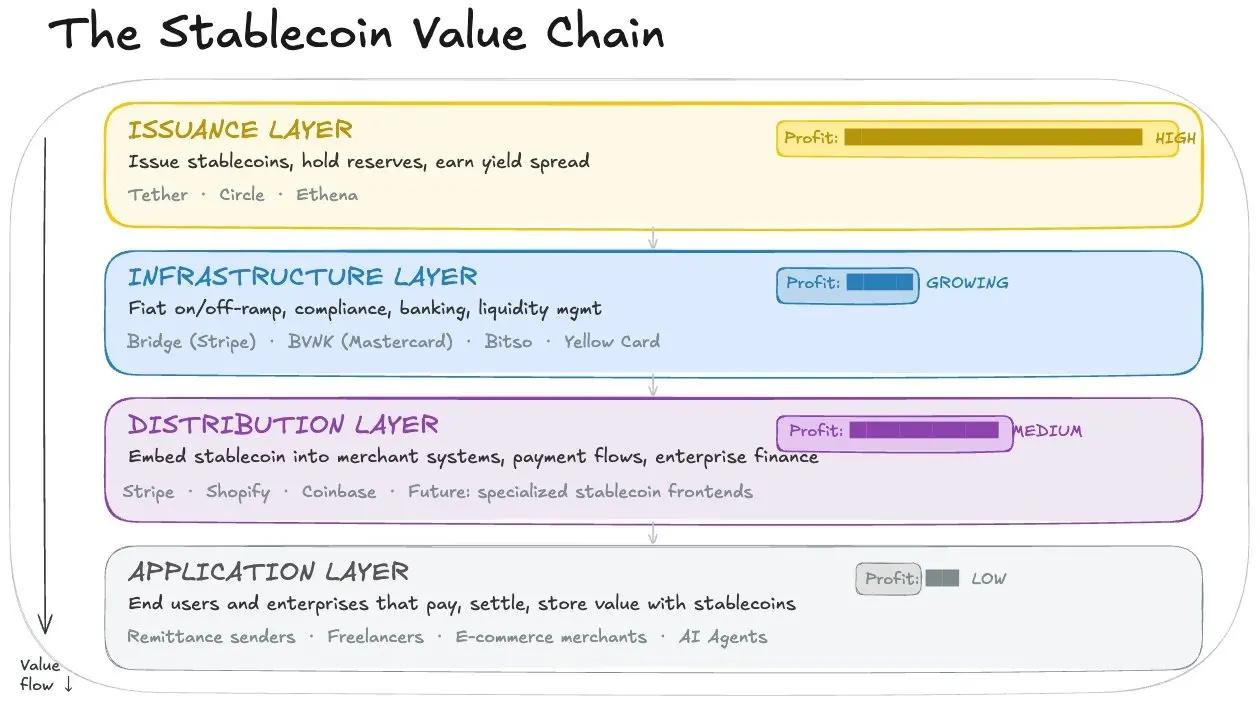
I categorize stablecoins into four layers:

  1. Issuance Layer: Mints stablecoins, holds reserve assets, earns the spread. Representatives: Tether and Circle;
  2. Infrastructure Layer: Connects stablecoins to the real-world financial system—fiat on/off ramps, bank integrations, asset management, compliance. Representatives: Bridge (acquired by Stripe), BVNK (acquired by Mastercard), Bitso, Yellow Card, etc.
  3. Acquiring/Distribution Layer: Embeds stablecoins into merchant systems, manages payment flows, enterprise financial software. Representatives: Stripe, Infini, Coinbase.
  4. Application Layer: End-users and businesses that use stablecoins for payments, settlement, and storage of value.

The Issuance Layer receives user funds and captures the thickest spread; the middle two layers profit from volume, distribution fees, and underlying infrastructure; the Application Layer enjoys convenience but has little bargaining power.

I believe the Infrastructure Layer is currently underappreciated.

It handles the "dirty work": integrating with banks, handling KYC/AML, processing local fiat on/off ramps, connecting merchants, APIs, card networks, and solving settlement and regulatory issues across different countries.

Conversely, this is also where its moat lies. Because technically, transferring USDC on-chain is not the hard part. The real difficulty is penetrating the real world—getting a Latin American company, an African payment provider, or an overseas platform to incorporate stablecoins into their daily cash flows. Someone has to do this dirty work.

The On-Chain Part is Easiest, the Bridge to Reality is Hardest

At first glance, stablecoin payments seem straightforward: fast on-chain transfers, low fees—isn't it just about distributing the product to users?

But the real challenge for stablecoins is the vast gap between the chain and the real-world financial system. Businesses have decision and migration costs; they won't switch their entire workflow just because they heard stablecoins settle in 1 second.

A series of questions arise: How to convert fiat to stablecoins? How to convert back? How to handle reconciliation and taxation? Will the bank block us later? Do users still need to learn how to use a wallet?

The core work of the Infrastructure Layer is bridging the two sides: connecting to the chain and wallets on one end, and to banks, local payment networks, enterprise systems, and compliance on the other.

Stripe's acquisition of Bridge in 2025 bought its stablecoin orchestration system—helping businesses integrate stablecoin capabilities into their operations. Mastercard's announced acquisition of BVNK in March 2026 had similar reasoning.

In other words, traditional payment companies are competing to become the default gateway for businesses using stablecoins.

The key to scaling stablecoin payments lies here.

Paving the Way

Looking further into the Infrastructure Layer:

  1. On/Off Ramps + Currency Exchange. Most business scenarios involve the process "local currency → stablecoin → local currency." This involves banking relationships, compliance, liquidity, and other issues.
  2. API + Account Layer. Businesses need a set of financial capabilities embedded into their workflows—account opening, payments, fund splitting, clearing, reconciliation. This is somewhat like financial SaaS, similar to the Neobank concept.
  3. Payment Network Connectivity. The more payment rails, banks, and regions connected, the more dependent clients become, gradually increasing switching costs.
  4. Capital Efficiency. Helping businesses reduce idle funds, waiting times, and FX losses.

I believe its characteristics dictate a path of initial hardship followed by reward.

  • Grunt Work: It requires connecting banks, achieving compliance, obtaining licenses, and building local teams country by country.
  • Front-loaded Investment to Capture Entry Points: Businesses won't easily switch their payment infrastructure. Those who first secure large clients, banking relationships, compliance pathways, and local fiat rails will later benefit from network effects. Currently, these companies are in a "land grab" phase, far from harvest time.
  • Squeezed by Upstream and Downstream: Upstream issuers take the spread first, while downstream platforms want to control the user interface. The infrastructure layer is in the middle, in an awkward position—"everyone needs you, but no one wants you to earn too much."

Currently, it is in the intermediate stage of moving toward "bargaining power formation."

If we only look at today, the Issuance Layer takes the largest profit, while the Infrastructure Layer is thinner and more capital-intensive.

But if we're talking about how to invest in stablecoins, the seigniorage logic of the Issuance Layer is already well understood by the market, with pricing increasingly revolving around interest rates, regulation, and profit sharing. The Infrastructure Layer is less noticeable today, often simply because it's still in the early investment phase. Bargaining power and user habits haven't fully solidified yet.

Once stablecoins further become the default rails for enterprise funds, the true beneficiaries will be those who, over the years, successfully bridged stablecoins into real-world commercial systems.

Câu hỏi Liên quan

QAccording to the article, how many layers is the stablecoin ecosystem divided into? Name them.

AThe stablecoin ecosystem is divided into four layers: 1. Issuance Layer, 2. Infrastructure Layer, 3. Acquirer/Distribution Layer, and 4. Application Layer.

QWhich layer does the author believe is currently undervalued or underappreciated, and why?

AThe author believes the Infrastructure Layer is currently undervalued. It's considered less glamorous because it involves difficult 'dirty work' like bank integration, KYC/AML, local fiat on/off-ramps, merchant onboarding, and solving cross-border regulatory issues. However, this complexity also creates its moat.

QWhat is the core challenge for enabling widespread stablecoin payment adoption, as described in the article?

AThe core challenge is bridging the gap between the blockchain and the real-world financial system. While moving tokens on-chain is technically simple, the real difficulty lies in integrating stablecoins into business workflows, handling fiat conversions, accounting, tax compliance, and overcoming enterprise decision and switching costs.

QWhat strategic moves by traditional payment companies (Stripe and Mastercard) does the article mention, and what is their goal?

AThe article mentions Stripe's acquisition of Bridge in 2025 and Mastercard's announcement to acquire BVNK in 2026. Their goal is to secure the role of becoming the default gateway/entry point for businesses wanting to integrate stablecoin capabilities into their operations.

QWhat are the three key characteristics of the Infrastructure Layer that make it a 'first bitter, then sweet' business?

A1. It involves hard 'dirty work' requiring country-by-country bank integrations, compliance, licensing, and local team building. 2. It requires significant upfront investment to capture market entry points (clients, banking relationships, compliance paths) before network effects can develop. 3. It is squeezed between the profitable upstream Issuance Layer and the downstream platforms that want to control user access, making its position initially precarious.

Nội dung Liên quan

Đề Xuất Phí Tài Trợ Của XRP Ledger Có Thể Khiến XRP Ít Hiển Thị Hơn Với Một Số Người Dùng

Đề xuất sửa đổi XRPL có tên XLS-68, nằm trong gói sửa đổi xrpld v3.3.0, cho phép các nhà tài trợ chi trả phí giao dịch và khoản dự trữ cho người dùng khác. Điều này có thể cho phép một số tương tác với ví xảy ra mà người dùng cuối không cần trực tiếp nắm giữ XRP. Tính năng này nhằm giảm ma sát khi onboarding người dùng mới và hướng tới trừu tượng hóa phí (fee abstraction), giúp trải nghiệm người dùng đơn giản hơn, đặc biệt có lợi cho các ứng dụng doanh nghiệp và hướng đến người tiêu dùng. Mặc dù điều này có thể khiến XRP ít hiển thị hơn trong một số hành trình của người dùng, nhưng nó không nhất thiết làm giảm nhu cầu đối với XRP. Các nhà tài trợ vẫn cần XRP để tài trợ cho hoạt động, và việc cải thiện trải nghiệm người dùng có thể thu hút nhiều ứng dụng và giao dịch hơn trên mạng lưới, từ đó có thể bù đắp cho việc giảm khả năng hiển thị. Tác động cuối cùng phụ thuộc vào việc áp dụng, hành vi của nhà tài trợ và cách các ứng dụng tích hợp tính năng. Đề xuất hiện cần đạt được sự đồng thuận cần thiết từ các trình xác thực trước khi được kích hoạt.

bitcoinist28 phút trước

Đề Xuất Phí Tài Trợ Của XRP Ledger Có Thể Khiến XRP Ít Hiển Thị Hơn Với Một Số Người Dùng

bitcoinist28 phút trước

Tăng trưởng mạnh mẽ, nâng lãi suất nhẹ nhàng, giá dầu kiểm soát được, thị trường đang định giá một sự hoàn hảo không tồn tại

Thị trường tài chính toàn cầu đang đồng thời định giá kỳ vọng vào tăng trưởng mạnh mẽ, lãi suất tăng nhẹ, cú sốc nguồn cung năng lượng được kiểm soát và giá dầu giảm. Sự kết hợp "hoàn hảo" này có vẻ có lợi cho tài sản rủi ro, nhưng để nó thành hiện thực, hầu như không có chỗ cho sai sót về chính sách, lạm phát và địa chính trị. Các chỉ báo rủi ro như chỉ số chứng khoán Mỹ ở mức cao kỷ lục và chênh lệch tín dụng thấp phản ánh niềm tin vào sức bền của tăng trưởng kinh tế. Tuy nhiên, thị trường lãi suất chỉ định giá mức tăng lãi suất rất hạn chế từ Cục Dự trữ Liên bang (Fed) trong năm tới, mâu thuẫn với dữ liệu lạm phát vẫn còn cao và dự báo tăng trưởng mạnh. Lịch sử cho thấy Fed có thể thắt chặt chính sách mạnh hơn nhiều so với kỳ vọng hiện tại của thị trường nếu tăng trưởng và lạm phát vẫn kiên cường. Trên thị trường dầu mỏ, giá dầu đã giảm so với đỉnh gần đây, nhưng kỳ vọng này dựa nhiều vào việc eo biển Hormuz sẽ sớm thông trở lại – một điều chưa xảy ra. Rủi ro đối với hạ tầng năng lượng, như các cuộc tấn công vào cơ sở lọc dầu, vẫn tồn tại. Giá dầu biến động mạnh trong năm nay cho thấy cú sốc nguồn cung chưa biến mất và rủi ro lạm phát có thể bị đánh giá thấp. Các tín hiệu từ các loại tài sản khác nhau không đồng bộ. Trong khi thị trường chứng khoán và tín dụng phản ánh viễn cảnh "tăng trưởng bền vững, dầu kiểm soát", thì thị trường trái phiếu (lợi suất tăng) dường như vẫn tính đến tác động lâu dài của xung đột và cú sốc năng lượng. Tóm lại, kịch bản hoàn hảo mà thị trường đang định giá đòi hỏi nhiều điều kiện lạc quan phải đồng thời xảy ra: tăng trưởng mạnh từ phía cung, lạm phát giảm, rủi ro địa chính trị hạ nhiệt và nguồn cung năng lượng ổn định. Bài học then chốt là thị trường đang để lại rất ít "khoảng đệm" cho sai lệch. Bất kỳ yếu tố nào trong số này không đạt như kỳ vọng đều có thể khiến nhà đầu tư phải định giá lại hoàn toàn triển vọng tăng trưởng, lãi suất và tài sản rủi ro.

marsbit58 phút trước

Tăng trưởng mạnh mẽ, nâng lãi suất nhẹ nhàng, giá dầu kiểm soát được, thị trường đang định giá một sự hoàn hảo không tồn tại

marsbit58 phút trước

StonkBroker có phải là rồng thứ hai không thể chối cãi của Robinhood Chain?

StonkBroker có thực sự là dự án lớn thứ hai trên Robinhood Chain? StonkBroker (STONKBROKER) đã gây chú ý với mức tăng 9 lần chỉ sau 14 ngày, vốn hóa đạt 1 tỷ USD và bộ sưu tập NFT của nó có giá sàn vượt 13 ETH, cao hơn cả BAYC. Nhiều người coi đây là dự án lớn thứ hai (long nhị) trên Robinhood Chain, sau CASHCAT. Tuy nhiên, phân tích sâu cho thấy phần lớn doanh thu hiện tại của dự án đến từ "Phí giao dịch NFT AMM" và "Phí kích hoạt Broker", vận hành dựa trên một vòng xoáy tăng giá giữa NFT và token. Mô hình này thành công trong việc thu hút sự chú ý và tạo thanh khoản, nhưng về bản chất vẫn giống một hình thức staking thúc đẩy tăng giá kép, chưa phải là doanh thu ổn định từ các sản phẩm cốt lõi đã hoàn thiện như Launchpad. Mặc dù vậy, sự tăng trưởng mạnh mẽ cho thấy đội ngũ phía sau có năng lực và cộng đồng có độ gắn kết. Dự án sắp ra mắt Launchpad chính thức với token $CLOCKIN, và kết quả của nó sẽ tác động lớn đến hiệu suất của token chính STONKBROKER. Tóm lại, việc khẳng định StonkBroker là long nhị còn hơi sớm. Tương lai của nó phụ thuộc vào khả năng tạo ra lợi nhuận thực sự cho người dùng và cạnh tranh thị phần khi các sản phẩm như Launchpad đi vào hoạt động. Nhà đầu tư nên thận trọng quan sát sự phát triển của các dự án con (như $CLOCKIN) và cân nhắc kỹ rủi ro cũng như tỷ lệ cược trước khi đưa ra quyết định.

marsbit1 giờ trước

StonkBroker có phải là rồng thứ hai không thể chối cãi của Robinhood Chain?

marsbit1 giờ trước

Giao dịch

Giao ngay
活动图片