The History of U.S. Stocks is, Behind It, a History of American Wars

marsbitXuất bản vào 2026-05-08Cập nhật gần nhất vào 2026-05-08

Tóm tắt

The article argues that the history of the U.S. stock market is deeply intertwined with American military conflicts. While current Middle East tensions raise economic concerns, major indices like the S&P 500 and Nasdaq continue hitting new highs. Historical analysis shows U.S. wars, from the Spanish-American War to recent conflicts in the Middle East, have often coincided with market gains, as seen in the Dow Jones's performance during these periods. The U.S. transitioned from a war participant to an initiator, with most conflicts post-Vietnam being short, focused on oil, and achieving strategic goals. The market's reaction to war has evolved. Pre-1950s, investor sentiment directly drove swings based on battle outcomes. From the Korean War onward, the focus shifted to economic channels like inflation, oil prices, and fiscal policy. For instance, during the Gulf War, stock movements inversely correlated with oil price swings. The primary beneficiary industries have also changed: coal dominated WWII, oil surged during Korea and Vietnam, but by the Gulf War, the indirect economic impact made consumer staples outperform. Overall, as the U.S. economy grew, the direct market impact of individual wars diminished, giving way to broader macroeconomic factors like interest rates and deficits as the key drivers.

Written by: Li Jia

Source: Wall Street News

When cannons roar, gold pours in. Just as the market is hotly debating whether Middle East conflicts will drag down the global economy, the S&P 500 and Nasdaq indices have both hit new record highs. What exactly does war mean for U.S. stocks?

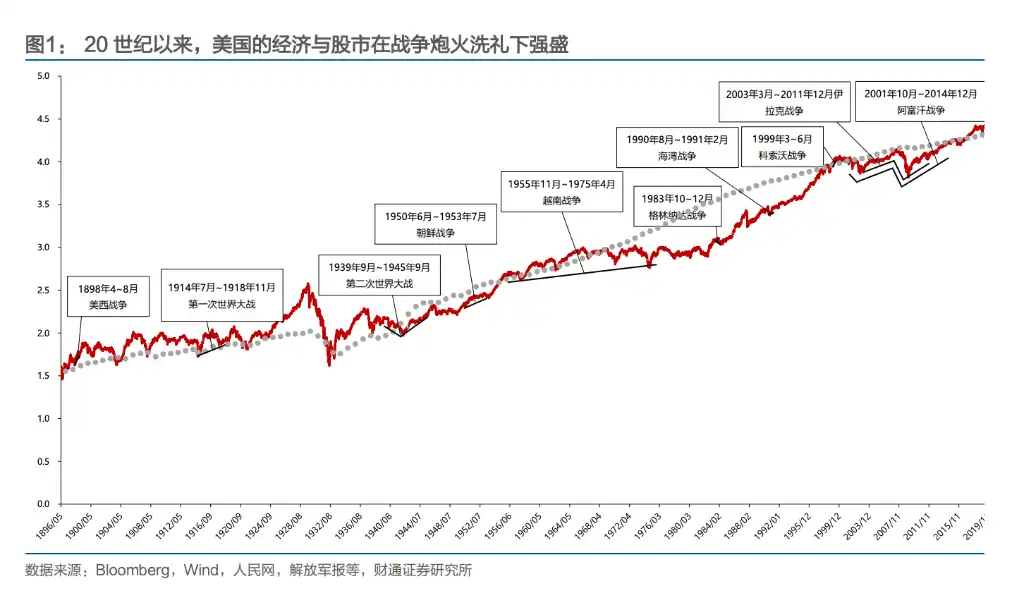
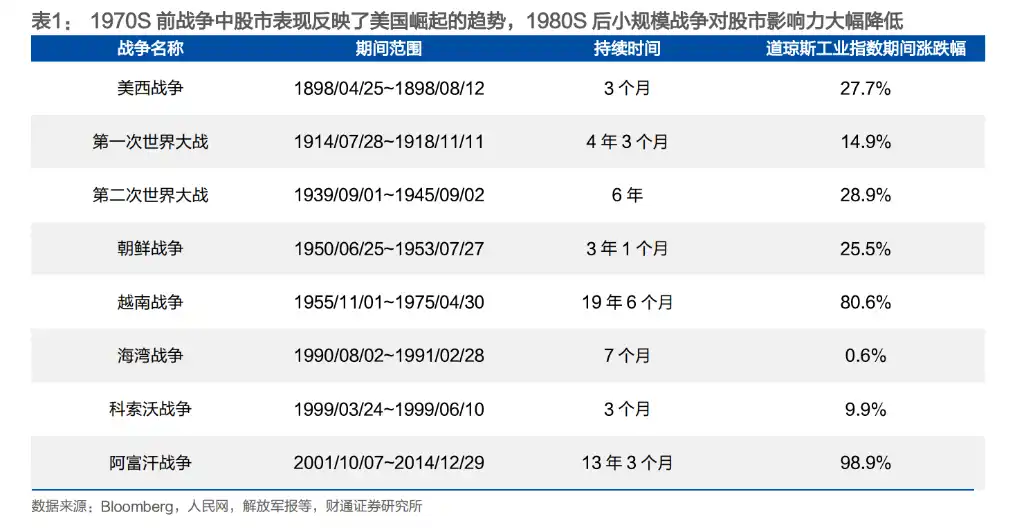
A report from Caitong Securities provides a straightforward answer: War and the long-term bull market in U.S. stocks are not opposites but rather symbiotic. The historical performance of the Dow Jones Industrial Average confirms this—it rose 28% during the Spanish-American War, 26% during the Korean War, and still gained over 80% during the 19-year Vietnam War, while nearly doubling during the Afghanistan War, which spanned the period around the 2008 financial crisis.

Since becoming the world's largest economy at the end of the 19th century, the U.S. has gained substantial benefits from most wars it fought, except for the Vietnam War. From seizing Spanish colonies in the Spanish-American War to profiting handsomely from the two World Wars, and further to the Gulf War and subsequent smaller-scale conflicts centered around oil resources, the U.S. completed its transformation from a 'war participant' to a 'war initiator.'

The reaction path of U.S. stocks amid the sound of gunfire is also clear: During WWII and earlier wars, the market was primarily impacted through sentiment shocks. Starting with the Korean War, this direct effect gradually weakened, and wars increasingly transmitted their impact to the stock market through economic channels like inflation, oil prices, and fiscal deficits.

The Vietnam War was the only war where the U.S. suffered a 'loss,' and it profoundly rewrote its war logic. Since then, almost every conflict initiated by the U.S. has shared three characteristics: short duration, limited geographic scope, and a focus on oil—with all ultimately achieving their objectives.
From 'Taking Advantage of a Fire' to Initiating Trouble: The Three Shifts in American War Strategy

The 1898 Spanish-American War was the first major war actively initiated by the U.S. At that time, domestic monopoly conglomerates urgently needed new markets, investment venues, and sources of raw materials, and Spain's crumbling colonial empire became the ideal target. After the war, the U.S. gained control over Cuba and acquired the Philippine Islands, Guam, and Puerto Rico. The Dow Jones Industrial Average rose 28% during the three-month war, in sync with victories on the main battlefields.

When World War I broke out, the U.S. initially remained neutral. During the market closure in July 1914, investors realized America would become the biggest beneficiary of the European conflict—its homeland, far from the battlefield, could continue production and export arms to Europe. By 1917, American banks, including J.P. Morgan, had provided $10 billion in loans to the British and French governments for purchasing weapons. Although the index fell nearly 10% after the official entry into the war in April 1917, the industrial index had already risen approximately 107% from its low in 1914 to March 1917.

World War II was the crucial conflict that established the U.S. as a global hegemon. At the outbreak in September 1939, U.S. stocks initially fell due to suppressed corporate earnings expectations from the 'excess profits tax'—Congress imposed a tiered tax of up to 95% on profits exceeding $5,000, severely dampening the numerator in the Dividend Discount Model (DDM). It wasn't until the Battle of the Coral Sea and the Battle of Midway in May 1942 turned the tide of war that investors keenly sensed the war's direction, leading U.S. stocks to bottom out and rebound ahead of time. The industrial index rose 82% in the latter half of the war, the transportation index rose 127%, and the utilities index surged 203%.

The Korean War was the first war the U.S. 'did not win.' Although military demand stimulated the post-WWII sluggish economy, the U.S. military failed to achieve its stated objectives. Nonetheless, the Dow Jones Industrial Average still rose 26% throughout the entire period, with the transportation index soaring 86%.

The Vietnam War became a watershed; it was the only war where the U.S. was defeated and gained no benefits.

The U.S. defense budget skyrocketed from $49.6 billion in 1961 to $81.9 billion in 1968 (43.3% of the federal budget), the fiscal deficit ballooned from $3.7 billion to $25 billion, and inflation rose from 1.5% to 4.7%. The U.S. share of the world's total GDP fell from 34% to less than 30%. Post-war, U.S. war strategy shifted completely: it abandoned large-scale ground wars in favor of short-duration, low-casualty, air-strike-centric 'proxy-style' conflicts.

Subsequent wars—the Gulf War, Kosovo War, Afghanistan War, and Iraq War—were all without exception initiated by the U.S., leveraging local conflicts or black swan events. The war zones were mainly concentrated in the Middle East and the Balkans, with the core objectives revolving around oil resource control and military demand.
The Transmission of War to the Stock Market Has Changed: From Sentiment-Driven to Economy-Driven

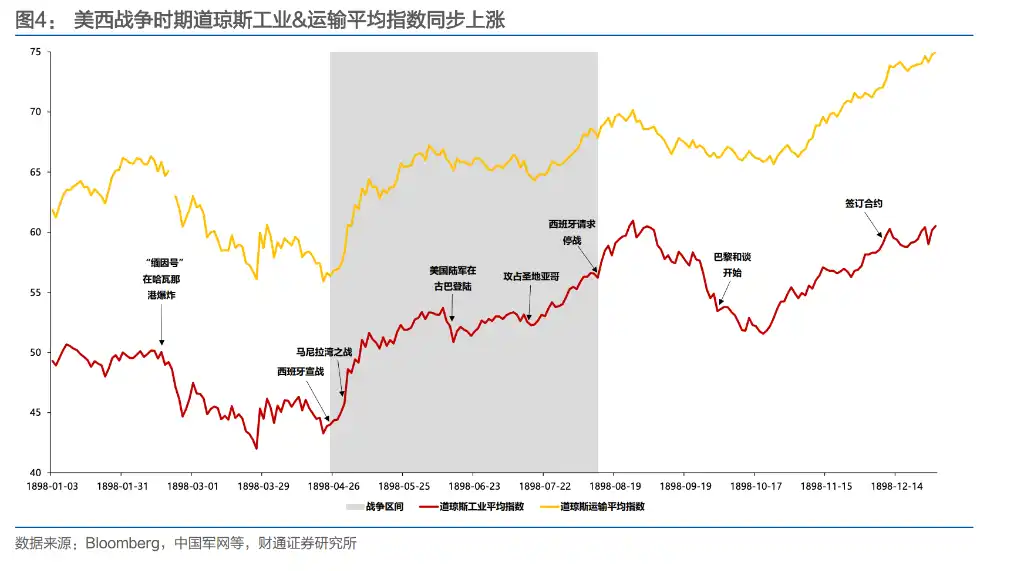
During WWII and earlier, war events often directly impacted investor sentiment. During the Spanish-American War, victories at the Battle of Manila Bay and the Battle of Santiago de Cuba each drove the index up by about 10% within ten days. In contrast, news of the U.S. entering the two World Wars often triggered panic selling.
But starting with the Korean War, this direct impact gradually faded. From November 1950 to February 1951, despite successive retreats by UN and U.S. forces, the U.S. stock market continued to rise—the reason being that the post-WWII stagnant economy restarted during the Korean War: U.S. real GDP grew about 8.7% in 1950 and remained above 8% in 1951. The fiscal expansion brought by the war, in turn, became a catalyst for economic recovery.

This shift became even more pronounced during the Vietnam War. The Battle of Ia Drang in November 1965 (the first large-scale battle for U.S. troops in Vietnam) did not cause a significant market shock; the 'Tet Offensive' launched by North Vietnam in early 1968 also failed to stop U.S. stocks from reaching new highs. What truly drove the market was instead the Federal Reserve tightening credit conditions in 1966 in response to Vietnam War expenditures, along with the two economic recessions of 1969-1970 and 1973-1975. War sentiment had given way to macroeconomic policy and corporate earnings.

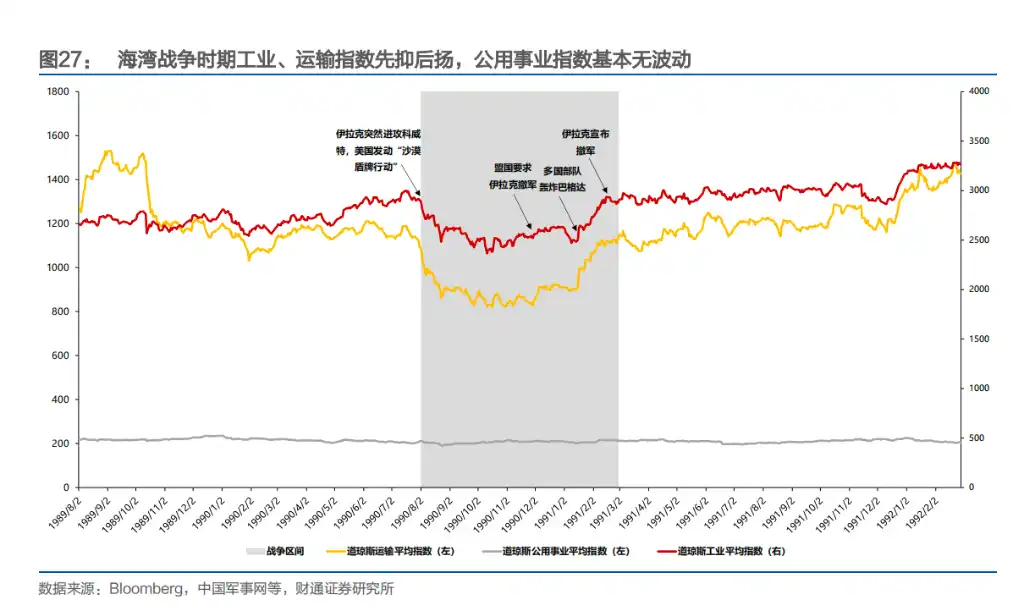
The Gulf War provides the clearest case of 'economic transmission.' After Iraq's invasion of Kuwait in August 1990, oil prices surged, and the market anticipated a U.S. economic recession, pushing S&P 500 valuations to a bottom. When coalition forces bombed Baghdad in January 1991, oil prices fell back to pre-war levels, and the stock market rebounded in sync. During the war, the Dow and crude oil prices moved almost perfectly inversely—the market was trading the trade-off between inflation and growth.

The 2001 Afghanistan War and the 2003 Iraq War further validated this pattern. The most symbolic moment was perhaps the killing of Osama bin Laden in May 2011—arguably the most breakthrough moment in the Afghanistan War. The next day, the Dow fell a mere 0.02%, and the S&P 500 declined 0.18%. The market almost completely ignored the news.

In summary, the reaction of U.S. stocks to war has undergone a clear evolution path: shifting from 'sentiment dominance' to 'economic transmission.' Early wars directly shook the market through news of victories and defeats, but since the Korean War, the stock market has increasingly focused on real economic variables like fiscal expansion, inflation expectations, oil price volatility, and monetary policy.

War itself is no longer the reason for rises or falls; how war affects growth and costs is what the market truly prices.

Which Industry Profits from War? The Answer is Changing

During WWII, coal was the lifeblood of war. Bituminous coal's share rose from 43.8% pre-war to 48.9%, and the industry cumulatively rose 415%.

During the Korean War, oil took over as the new protagonist. Crude oil extraction and refining took the top two spots for gains, with profits climbing continuously from mid-1950 to the first half of 1952. During the Vietnam War, the collapse of the Bretton Woods system forced the U.S. dollar to depreciate, and OPEC was allowed to raise prices to compensate for losses. The oil extraction industry exploded during the dollar crisis from late 1970 to early 1973, surging a staggering 1378% throughout the war.

The Kosovo War continued this pattern, with raw materials and energy industries performing best.

The Gulf War is the only exception—the transmission path shifted to the indirect mode of 'oil price → economic expectations,' making consumer staples and health industries advantageous in the short term, while energy, raw materials, industrials, and other heavy-asset sectors performed the worst.

A notable trend is: As the U.S. economy's size has expanded, the defense industry has transformed from a growth engine into a fundamental part of the economy. The marginal contribution of any single war to the overall economy has been declining, and the driving force for the stock market has increasingly shifted to macroeconomic variables like inflation, interest rates, and fiscal deficits.


Câu hỏi Liên quan

QAccording to the article, how has the relationship between war and the U.S. stock market evolved over time?

AThe relationship has evolved from one where war directly impacted the market through sentiment (e.g., WWII and earlier), to one where its influence is transmitted indirectly through economic channels like inflation, oil prices, and fiscal deficits (e.g., from the Korean War onwards). The market now prices how war affects growth and costs, not the war events themselves.

QWhat was the turning point in U.S. war strategy according to the analysis, and what were its key features?

AThe Vietnam War was the turning point. It was the only war the U.S. lost and gained no benefit from. Post-Vietnam, U.S. strategy shifted to conflicts characterized by being short in duration, small in scale, and centered around oil resources, often fought through proxies or with air power dominance.

QWhich sector benefited the most during World War II, and how did the leading sector change in subsequent major conflicts?

ADuring World War II, the coal industry benefited the most, with its share of production rising significantly. In subsequent conflicts, the leading sector shifted: petroleum took the lead during the Korean and Vietnam Wars. However, the Gulf War was an exception, where consumer staples and healthcare performed better due to the indirect economic transmission via oil prices.

QHow did the U.S. stock market react to key battlefield victories in early wars versus significant events in modern wars, such as the killing of Osama bin Laden?

AIn early wars like the Spanish-American War, key battlefield victories (e.g., Manila Bay) caused immediate and significant stock market rallies (~10% in 10 days). In contrast, modern wars show a muted direct reaction. For example, the killing of Osama bin Laden in 2011 resulted in only minor daily movements in major indices, indicating the market had become largely indifferent to such event-driven war news.

QWhat role did World War I and World War II play in America's rise to global economic dominance, according to the article?

AWorld War I allowed the initially neutral U.S. to profit massively by producing and exporting arms and supplies to European allies, with banks providing huge loans. World War II was the key conflict that cemented America's global霸主 (hegemony) status. Although initial war taxes suppressed corporate profits, the market rebounded strongly after pivotal battles turned the tide, and the war effort ultimately solidified the U.S. as the world's leading economic and military power.

Nội dung Liên quan

AI Trung chuyển gây tranh luận sôi nổi trên Zhihu: Đằng sau Token rẻ, người dùng thực sự lo lắng điều gì?

Một cuộc thảo luận trên Zhihu về "trạm trung chuyển AI" đã đưa chủ đề "Token giá rẻ" ra trước đông đảo người dùng, vượt khỏi phạm vi nhà phát triển. Cuộc thảo luận tập trung vào những lo ngại thực tế hơn là việc phán xét tính hợp pháp. Người dùng quan tâm hàng đầu tới tính xác thực của mô hình: liệu tên mô hình họ gọi có thực sự là mô hình đó hay đã bị "đánh tráo" thành phiên bản rẻ hơn, do nguồn cung token giá rẻ thường không minh bạch. Điều này tạo ra giao dịch thiếu cân bằng thông tin. Về chi phí, giá rẻ của trạm trung chuyển thường được so sánh với API chính thức tính theo lượng dùng, nhưng có thể không rẻ hơn gói đăng ký chính thức, mô hình trong nước hay hạn mức miễn phí. Người dùng cần xác định nhu cầu thực tế của mình trước. Nguồn gốc token giá rẻ được chỉ ra có thể từ kênh hợp pháp (mua số lượng lớn, tối ưu định tuyến) đến các kênh xám (chia sẻ tài khoản, lợi dụng chênh lệch giá, thẻ gian lận). Điều này làm tăng chi phí tin cậy, bao gồm rủi ro về tính ổn định dịch vụ và số dư tài khoản. Rủi ro an ninh dữ liệu là mối lo ngại lớn, đặc biệt khi xử lý mã nguồn, tài liệu kinh doanh hay thông tin khách hàng nhạy cảm. Trong các kịch bản Agent, rủi ro có thể leo thang từ "câu trả lời sai" sang "thực thi sai lệnh". Cuộc thảo luận đi đến đồng thuận chung: có thể sử dụng trạm trung chuyển cho các nhiệm vụ ít nhạy cảm, thay thế được, nhưng không nên coi đó là lựa chọn mặc định. Các khuyến nghị bao gồm: không nạp số tiền lớn, không ràng buộc toàn bộ quy trình làm việc, giữ đường dự phòng, kiểm tra chất lượng mô hình định kỳ và tuyệt đối không kết nối vào môi trường sản xuất của doanh nghiệp. Bài học cốt lõi là chi phí thực sự của việc sử dụng AI không chỉ nằm ở giá token, mà còn ở sự tin cậy, an toàn dữ liệu và trách nhiệm giải trình.

marsbit18 phút trước

AI Trung chuyển gây tranh luận sôi nổi trên Zhihu: Đằng sau Token rẻ, người dùng thực sự lo lắng điều gì?

marsbit18 phút trước

Hiệp hội Blockchain Thúc giục Thượng viện Thông qua Đạo luật CLARITY với Lá thư được Hỗ trợ bởi 160 Cựu Quan chức

Hiệp hội Blockchain, một trong những nhóm vận động hàng đầu ngành, đã gửi thư tới lãnh đạo Thượng viện Mỹ, thúc giục thông qua Đạo luật CLARITY. Thư có chữ ký của 160 cựu chuyên gia an ninh, tình báo và thực thi pháp luật. Các bên ký tên cho rằng thiếu khuôn khổ pháp lý rõ ràng sẽ đẩy hoạt động tiền mã hóa ra nước ngoài, gây khó khăn cho việc điều tra tội phạm tài chính. Đạo luật CLARITY nhằm tăng cường năng lực thực thi pháp luật và ngăn ngừa tội phạm tài chính trong lĩnh vực tài sản số. Các biện pháp chính bao gồm: củng cố nghĩa vụ chống tài chính bất hợp pháp (mở rộng yêu cầu theo Đạo luật Bảo mật Ngân hàng và luật trừng phạt), tăng cường chia sẻ thông tin giữa Bộ Tài chính, Bộ Tư pháp, FBI, DEA và khu vực tư nhân, cũng như tăng cường bảo vệ cho các máy giao dịch tài sản số (kiosk) thông qua giám sát giao dịch, báo cáo, hạn mức và các quy định chống gian lận. Hiệp hội nhấn mạnh đây là các biện pháp tăng cường thực thi, không phải bãi bỏ quy định. Một cuộc họp thị trấn trực tuyến sẽ được tổ chức để thảo luận về lợi ích của dự luật đối với thực thi pháp luật và an ninh quốc gia. Dự luật đã được Ủy ban Nông nghiệp Thượng viện thông qua một phần vào tháng 1 và dự kiến được đưa ra biểu quyết toàn thể tại Thượng viện vào mùa hè này. Tuy nhiên, nếu thông qua, nó vẫn cần được Hạ viện phê chuẩn, và có thể cần phải điều chỉnh để phù hợp với phiên bản đã được Hạ viện thông qua vào mùa thu năm ngoái.

bitcoinist30 phút trước

Hiệp hội Blockchain Thúc giục Thượng viện Thông qua Đạo luật CLARITY với Lá thư được Hỗ trợ bởi 160 Cựu Quan chức

bitcoinist30 phút trước

ByteDance Dùng CPU Arm, Ông Hoàng Nhân Huân: Đáng Tiếc Không Mua Được Arm

Bài báo đưa tin từ sự kiện Computex 2026, nơi CEO của Arm, Rene Haas, thông báo rằng ByteDance (TikTok) và Oracle đã áp dụng chip CPU dành cho trung tâm dữ liệu do Arm tự nghiên cứu, tên là Arm AGI. Arm đã tăng gấp đôi kỳ vọng về nhu cầu đối với CPU này, dự kiến đạt doanh thu 20 tỷ USD vào các năm tài chính 2027-2028 và 150 tỷ USD hàng năm trong khoảng 5 năm. Haas cũng chia sẻ quan điểm rằng việc Mỹ ngăn cản xuất khẩu CPU AI sang Trung Quốc là gần như không thể. Trong một cuộc đối thoại thú vị, CEO NVIDIA, Jensen Huang, đã tham gia và bày tỏ sự tiếc nuối khi NVIDIA không thể mua lại Arm trước đây. Ông cũng giải thích lý do đằng sau việc NVIDIA phát triển siêu chip RTX Spark dựa trên kiến trúc Arm, nhấn mạnh nhu cầu về CPU mạnh mẽ cho các tác nhân AI (AI agent) chạy cục bộ trên PC. Huang dự đoán ngành công nghiệp máy tính có thể mở rộng gấp mười lần nhờ sự phát triển của các tác nhân AI tự chủ. Bài báo cũng đề cập đến những tiến bộ của Arm trong lĩnh vực chip PC và CPU cho trung tâm dữ liệu. Nhiều đối tác lớn như OpenAI, Meta, Google và Microsoft đang sử dụng hoặc hợp tác với Arm. Haas đã công bố lộ trình phát triển cho các thế hệ CPU Arm AGI tiếp theo, khẳng định cam kết lâu dài trong việc tự sản xuất chip. Kết luận chỉ ra rằng sự bùng nổ của các tác nhân AI đang dịch chuyển sự chú ý trong cuộc đua sức mạnh tính toán sang CPU, thúc đẩy xu hướng tích hợp theo chiều dọc trong ngành công nghiệp bán dẫn, nơi hiệu quả năng lượng trở thành yếu tố cạnh tranh chính.

marsbit1 giờ trước

ByteDance Dùng CPU Arm, Ông Hoàng Nhân Huân: Đáng Tiếc Không Mua Được Arm

marsbit1 giờ trước

Hướng dẫn Q3 của Broadcom thấp hơn kỳ vọng 1,2 tỷ USD, giá cổ phiếu giảm hơn 13% sau giờ giao dịch, câu chuyện AI đang 'hạ nhiệt'?

Tóm tắt báo cáo kết quả kinh doanh Q2/2026 và dự báo Q3 của Broadcom Broadcom đã công bố kết quả kinh doanh quý 2 năm tài chính 2026 với doanh thu 221,9 tỷ USD, tăng 48%, trong đó doanh thu bán dẫn AI đạt 108 tỷ USD, tăng 143%, và đây là quý tăng trưởng thứ 13 liên tiếp cho phân khúc này. Lợi nhuận điều chỉnh EBITDA đạt mức kỷ lục 152 tỷ USD. Tuy nhiên, dự báo của công ty cho quý 3 đã khiến thị trường thất vọng. Mặc dù dự kiến tổng doanh thu đạt 294 tỷ USD (vượt kỳ vọng), doanh thu bán dẫn AI được hướng dẫn chỉ ở mức 160 tỷ USD, thấp hơn khoảng 7% so với kỳ vọng chung của các nhà phân tích (172 tỷ USD). CEO Hock Tan cũng không nâng dự báo doanh thu bán dẫn AI cho cả năm tài chính 2026, vẫn giữ ở mức hơn 1000 tỷ USD. Đặc biệt, ông Tan cho biết tỷ trọng doanh thu từ mạng AI trong doanh thu bán dẫn AI, hiện ở mức gần 40%, dự kiến sẽ trở về mức ~30% trong tương lai. Tuyên bố này có thể tạo ra áp lực định giá lại đối với các công ty con ngành quang học (như Zhongji Innolight, Eoptolink) vốn được định giá cao dựa trên kỳ vọng tăng trưởng liên tục của phân khúc mạng. Phản ứng thị trường rất tiêu cực. Cổ phiếu AVGO của Broadcom lao dốc hơn 13% trong giao dịch ngoài giờ, làm bốc hơi hơn 2700 tỷ USD vốn hóa thị trường. Hiệu ứng lan tỏa khiến cổ phiếu Marvell và một số công ty trong lĩnh vực kết nối AI khác cũng giảm theo. Sự sụt giảm này được cho là do việc chốt lời sau một đợt tăng mạnh trước đó và định giá cao (PE ~90 lần) so với mặt bằng ngành. Dù vậy, lãnh đạo Broadcom vẫn khẳng định nhu cầu chip AI "khó có thể được đáp ứng đầy đủ" và giữ vững tầm nhìn dài hạn. Đợt điều chỉnh này là điểm chuyển giao câu chuyện AI hay chỉ là đợt chốt lời thông thường sẽ cần được theo dõi thông qua các động thái chi tiêu vốn tiếp theo của các nhà cung cấp dịch vụ đám mây quy mô lớn.

marsbit1 giờ trước

Hướng dẫn Q3 của Broadcom thấp hơn kỳ vọng 1,2 tỷ USD, giá cổ phiếu giảm hơn 13% sau giờ giao dịch, câu chuyện AI đang 'hạ nhiệt'?

marsbit1 giờ trước

Giao dịch

Giao ngay
Hợp đồng Tương lai
活动图片




