Written by: Ryan Weeks, Todd Gillespie, Annie Massa, Bloomberg
Compiled by: Luffy, Foresight News
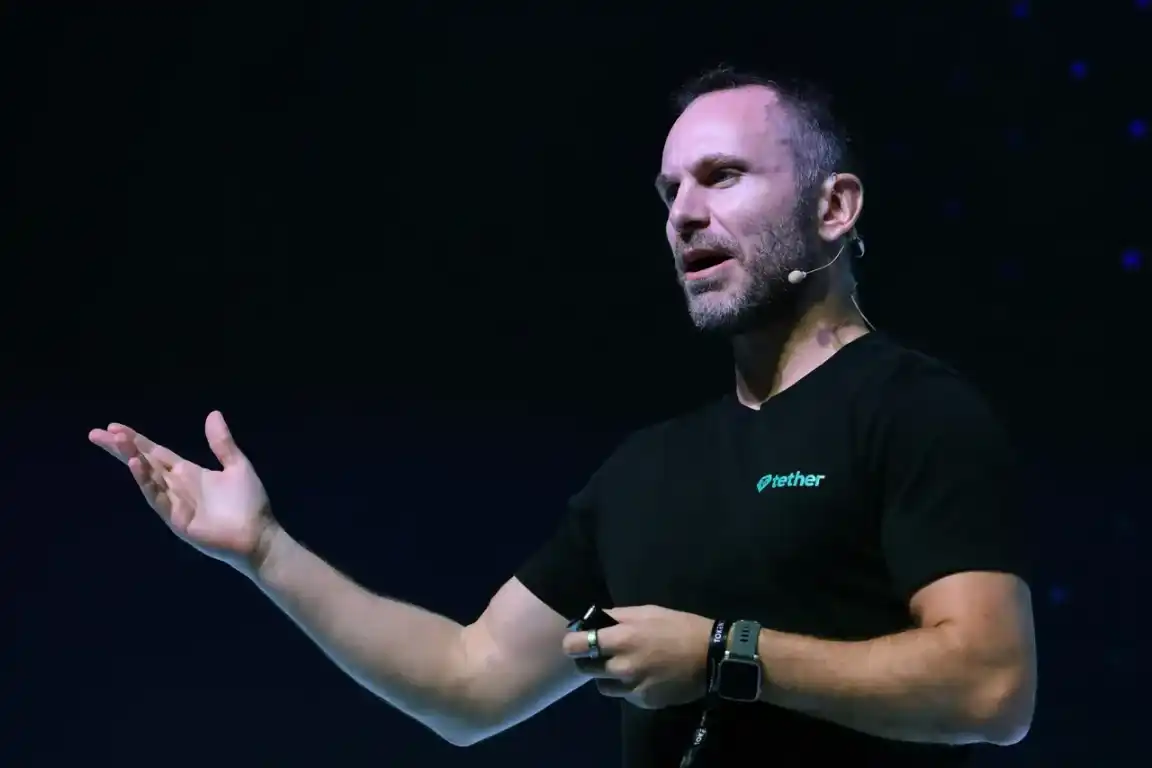
In a dimly lit hotel banquet hall in San Salvador, the capital of El Salvador, billionaire Paolo Ardoino, CEO of Tether Holdings SA, delivered a series of grim predictions. Against a backdrop of storm clouds, he prophesied global geopolitical chaos, the collapse of monetary systems, and societal breakdown. Ardoino stated that Tether is preparing for this impending "apocalypse."
In reality, the company behind the world's most popular stablecoin is in a period of rapid expansion. As a "digital dollar," USDT underpins global cryptocurrency trading and capital flows. Tether reported profits exceeding $10 billion last year—a staggering return for a company with just 300 employees—and is quickly using its cash to invest in and acquire stakes in various businesses worldwide. With Trump's return to the White House, the company now has formal access to the world's wealthiest and most mature financial market.
Ardoino said in an interview with Bloomberg News during a conference in San Salvador in January: "Tether is almost like a combination of Google and BlackRock. We have a massive financial arm capable of creating a truly positive impact." Tether moved its global headquarters to this Central American capital city last year.
Now, Ardoino is placing the United States at the core of his expansion plans, backed by allies of the Trump administration, including Commerce Secretary Howard Lutnick, a long-time banking partner of Tether whose family business also holds a stake in the company. In January, Tether launched a new stablecoin for the U.S. market and intensified its lobbying efforts in Washington. The company is also attracting investors globally, aiming for a valuation of $500 billion, which would place it among the world's most highly valued private companies.
This marks a stunning reversal of fortune. According to Bloomberg News, during President Biden's term, Tether was a target of federal authorities. Since 2021, its flagship token USDT and associated exchange Bitfinex have been banned from operating in New York.
Critics argue that USDT's popularity in underground criminal activities remains undiminished, and the expanding conflict in the Middle East has once again highlighted its prevalence within Iran's Islamic Revolutionary Guard Corps. Despite widespread financial sanctions against Iran, USDT remains the backbone of its thriving crypto economy. In January, a case study by research firm TRM Labs detailed how the IRGC processed approximately $1 billion in cryptocurrency transactions between 2023 and 2025, with "the vast majority conducted using USDT."
Tether said in a statement: "Tether places a high priority on combating fraud, consumer harm, and the misuse of USDT, maintaining a zero-tolerance policy towards illegal activities." The company added that it cooperates with law enforcement agencies worldwide and has frozen about $4 billion worth of USDT at the request of authorities.
Nearly half of that was blacklisted at the request of the U.S. government, which has publicly acknowledged Tether's cooperation. By pausing regulatory actions and pardoning crypto fraudsters, the U.S. government has also signaled that the pressure on the crypto industry has significantly eased.
Meanwhile, driven by Tether, its peers, and Treasury Secretary Scott Bessent, U.S. lawmakers are accelerating legislation to encourage the adoption of stablecoins. Bessent stated in a hearing that demand for dollar-pegged stablecoins would boost demand for U.S. Treasuries, thereby lowering U.S. borrowing costs. According to The New York Times, Tether also plans to support a new political spending group ahead of the midterm elections this year and can participate through its newly established U.S. subsidiary. An entity calling itself "Tether America" has signed on as a donor to a Trump White House banquet hall project.
Beyond the doomsday prophecies and political maneuvering, Tether's transactions and fundraising efforts have raised new questions about the fundamental details of its business model. The company has not fully disclosed its investment portfolio—which now includes over 140 investments and is considered core to its business strategy. According to people familiar with the matter, Tether provided more financial data to potential investors after they requested greater transparency in a recent funding round.
Bloomberg has identified more than twenty companies in Tether's expanding investment portfolio through public documents and statements. Many are concentrated in the crypto and payments industries; others (including Tether's largest publicly disclosed investments to date) extend its reach into commodities, media, artificial intelligence, energy, and other sectors.
According to a Bloomberg report on Thursday, the company's investment chief, Richard Heathcote, the primary architect of its vast portfolio, is soon to hand over his responsibilities to a deputy. Heathcote, a former broker at Cantor Fitzgerald's BGC Group, played a key role in fostering Tether's relationship with the investment bank, which has been run by the Lutnick family for decades.
Despite years of promises for a full audit, Tether has yet to release one. Accounting firm BDO provides quarterly attestations of the assets backing USDT. Last week, Deloitte completed certification of the first reserve report for Anchorage Digital Bank, which is responsible for issuing Tether's new token for the U.S. market, USAT.
Tether has told investors it aims to complete a full audit by the end of 2026, according to people familiar with the matter. Ardoino said the company is in talks with Big Four accounting firms: "I won't make promises, but this is an extremely high priority, and it's progressing very well."
He may have no choice. Last month, Democratic Senator Jack Reed specifically named Tether in proposing a new bill that would require foreign issuers of dollar-backed stablecoins to undergo audits. Arthur Wilmarth, an emeritus professor of law at George Washington University who has long studied the potential systemic risks of stablecoins, said: "I'm not sure anyone knows the full extent of Tether's exposures. The key point is that much of this information is not transparent; it's hidden."
While Ardoino stood in the spotlight at the event in El Salvador, his U.S. business chief, Bo Hines, kept a low profile. After the event, the 30-year-old former football player and former White House crypto advisor boarded a private jet back to Charlotte, North Carolina, where he is building Tether's U.S. headquarters.
Hines, along with former PayPal lobbyist Jesse Spiro, is responsible for promoting Tether in the U.S. Its new token, USAT, is designed to maintain a stable value of $1 while complying with a law passed in 2025 that requires U.S.-issued stablecoins to be backed by short-term Treasuries and imposes stricter regulations on marketing and compliance.

In emerging markets, Tether users typically seek access to dollars or a fast, low-cost way to transfer money domestically and internationally. But in the U.S., stablecoins are more likely to gain traction in everyday commerce as a tool to avoid the fees and delays associated with banks and credit cards. Proponents say this can save costs for merchants and users, while skeptics worry about the lack of safeguards and the irreversible nature of the transactions.
Tether also sees the U.S. as fertile ground for future investments. In his keynote speech in El Salvador, Ardoino highlighted the company's stake in the popular video platform Rumble, calling it a "real-world case for defending the truth." The company plans to integrate its stablecoin to facilitate payments for Rumble's millions of monthly users.
"We are now investing in other platforms in the U.S.," Ardoino said. He declined to specify target assets but added that the goal is to add millions more monthly active users to U.S. digital platforms, laying the foundation for USAT to become an "inter-platform payment system."
As the company pivots its business towards the U.S., it is clearly hedging its bets in both directions. In Ardoino's most extreme vision of the future, the dollar loses its dominance—but Tether survives thanks to its growing footprint and holdings of gold and Bitcoin. Of course, another possibility is that the dollar remains the global reserve currency for the foreseeable future, in which case Tether's strong U.S. operations and political influence would be an advantage.
Tether's fate is already more tangibly tied to the United States. The company has become one of the largest holders of U.S. Treasury debt. According to its latest disclosure, 63% of its $193 billion in reserves at year-end were U.S. Treasuries. Tether claims to be the 17th largest holder of U.S. debt and the largest non-sovereign holder—a fact that makes some policymakers uneasy.
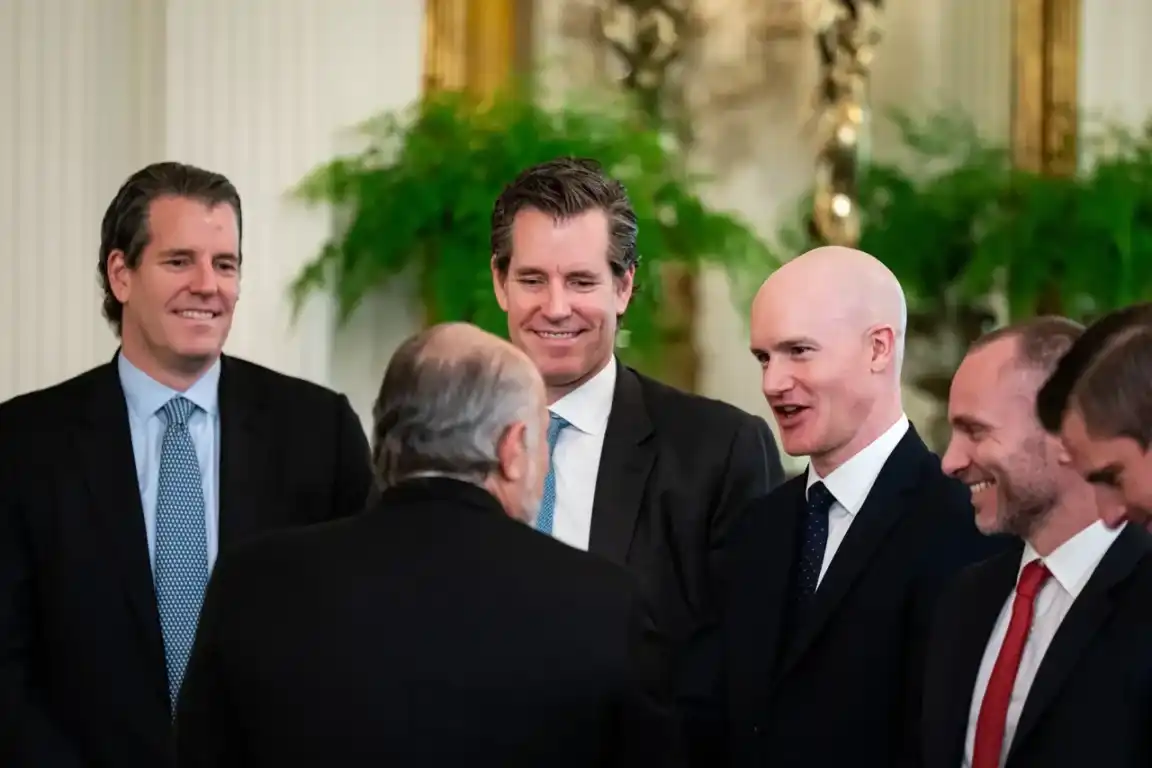
July 2025: Paolo Ardoino and Commerce Secretary Lutnick converse with Gemini's Winklevoss twins and Coinbase's Brian Armstrong at a cryptocurrency legislation signing ceremony at the White House.
Carole House, former Special Advisor for Cybersecurity and Critical Infrastructure Policy at the White House National Security Council during the Biden administration, said: "Reportedly, Tether holds over $100 billion in U.S. Treasuries, making it one of the largest holders globally, yet it is not subject to the direct regulation we impose on domestic institutions of comparable size."
The income from these Treasuries funds Tether's recent investment deals. According to one person familiar with the matter, potential investors have asked the company about the impact of falling interest rates. The person added that Tether believes that for every 25 basis points the Federal Reserve cuts rates, it would need to issue an additional $10 billion in tokens to maintain the same level of profit.
Meanwhile, a host of competitors has emerged in the U.S. market, and overall demand for USDT and other stablecoins has plateaued in recent months, in line with the broader crypto market downturn. The International Monetary Fund warned in 2025 that a stablecoin run could trigger a sell-off in the Treasury market.
Nonetheless, Tether's deep pockets have been welcomed by new banking partners beyond the Lutnick family's Cantor Fitzgerald. Morgan Stanley, Brazil's BTG Pactual, and First Abu Dhabi Bank have all provided advisory services for its fundraising, according to people familiar with the matter. These banks declined to comment.
There are more signs that the company is seeking traditional markers of legitimacy. Ardoino appointed a new Chief Financial Officer, Simon McWilliams, last year. He also hired Ben Habbel as Chief Business Officer to formalize the company's internal structure; Habbel is a luxury real estate investor who recently acquired the Nobu Hotel in London's Shoreditch. A senior precious metals trader from HSBC Holdings has also joined to help manage its growing gold reserves. Last year, Tether purchased 70 tonnes of gold, surpassing the publicly disclosed purchases of almost any central bank.
With its relatively lean workforce, Tether is likely the most profitable company per capita globally. Ardoino is also happy to tout its streamlined structure and 99% profit margins. Even so, he acknowledges the need to expand headcount: the workforce has tripled in the past 18 months and hiring continues. Its closest global competitor, Circle Internet Group, had about 880 employees as of June 2024, when its stablecoin USDC had a circulation of $32 billion.
Ardoino said compliance is Tether's largest department, with nearly 50 people monitoring transactions and coordinating with law enforcement agencies upon request. Even so, the team's size remains much smaller than the compliance teams at banks and even some crypto rivals.
Beyond the core business, Tether's leadership is known for being insular. Ardoino and Chief Operating Officer Claudia Lagorio are married, and several executives hold multiple roles at Tether and its associated company Bitfinex.
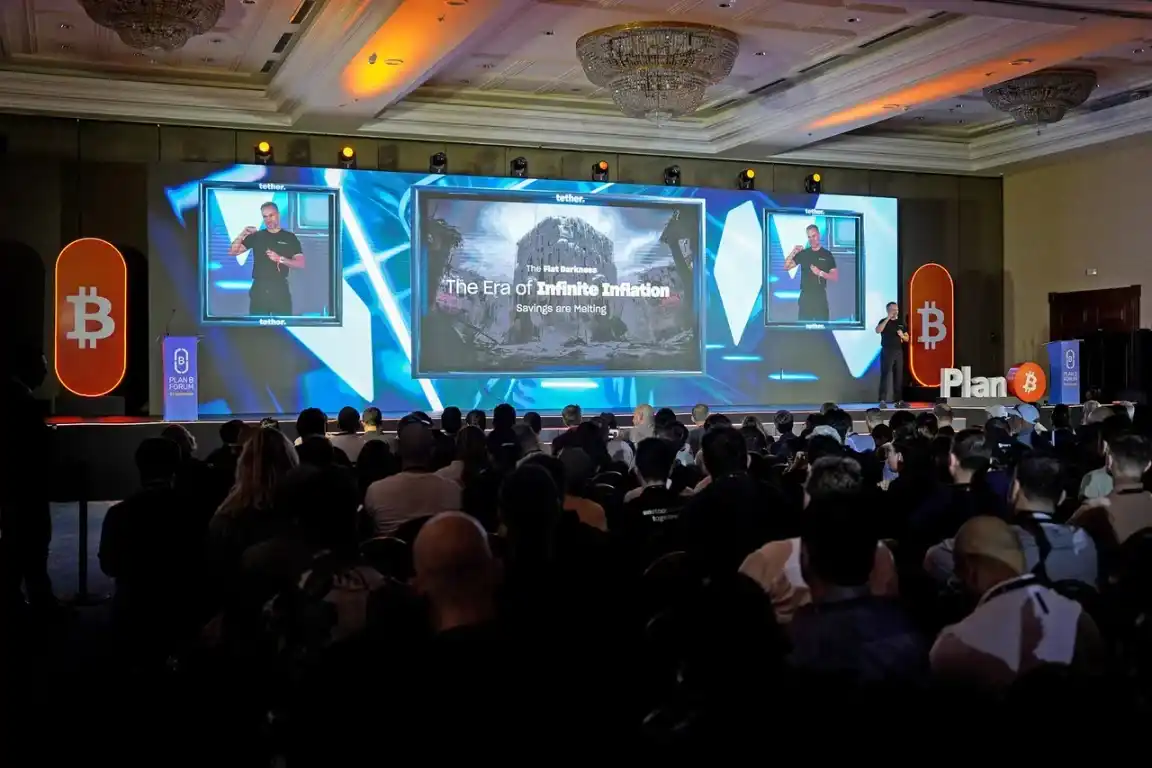
Paolo Ardoino at the Plan B Forum Bitcoin conference in San Salvador in January
Even while seeking new funding, Ardoino remains wary of allowing more outsiders deep into Tether. On the question of a future public listing, the thought of reporting to investors every quarter displeases him. "I don't want to spend time every three months optimizing for profits," he said. "I want to optimize for the company's impact on society."
Unlike many early-stage tech companies, most employees have not received stock options, according to people familiar with Tether's compensation structure. Even if Tether completes its funding at a record valuation for a private company, they won't benefit from it. The funding process has been delayed by months from initial expectations, but Ardoino says he is in no hurry. With its massive profits, the company doesn't need the money and can hold out for its target valuation.
Whether investors agree with Ardoino's assessment of Tether and humanity's future remains to be seen. But Tether's expanding investment portfolio, its holdings of U.S. Treasuries and gold, and its intent to influence U.S. politics mean it can no longer be dismissed as a crypto niche product.
George Washington University professor Wilmarth said, "A few years ago, there was no connection between cryptocurrency and traditional finance, so perhaps it wasn't a problem. But now the situation is completely different; the two are more intertwined than ever before."