‘Tax headache eased?’ IRS extends crypto relief to end of 2026

ambcryptoXuất bản vào 2026-03-19Cập nhật gần nhất vào 2026-03-19

Tóm tắt

The U.S. IRS has extended temporary tax relief for cryptocurrency investors until the end of 2026, allowing them to use alternative methods to calculate capital gains instead of relying solely on broker-submitted reports. This is the second such extension and aims to reduce tax burdens for investors. Previously, the mandatory FIFO (first-in, first-out) method often resulted in higher taxes by requiring the sale of older, more appreciated coins first. The alternative methods enable investors to potentially report more recent, lower-gain or loss-making sales. The relief also addresses operational challenges for crypto exchanges, which faced significant compliance burdens under the stricter reporting rules. The IRS is gradually phasing in reporting requirements and has proposed making electronic submission the default for tax documents.

The U.S. tax season is here, and there is some sigh of relief for crypto holders using centralized exchanges.

In its latest guidance, the U.S. Internal Revenue Service (IRS) gave crypto holders a free pass to use alternative methods to identify crypto sales for tax purposes instead of relying on their broker-submitted reports.

This is the second time the watchdog has extended the relief, and it could again help lower the tax bill for crypto investors. Initially, the agency mandated crypto exchanges to adopt the FIFO (first-in, first-out) method to track investors’ buy and sell prices for each coin.

For users, this meant that the oldest coins, which were acquired cheaply and have since appreciated significantly, should be reported first. This would result in a higher tax bill due to a higher capital gains tax.

With alternative reporting methods, however, you could include the most recently acquired coins that haven’t rallied much or are in the red.
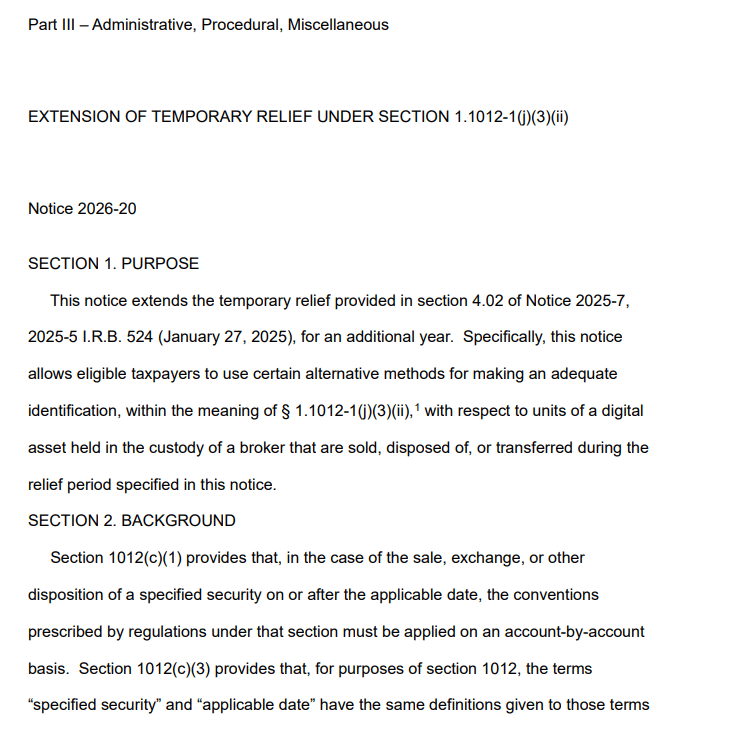
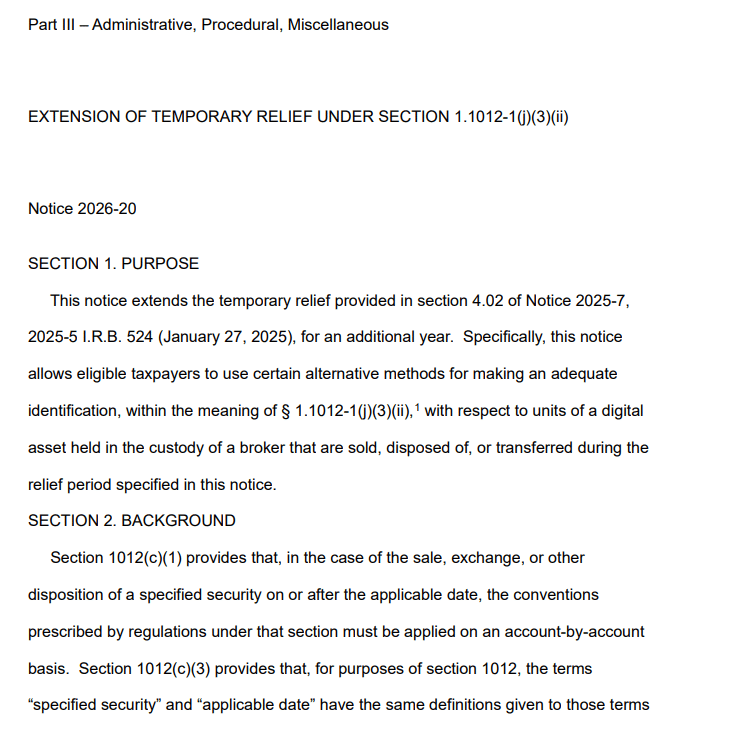
Source: IRS

U.S. crypto tax compliance burden

According to Shehan Chandrasekera, head of tax at Coin Tracker, the IRS guidance will offer incredible relief to investors, albeit with a few friction points.

He said,

The IRS just quietly saved crypto investors from a massive tax headache by issuing Notice 2026-20.

The temporary relief will be extended up to the end of 2026. But the move isn’t out of just goodwill from the taxman.

Its strict crypto reporting regime has a compliance burden on operators. Notably, crypto exchanges must report the cost basis for each coin bought by each investor to the IRS, along with other data.

At the same time, a duplicate of the report should be given to the customer or physically mailed if the customer hasn’t opted for digital copies. Most brokers have complained that this would be a massive operational burden.

To alleviate this, the agency opted for phased-in reports, starting with only gross proceeds or total crypto sales in reports submitted in 2025. For crypto assets bought in 2026, cost basis data was included in the submitted reports (Form 1099-DA).

Earlier this month, the IRS proposed scrapping physical copies sent to customers and making ‘electronic submission’ the default for tax reports.


Final Summary

  • The IRS will allow crypto investors to use their reporting methods for crypto taxes until the end of the year, rather than relying on the strict broker-submitted reports.
  • The move comes as the agency grapples with ways of lowering tax compliance burdens for crypto investors and brokers.


Câu hỏi Liên quan

QWhat relief has the IRS extended to crypto holders until the end of 2026?

AThe IRS has extended temporary relief allowing crypto holders to use alternative methods to identify crypto sales for tax purposes instead of relying strictly on broker-submitted reports.

QWhy was the FIFO method problematic for crypto investors?

AThe FIFO method required reporting the oldest coins first, which were often acquired cheaply and had appreciated significantly, resulting in higher capital gains taxes.

QWhat is the IRS's motivation for extending this relief, according to the article?

AThe move isn't just out of goodwill; the strict crypto reporting regime places a significant compliance burden on both operators (exchanges) and investors, and the IRS is grappling with ways to reduce these burdens.

QWhat change did the IRS propose earlier this month regarding tax report delivery?

AThe IRS proposed scrapping physical copies of tax reports sent to customers and making 'electronic submission' the default method.

QWhat did Shehan Chandrasekera say about IRS Notice 2026-20?

AShehan Chandrasekera stated that 'The IRS just quietly saved crypto investors from a massive tax headache by issuing Notice 2026-20.'

Nội dung Liên quan

Tại sao Bitcoin duy trì mức 64.000 USD sau lần tạm dừng cứng rắn của Fed

Bitcoin duy trì quanh mức 64.000 USD sau cuộc họp của Fed. Dù Fed giữ lãi suất trong khoảng 3,50–3,75%, ba thành viên ủy ban đã bỏ phiếu ủng hộ tăng lãi suất, gửi đi tín hiệu chính sách thắt chặt hơn dự kiến. Bitcoin phản ứng biến động nhưng cuối cùng ổn định quanh 64.000 USD, với vùng hỗ trợ 63.000–63.500 USD và kháng cự ở 66.000 USD. ETF Bitcoin ghi nhận dòng vốn ròng chảy vào 32,1 triệu USD, chấm dứt chuỗi rút tiền, trong khi ETF Ethereum tiếp tục thất thoát 18,65 triệu USD. Điều này cho thấy sự luân chuyển vốn sang Bitcoin giữa bối cảnh bất ổn vĩ mô. Ethereum giao dịch quanh 1.900 USD, áp lực bán tăng nhưng mạng lưới vẫn mạnh với lượng ETH chờ staking cao. Các altcoin khác di chuyển không đồng nhất. Về pháp lý, dự luật CLARITY Act bị trì hoãn đến sau kỳ nghỉ tháng 8 của Thượng viện Mỹ, khiến thị trường thận trọng hơn về khả năng thông qua vào năm 2026. Tóm lại, thị trường tiền mã hóa đang trong trạng thái chờ đợi, với Bitcoin thể hiện sự kiên cường nhờ dòng vốn ETF. Các nhà đầu tư trung hạn cần theo dõi khả năng giữ trên 63.000 USD của Bitcoin, mức 1.860 USD của Ethereum và dòng vốn thể chế để tìm tín hiệu cho sự phục hồi trong nửa cuối năm 2026.

cryptonews.ru3 giờ trước

Tại sao Bitcoin duy trì mức 64.000 USD sau lần tạm dừng cứng rắn của Fed

cryptonews.ru3 giờ trước

Parker Lewis Lý Giải Tại Sao Bitcoin Vẫn Là Đồng Tiền Tốt Nhất

Nhà phân tích Bitcoin uy tín Parker Lewis chỉ trích mạnh mẽ các chiến lược tiếp thị của các công ty tự xưng là kho bạc tiền mã hóa. Ông cho rằng việc các công ty này huy động vốn thông qua việc bán "tín dụng số" dưới dạng cổ phiếu ưu đãi vĩnh viễn đã làm sai lệch bản chất của tiền mã hóa đầu tiên. Lewis nhấn mạnh Bitcoin không có lợi suất định sẵn, và việc hứa hẹn cổ tức thường xuyên là một trò chơi rủi ro cao, dựa chủ yếu vào việc thu hút nhà đầu tư mới trên thị trường tăng trưởng. Ông dẫn chứng sự chênh lệch lớn giữa thị trường tín dụng toàn cầu (300 nghìn tỷ USD) và thị trường cổ phiếu ưu đãi vĩnh viễn (1 nghìn tỷ USD) để chứng minh rủi ro của các công cụ phái sinh này, thường được chuyển cho các nhà đầu tư nhỏ lẻ. Lewis bác bỏ quan điểm cho rằng Bitcoin quá biến động, lập luận rằng biến động là hệ quả tự nhiên của việc chấp nhận một loại tài sản mới. Với nguồn cung cứng và không co giãn, mỗi làn sóng người dùng mới sẽ dẫn đến biến động giá mạnh. Thay vì mua cổ phiếu phái sinh của các công ty như MicroStrategy, ông khuyên nên mua Bitcoin trực tiếp, vì điều này an toàn hơn về mặt toán học so với việc giao tiền cho các nhà quản lý tập đoàn. Việc chuyển hướng sang các công cụ phái sinh làm mất tập trung vào mối đe dọa thực sự: sự mất giá nhanh chóng của tiền pháp định. Lewis đưa ra "Chỉ số thịt bò" của riêng mình, cho thấy mức lạm phát tiêu dùng thực tế khoảng 12-13% mỗi năm, cao hơn nhiều so với số liệu chính thức. Ông kết luận rằng chiến lược tài chính an toàn và hiệu quả nhất trong bối cảnh lạm phát toàn cầu là sở hữu trực tiếp Bitcoin và tự kiểm soát khóa riêng tư, thay vì theo đuổi lợi nhuận đầy rủi ro từ cổ phiếu kho bạc tiền mã hóa.

cryptonews.ru3 giờ trước

Parker Lewis Lý Giải Tại Sao Bitcoin Vẫn Là Đồng Tiền Tốt Nhất

cryptonews.ru3 giờ trước

Giao dịch

Giao ngay
活动图片




