Stole $2 Million from pump.fun, Sentenced to 6 Years in Prison, He Chose to 'Self-Destruct'

marsbitXuất bản vào 2026-03-06Cập nhật gần nhất vào 2026-03-06

Tóm tắt

In May 2024, pump.fun was exploited for approximately $2 million worth of SOL and meme coins. The attacker, Jarett Dunn (also known as Stacc), a former employee, was later sentenced to six years in prison. Two days prior to the sentencing, he leaked internal Telegram chats from his time at the company, claiming to be a whistleblower exposing misconduct. However, the leaked messages did not reveal deliberate malicious activities such as market manipulation or fee misconduct by pump.fun. Instead, Dunn highlighted issues like the team's failure to implement KYC/AML measures for live streaming features, which he had warned about, and what he perceived as irresponsible attitudes toward known "Ruggers" (developers who abandon projects after fundraising). Some messages also illustrated the company's early-stage disorganization, including rushed contracts under investor pressure. Dunn, a talented programmer diagnosed with paranoid schizophrenia at age 20, had joined pump.fun just six weeks before the attack. His mother had recently died, and he had been off medication for months. After the exploit, he was arrested near pump.fun’s London office and underwent mental health treatment. He later attempted to withdraw his guilty plea and expressed homelessness in social media posts. The leak included private phone numbers of pump.fun co-founders, raising privacy concerns. The overall narrative portrays a troubled individual whose actions were influenced by personal trauma and mental hea...

In May 2024, pump.fun was hacked, with the attacker stealing approximately $2 million worth of SOL and a large number of meme coins. At the time, the attacker claimed they would airdrop these funds randomly to players on Solana, once dubbed the "Robin Hood of the crypto world."

Jarett Dunn (online alias Stacc), the attacker, is a former pump.fun employee. Last December, he was sentenced to 6 years in prison by a judge in London.

Two days ago, he exposed a large number of Telegram chat records from his time at pump.fun.

So I spent a lot of time going through these chat logs one by one. Honestly, after reading them, I was confused because these records did not contain the kind of intentional malicious content I had imagined, such as the pump.fun team manipulating liquidity or secretly collecting user fees. There was also no content suggesting major personal moral issues with founder alon or other team members.

But in Jarett Dunn's tweet, he called himself a whistleblower and viewed his exposure as a form of "righteous self-destruction." Someone expressed the same doubt in his comments, to which he replied:
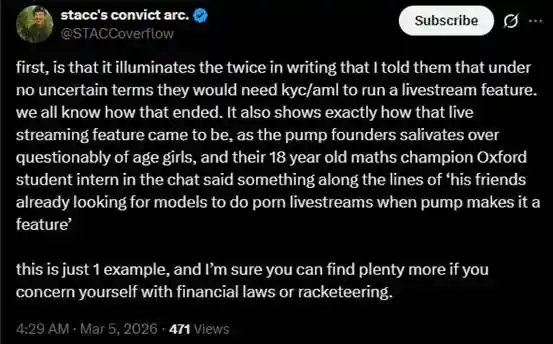
"These records show that I told them twice they must complete the KYC/AML process to enable livestreaming on the platform, (but they ignored it) and then we all know how things ended up (referring to the chaotic and unrestrained livestreaming scene on pump.fun in its early days)."

If this accusation has some merit, the next one is a bit more of a leap:

"An employee said something like this in the group: his friend was already looking for models to do porn as soon as pump.fun's livestreaming went live."

The chat record corresponding to this accusation is as follows. First, pump.fun co-founder Sapijiju shared a Twitch streamer in the pump.fun company group, saying another Twitch streamer had launched a token through pump.fun. An employee stated that this streamer was a Rugger (someone who performs a rug pull) and had rugged 5 tokens the day before.
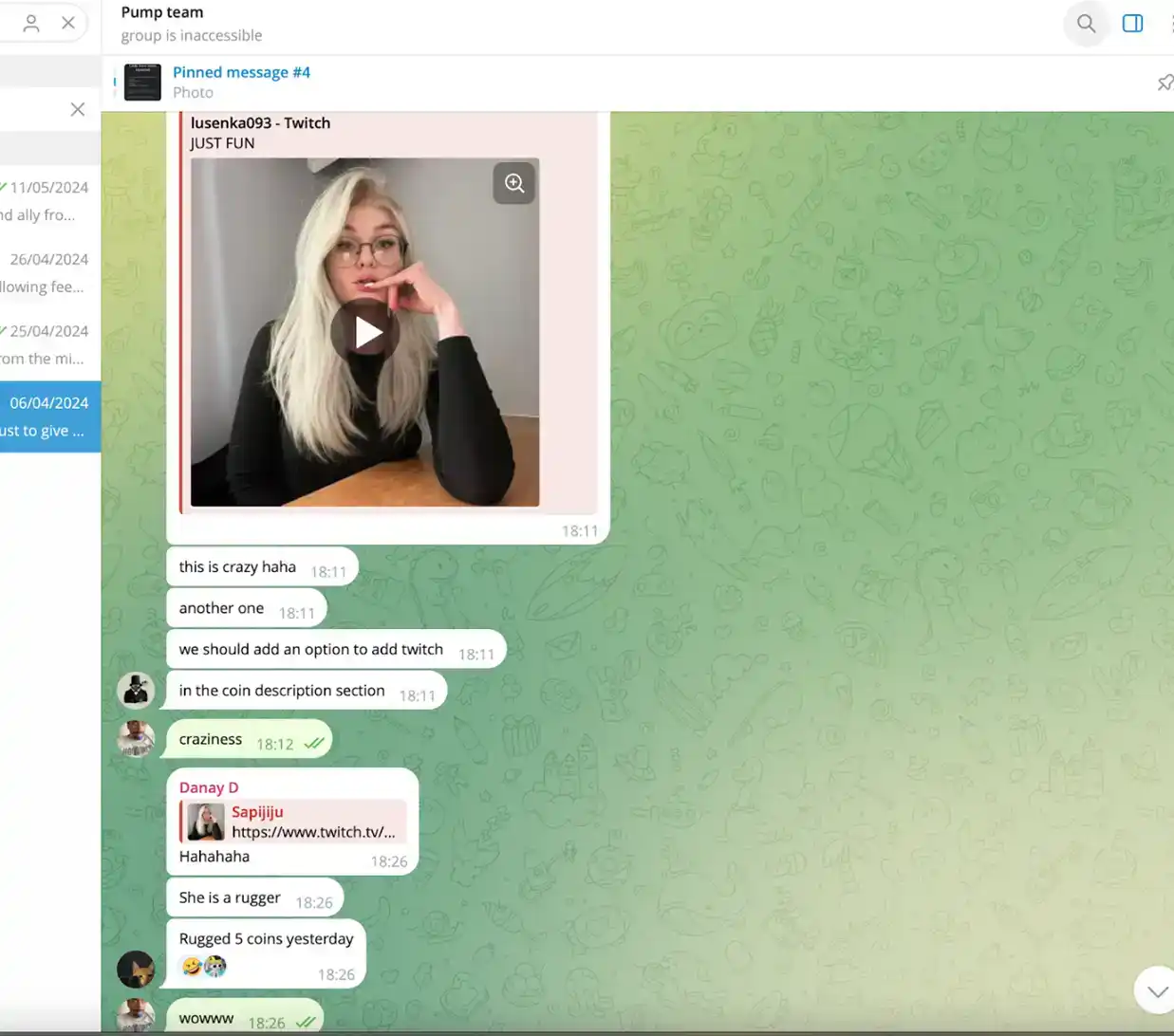
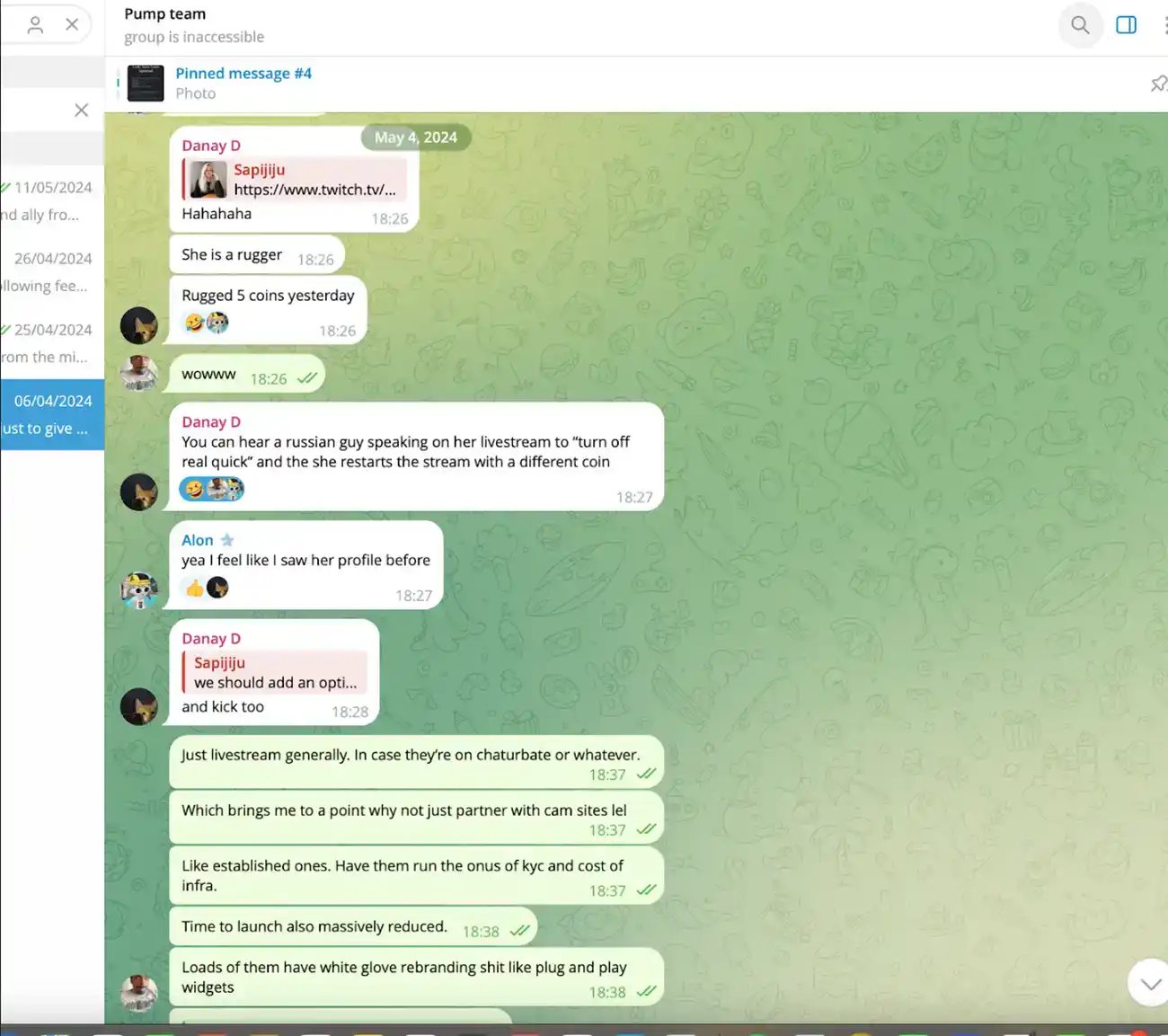
Then this employee said his friend was looking for "models" (to do the same thing). In context, this seems more like a joke. However, Jarett Dunn's suggestion was indeed interspersed, where he took the opportunity to express that partnering with a livestreaming platform would be better, as it would avoid KYC responsibilities and significantly shorten the time needed for pump.fun to launch its livestreaming feature.
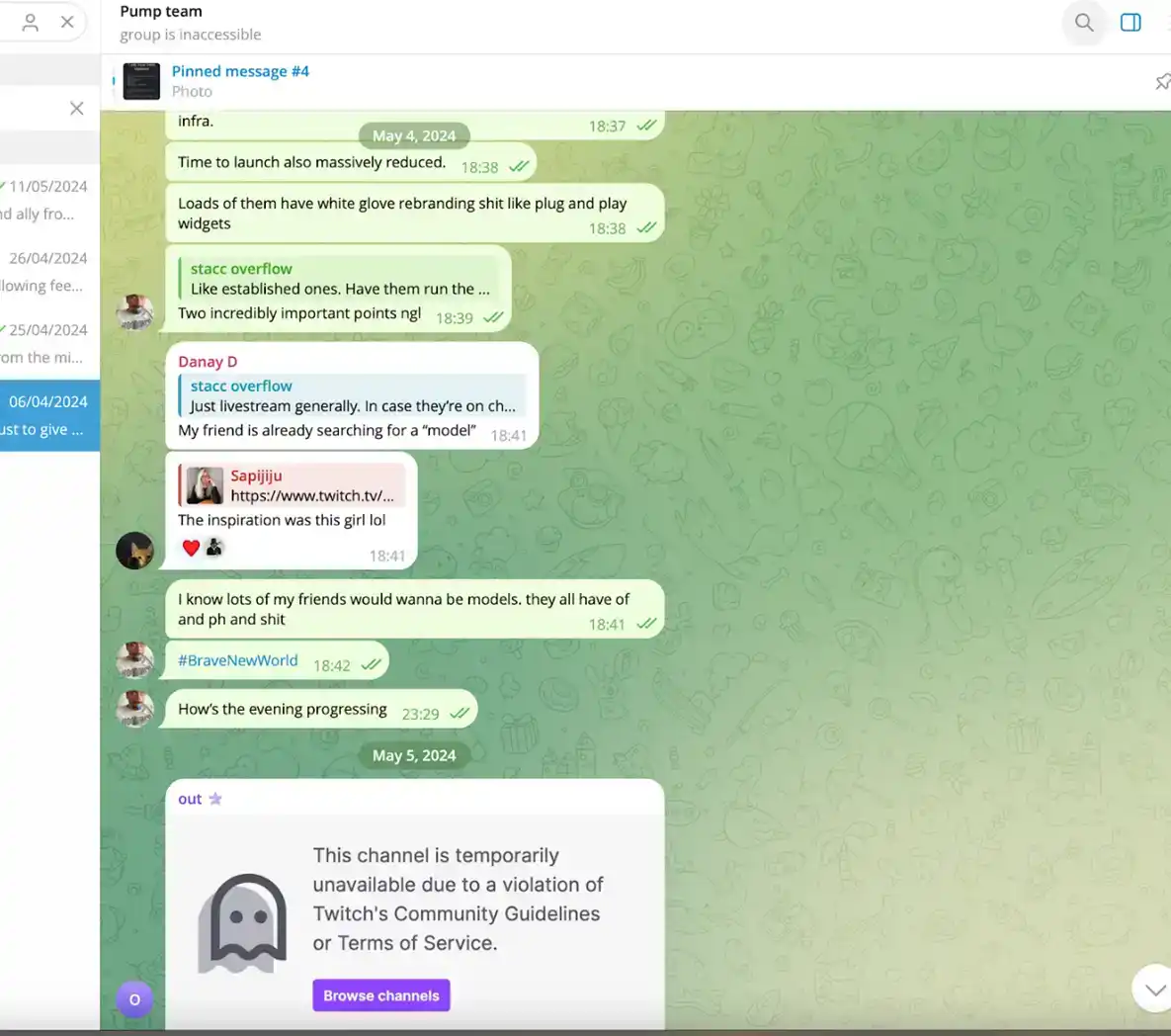
The more significant accusation here should be that the entire team, knowing this was a serial Rugger, still maintained a casual, joking attitude. alon, as a co-founder, stated in the records that he "felt like he had seen her profile before," and then nothing more came of it.
Some other records show the early "makeshift" nature of pump.fun. For example, creating a contract they themselves felt was "a piece of shit" just to handle investor pressure (needing to show investors how many employees the company had), while also looking for lawyers to draft a new one. For a then "young" pump.fun, it's hard to call this a black mark:
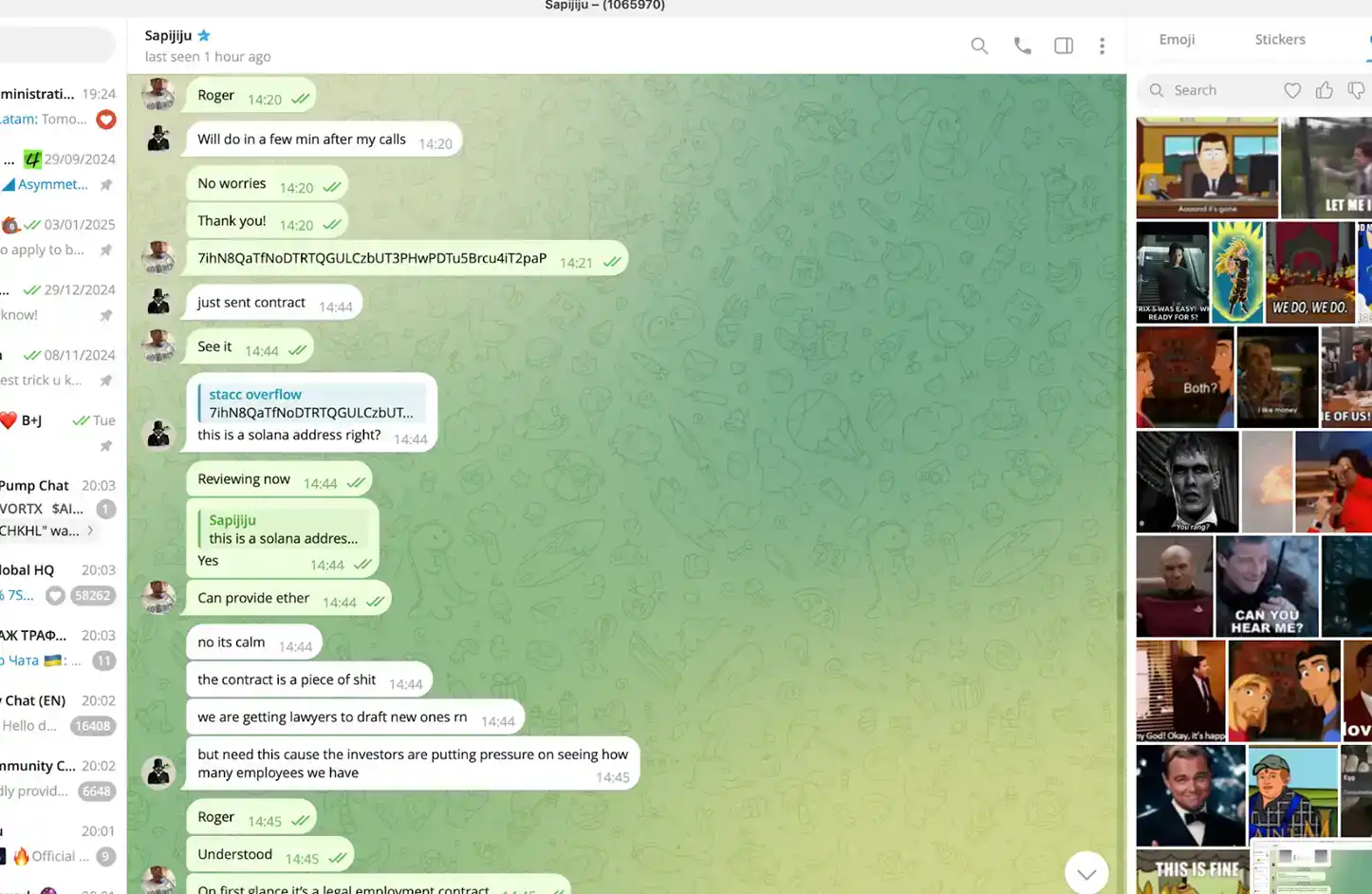
The most "explosive" part of the records disclosed by Jarett Dunn might be the release of the phone numbers associated with the Telegram accounts of alon and Sapijiju. Since this involves privacy, screenshots of this part will not be included in this article.

So, what kind of deep grudge is this? From the records, I cannot find the beginning of the enmity between Jarett Dunn and pump.fun, but he is a talented programmer who was also diagnosed with paranoid schizophrenia at the age of 20.

Two years ago, when he attacked pump.fun, his mother had recently passed away. At this time, he had only been with pump.fun for 6 weeks.

Four days after the attack, he was arrested at a hotel located just 90 meters from pump.fun's office in London; he was staying there. After his arrest, he was immediately deemed unfit for questioning by the police and sent to a hospital for a two-week mental health treatment, having been off his medication for months.

At his sentencing hearing two months after pleading guilty, he tried to withdraw his plea, a sudden change that made his legal team quit.

In September 2023, he wrote in a tweet, "I'm homeless, planning to sleep in the park, fighting the bugs I created with 5G."

Yet in the records, pump.fun reimbursed his flight tickets for him to fly from Canada to the UK. Was he happy and fulfilled back then?

Faced with such a complex, life-troubled programmer, I can only sigh at the vicissitudes of life.


Câu hỏi Liên quan

QWho was the individual responsible for the $2 million hack of pump.fun and what was his sentence?

AJarett Dunn (also known as Stacc), a former pump.fun employee, was responsible for the hack. He was sentenced to 6 years in prison by a judge in London.

QWhat was the main reason Jarett Dunn gave for his 'whistleblower' act of leaking internal chats?

AHe claimed that he had twice warned the pump.fun team that they needed to complete KYC/AML procedures before launching a live-streaming feature, but they ignored him, which he implied led to the platform's early chaos.

QWhat personal circumstances were mentioned that may have contributed to Jarett Dunn's actions?

AHe was diagnosed with paranoid schizophrenia at age 20, his mother had recently passed away just before the attack, and he had been off his prescribed medication for several months.

QAccording to the article, what was the nature of the most 'explosive' information leaked by Dunn?

AThe most sensitive information leaked was the personal phone numbers associated with the Telegram accounts of pump.fun's co-founders, Alon and Sapijiju.

QHow did the author of the article characterize the internal chat logs that were leaked?

AThe author was initially confused because the logs did not contain evidence of intentional malicious acts like market manipulation or stealing user fees. Instead, they showed a 'ragtag' or immature early-stage startup culture with some questionable jokes and attitudes, but not major ethical scandals.

Nội dung Liên quan

Làm thế nào để khiến bản thân trở nên không thể bị thay thế bởi trí tuệ nhân tạo

**Tóm tắt: Làm thế nào để trở nên không thể bị thay thế bởi AI** Bài viết phản đối việc than vãn về AI và thay vào đó đề xuất một giải pháp căn cơ: trở thành một "siêu cá nhân" không thể bị thuê mướn. Mối đe dọa thực sự không phải là AI, mà là tình trạng "nô lệ lương thưởng" – phụ thuộc hoàn toàn vào người khác để sinh tồn, làm công việc nhàm chán mà không có mục đích. Để thoát khỏi vòng luẩn quẩn này và phát triển mạnh trong kỷ nguyên AI, bạn cần trau dồi 5 yếu tố then chốt: 1. **Tính tự chủ:** Khả năng hành động mà không cần chờ chỉ thị. 2. **Khiếu thẩm mỹ:** Khả năng nhận biết điều gì thực sự có giá trị. 3. **Khả năng thuyết phục:** Thu hút sự chú ý và sự công nhận. 4. **Sự kiên trì:** Không sợ thất bại, xem đó là bài học. 5. **Khả năng lặp:** Điều chỉnh dựa trên phản hồi để tiến tới mục tiêu. Giải pháp là đầu tư vào sự nghiệp của chính mình. Trong khi AI giỏi tạo ra "tài sản" (nội dung, code), nó không thể thay thế được khả năng phân biệt thứ gì đáng để tạo ra, làm cho mọi người quan tâm và kiên trì theo đuổi. Trong hai kỹ năng đòn bẩy mạnh mẽ là **Code (Lập trình)** và **Media (Nội dung)**, bài viết nhấn mạnh **Nội dung** quan trọng hơn. Giá trị của nội dung là chủ quan và đòi hỏi sự am hiểu, trải nghiệm mà AI khó có được, tạo không gian cho các cá nhân sáng tạo thực sự. **Cách bắt đầu (Bài tập 15 phút):** 1. **Khai thác nguyên liệu thô của bạn:** Xác định chủ đề bạn am hiểu sâu, vấn đề bạn tự giải quyết được, hay sở thích đặc biệt từ nhỏ. 2. **Xác định "trục phản biện" của bạn:** Tìm ra quan điểm độc đáo của bạn – những điều bạn tin là đúng nhưng số đông lại sai trong lĩnh vực của mình. 3. **Xuất bản ý tưởng đầu tiên:** Kết hợp câu trả lời từ bước 1 và 2, tạo ra một nội dung (bài đăng, video) và đăng nó lên. Hành động này mang lại phản hồi thực tế, bắt đầu quá trình học hỏi, lặp lại và phát triển kỹ năng thuyết phục. Bằng cách xây dựng một sự nghiệp xoay quanh con người thật, trải nghiệm thật và góc nhìn độc đáo của mình thông qua nội dung, bạn có thể tạo ra giá trị mà AI không thể sao chép, từ đó trở nên không thể thay thế.

marsbit2 giờ trước

Làm thế nào để khiến bản thân trở nên không thể bị thay thế bởi trí tuệ nhân tạo

marsbit2 giờ trước

Nhờ việc tung xúc xắc, chìa khóa Bitcoin được lưu trữ offline, nhưng không phải ai cũng muốn làm điều này

Cảm biến từ cuộc tranh cãi gần đây xung quanh lỗ hổng trong ví phần cứng Coldcard, bài viết thảo luận về phương pháp tạo seed (cụm từ khôi phục) cho ví Bitcoin bằng cách xúc xắc vật lý. Mỗi lần xúc xắc công bằng cung cấp khoảng 2,6 bit entropy (thước đo tính ngẫu nhiên). Để đạt mức entropy an toàn cho một seed 12 từ (128 bit), cần khoảng 50 lần xúc xắc; Coldcard khuyến nghị 99 lần để đạt mức bảo mật cao hơn. Lợi thế chính của phương pháp này là tách biệt hoàn toàn với bất kỳ lỗi phần cứng hoặc phần mềm nào trong trình tạo số ngẫu nhiên của thiết bị, từ đó bảo vệ seed chính của ví. Tuy nhiên, bài viết cảnh báo rằng trong sự cố Coldcard, các chức năng phụ khác của thiết bị (như tạo ví giấy, khóa đa chữ ký, mật mã phiên USB) vẫn có thể bị ảnh hưởng nếu chúng dựa vào trình tạo số lỗi, ngay cả khi seed chính được tạo an toàn bằng xúc xắc. Nhược điểm lớn của việc dùng xúc xắc là quá trình thủ công, dễ xảy ra sai sót, tốn thời gian và không thực tế cho đa số người dùng mới. Người dùng có thể ghi chép sai, sử dụng xúc xắc gian lận, hoặc để lộ chuỗi kết quả. Do đó, mặc dù có nền tảng toán học vững chắc, phương pháp này đòi hỏi sự tỉ mỉ cao và không phải là giải pháp khả thi cho việc áp dụng Bitcoin rộng rãi. Bài viết kết luận rằng mục tiêu dài hạn vẫn là phát triển phần cứng/phần mềm tạo số ngẫu nhiên mạnh mẽ và đáng tin cậy, trong khi vẫn giữ phương pháp thủ công như một tùy chọn cho người dùng có kinh nghiệm. Cuối cùng, bài viết đưa ra khuyến nghị cho chủ sở hữu Coldcard: cập nhật firmware, kiểm tra các chức năng phụ đã sử dụng và xem xét các biện pháp bảo mật bổ sung như ví đa chữ ký kết hợp nhiều nhà sản xuất để giảm thiểu rủi ro từ một điểm yếu đơn lẻ.

cryptonews.ru5 giờ trước

Nhờ việc tung xúc xắc, chìa khóa Bitcoin được lưu trữ offline, nhưng không phải ai cũng muốn làm điều này

cryptonews.ru5 giờ trước

Michael Saylor tuyên bố, bản cập nhật Bitcoin mà ông phản đối đã không thể được thông qua!

Michael Saylor tuyên bố rằng về mặt toán học, BIP-110 không thể đạt ngưỡng hỗ trợ 55% từ các tình nguyện viên trong chu kỳ điều chỉnh độ khó khai thác Bitcoin hiện tại. Dữ liệu của ông cho thấy, trong tổng số 946 khối được tạo ra tính đến khối 960.561, chỉ 24 khối chứa tín hiệu ủng hộ BIP-110 trong trường phiên bản tiêu đề khối. Tất cả các tín hiệu này đều đến từ thợ đào DATUM chia sẻ phần thưởng thông qua nhóm khai thác OCEAN, và không có tín hiệu nào từ các thợ đào bên ngoài OCEAN. Saylor nhấn mạnh rằng trong tình huống này, BIP-110 sẽ không đạt được mức hỗ trợ tự nguyện 55% trong chu kỳ xem xét, và các tín hiệu hiện tại không thể được coi là sự đồng thuận chung của các thợ đào. BIP-110 là một đề xuất nhằm gây khó khăn cho việc thêm ảnh, văn bản hoặc các loại dữ liệu lớn khác vào mạng Bitcoin, ngoài giao dịch chuyển tiền. Người ủng hộ cho rằng Bitcoin chỉ nên được dùng để chuyển tiền và không nên làm tắc nghẽn mạng bằng dữ liệu không cần thiết. Tuy nhiên, Michael Saylor phản đối BIP-110. Ông lập luận rằng mạng Bitcoin không nên quyết định giao dịch nào là cần thiết, luật lệ không nên thay đổi theo ý muốn của một số ít người, và tỷ lệ hỗ trợ cao có thể không phản ánh đúng sự ủng hộ thực sự của thợ đào do một phần mềm tự động hóa quá trình báo hiệu.

cryptonews.ru5 giờ trước

Michael Saylor tuyên bố, bản cập nhật Bitcoin mà ông phản đối đã không thể được thông qua!

cryptonews.ru5 giờ trước

Số lượng bình luận tiêu cực về Bitcoin đạt mức cao nhất lịch sử: Điều này có nghĩa là gì?

Công ty phân tích tiền mã hóa Santiment thông báo rằng tình cảm tiêu cực đối với Bitcoin trên mạng xã hội đã đạt mức cao kỷ lục. Tỷ lệ bình luận tích cực/tiêu cực về Bitcoin trên các nền tảng như X, Reddit, Telegram đã giảm xuống mức thấp nhất kể từ khi công ty triển khai hệ thống giám sát hiện đại. Một lỗ hổng bảo mật trong phần sụn của ví cứng Coldcard được xác định là nguyên nhân chính gây lo ngại, làm dấy lên nghi ngờ về tính an toàn của phương pháp lưu trữ lạnh vốn được coi là an toàn nhất. Santiment lưu ý rằng, khác với các cuộc khủng hoảng lớn trước đây như sự sụp đổ của FTX hay Mt. Gox, cuộc thảo luận lần này tập trung vào rủi ro bảo mật phần cứng và ví lạnh nói chung, thay vì chỉ trích các sàn giao dịch tập trung. Theo dữ liệu, hiện chỉ có 0,58 bình luận tích cực cho mỗi bình luận tiêu cực về Bitcoin, cho thấy "nỗi sợ hãi" đang áp đảo "lòng tham" ở mức đáng kể. Mặc dù dữ liệu chỉ trong một ngày, mức độ hoảng loạn hiện tại được đánh giá là cao hơn cả đỉnh lo ngại về chiến tranh đầu năm và các cuộc khủng hoảng tiền mã hóa lớn trong quá khứ.

cryptonews.ru6 giờ trước

Số lượng bình luận tiêu cực về Bitcoin đạt mức cao nhất lịch sử: Điều này có nghĩa là gì?

cryptonews.ru6 giờ trước

Giao dịch

Giao ngay
活动图片




