Stablecoins are leaving exchanges – and traders aren’t buying the dip

ambcryptoXuất bản vào 2025-12-23Cập nhật gần nhất vào 2025-12-23

Tóm tắt

Stablecoins are being withdrawn from cryptocurrency exchanges at the fastest rate in the current market cycle, signaling a sharp decline in short-term risk appetite among traders. Despite a growing overall stablecoin supply—largely backed by U.S. Treasuries—investors are choosing to hold capital off exchanges rather than deploy it during the market downturn. This cautious behavior is evident in the significant outflows from major exchanges like Binance, which saw nearly $1.9 billion in net outflows over 30 days. While Bitcoin has corrected roughly 36% from its October highs, traders have been unwinding leverage, with open interest falling more than 40%. However, stablecoins aren't exiting the crypto ecosystem entirely. Instead, they are migrating to safer blockchain networks like TON, Ethereum, and Polygon, while trading-focused chains such as Solana and Tron experience outflows. The shift reflects a defensive strategy: investors are prioritizing safety and yield offered by stablecoins—which function like low-risk money market instruments—over exposure to volatile assets. This trend is likely to persist until market confidence returns.

Stablecoins are moving off crypto exchanges at the fastest pace this cycle. Instead of putting capital to work, investors are choosing to wait.

This is happening even as stablecoin supply continues to grow, backed largely by U.S. Treasuries. Everyone’s staying liquid, but holding back until market conditions improve.

Traders take a step back

The speed at which stablecoins are being pulled has caused a drop in short-term risk appetite.

While Bitcoin’s correction fell further (now down roughly 36% from its early October highs), traders have been unwinding leverage. OI has fallen more than 40%.

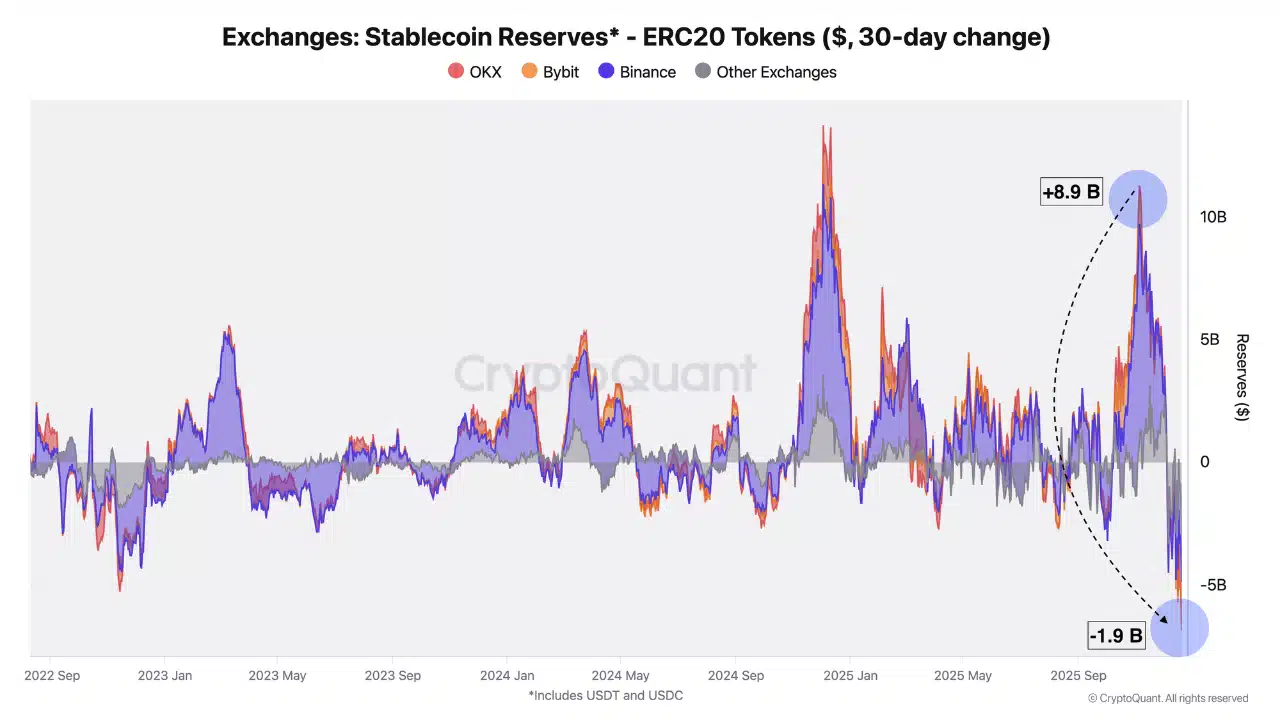
Source: CryptoQuant

December was the steepest decline in ERC-20 stablecoin reserves across major exchanges in this cycle. These tokens are usually on exchanges ready to be deployed.

This time, they are being pulled out instead. The change is easily visible on Binance, where an inflow trend flipped into nearly $1.9 billion in net outflows over 30 days. This is an obviously cautious move.

Stablecoins aren’t quitting crypto altogether though

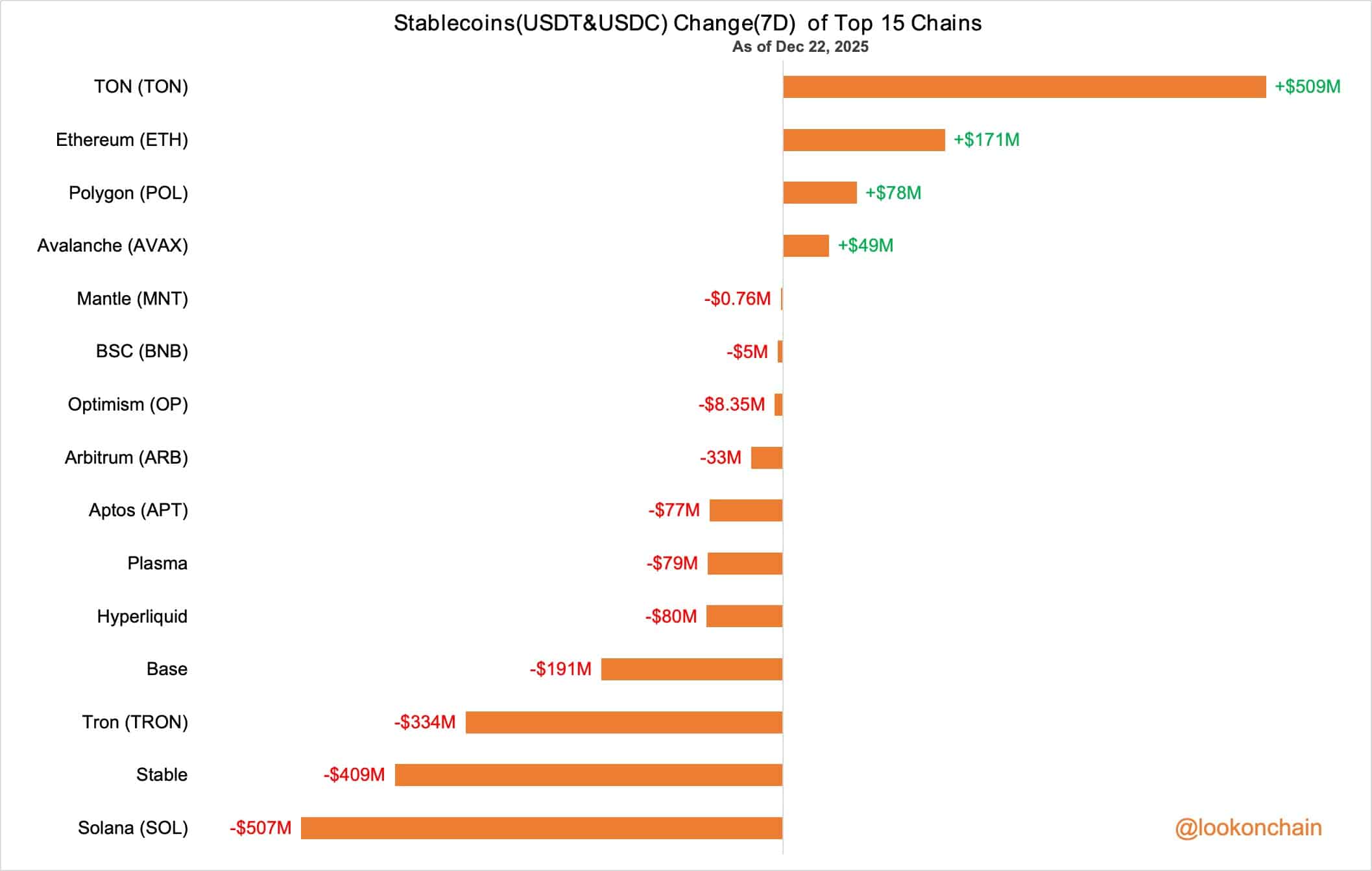
They are simply shifting across networks instead of being on exchanges. Over the past week, total stablecoin supply still grew by about $509 million.

Source: Lookonchain

The biggest inflows were seen on TON, which added over $500 million, followed by Ethereum and Polygon. In contrast, networks tied more closely to trading activity, such as Solana and Tron, saw large outflows.

Investors aren’t taking any new risks, and are simply waiting for clear signs before committing.

Defensive, not disappearing

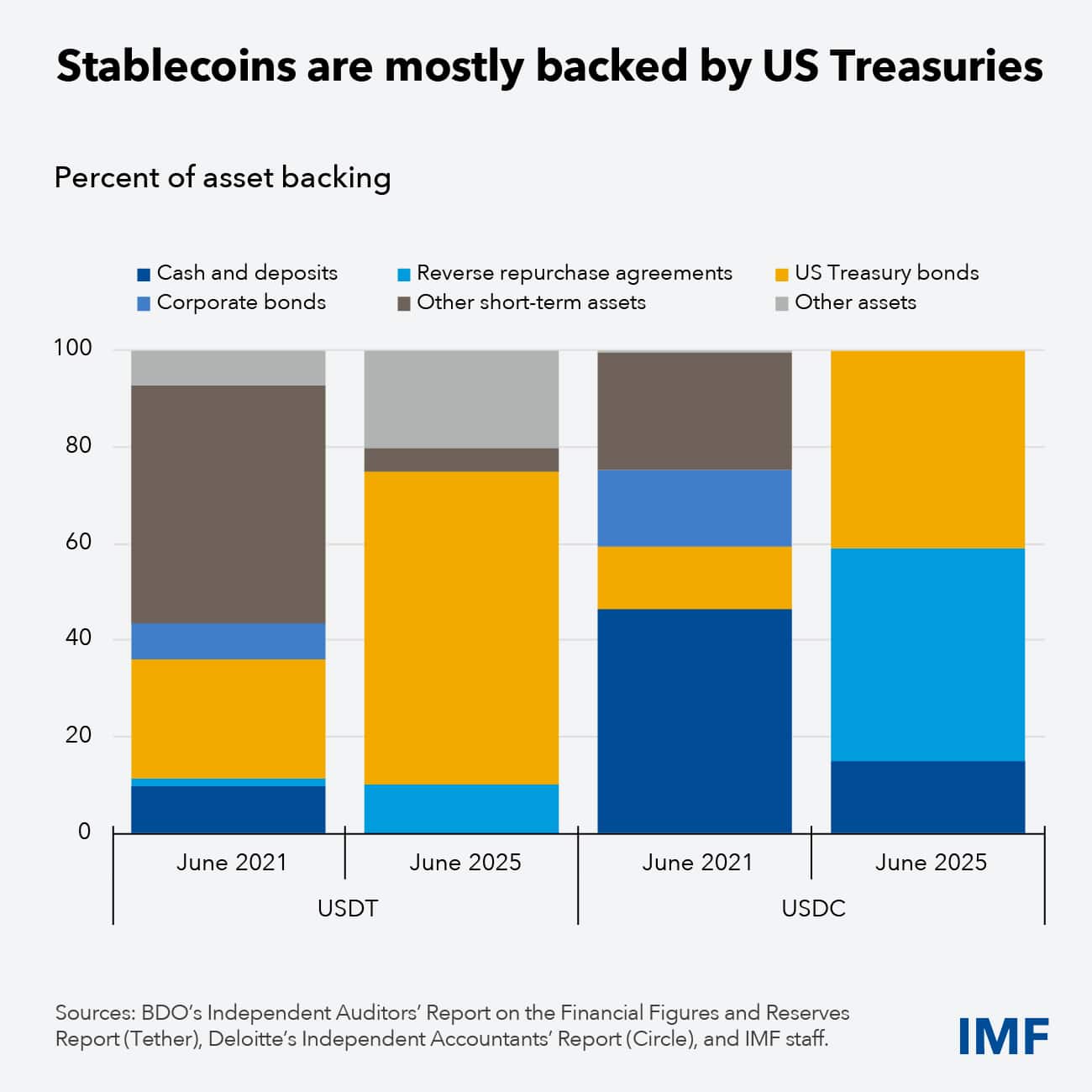
Today, most major stablecoins are backed largely by U.S. Treasuries and other short-term government assets, making them more or less low-risk money market instruments.

Source: IMF

This explains why capital is staying in stablecoins even as it leaves exchanges. Investors are choosing safety and yield over chaos. Until confidence returns, this defensive positioning is likely to persist.


Final Thoughts

  • Stablecoins are leaving exchanges at record speed as traders cut risk.
  • Capital is on safer chains until confidence returns.
Next: Solana: Short-term pain, long-term hope? SOL faces liquidation test
Share
  • Share
  • Tweet

Câu hỏi Liên quan

QWhat is the main trend observed with stablecoins on crypto exchanges in the current cycle?

AStablecoins are moving off crypto exchanges at the fastest pace this cycle, with investors choosing to hold liquid assets rather than deploying capital.

QHow has the withdrawal of stablecoins affected market activity and trader behavior?

AThe rapid withdrawal of stablecoins has caused a drop in short-term risk appetite, leading traders to unwind leverage, with open interest falling more than 40%.

QWhich blockchain networks saw the largest inflows of stablecoins, and what does this indicate?

ATON saw the largest inflows, adding over $500 million, followed by Ethereum and Polygon, indicating a shift to safer chains rather than those tied to active trading like Solana and Tron.

QWhy are investors choosing to hold stablecoins even as they leave exchanges?

AInvestors are opting for safety and yield, as stablecoins are largely backed by U.S. Treasuries and short-term government assets, making them low-risk money market instruments.

QWhat was notable about Binance's stablecoin flows in December?

ABinance experienced a significant shift from inflows to nearly $1.9 billion in net outflows over 30 days, reflecting a cautious move by investors.

Nội dung Liên quan

Ghi chép 8 năm khởi nghiệp của đối tác định hướng AI tại a16z

Tác giả, một doanh nhân tiên phong trong lĩnh vực AI generative, đã chia sẻ hành trình 8 năm xây dựng Rosebud AI và những suyết định quan trọng trước khi chuyển sang vai trò mới với tư cách đối tác tại a16z, tập trung đầu tư vào cơ sở hạ tầng AI. Bắt đầu từ năm 2018 khi AI generative còn được gọi là "truyền thông tổng hợp", ông tin tưởng vào tiềm năng biến việc sáng tạo trở nên dễ dàng như chơi game. Các sản phẩm ban đầu như TokkingHeads đã thu hút hàng triệu người dùng bằng cách thiết kế trải nghiệm đơn giản, che đi những hạn chế của mô hình AI thời kỳ đầu. Sự ra mắt của GPT-4 vào năm 2023 là bước ngoặt, khi khả năng tạo mã đủ mạnh để phát triển công cụ trò chơi cho người sáng tạo không chuyên. Ông nhấn mạnh rằng giai đoạn chứng minh khả năng của AI generative đã kết thúc, và cuộc cạnh tranh tiếp theo sẽ xoay quanh việc tổ chức, sản phẩm hóa và thương mại hóa các khả năng này. Trong vai trò mới tại a16z, ông sẽ tập trung vào đầu tư vào frontier model stack, cơ sở hạ tầng và các công cụ phát triển xung quanh mô hình AI. Ông cũng bày tỏ sự lạc quan về những đột phá mà AI mang lại trong lĩnh vực toán học và khoa học.

marsbit5 giờ trước

Ghi chép 8 năm khởi nghiệp của đối tác định hướng AI tại a16z

marsbit5 giờ trước

Giao dịch

Giao ngay
Hợp đồng Tương lai

Bài viết Nổi bật

Làm thế nào để Mua T

Chào mừng bạn đến với HTX.com! Chúng tôi đã làm cho mua Threshold Network Token (T) trở nên đơn giản và thuận tiện. Làm theo hướng dẫn từng bước của chúng tôi để bắt đầu hành trình tiền kỹ thuật số của bạn.Bước 1: Tạo Tài khoản HTX của BạnSử dụng email hoặc số điện thoại của bạn để đăng ký tài khoản miễn phí trên HTX. Trải nghiệm hành trình đăng ký không rắc rối và mở khóa tất cả tính năng. Nhận Tài khoản của tôiBước 2: Truy cập Mua Crypto và Chọn Phương thức Thanh toán của BạnThẻ Tín dụng/Ghi nợ: Sử dụng Visa hoặc Mastercard của bạn để mua Threshold Network Token (T) ngay lập tức.Số dư: Sử dụng tiền từ số dư tài khoản HTX của bạn để giao dịch liền mạch.Bên thứ ba: Chúng tôi đã thêm những phương thức thanh toán phổ biến như Google Pay và Apple Pay để nâng cao sự tiện lợi.P2P: Giao dịch trực tiếp với người dùng khác trên HTX.Thị trường mua bán phi tập trung (OTC): Chúng tôi cung cấp những dịch vụ được thiết kế riêng và tỷ giá hối đoái cạnh tranh cho nhà giao dịch.Bước 3: Lưu trữ Threshold Network Token (T) của BạnSau khi mua Threshold Network Token (T), lưu trữ trong tài khoản HTX của bạn. Ngoài ra, bạn có thể gửi đi nơi khác qua chuyển khoản blockchain hoặc sử dụng để giao dịch những tiền kỹ thuật số khác.Bước 4: Giao dịch Threshold Network Token (T)Giao dịch Threshold Network Token (T) dễ dàng trên thị trường giao ngay của HTX. Chỉ cần truy cập vào tài khoản của bạn, chọn cặp giao dịch, thực hiện giao dịch và theo dõi trong thời gian thực. Chúng tôi cung cấp trải nghiệm thân thiện với người dùng cho cả người mới bắt đầu và người giao dịch dày dạn kinh nghiệm.

Tổng lượt xem 421Xuất bản vào 2024.12.13Cập nhật vào 2025.03.21

Làm thế nào để Mua T

Thảo luận

Chào mừng đến với Cộng đồng HTX. Tại đây, bạn có thể được thông báo về những phát triển nền tảng mới nhất và có quyền truy cập vào thông tin chuyên sâu về thị trường. Ý kiến ​​của người dùng về giá của T (T) được trình bày dưới đây.

活动图片