Spot volumes drop 66% in ‘lulls’ that often precede next cycle leg: Bitfinex

cointelegraphXuất bản vào 2025-12-13Cập nhật gần nhất vào 2025-12-13

Tóm tắt

Bitfinex reports a 66% decline in crypto spot trading volumes this quarter, dropping from over $500 billion in early November to around $250 billion. The exchange notes this mirrors historical market lulls that often precede the next cycle upswing. Analysts observe Bitcoin's tightening price structure near key levels of $89,000–$92,000, suggesting a breakout toward $100,000 is possible if resistance is broken. Despite a recent Fed rate cut and a large institutional purchase, momentum faded as the move was already priced in, leaving markets subdued amid softer ETF inflows and macroeconomic uncertainty.

Bitfinex says crypto spot trading activity has fallen sharply this quarter, with volumes down 66% from January’s peak as traders step back amid softer ETF inflows and an uncertain macro backdrop.

In a Sunday post on X, the exchange noted that the slowdown mirrors periods seen in earlier market cycles, where extended lulls often “precede the next leg in the cycle.”

According to data from CoinMarketCap, 30-day crypto spot volumes have slipped from over $500 billion in early November to roughly $250 billion this week.

Trading activity struggled to stay above the $300–$350 billion range throughout late November and early December, with several sessions sliding toward $200 billion, levels not seen in months. The decline followed a brief spike in mid-November, when volumes exceeded $550 billion before retreating quickly, data shows.
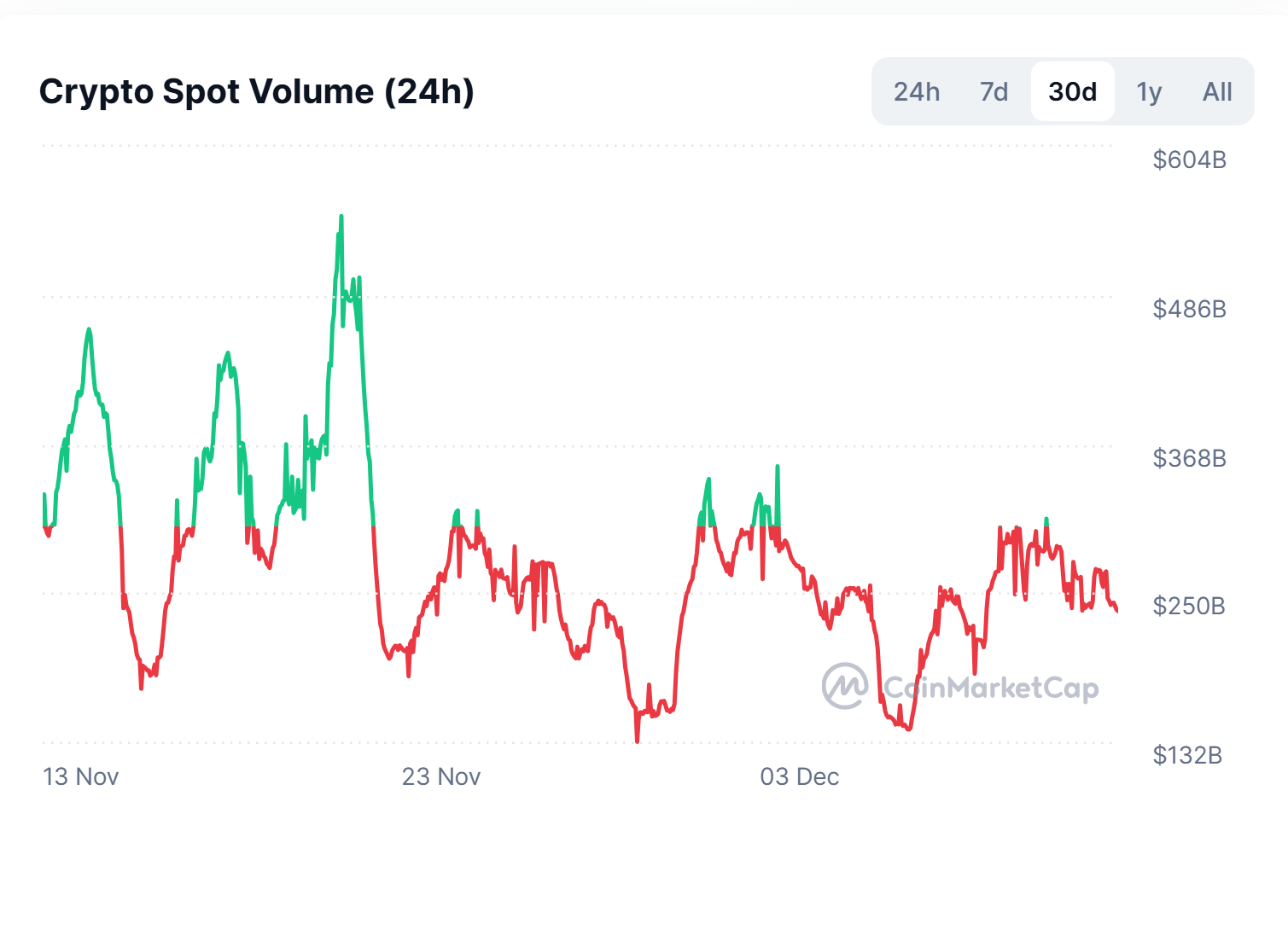
Spot crypto volumes continue to drop. Source: CoinMarketCap

Related: Brazil’s largest private bank advises investors to allocate 3% to Bitcoin in 2026

Bitcoin nearing breakout as key levels tighten

Meanwhile, market analysts say the current environment resembles previous pre-breakout periods. In a recent post on X, Michaël van de Poppe noted a tightening price structure in Bitcoin (BTC), saying that major macro events in the coming week could drive a surge in volatility.

“Bitcoin holds above this crucial level, but I'm sure we'll start to see volatility pick up significantly over the course of the next days,” the analyst said.

He pointed to key levels at $89,000 and $92,000, arguing that a break above resistance could accelerate a move toward $100,000 before 2026, while losing support risks another retest of lower ranges.

Related: Bitcoin rallies fail at $94K despite Fed policy shift: Here's why

Crypto slips despite fed cut

As Cointelegraph reported, Bitcoin briefly climbed to $94,330 early in the week, lifted by Strategy’s $962 million purchase, its largest Bitcoin investment since mid-2025.

However, the momentum faded quickly as traders awaited the final Federal Open Market Committee meeting of the year. The Federal Reserve delivered a widely expected 25-basis-point rate cut on Wednesday, giving markets a short-lived boost before sentiment cooled again. According to CoinEx analyst Jeff Ko, the move offered little upside because it was “already priced in.”

Magazine: 2026 is the year of pragmatic privacy in crypto — Canton, Zcash and more

Câu hỏi Liên quan

QAccording to Bitfinex, by what percentage have crypto spot trading volumes dropped from January's peak?

ACrypto spot trading volumes have dropped by 66% from January's peak.

QWhat does Bitfinex suggest that the current market slowdown often precedes, based on historical cycles?

ABitfinex suggests that extended lulls in the market often precede the next leg in the cycle.

QWhat are the two key Bitcoin price levels mentioned by analyst Michaël van de Poppe that could determine the next major price move?

AThe two key Bitcoin price levels are $89,000 and $92,000.

QDespite a Fed rate cut, why did the crypto market see little upside according to CoinEx analyst Jeff Ko?

AThe market saw little upside because the rate cut was already priced in by investors.

QWhat event in mid-November 2025 caused a brief spike in crypto trading volumes before they retreated?

AA brief spike in mid-November was caused by volumes exceeding $550 billion, though the article does not specify the exact event that triggered it.

Nội dung Liên quan

Polymarket Bị Kẹt: Bài Kiểm Tra Thực Sự Sau Khi Vượt Qua Giai Đoạn Lưu Lượng Tăng Đột Biến

Polymarket, nền tảng dự đoán thị trường hàng đầu, đang đối mặt với thách thức lớn khi trải nghiệm giao dịch xuống cấp do hạ tầng không theo kịp đà tăng trưởng. Phó chủ tịch kỹ thuật Josh Stevens thừa nhận vấn đề và công bố kế hoạch cải tổ toàn diện, bao gồm: giảm độ trễ dữ liệu, sửa lỗi hủy lệnh, xây dựng lại hệ thống order book (CLOB), nâng cao hiệu suất website, và quan trọng nhất là di chuyển chain (chain migration). Nguyên nhân sâu xa nằm ở việc Polymarket không còn là ứng dụng dự đoán đơn thuần mà đã phát triển thành một nền tảng giao dịch tần suất cao. Polygon, từng là lựa chọn chi phí thấp hoàn hảo, giờ đây trở thành rào cản kỹ thuật. Động thái này ngay lập tức thu hút sự quan tâm của các blockchain khác như Solana, Sui, Algorand... trong khi Polygon nỗ lực giữ chân ứng dụng quan trọng này - nguồn đóng góp phí giao dịch đáng kể cho hệ sinh thái của họ. Bài kiểm tra thực sự của Polymarket không chỉ là chọn chain mới, mà là xây dựng một hệ thống giao dịch đủ mạnh và ổn định để giữ chân người dùng trong giai đoạn tăng trưởng mới, nơi độ tin cậy quan trọng hơn bao giờ hết.

Odaily星球日报16 giờ trước

Polymarket Bị Kẹt: Bài Kiểm Tra Thực Sự Sau Khi Vượt Qua Giai Đoạn Lưu Lượng Tăng Đột Biến

Odaily星球日报16 giờ trước

Điều chỉnh kỳ vọng giảm cho chu kỳ tăng giá tiếp theo của BTC

Tác giả Alex Xu, một nhà đầu tư Bitcoin lâu năm, đã chia sẻ quyết định giảm dần tỷ trọng BTC trong danh mục đầu tư của mình, từ vị thế lớn nhất xuống còn khoảng 30%, và giải thích lý do cho việc điều chỉnh kỳ vọng về đỉnh giá trong chu kỳ bull market tiếp theo. Các lý do chính bao gồm: 1. **Năng lượng tăng trưởng tiềm năng giảm:** Các chu kỳ trước được thúc đẩy bởi việc mở rộng đối tượng đầu tư theo cấp số nhân (từ cá nhân đến tổ chức). Chu kỳ tới cần sự chấp nhận từ các quỹ đầu tư quốc gia hoặc ngân hàng trung ương, điều này khó xảy ra trong 2-3 năm tới. 2. **Chi phí cơ hội cá nhân:** Tìm thấy nhiều cơ hội đầu tư hấp dẫn khác (cổ phiếu công ty) với mức giá hợp lý. 3. **Tác động tiêu cực từ sự thu hẹp của ngành crypto:** Nhiều mô hình Web3 (SocialFi, GameFi...) không thành công, dẫn đến sự thu hẹp của toàn ngành và làm chậm tốc độ tăng trưởng số người nắm giữ BTC. 4. **Áp lực từ nhà mua lớn nhất (MicroStrategy):** Chi phí huy động vốn của MicroStrategy tiếp tục tăng cao (lãi suất 11.5%), có thể làm giảm tốc độ mua vào và gây áp lực bán. 5. **Sự cạnh tranh từ Vàng được token hóa:** Sản phẩm vàng token hóa (tokenized gold) đã thu hẹp khoảng cách về tính dễ chia nhỏ, dễ mang theo và dễ xác minh so với BTC. 6. **Vấn đề ngân sách bảo mật:** Phần thưởng khối giảm sau mỗi lần halving làm trầm trọng thêm vấn đề ngân sách cho bảo mật mạng lưới. Tác giả vẫn giữ một phần BTC đáng kể và sẵn sàng mua lại nếu các lý kiến trên được giải quyết hoặc xuất hiện các yếu tố tích cực mới, với điều kiện giá cả phù hợp.

marsbit16 giờ trước

Điều chỉnh kỳ vọng giảm cho chu kỳ tăng giá tiếp theo của BTC

marsbit16 giờ trước

Giao dịch

Giao ngay
Hợp đồng Tương lai
活动图片





