This weekly report covers the period from April 4, 2026, to April 10, 2026.
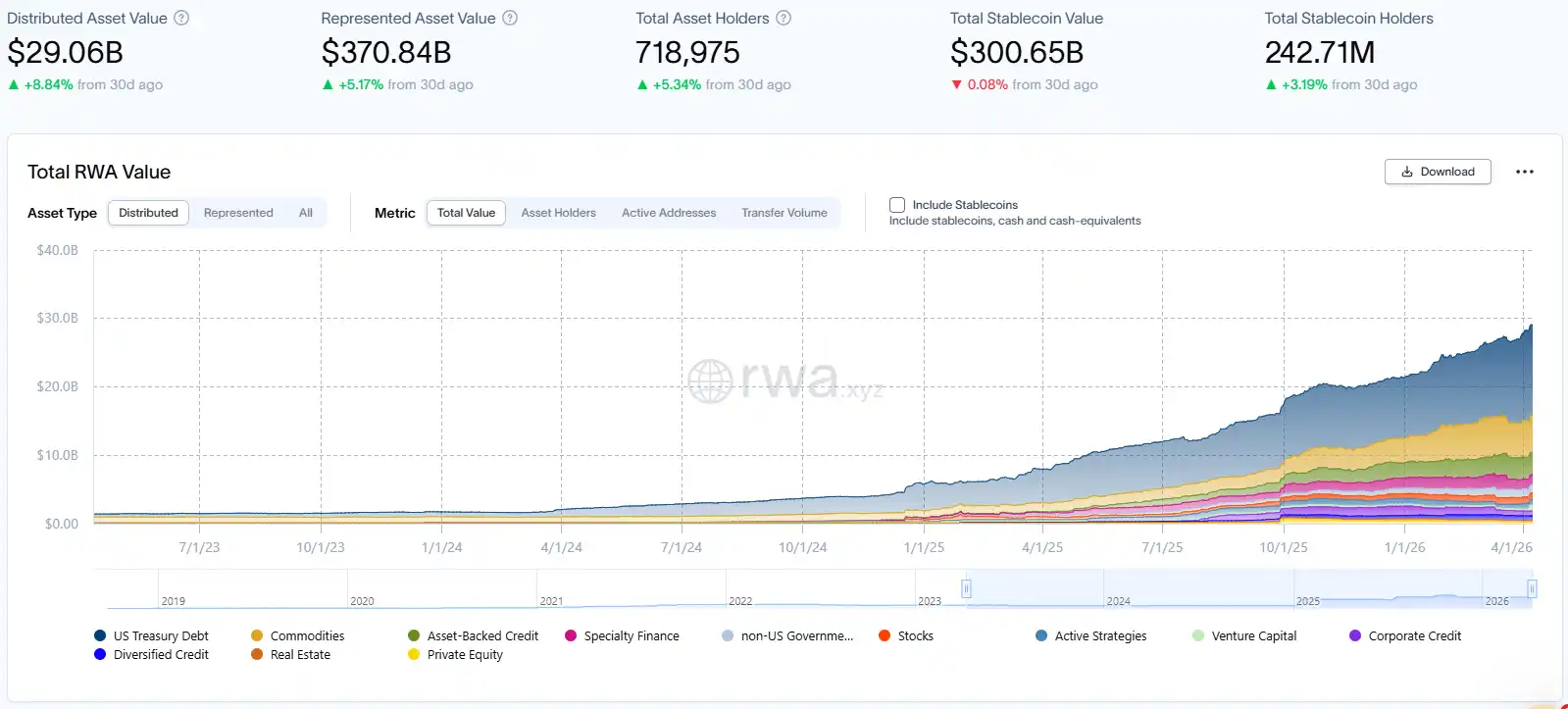
This week, the total on-chain market capitalization of RWA rose to $290.6 billion, the stablecoin market cap consolidated at a high level of $3,006.5 billion, monthly transfer volume hit a new high of $10.21 trillion, and the number of monthly active addresses surged by 15.24%, indicating accelerated recovery in retail participation.
Regulatory层面迎来历史性突破: HSBC and Standard Chartered officially obtained stablecoin licenses in Hong Kong, marking the beginning of the era of compliant stablecoins in Hong Kong; the US FDIC released draft guidelines for stablecoin issuance, and the Treasury Department plans to require issuers to bear AML and sanctions compliance obligations; South Korea, Dubai, Russia, and other regions are also advancing stablecoin and RWA legislation simultaneously, accelerating the global regulatory framework towards enforceable details.
Project level: Six Swiss banks, including UBS, plan to test the digital Swiss franc; Securitize provides tokenization services for the common stock of Nasdaq-listed company Currenc; SBI Ripple Asia completes the development of an XRP Ledger token issuance platform; Circle launches CPN Managed Payments to expand stablecoin payment services.
Funding level: Pharos raised $44 million in Series A funding to advance the RWA public chain; GSR led an investment in the tokenization platform Libeara; Gobi Ventures invested in Transak to expand compliant payment infrastructure in Asia.
Data Perspective
RWA Sector Overview
Latest data from RWA.xyz reveals that as of April 10, 2026, the total on-chain market capitalization of RWA rose to $290.6 billion, an increase of 8.84% compared to the previous month, maintaining growth for multiple consecutive months and becoming the main engine of scale expansion. The total number of asset holders increased to approximately 718,900, up 5.34% from the previous month, matching the asset growth rate.
Stablecoin Market
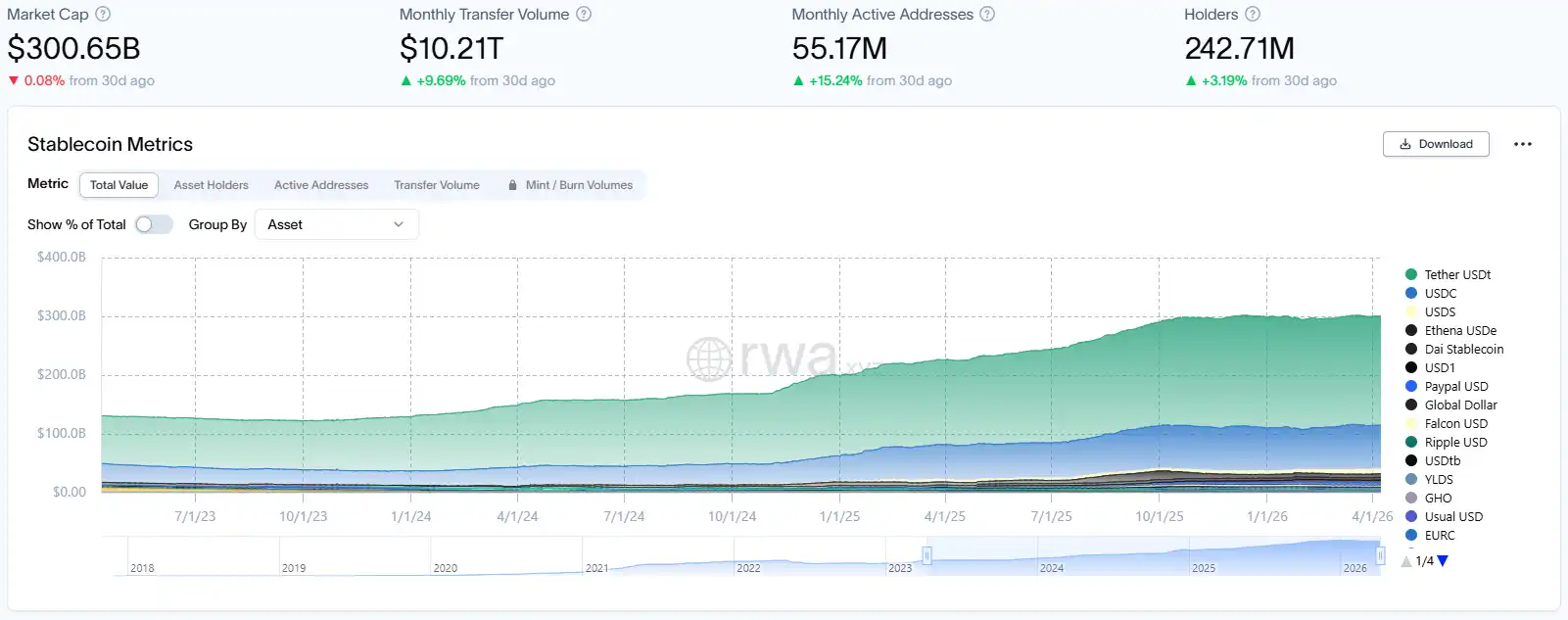
The total stablecoin market capitalization declined slightly to $3,006.5 billion, down 0.08% from the previous month, with the overall size consolidating at a high level and liquidity pools under marginal pressure; monthly transfer volume increased significantly to $10.21 trillion, up 9.69% from the previous month, hitting a recent high. The capital turnover efficiency reached 33.9x, improving again.
The total number of monthly active addresses increased to 55.17 million, a significant jump of 15.24% from the previous month; the total number of holders steadily expanded to 243 million, up 3.19% from the previous month. The resonance between the two indicates accelerated recovery in retail participation and a clear rebound in market settlement demand.
The leading stablecoins are USDT, USDC, and USDS. Among them, USDT's market cap increased slightly by 0.25% compared to the previous month; USDC's market cap decreased by 1.7%; USDS's market cap increased by 2.88%.
Regulatory News
Two Hong Kong Licensed Stablecoin Entities Plan Initial HKD-Denominated Issuance, Aiming for Launch in Coming Months
The Hong Kong Monetary Authority (HKMA) has issued the first batch of stablecoin issuer licenses under the Stablecoin Ordinance to two institutions: Anchorpoint Financial Limited (a joint venture between Standard Chartered Hong Kong, HKT, and Animoca Brands) and The Hongkong and Shanghai Banking Corporation Limited (HSBC). In the first phase, both institutions plan to issue Hong Kong dollar-denominated stablecoins, focusing on cross-border payments, local payments, and tokenized asset settlement, while exploring scenarios like programmable payments and supply chain finance. The licensed institutions must implement strict reserve management, price stability mechanisms, redemption arrangements, and AML risk controls, and officially launch their products around mid to second half of this year after completing technical and operational preparations. Both institutions plan to complete preparations and launch related services in the coming months.
Stablecoin Yield Debate Nears Conclusion, Clarity Act Enters Critical Countdown
According to a Cryptoinamerica report, the core disagreement between the US crypto industry and banks regarding stablecoin yield mechanisms may be nearing resolution. Multiple sources indicate that new rounds of communication have begun on a latest compromise proposal, with overall expectations turning optimistic, though details have not been disclosed.
The current focus of contention is how to provide yields or rewards to stablecoin holders without triggering outflows of bank deposits. A draft previously pushed by senators had caused industry dissatisfaction, with institutions including Coinbase and Stripe expressing concerns.
The market-focused Clarity Act is expected to enter committee review in late April. If the yield issue is alleviated, the legislative focus will shift to remaining topics like DeFi, tokenization, and token classification.
Additionally, a White House study on stablecoin yields and their impact on the banking system has yet to be released. It is reported that the study's conclusions are generally supportive of the crypto industry, but the reason for the delay remains unclear.
US FDIC Releases Draft Guidelines for Institutional Stablecoin Issuance, Covering Reserves, Redemptions, and Capital Requirements
According to Bloomberg, the US Federal Deposit Insurance Corporation (FDIC) has released draft guidelines for banks and fintech subsidiaries issuing stablecoins, covering regulations on reserve assets, stablecoin redemptions, permitted activities, and capital requirements. FDIC Chairman Travis Hill stated that with advancements in digital assets, technological developments in financial institutions, and the Trump administration's support for the crypto industry, stablecoins and tokenized deposit products continue to develop, with increasing application scenarios. This proposal is part of the rulemaking work by the FDIC, OCC, and Federal Reserve following the passage of the GENIUS Act last year. The FDIC plans to seek public comment on 144 specific questions, including permitted and prohibited activities, capital requirements, treatment of pass-through insurance, and the yield ban. The proposal will also reaffirm through regulation that tokenized forms of deposits still qualify as deposits under the Federal Deposit Insurance Act.
US Treasury Plans to Require Stablecoin Issuers to Bear AML and Sanctions Compliance Obligations
According to CoinDesk, the US Treasury's Financial Crimes Enforcement Network (FinCEN) and the Office of Foreign Assets Control (OFAC) will jointly issue a rule proposal requiring institutions issuing stablecoins in the US to establish robust anti-money laundering and sanctions compliance systems. This includes the ability to "intercept, freeze, and reject" suspicious transactions and fulfill obligations under the Bank Secrecy Act. The rules will implement the GENIUS Act passed last year, clarifying that issuers must identify high-risk customers and activities based on their business, cooperate with FinCEN's investigations into "primary money laundering concerns," and use risk-based measures to identify and block transactions that may violate US sanctions. Issuers with compliance systems deemed to have serious or systemic deficiencies may face enforcement actions.
South Korea's Ruling Party Proposes Applying Forex Regulations to Stablecoins, Mandates Trust for RWA Assets
According to Seoul Economic Daily, the latest consolidated bill from the ruling Democratic Party's Digital Asset Special Task Force has, for the first time, clarified issuance standards for Real-World Asset (RWA) tokenization. It requires issuers to deposit associated assets into a management trust pursuant to the Capital Markets Act, with detailed rules to be specified by presidential decree. For stablecoins, the bill stipulates that if used for foreign exchange transactions, they are considered payment instruments under the Foreign Exchange Transactions Act. Operators will be automatically subject to supervision by foreign exchange authorities without separate registration, and daily consumer payments may be exempt from reporting obligations. The bill also explicitly prohibits stablecoin issuers from paying interest to holders in any form. The Financial Services Commission must develop interoperability technical standards for stablecoins to prevent liquidity fragmentation when Korean won stablecoins are issued on multiple chains. Exchange and fragmented disclosure systems will be integrated into a unified disclosure system under the Digital Asset Industry Association. Core controversial clauses, such as exchange major shareholder ownership limits and stablecoin issuer holdings of bank shares, were not included in this bill.
Dubai's VARA Clarifies Three Pathways for Stablecoin and RWA Token Issuance Rules
According to Cointelegraph, the Dubai Virtual Assets Regulatory Authority (VARA) has issued issuance guidelines categorizing token offerings into three classes: Category 1 for fiat-backed and asset-backed tokens, Category 2 for tokens that must be distributed through VARA-licensed intermediaries, and Category 3 for exempt tokens with limited functionality. The guidelines require clear disclosure of reserve assets, redemption rights, and legal structure for stablecoins and RWA tokens, and strengthen the due diligence and ongoing compliance verification responsibilities of licensed distributors. VARA emphasizes an information disclosure mechanism centered on whitepapers and independent risk disclosure documents, providing a unified rule reference for issuing and distributing virtual assets in Dubai.
Russian Central Bank Advances Digital Ruble Launch to Counter Economic and Sanctions Pressure
According to DL News, the Russian Central Bank will officially launch the digital ruble on September 1, aiming to strengthen anti-corruption efforts, enhance the traceability of budget funds, and reduce reliance on the US dollar and SWIFT in foreign trade. The central bank requires large banks and retailers to provide digital ruble services starting in September, medium-sized institutions a year later, and all others must connect by 2028 at the latest. However, polls show about 51% of surveyed Russians are unwilling to use the digital ruble, with only 7% feeling adequately informed about the project. Most banking professionals also question its necessity. Regulators also hope to use the digital ruble for cross-border settlements with other CBDCs on platforms like mBridge to circumvent sanctions.
Local Insights
Hong Kong Mortgage Corp. Plans to Use Blockchain for World's Largest Digital Bond Issuance, Raising Up to HKD 12 Billion
According to Bloomberg, Hong Kong Mortgage Corp., a financial institution wholly owned by the Hong Kong government, is considering issuing its first digital bond, aiming to raise approximately HKD 10 to 12 billion. If the upper limit is reached, it would become the world's largest digital bond issuance by size. The multi-tranche bond is planned to be denominated in Hong Kong dollars and offshore yuan, with market sales potentially starting as early as next month; specific terms are still under discussion. The report notes that this move aligns with Hong Kong's policy direction to promote the normalized issuance of digital assets and tokenized bonds. The related digital bonds will be issued, traded, and settled via blockchain to shorten settlement cycles and reduce operational costs.
Project Progress
Six Swiss Banks, Including UBS, Plan to Test Digital Swiss Franc in 2026
According to SolanaFloor, six Swiss banks, including the largest bank UBS, plan to test a digital version of the Swiss franc in 2026 to explore its use in real banking and financial application scenarios.
Securitize Provides On-Chain Tokenization Services for Currenc Common Stock
According to The Block, Nasdaq-listed company Currenc Group Inc. has commissioned Securitize to tokenize its common stock, planning to enable 24/7 trading, fractional ownership, and support integration with DeFi protocols and algorithmic trading. Currenc is the first company to announce tokenization plans after Securitize was selected by the New York Stock Exchange to build a 24/7 on-chain securities platform. Securitize currently participates in about 70% of the US on-chain asset tokenization market, is a service provider for major on-chain RWA like the BlackRock BUIDL fund, and assisted Exodus with its on-chain stock issuance. Currenc focuses on cross-border payments, e-wallet infrastructure, and AI enterprise tools, and is advancing a proposed reverse merger with Animoca Brands. Securitize itself also plans to list on Nasdaq via a SPAC transaction initiated with Cantor Fitzgerald, with a proposed ticker symbol SECZ.
SBI Ripple Asia Completes Development of Japanese XRP Ledger Token Issuance Platform and Obtains Prepaid Payment Instrument License
According to CoinDesk, SBI Ripple Asia has completed the development of a token issuance platform based on the XRP Ledger and has registered as a Prepaid Payment Instrument issuer in Japan. The platform will support enterprises in issuing tokenized payment instruments on the XRP Ledger for prepaid scenarios, among others. Following registration, SBI Ripple Asia can compliantly conduct related prepaid payment business in Japan, providing infrastructure for XRP-based tokenized payments.
Fundrise's VCX Fund and Kraken Launch Tokenized Share Fund
According to Crowdfundinsider, VCX, an innovation fund under tech investment platform Fundrise, announced a partnership with cryptocurrency exchange Kraken to tokenize its fund shares. The tokenized asset, named VCXx, will be listed for trading on Kraken's exclusive xStocks platform, where investors can purchase using the USDG stablecoin or US dollars directly.
OFA Group Secures $15 Million Agreement to Provide RWA Tokenization Services for New York Real Estate Project
According to Globenewswire, Nasdaq-listed digital asset infrastructure company OFA Group (OFAL) announced an RWA tokenization service agreement with MD Queens Development. Its Hearth platform will provide blockchain infrastructure for a comprehensive development project in Long Island, New York, and conduct tokenization early in the development phase.
The tokens represent equity in the project's SPV and do not directly correspond to real estate ownership. OFA will receive $15 million in compensation, paid in stages based on project milestones. This move signifies RWA transition from concept to commercial implementation, with traditional large-scale real estate development formally integrating compliant on-chain financing and equity management.
BNB Chain Ecosystem RWA Platform Tiko Officially Launched Recently
According to an announcement on TIKO's Medium blog, the tokenized US stock trading platform Tiko has officially launched recently. Positioned as an RWA platform within the BNB Chain ecosystem, it supports users trading tokenized US stocks via self-custody wallets and USDT. The platform claims to hold dual licenses (Investment Dealer and VASP) from the Mauritius FSC, offers 1:1 asset backing, direct connectivity to licensed brokers for Nasdaq feeds, and enables low slippage with on-chain settlement in seconds.
Circle Launches CPN Managed Payments to Expand Stablecoin Payment Services
According to a report on Circle's official website, Circle has launched CPN Managed Payments. This new product targets banks, Payment Service Providers (PSPs), fintech companies, and large tech enterprises, offering wallet and blockchain infrastructure managed by Circle. Institutions can facilitate fiat-to-fiat and fiat-to-stablecoin payment flows on the CPN network without needing to build their own wallets, operate on-chain infrastructure, or directly handle stablecoin minting, custody, and compliance licensing.
BitMart to List USDCx for Spot Trading
Digital currency trading platform BitMart announced it will list USDCx (USDCX) and open USDCX/USDT spot trading on April 8. The platform has already enabled USDCX deposits starting at 8:00 UTC on April 8, with trading commencing at 10:00 UTC on April 8. USDCx is promoted by entities related to the Aleo ecosystem, and its token will gain secondary market liquidity through centralized exchange listings.
RWA Trading Platform MSX Lists New Assets Across Multiple Sectors
According to official news, MSX has listed the storage ETF $DRAM.M, AI chip testing equipment maker $AEHR.M, and military 3D printing supplier $VELO.M for spot trading.
Funding Dynamics
Pharos Raises $44 Million Series A to Advance RWA Public Chain Infrastructure
Public chain project Pharos announced the completion of a $44 million Series A funding round. Investors include Sumitomo Corporation CVC, SNZ, Chainlink, Flow Traders, and several undisclosed global financial institutions. Pharos is positioned as a financial-grade asset-native Layer 1 for RWA and traditional finance, touting its deeply parallel execution architecture and native compliance, aiming to capture a share of the approximately $50 trillion RWA and TradFi market. During the AtlanticOcean testnet phase, the project claims millions of user and address participations and has reached an RWA cooperation with photovoltaic company GCL Group for solar assets.
GSR Leads Investment in SC Ventures-Backed Tokenization Platform Libeara
According to The Block, market maker GSR has led an investment in SC Ventures-backed tokenization platform Libeara to support its strategy of building a Web3 "investment bank." GSR had previously acquired Autonomous and Architech to enhance its token advisory business, and this cooperation complements its missing "one-click tokenization" capability.
Libeara, founded in 2023, has supported over $1 billion in on-chain asset issuance, including Asia's first tokenized retail money market fund, and has obtained a Capital Markets Services license from the Monetary Authority of Singapore. GSR's Chief Legal and Strategy Officer stated that tokenizing any asset in a compliant manner is the company's goal, having engaged with tokenization projects involving movie studios, farmland, and real estate in the past two months. GSR is positioning itself as a comprehensive, end-to-end global digital asset and RWA capital markets partner, essentially a "Web3 investment bank."
Gobi Ventures Invests in Transak to Expand Compliant Stablecoin and Digital Asset Payment Infrastructure in Asia
According to official news, Gobi Partners announced an investment in global payment infrastructure provider Transak to support the expansion of compliant stablecoin and digital asset payment services in Asia.
Reportedly, Transak, founded in 2019, provides a regulated payment layer enabling bidirectional conversion between fiat and digital assets through a single API, covering KYC, AML, risk monitoring, licensing requirements, and local payment integrations. The company has obtained 21 regulatory approvals in the US, UK, Eurozone, Australia, Canada, and India, with plans to expand to the Middle East, Latin America, and Asia-Pacific. Transak has established its Asia-Pacific headquarters in Hong Kong and plans to deepen integration with regional payment networks and banking partners.
Insight Highlights
White House Report: "Banning Stablecoin Yields" Has Extremely Limited Boost for Bank Lending
The US President has signed the GENIUS Act, requiring stablecoin issuers to back stablecoins 1:1 with high-quality assets (USD, short-term Treasuries, reverse repos, money market funds, etc.) and prohibiting direct interest payments to holders. A report titled "Effects of Stablecoin Yield Prohibition on Bank Lending" released today by the White House Council of Economic Advisers indicates that, based on model predictions, a comprehensive ban on stablecoin yields would increase bank loans by only approximately $2.1 billion under baseline scenarios, about 0.02% of total loans, while resulting in a net welfare loss of about $800 million. Large banks would contribute about 76% of the new lending, and community banks about 24%. The report states that concerns about "deposit outflows" are quantitatively small because most stablecoin reserves still flow back into the financial system in forms like Treasuries, with only a limited portion truly exiting the credit multiplier. Even under extreme assumptions where reserves are entirely non-lendable cash and the Fed abandons its current framework, the increase in bank lending would only be about 4.4%. The report concludes that yield bans offer极小 (extremely little) protection for bank lending but would削弱 (weaken) the competitive benefits brought by stablecoins.
TD Cowen: White House Stablecoin Report Unlikely to Resolve Legislative Hurdles, Clarity Act Path May Get Harder
According to The Block, TD Cowen stated that the recent White House stablecoin report is unlikely to eliminate the political obstacles facing cryptocurrency legislation, and the path for the Clarity Act may become more difficult. The report indicated that banning stablecoin yields has a minuscule impact on bank lending, generating only a $2.1 billion growth (0.02% of total loans), a stance closer to the crypto industry's view than the banking sector's.
TD Cowen analysts believe that as long as small banks still view stablecoins as a threat to their deposit business, they will oppose crypto legislation unless the law explicitly prohibits stablecoin yields. The analysts also noted that the report suggests President Trump may want to allow stablecoin yields, meaning a compromise solution allowing platforms to pay usage rewards but prohibiting holding rewards might not gain presidential support, making passage of the Clarity Act more difficult. TD Cowen had previously lowered its expectation for the bill's passage this year to one-third.
S&P Global: Banks Remain Cautious on Stablecoin Initiatives, Most Still in Wait-and-See Mode
According to CoinDesk, the latest report from S&P Global Market Intelligence states that despite the stablecoin market cap rising to approximately $3.16 trillion and transaction volumes reaching trillions of dollars, US banks overall remain cautious. Only about 7% of small and medium-sized banks are developing relevant frameworks, with no substantive pilots yet. The report notes that banks are primarily concerned about deposits being "drained" by stablecoins, increased competition with new types of licensed entities, and unclear revenue models. Large global banks are more likely to explore issuing tokenized deposits or their own digital assets, while smaller institutions prefer acting as conduits between fiat and stablecoins. The report expects banks involved in cross-border business to be under the most pressure to upgrade systems to support multi-rail payments and wallet infrastructure.
Chainalysis: Projects Stablecoin Transaction Volume Could Reach $1,500 Trillion by 2035
According to The Block, a report by Chainalysis projects that stablecoin transaction volume could reach up to $1,500 trillion by 2035. Baseline growth alone would bring adjusted stablecoin transaction volume to $719 trillion by 2035, and with macro catalysts like demographic shifts and merchant adoption, the upper limit could be significantly higher. The report points out that in 2025, stablecoins processed approximately $28 trillion in "real economic activity," a figure that excludes trading noise and only counts payment, remittance, and settlement scenarios. Two major drivers include: an expected $100 trillion wealth transfer from older generations to more digitally-native Millennials and Gen Z between 2028 and 2048; and deeper embedding of stablecoins into merchant checkout and back-office payment systems, where users may not even perceive the underlying crypto technology. Chainalysis expects stablecoin payment volumes to parity with Visa and Mastercard between 2031 and 2039.
Tech Giants Eye Stablecoins Collectively: Meta Is Just the Beginning
PANews Summary: Global tech giants like Meta are collectively shifting towards a stablecoin payment strategy. From the early days of Libra (Diem) attempting to challenge monetary sovereignty and build its own financial system, the approach has now transformed into integrating with third-party stablecoin systems, with companies like Meta reaching a compliance consensus of "borrowing the path to run the car."
The core of this strategy is "traffic is king, compliance is outsourced." By handing over compliance and infrastructure to professional partners, giants can avoid regulatory risks and focus on controlling payment entry points and the underlying transaction data and ecosystem value. Besides Meta, Google, Apple, X, and Shopify are also actively integrating stablecoins to reduce cross-border settlement costs and position themselves for automated transactions in the AI era.
Stablecoins are evolving from speculative assets into the payment foundation of the next generation internet. The entry of major tech firms signals that a deep competition for control over digital life has officially begun.
Era of 'Easy Money' with Stablecoins Ending, DeFi Native Stablecoins May Become New Engine in Regulatory Gaps
PANews Summary: With the advancement of regulations like the Clarity Act, the stablecoin market is shifting from an "easy money" model to a "work-for-reward" model. The bill aims to block the path for centralized exchanges (CEXs) to provide passive interest to stablecoin holders through Treasury bill yields, intending to protect bank deposits and define the non-security nature of payment stablecoins.
However, the bill leaves room for "activity rewards," such as staking, providing liquidity, or trading incentives. This means stablecoins like USDC will tend towards being pure payment tools, while DeFi native stablecoins like USDe and USDS,凭借 (relying on) their derivative hedging or protocol profit-sharing logic, can utilize compliance gaps to承接 (take on) the yield engine function.
Overall, the stablecoin track is facing a dual-track transformation. Future yields will no longer belong to mere holders but to active participants contributing to protocol activities.







