
Author: starzq, Host of Day1Global Podcast
Robinhood and Coinbase, the two leading crypto and U.S. stock platforms, were founded in the same year and went public in the same year. In 2025, they charted completely different trajectories—Robinhood steadily rose to become a major bull stock of the year, while Coinbase rode a "roller coaster":
-
Robinhood: Gained over 200% in 2025, with its stock price soaring from under $40 at the start of the year to a high of $153, currently settling around $117. Its market cap surpassed $100 billion, and it was included in the S&P 500 index.
-
Coinbase: Experienced a roller coaster ride, starting the year at $250, hitting a historic high of $444 in July, but then pulling back significantly, now back around $250. Its annual return is nearly flat, with a market cap of approximately $65-68 billion.
Even more interestingly, six months ago (July 2025), Robinhood made a high-profile announcement at the ECC conference in Cannes, France—in the same castle featured in Hitchcock's film "To Catch a Thief"—declaring it would tokenize hundreds of U.S. stocks, including equities of unlisted companies like OpenAI and SpaceX, and make them available for trading to EU users.
At the time, we saw this as a signal of "stealing Coinbase's home turf."
Half a year later, how has the battle unfolded? Robinhood has not only accelerated in tokenized stocks but also entered the prediction markets, becoming the fastest-growing player in that business. Coinbase, not to be outdone, launched major moves at the end of 2025, announcing its entry into stock trading and prediction markets, vowing to become an "Everything Exchange."
The head-to-head confrontation between the two companies has finally arrived.
In this article, we provide an in-depth analysis of Robinhood and Coinbase's history and current state, as well as the key conditions for achieving 10x growth over the next 3-5 years. Welcome to read on.
Interjection: This article is based on our in-depth podcast interview from Day1Global, released on July 21, 2025, supplemented with the latest developments from the second half of 2025. The original interview video is included below for more details. Welcome to watch.

Audio version: Xiaoyuzhou, Apple, Spotify
I. How Similar Are These Two Companies?
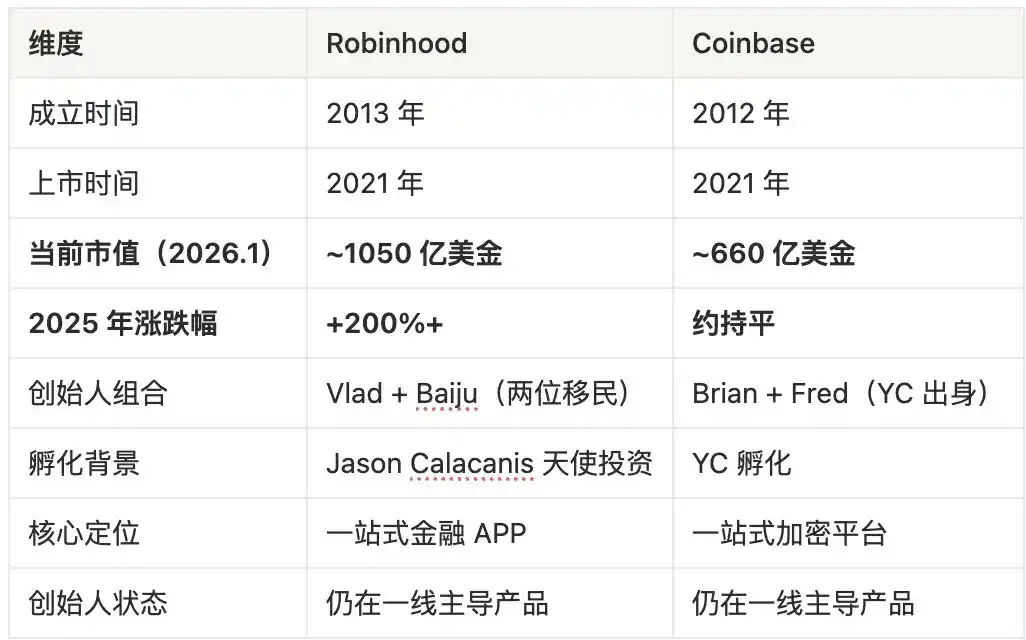
First, let's look at some striking similarities:
Both companies are products of the mobile internet era, both have a "founder-led"特质 (characteristic), and both are trying to become the "new Wall Street" in the minds of the next generation of young people.
But their DNA and paths are actually quite different.
II. Robinhood: The Retail Investor's Carnival, From Commission-Free to 0DTE Options
To quickly understand Robinhood, I recommend the movie: "Dumb Money."
This movie tells the story of the 2021 GameStop retail investor battle against Wall Street, and Robinhood was the main battlefield of that campaign.
Robinhood has three core features:
1. Mobile-First
From its founding in 2013 to early 2025, Robinhood only had a mobile app. It wasn't until 2025 that they launched a PC version—specifically targeted at professional traders.
This isn't a technical capability issue but a product philosophy: their core users are young people lying in bed buying stocks on their phones.
2. Zero-Commission Trading
Traditional brokers charge $5-10 per trade, which for a college student buying $10 worth of stock equates to a 50%-100% cost.
Robinhood bypassed this with the "Payment for Order Flow" (PFOF) model: it sells users' order information to market makers (like Citadel), who profit from high-frequency trading spreads and then return a portion of the profits to Robinhood.
The user experience is zero fees, but they are "invisibly harvested."
This model is essentially the same as MEV (Maximal Extractable Value) in DeFi.
3. Gamified Investment Experience
Robinhood's interface is extremely simple—swipe up to buy, one button completes the trade. Even candlestick charts were added much later; initially, there were only simple line charts.
This design turned investing into a "game," especially during the pandemic, when young Americans took the $1,000+ government stimulus checks and rushed into Robinhood to trade stocks and options.
The combination of pandemic + stimulus + gamified experience + gambling ban (online gambling is illegal in the U.S.) made Robinhood the "legal casino" for that generation of young people.
Robinhood's Revenue Structure: Cryptocurrency is Already Half the Pie
One data point that surprised me:
According to Q4 2024 earnings, Robinhood's total revenue was $1 billion, of which:
-
Transaction-based revenue accounted for 67%
-
Cryptocurrency trading accounted for 53% of transaction-based revenue
-
Options trading accounted for 33%
-
Traditional stock trading was less than 10%
This means that while Robinhood looks like a brokerage, cryptocurrency is already its largest source of revenue.
This also explains why they are so aggressively pursuing "tokenized stocks"—they are guiding their core user base (crypto-native users) towards a new asset class.
Robinhood's "Triple Strike" in the Second Half of 2025
First Strike: Inclusion in the S&P 500
In September 2025, Robinhood was officially included in the S&P 500 index, replacing casino operator Caesars Entertainment. This was a historic moment—from a meme stock trading platform to a blue-chip component, Robinhood completed its transformation from "rebellious kid" to "mainstream player."
The stock price surged 15% that day. Inflows from passive funds brought significant capital.
Second Strike: Prediction Markets Become the Fastest-Growing Business
In March 2025, Robinhood partnered with CFTC-regulated prediction market Kalshi to launch the prediction market Hub. Users can trade on sports events, economic data, political events, etc.
In just one year, this business exploded:
-
Over 1 million users participated in trading
-
Cumulative trading volume of 9 billion contracts
-
Annualized revenue has exceeded $100 million
-
November was the strongest single month ever, with trading volume exceeding 3 billion contracts
Prediction markets have become the fastest-growing product line in Robinhood's history.
Analysts believe this is one of the core drivers behind Robinhood's 200% stock price surge in 2025.
Even more aggressively, in November 2025, Robinhood partnered with top market maker Susquehanna International Group (SIG) to acquire the CFTC-licensed exchange MIAXdx (formerly LedgerX). This means Robinhood is no longer content with being an "intermediary" but wants to run its own prediction market exchange.
CEO Vlad said at the launch event: "What excites us most is the ability to innovate products ourselves, rather than just selling what others already have."
Third Strike: Full Rollout of Tokenized Stocks
We discussed Robinhood's tokenized stock announcement in our July 2025 podcast. At that time, they had deployed about 200 stock tokens on Arbitrum.
Half a year later (January 2026), that number has skyrocketed to nearly 2,000.
Specific data:
-
Cumulative minting volume: $55.5 million
-
Market cap: Over $13 million
- Coverage: 73% U.S. stocks + 24% ETFs + some commodities and crypto ETFs
-
Users can trade 24/7 (not limited to U.S. market hours)
-
Minimum investment threshold: Only 1 Euro
CEO Vlad posted on X: "slowly, then all at once"—this is exactly the state tokenized stocks are experiencing.
More importantly, Robinhood is developing its own Robinhood Chain (an L2 chain based on Arbitrum), specifically optimized for RWA tokenization, planned to support 24/7 trading, self-custody, and cross-chain bridging.
The Head of Strategy at Offchain Labs (Arbitrum developer) revealed that Robinhood has a "three-phase plan":
-
Phase 1 (Now): Tokenized stocks can only be traded within the Robinhood app
-
Phase 2: Enable 24/7 trading via Bitstamp
-
Phase 3: Stock tokens become fully permissionless assets; users can withdraw to external wallets and use them in DeFi
This is the real ambition—to make stocks flow as freely as ERC-20 tokens.
An Exciting Policy Signal
Vlad mentioned a detail in a 2025 interview: a clause in the U.S. "Beautiful Act" under discussion that has bipartisan support—
Every child born in the U.S. would automatically receive a brokerage account at birth, with $1,000 deposited directly by the government.
This is like an "investment version of Nuerhong" (a Chinese tradition of storing wine for a daughter's wedding)—start dollar-cost averaging from birth and witness the power of compound interest when they grow up.
If Robinhood can secure this partnership, user growth could explode.
III. Coinbase: The AWS of the Crypto World
If Robinhood is like Amazon's e-commerce frontend—you can buy anything with an extremely smooth experience—then Coinbase is more like Amazon's AWS—you might not感知 (perceive) its presence, but the entire ecosystem runs on it.
Coinbase's Origin Story
Founder Brian Armstrong's story is quite interesting:
After graduating from Rice University, he took a gap year in Argentina and witnessed the collapse of the Argentine currency firsthand. Back in the U.S., during a Thanksgiving holiday, he came across the Bitcoin whitepaper on Reddit and was instantly captivated.
His idea was simple: Why can't there be a Bitcoin wallet as simple as a bank account?
So he worked as a security engineer at Airbnb to gain experience, then applied to Y Combinator (YC) and started Coinbase.
An interesting piece of gossip: Vitalik (Ethereum founder) once interviewed at Coinbase but ultimately said, "I have other things to do," and declined the offer.
Those "other things" were the newly launched Ethereum in 2014.
Coinbase's B2B Empire
Many people's impression of Coinbase is still that of a "crypto exchange," but in reality, its B2B business is its true moat:
1. Coinbase Prime: Institutional Custody
Almost all major Bitcoin ETFs (BlackRock, Bitwise, etc.) use Coinbase for Bitcoin custody behind the scenes. It currently custodies assets worth more than $200 billion.
2. Circle Partnership: Largest Distributor of USDC
Coinbase is an early investor in and the largest distribution channel for USDC. According to the agreement:
-
Coinbase keeps 100% of the interest generated on USDC held on its platform
-
Coinbase keeps 50% of the interest generated on USDC held on other platforms
This means that half the money Binance makes promoting USDC goes to Coinbase.
This is also why Binance started promoting other stable币 (stablecoins)—rather than送钱 (giving money) to a competitor, it's better to create your own.
3. Base Chain: Ethereum's Most Formidable L2
Coinbase built its own Ethereum Layer 2 network, Base, which currently handles over 10 million daily transactions. While some worry about the conflict of interest in an "exchange running a public chain," Base has performed well in terms of user growth and ecosystem development.
4. Crypto as a Service: AWS for Crypto
Coinbase packages its trading, custody, wallet, and payment capabilities into APIs, allowing traditional financial institutions to integrate directly. Reportedly, over 200 institutional clients are already using it.
This means that in the future, when you buy cryptocurrencies on traditional platforms like BlackRock or Charles Schwab, the backend service provider will likely be Coinbase.
Coinbase's "Last Stand" at the End of 2025
Watching Robinhood's rapid progress, Coinbase finally made major moves in December 2025.
2025.12.17: Announced the "Everything Exchange" Strategy
This might be the biggest product upgrade in Coinbase's history:
-
Entered stock trading: U.S. users can directly buy and sell U.S. stocks and ETFs on Coinbase, settled in USD or USDC
-
Launched prediction markets: Partnered with Kalshi to allow users to trade on sports, politics, economics, and other event outcomes
Launched Coinbase Tokenize: An RWA tokenization platform for institutions -
Launched AI Wealth Advisor: Uses AI to provide investment advice to users
-
Launched Coinbase Business: A one-stop crypto service for businesses
Brian Armstrong said at the launch event: "Our goal is to make Coinbase a complete financial platform—cryptocurrency, stocks, derivatives, prediction markets, all in one APP."
This is the first time Coinbase has directly targeted Robinhood's retail business.
2025.12.22: Acquired The Clearing Company
Just five days after the announcement, Coinbase announced the acquisition of prediction market company The Clearing Company. Its founder, Toni Gemayel, is called a "shaper of the modern prediction market landscape."
Coinbase stated that this acquisition would bring "the specialized talent needed to scale prediction markets."
Coalition for Prediction Markets: Industry Alliance Formed
On December 11, 2025, Kalshi, Crypto.com, Robinhood, Coinbase, and Underdog jointly formed the "Coalition for Prediction Markets" to jointly promote prediction market-friendly regulation in the U.S.
Interestingly, competitors Robinhood and Coinbase found themselves on the same side for this issue.
Prediction markets have become a giant market with nearly $28 billion in global trading volume, and both companies are competing for this pie.
Coinbase's Compliance Advantage
Charlie shared a detail: Every Coinbase employee's email signature has a link—Stand With Crypto.
This is a public advocacy platform supported by Coinbase, with over 2 million signatures supporting cryptocurrency. It also rates U.S. lawmakers on their Crypto-friendliness.
Since 2020, Brian Armstrong has frequently traveled to Washington D.C. for policy lobbying. Coinbase, along with investors like A16Z, formed a "Crypto lobbying alliance" with deep布局 (layout) at the regulatory level.
This compliance advantage is hard to replicate.
In contrast, although relations have improved recently, Robinhood's relationship with regulators is still not as smooth as Coinbase's.
IV. Who Will Win? Who Is the Next 10x Stock?
Six months ago, we thought these two companies weren't doing exactly the same thing. But now, it seems a head-on confrontation is inevitable:
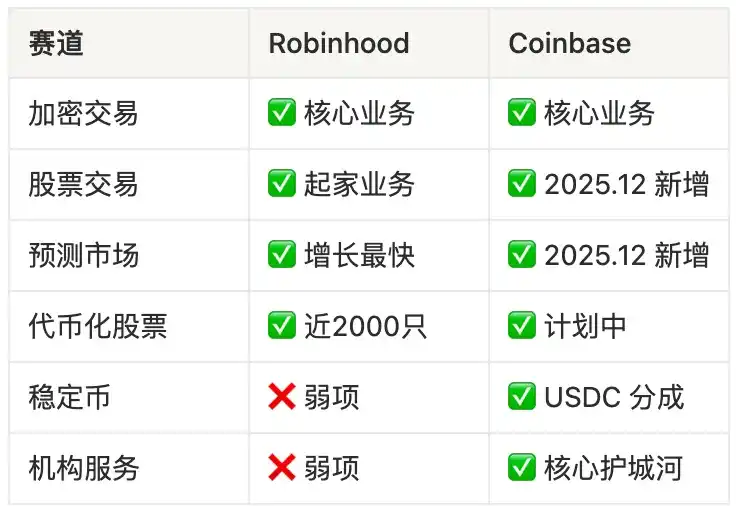
But their core strengths remain different:
-
Robinhood is a To C super APP: Acquires young retail investors with an极致 (ultimate) user experience, then monetizes through trading, subscriptions, credit cards, prediction markets, etc. CEO Vlad has a "cult leader"-like personal charm, reminiscent of Jobs.
-
Coinbase is a To B infrastructure: Empowers the entire industry through custody, data, API services, similar to Visa's role in payments—letting partners make big money while taking a cut itself, potentially ending up larger than any single partner.
Finally, back to the title's question: Over the next 3-5 years, which is more likely to become a 10x stock, Robinhood or Coinbase?
Let's do some math first:

From a purely mathematical perspective, Coinbase's 10x target is easier to achieve—$660 billion is roughly Visa's size, while Robinhood would need to surpass JPMorgan to become one of the world's largest financial institutions.
But investment isn't just about the destination; it's also about the path.
Conditions Needed for Robinhood's 10x Path:
-
Prediction market annual revenue grows from $100 million to $3-5 billion (if prediction markets truly become a "new form of media,"参考 (reference) DraftKings + FanDuel's scale)
-
Tokenized stocks become mainstream, capturing 10-20% of the traditional brokerage market share
-
Secures the U.S. "newborn brokerage account" policy红利 (dividend)
-
Maintains leading position in cryptocurrency trading
Core Variable: User Mindshare. If the next generation of Americans thinks of "investing" and immediately thinks of Robinhood, just like we think of "search" and think of Google, 10x is not a dream.
Risk: Valuation is already high (P/S 25x), and much growth expectation is already priced in. If prediction markets or tokenized stocks underperform, it could face a valuation correction.
Overall Judgment: 10-15% probability of 10x in 3-5 years
Conditions Needed for Coinbase's 10x Path:
-
Bitcoin/Ethereum enters a new major bull market, doubling trading volume and custody scale
-
USDC circulation grows from $70 billion to $200-300 billion, making stablecoin revenue a cash cow
-
B2B business (Prime, CaaS) wins over traditional financial institutions, becoming the "AWS for crypto"
-
Base chain ecosystem explodes, significantly increasing on-chain fee revenue
-
New businesses in stock trading and prediction markets prove successful
Core Variable: Overall size of the crypto industry. If the total crypto market cap grows from $3 trillion to $15-20 trillion, Coinbase, as infrastructure, benefits the most.
Risk: Highly dependent on crypto cycles; revenue can halve during bear markets. New businesses (stocks, prediction markets) started late and need time to catch up to Robinhood.
Overall Judgment: 15-20% probability of 10x in 3-5 years
V. Conclusion
The "Wall Street" in the eyes of the next generation might be a combination of Robinhood + Coinbase.
"For the next generation's mindshare, Robinhood might be the primary consumer entry point.而 (And) Coinbase will become the core service architecture behind traditional Wall Street institutions and the new generation of Crypto asset management. Both sides can win."
As for who can grow from the current hundred-billion level to JP Morgan's $800 billion?
It depends on the trends of the next 10 years—it could be the massive爆发 (explosion) of stablecoin payments, the普及 (popularization) of tokenized stocks, prediction markets becoming a new social media入口 (entry point), or something we can't even imagine yet.
But one thing is certain: the mega-trend of stock-crypto integration is irreversible, and both companies are standing at the crest of this wave.
If you don't want to miss out, you can follow Cathie Wood's example and配置 (allocate) both, haha. However, Robinhood rose over 200% in 2025, and its current P/S ratio is 25x, significantly higher than its historical average of 11x. Short-term valuation is偏高 (on the high side); if entering,建议 (suggest) waiting for a pullback. Coinbase is relatively平稳 (stable), with no major valuation changes, but the effects of its strategic shift at the end of 2025 still need to be observed.
Disclaimer: All discussions in this article do not constitute investment advice, DYOR (Do Your Own Research).







