Author: Bryan Vong, Foresight Ventures
In the six months from September 2025 to March 2026, every major player in the global payments space made significant moves. OpenAI and Stripe jointly released the Agentic Commerce Protocol (ACP). Google launched the Universal Commerce Protocol (UCP). Within a week, Visa and Mastercard successively released their respective Agent payment frameworks. Two months later, Coinbase's x402 protocol had processed over 15 million transactions on the Base chain. In March 2026, Stripe and Tempo jointly released the Machine Payments Protocol (MPP).
These intensive actions by tech giants and financial institutions are no coincidence; they are a collective response from the payments industry to the same challenge: when AI Agents become the most active consumers on the internet, the existing payment infrastructure is fundamentally inadequate for their operational needs.
Every design of the traditional payment system is based on the premise of "human operation": it relies on browser interfaces, manually filling out forms, clicking "confirm payment," and verifying identity through CAPTCHAs. The operational logic of an Agent is completely different: it requires machine-readable standard interfaces, millisecond-level authorization responses, and infrastructure adapted for high-frequency, small-amount settlements.
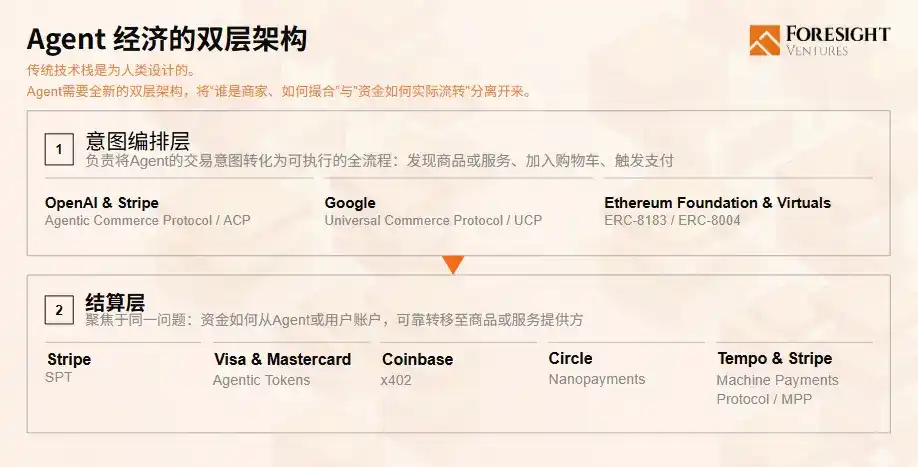
This infrastructure battle will not be dominated by a single protocol but is forming a clear two-tier architecture. The intent layer defines "who is the merchant and how to match," while the settlement layer defines "how funds actually flow." The two layers are independent and evolve separately but are indispensable. Without either layer, the commercial closed loop of the Agent economy cannot be realized.
Part One: Intent Orchestration Layer
The intent orchestration layer is responsible for translating an Agent's transaction intent into an executable end-to-end process: discovering goods or services, adding them to a cart, and triggering payment. This layer has formed two distinct tracks.
1.1 Agent Shopping on Behalf of Humans
The core conflict in this track is not payment, but access. Traditional e-commerce platforms are designed for human users; Agents cannot parse visual pages or click interactive elements. For an Agent to shop on behalf of a human, merchants must provide machine-readable, standardized interfaces.
ACP (Agentic Commerce Protocol): AI Shopping Experience within a Closed Ecosystem
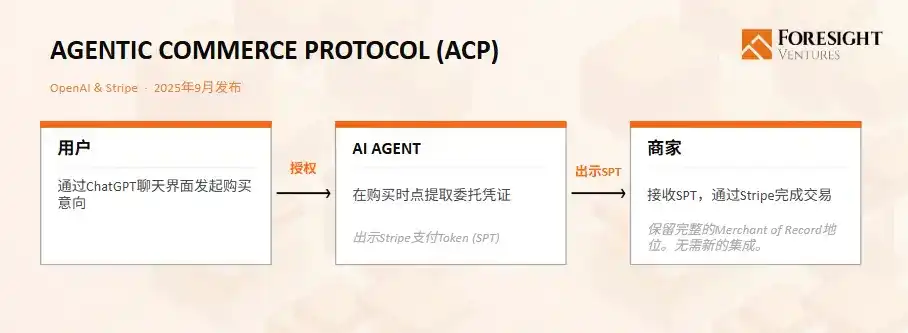
ACP was jointly released by OpenAI and Stripe in September 2025. Its core mechanism is delegated payment: users grant payment authority to the Agent upon confirming a purchase. The Agent completes the transaction using payment credentials compliant with the Delegated Payment Spec, and the merchant retains the Merchant of Record status. Currently, Stripe's SPT is the first and only implemented solution in this system.
ChatGPT Instant Checkout launched in September 2025 but was shut down in March 2026 due to low conversion rates. OpenAI has shifted its strategic focus to product discovery, where ChatGPT displays products and then directs users to the merchant's native site to complete the transaction. The ACP protocol itself remains in a more streamlined form, supporting exclusive ChatGPT apps for several large retailers. Merchants must apply to join, and OpenAI controls the display.
UCP (Universal Commerce Protocol): Long-term Layout of Open Standards
UCP was announced personally by Google CEO Sundar Pichai at the NRF retail annual meeting in January 2026 and has garnered over 30 partners, including mainstream platforms like Shopify, Stripe, Visa, Mastercard, Walmart, and Wayfair. The core mechanism of UCP is merchant capability declaration: merchants publish a JSON-formatted UCP configuration file under their own domain, declaring their supported transport and payment capabilities, which AI can read directly. Google aims to position Gemini as the core discovery layer for Agent shopping.
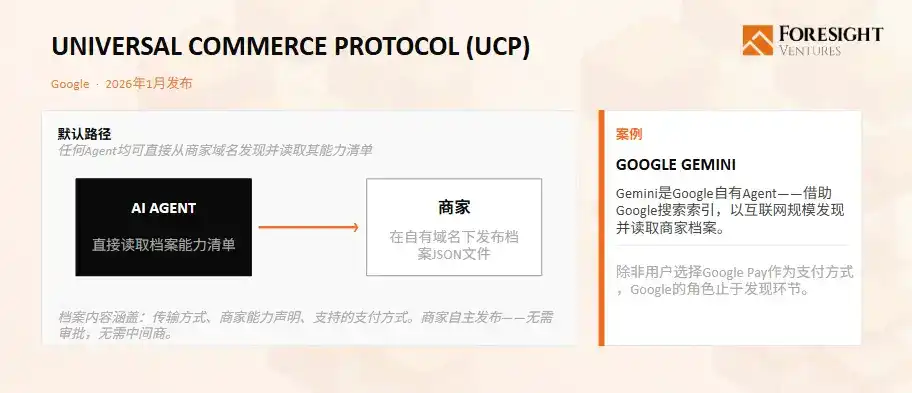
The key difference is that Google deliberately avoids the role of a middleman. It doesn't need to own the transaction itself, only control the upstream环节 of product discovery. ACP and UCP are not in competition; they represent two different market propositions: the former trades a closed ecosystem for极致 user experience and control, while the latter trades open standards for greater scale effects and interoperability.

1.2 Transactions Between Agents
If Track A solves how Agents shop on behalf of humans, Track B addresses a more fundamental problem: when both parties to a transaction are Agents, with no human merchant involved, where does trust come from? Agents lack credit背书, and consumer protection laws are inapplicable. The core矛盾 is: how to ensure the reliability of value exchange in a zero-trust environment.
ERC-8183 + ERC-8004: Trustless On-Chain Task Contracts
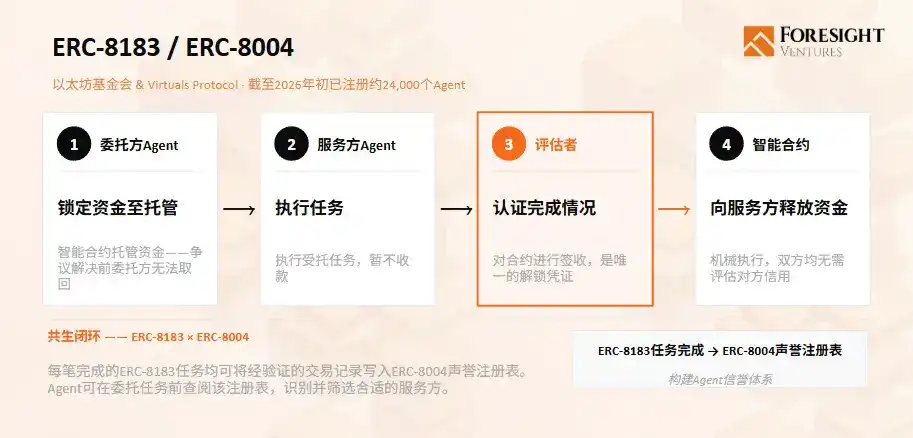
ERC-8183 was launched in March 2026 by the Ethereum Foundation's dAI team in collaboration with Virtuals Protocol. Each Job consists of three parties: Client (delegator), Provider (service provider), and Evaluator (assessor). Funds are escrowed by a smart contract until task acceptance is completed. The transacting parties do not need to trust each other, only the contract itself. ERC-8004 is a配套 identity protocol where each Agent registers on-chain and accumulates a reputation score based on historical transactions. Currently, about 24,000 Agents are registered network-wide.
Virtuals Protocol's Butler is the biggest promoter of this system, decomposing complex tasks and assigning them to specialized Agents for execution. This model aims to promote this三方 contract mechanism as an open standard, but widespread developer adoption still requires time.
The structural differences between the two tracks directly affect the choice of settlement layer protocol: Track A transactions naturally connect to fiat channels, while Track B transactions naturally rely on stablecoin channels.
Part Two: Settlement Layer
If the intent orchestration layer determines "what to trade," then the settlement layer solves "how the money reliably arrives." Currently, five protocols are competing in this领域, with their design philosophies and applicable scenarios各有侧重.
2.1 Delegated Payment / SPT (Stripe)
- Core Idea: Extend the existing银行卡 payment ecosystem rather than rebuild it.
- Operation: When a user authorizes an Agent, Stripe generates a Shared Payment Token (SPT) saved by the Agent. During a transaction, the Agent presents this time-limited, amount-capped token to the merchant. Funds are then settled through Stripe's standard银行卡 payment channels. In the backend, Stripe has integrated with Visa's "AI-Ready" and Mastercard's "Agentic Token" interfaces. Thus, regardless of the underlying card network, merchants face a unified SPT interface.
- Applicable Scenarios: Very suitable for standard retail and large transactions, especially for Agent-to-Agent payments that need consumer protection mechanisms like credit card chargebacks.
- Main Limitation: Its architecture relies on traditional card networks and is not suitable for high-frequency, micro-value (e.g., less than 1 cent) machine-to-machine payment scenarios.
2.2 Visa Intelligent Commerce and Mastercard Agentic Token
- Core Idea: Upgrade the tokenization technology of traditional card organizations to adapt to Agent transactions.
- Operation: Use dynamically encrypted payment tokens to replace real card numbers. Each token is bound to metadata such as the Agent's identity, spending limit, validity period, and range of merchants it can trade with. Final fund清算 is still done through the original银行卡 network.
- Development Status: Mastercard completed the world's first fully identified Agent transaction in September 2025 in collaboration with the Commonwealth Bank of Australia. Visa has also completed initial deployments in Europe through its "AI Ready" program.
- Main Limitation: The inherent minimum handling fee of银行卡 networks poses a hard constraint, making it difficult to support the potentially massive volume of micro-payments below $1 that may occur in the future.
2.3 x402 (Coinbase)
- Core Idea: Return to the underlying internet protocol, utilizing the rarely used "402 Payment Required" status code in the HTTP standard to natively integrate payments.
- Operation: When an Agent requests a resource, the server returns a 402 response with payment parameters. After the Agent signs the authorization, a settlement node within the protocol completes an atomic swap on the blockchain (typically using USDC), taking about two seconds. The entire process requires no account registration, API keys, or identity verification.
- Data & Status: As of the end of 2025, the protocol had processed over 100 million transactions across multiple blockchains. However, analysis indicates that a significant portion of this traffic belongs to internal testing and循环 transactions within the protocol. Although its architecture is designed for sub-cent payments with no minimum fee限制, the current challenge is to increase the density and quality of transactions in real business scenarios.
2.4 Nanopayments (Circle)
- Core Idea: Serve as an enhanced solution to x402, specifically optimizing the economic model for extremely high-frequency, extremely small-value payment scenarios.
- Operation: It also triggers an HTTP 402 response but employs a batch processing architecture at the settlement layer: the payer first deposits USDC into a Circle gateway. Subsequent payments are authorized via off-chain signatures and settled on-chain periodically in batches. This spreads the gas fee cost thin enough to be negligible, supporting payments as low as one-millionth of a dollar.
- Main Limitation: Both transacting parties must预先 open an account and deposit funds at the Circle gateway, making it a semi-closed system to some extent, and it cannot achieve real-time atomic delivery of funds. The protocol launched its testnet in March 2026.
2.5 MPP (Tempo + Stripe)
- Core Idea: Create a unified, pluggable multi-rail payment framework and apply to become the "official implementation" of HTTP 402.
- Core Innovation: It allows developers to integrate multiple payment rails under the same protocol framework. Agents can choose on-demand during a transaction:
- Tempo Stablecoin Rail: Supports per-transaction on-chain settlement or off-chain session batch settlement.
- Stripe Fiat Rail: Completes银行卡 payments via Shared Payment Tokens.
- Card Network Direct Rail: Directly uses Visa/Mastercard's智能 tokens.
- Bitcoin Lightning Network: Integrated via Lightspark.
- Key Feature: MPP introduces the concept of "Payment Sessions," similar to OAuth authorization. After a one-time pre-authorization and top-up, the Agent can achieve seamless, continuous real-time payments within the session without needing to go on-chain for every transaction.
- Strategic Significance: Stripe plays a dual role here—it is both a co-creator of the protocol and one of the payment options provided within the protocol. This means that无论 the market ultimately favors the open HTTP 402 system or traditional fiat channels, Stripe can ensure its core payment business is embedded in the future ecosystem.
Part Three: Status, Challenges, and Opportunities
3.1 Status and Challenges
In the past six months, the core related protocols have all been launched, but commercialization has generally lagged. In the settlement layer, x402 leads in transaction volume, but the real daily commercial transaction value is approximately $28,000; in the orchestration layer, the core ACP product was shut down due to low conversion rates. Newer protocols like ERC-8183 and MPP face the common situation where the narrative is ahead of implementation. This marks a critical stage: protocol architecture construction is largely complete, but scaled commercial application has not yet begun.
The current core challenge is the fragmentation of the intent orchestration layer. Merchants need to deal with multiple independent standards, SDKs, and compliance processes simultaneously, leading to high integration costs and unclear expectations. History shows that fragmented markets eventually催生 a unified integration layer, but this time may be different: platforms controlling traffic入口 (like OpenAI, Google, Microsoft) have strong incentives to build and maintain their own closed ecosystems rather than promote open integration. This logic is playing out simultaneously in global markets, and the final格局 will likely trend towards multiple regional closed ecosystems coexisting in parallel, rather than a single unified open standard. Therefore, the future integration layer will not be led by platforms but built by third-party infrastructure providers serving merchants.
3.2 Market Opportunities
Based on the above judgment, opportunities clearly exist at two levels:
Settlement Layer: The Most Certain Opportunity
Regardless of how fragmented the upper-layer ecosystems become, payment is a fundamental problem that any Agent must solve. A clear trend is: the orchestration layer continues to fragment due to platform interests, while the settlement layer is moving towards abstraction and integration due to developer efficiency pressures. Developers cannot maintain independent payment integrations for each ecosystem, and the economic incentive to consolidate into a unified solution is growing stronger.
This places clear demands on Agent wallets: they must support multiple payment rails. Fiat rails (e.g., SPT, Agentic Token) cover traditional physical goods consumption, while stablecoin rails (e.g., x402, MPP Session) cover on-chain services and A2A transactions. Both scenarios coexist and are unlikely to merge in the short term. The responsibility for flexible adaptation lies with the Agent side, not the merchant side: merchants choose which payment rails to support, a relatively stable decision for them; enterprises只需 configure stablecoins and authorized cards for their Agents, and the Agents can complete payments according to the rails supported by the counterparty. Wallets capable of handling multiple rails can cover the Agent's complete consumption scenario. Their value will accumulate deeply with every transaction跨越 different ecosystems, forming a deep infrastructure moat.
A2A Economy and Business Model Restructuring: A Long-term Blue Ocean Direction
The real market gap lies in application-layer services. The current A2A economy is still confined to crypto-native scenarios. Technically, it is entirely feasible for an Agent to "hire" another Agent to complete real-world tasks (e.g., data analysis, content creation, legal research, code review), but the corresponding supply of pay-per-call API services is extremely scarce. This is the biggest long-term opportunity and the direction with the least competition currently.
This opportunity is currently constrained by a real cold-start dilemma: reputation-based trust mechanisms like ERC-8183 require sufficient transaction density to generate meaningful trust signals. Microsoft predicts the number of active AI Agents will reach 1.3 billion by 2028, and there is an orders-of-magnitude gap between the current number and this target. This is not a temporary gap that will naturally resolve but a threshold that the A2A economy must cross to expand beyond crypto.
Its deeper significance lies in business model restructuring. The mainstream internet models of advertising and subscription are based on the assumption that "the user is human." Agents are not influenced by ads and do not need monthly subscriptions; they only pay for the results of individual tasks. The "pay-per-call" model represented by HTTP 402 provides a new path for API service providers: shifting from selling access rights to selling确切 results, enabling finer-grained value exchange. The expansion of the A2A economy and the prevalence of HTTP 402 are two sides of the same coin.
Conclusion
Agent commerce will evolve along two dimensions: the consumer side (Agent shopping for humans) will primarily rely on card rails, with development depending on the establishment of corporate authorization and user trust; the inter-Agent (A2A) side is technically ready on stablecoin rails, awaiting the scaling of applications and services.
The final格局 will be the协同 evolution of a two-layer protocol stack: the intent orchestration layer determines how transactions happen, and the settlement layer ensures how value flows.
For builders, the key now is to build broad access and integration capabilities. Infrastructure that can automatically route跨-protocol transactions and shield developers from underlying complexity will occupy a structural advantage when the market explodes. This is a value that沉淀 silently and is difficult to replace.
The key trigger for the inflection point will be the moment enterprises are willing to delegate expenditure authorization to Agents—including auditable transaction tracking, budget delegation mechanisms, and clear liability attribution when an Agent makes a mistaken purchase. At that time, Agent wallets that cover multiple payment rails and easy-to-use "pay-per-call" service directories will become the two most critical and yet unoccupied pieces of infrastructure. Neither position currently has a strong incumbent, and both will become crucial at the same moment.