Predicting the 'Side Hustles' of Market Giants: From Online Betting to Offline Store Openings

比推Xuất bản vào 2026-02-04Cập nhật gần nhất vào 2026-02-04

Tóm tắt

The competition between leading prediction market platforms Kalshi and Polymarket has expanded from online to offline. On February 4, Kalshi distributed free groceries (up to $50 per person) at a market in New York City, promoting its event-based trading platform with the slogan “We believe in free markets.” The campaign targeted economic concerns like inflation and aimed to attract users by lowering entry barriers. On the same day, Polymarket announced plans to open a permanent free grocery store in New York, supported by a $1 million donation to address food security. The store, set to open on February 12, aligns with Polymarket’s mission to make prediction markets accessible and socially impactful. This offline move reflects intensifying competition. Kalshi, compliant in the U.S., has partnered with platforms like Coinbase and reported annualized trading volume exceeding $100 billion. Polymarket faces regulatory challenges, including bans in Ukraine and Portugal, and restrictions in Nevada. It also competes with new entrants like Opinion, which raised millions and gained rapid traction. Other players, including Crypto.com, Kraken, Robinhood, and Hyperliquid, are also entering the prediction market space, driven by growing user interest in event-based trading. As global events like elections and sports continue to attract attention, prediction markets are poised for further growth, keeping platforms like Kalshi and Polymarket in a fierce battle for users.

Author: Ma He, Foresight News

Original Title: Behind the 'Side Hustles' of Prediction Market Giants: Opening Offline Grocery Stores Out of Anxiety?


Who would have thought that the competition between the two online prediction market giants, Kalshi and Polymarket, has already extended from purely online to offline.

At 12:00 PM on February 4th, Kalshi gave away free groceries to residents at the West Side Market on 84 Third Avenue in New York City, with a limit of up to $50 per person.

Kalshi CEO Tarek Mansour stated, "We believe in free markets," making it clear that this move aims to promote the concept of prediction markets through tangible benefits to the public.

The highlight of the event lies in its clever marketing strategy. First, it directly ties into current economic hot topics—inflation and rising living costs have become pain points for the American public. By offering free groceries, Kalshi not only provides immediate value but also positions itself as an "event contract exchange," allowing users to trade on events such as politics, economics, and sports.

For example, users can predict fluctuations in grocery prices or changes in economic indicators on the platform, thereby transforming the offline experience into online participation. Second, the event’s location in a high-density, high-consumption city like New York maximizes exposure. Official videos show crowds rushing in at the opening moment, likened to "Christmas revisited."

The event had a low barrier to entry: no app download was required to participate; one only needed to shop in-store, and Kalshi would cover the bill. This not only lowered the entry barrier for users but also reinforced the platform’s approachable image.

Unlike Kalshi’s short-term promotion, Polymarket’s offline activity is more long-term and ambitious.

On February 4th, Polymarket announced it would open a "free grocery store" in New York, located at 7 Madison Avenue, scheduled to officially open on February 12th. The store is supported by the Food Bank for New York City, with the project breaking ground in late 2025 and a lease agreement already signed. Additionally, Polymarket donated $1 million to address security concerns.

Polymarket’s announcement coincidentally came on the same day as Kalshi’s event, even with overlapping opening times, which is seen as a direct response.
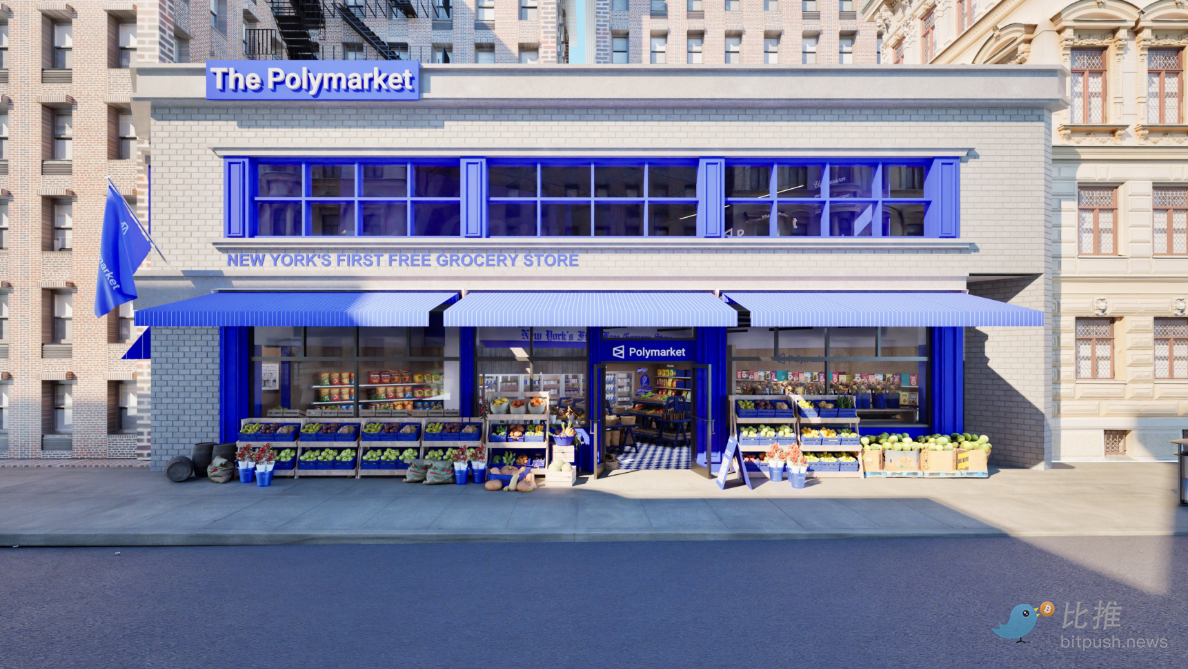
The highlight of Polymarket’s activity lies in its innovation and emphasis on social responsibility. First, this is not a one-time promotion but a permanent store where users can obtain groceries for free, addressing food security issues in New York. Second, this aligns closely with the platform’s core philosophy of revealing truth and allocating resources through prediction markets.

Polymarket founder Shayne Coplan stated that this move is an expansion of the platform from online to offline, aiming to "make prediction markets accessible."
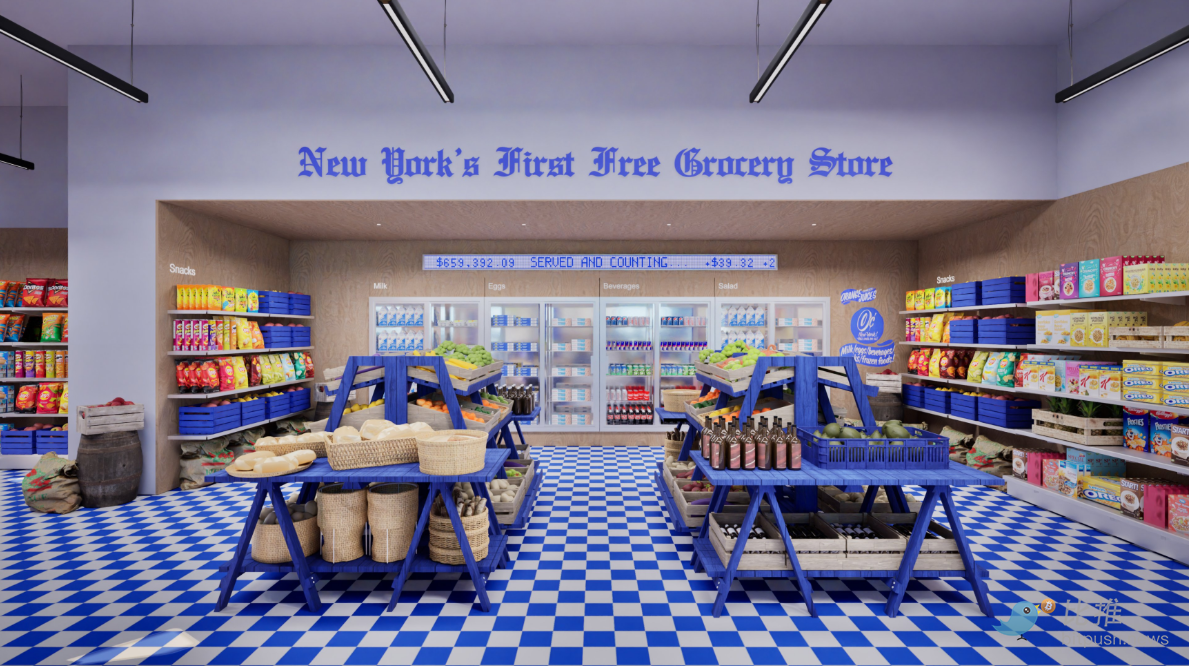
Polymarket incorporates its signature blue logo into the store, with a simple and stylish interior design. Compared to Kalshi’s $50 cap, Polymarket’s free model is more attractive and is expected to reach more low-income groups.

Intensified Rivalry Between the Two Platforms

The offline activities of Kalshi and Polymarket are a microcosm of the fierce competition in the prediction market.

Kalshi uses U.S. compliance as its moat, rapidly expanding its territory. It has not only integrated with various Web3 wallets like Phantom but also partnered with Coinbase to extend its services to all 50 U.S. states. Coinbase users can trade prediction market contracts with as little as $1. In January of this year, Kalshi officially announced that its annualized trading volume exceeded $100 billion.

Polymarket has not only strengthened collaborations with crypto-native players like Jupiter and Phantom but has also expanded its traffic channels by sponsoring events such as the Hollywood Golden Globe Awards.

However, the latest data shows that its market share is still being eroded by Kalshi.
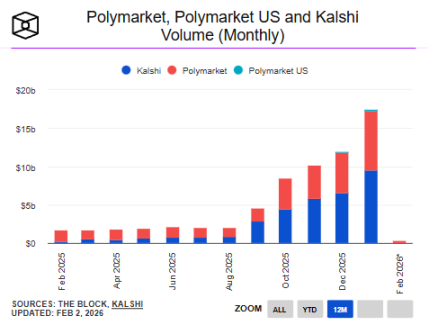
To make matters worse, Polymarket faces troubling regulatory issues.

In January of this year, Ukraine banned Polymarket, as the country’s current legal framework does not recognize prediction markets. Portuguese regulators have also ordered Polymarket to cease operations in the country.

In February, a Nevada court issued a temporary restraining order, prohibiting Polymarket from offering event contract services to Nevada residents before a preliminary hearing on February 11th.

Additionally, many regions in Asia view Polymarket as a gambling platform and have blocked its IP address.

Another competitor backed by Binance is also eyeing the market. Opinion completed a tens of millions of dollars funding round in December 2025. Driven by airdrop expectations, the platform’s trading volume exceeded $5 billion in just one month, with daily fee revenue consistently surpassing $100,000.
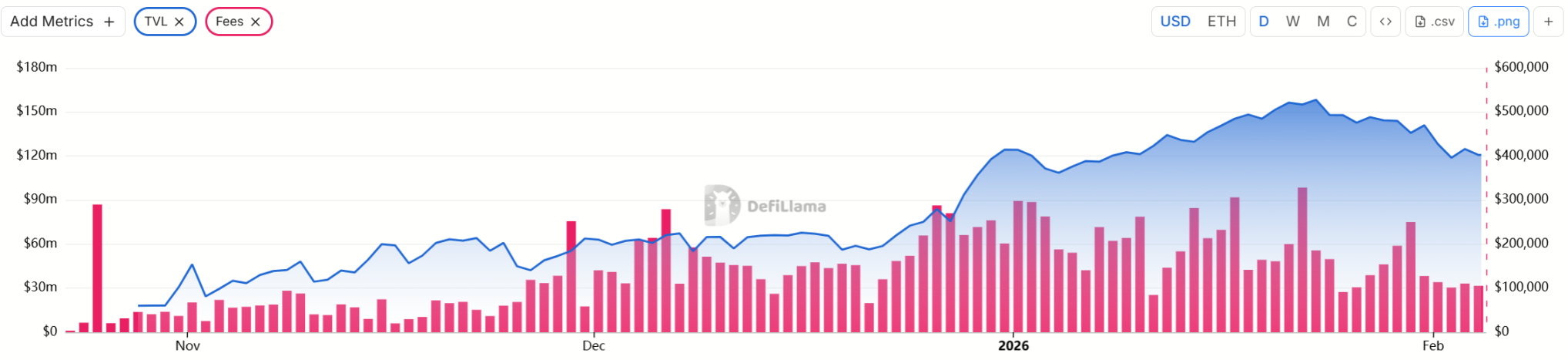
Meanwhile, various exchanges, DEXs, and traditional financial institutions are also entering the prediction market.

Bloomberg reported that Crypto.com announced on Tuesday that it would launch a dedicated prediction market platform, OG, just days before the Super Bowl. Its co-founder and CEO, Kris Marszalek, stated that its event contract business has grown 40 times week-over-week in the past six months, making the launch of an independent product necessary. Another crypto trading platform, Kraken, plans to launch prediction market services in 2026, as revealed by its Global Consumer Business Head, Mark Greenberg, on the Crypto World show.

Robinhood had already launched a prediction market before Trump’s election and plans to introduce more new event contracts. In October 2025, Robinhood CEO Vlad Tenev stated in an interview with Bloomberg that its prediction market segment is one of the fastest-growing sectors and one of its nine business lines with annual revenue exceeding $100 million.

Derivatives DEX leader Hyperliquid is also testing a native prediction market on its testnet. Hyperliquid announced that HyperCore will support Outcome Trading (HIP-4). Outcome Trading involves fully collateralized contracts settled within a fixed range. This is a universal foundational trading element applicable to scenarios such as prediction markets and bounded option-like instruments.

It features non-linear, time-bound contracts, offering a form of derivatives trading without leverage or liquidation, and can be combined with portfolio margin and HyperEVM. Currently, this feature is still under development and is only being tested on the testnet. Once technical development is complete, Hyperliquid will deploy standardized markets denominated in USDH.

The store openings by Kalshi and Polymarket are not just marketing but also battles to capture user attention.

Wars, political events, elections, and sports competitions are gathering global users online, enabling 24/7 non-stop global betting. Rule disputes, wealth stories, and insider trading are all unfolding simultaneously, with only money and brains never sleeping. Perhaps future hot events like the World Cup and U.S. elections will continue to drive prediction market trading volumes and recognition to new heights.

Before the final outcome is determined, no participant dares to let their guard down.


Twitter:https://twitter.com/BitpushNewsCN

Bitpush TG Discussion Group:https://t.me/BitPushCommunity

Bitpush TG Subscription: https://t.me/bitpush

Original link:https://www.bitpush.news/articles/7608693

Câu hỏi Liên quan

QWhat was the main purpose of Kalshi's free grocery giveaway event in New York?

AKalshi's free grocery event aimed to promote the concept of prediction markets by providing immediate value to the public, linking economic concerns like inflation to their platform where users can trade on events such as politics, economics, and sports.

QHow does Polymarket's approach to a physical store differ from Kalshi's event?

APolymarket's store is a permanent establishment in partnership with Food Bank for New York City, focusing on long-term social responsibility and addressing food insecurity, while Kalshi's was a temporary promotional event with a spending limit per person.

QWhat regulatory challenges is Polymarket currently facing?

APolymarket faces bans in Ukraine and Portugal, a temporary restriction order in Nevada, and is blocked in several Asia-Pacific regions where it is viewed as a gambling platform.

QWhich companies are emerging as new competitors in the prediction market space?

ANew competitors include Opinion, which received funding and rapid growth, Crypto.com's OG platform, Kraken's planned service, Robinhood's expanding prediction market, and Hyperliquid's testing of native prediction market features.

QWhat is the significance of the competition between Kalshi and Polymarket expanding to physical locations?

AThe expansion into physical locations represents a strategic move to capture user attention and market share beyond online platforms, using real-world engagement to drive awareness and participation in prediction markets amid growing competition.

Nội dung Liên quan

«Cưa mùa hè» tiếp tục: Phá vỡ $67,000 sẽ là khởi đầu cho đà tăng của Bitcoin

Giá Bitcoin giảm xuống 62.217 USD vào ngày 1/8, tiếp tục giai đoạn củng cố trong phạm vi 58.000 - 67.000 USD kể từ đầu tháng 6. Thị trường đang chia rẽ về hướng đi tiếp theo. Các nhà phân tích kỹ thuật chỉ ra hai kịch bản chính. Một số, như Crypto Candy và Jelle, dự báo khả năng giảm về vùng 60.000 USD nếu giá không vượt lên trên 66.000 USD, đồng thời mô tả thị trường đang trong giai đoạn "củng cát mùa hè" kéo dài. Ngược lại, những người khác như Daan Crypto Trades và Roman nhấn mạnh rằng việc phá vỡ mốc 67.000 USD với khối lượng giao dịch đủ mạnh có thể mở đường cho đợt tăng mạnh lên vùng 70.000 - 80.000 USD. Về góc nhìn dài hạn, nhà phân tích Gert van Lagen xem đây là giai đoạn tích lũy, với Bitcoin đang thử nghiệm đường viền cổ của mô hình "cốc và tay cầm" hình thành suốt 7 năm. Ông cũng lưu ý rằng các nhà đầu tư nắm giữ dài hạn vẫn kiên định, không chịu bán tháo. Tóm lại, thị trường Bitcoin đang trong thời kỳ tích lũy quan trọng, với hai mức giá then chốt là 60.000 USD và 67.000 USD. Việc phá vỡ một trong hai mức này sẽ định hình xu hướng chính tiếp theo.

cryptonews.ru18 phút trước

«Cưa mùa hè» tiếp tục: Phá vỡ $67,000 sẽ là khởi đầu cho đà tăng của Bitcoin

cryptonews.ru18 phút trước

Tuần tới cần chú ý|Đạo luật CLARITY dự kiến được biểu quyết tại Thượng viện; SpaceX, Circle công bố báo cáo tài chính (3.8-9.8)

**Tóm tắt các sự kiện quan trọng từ ngày 3 đến 9 tháng 8:** **Tuần tới sẽ có nhiều sự kiện đáng chú ý trong lĩnh vực tiền điện tử và công nghệ:** * **Pháp luật & Quy định:** Dự luật CLARITY Act, nhằm thiết lập khung quy định liên bang cho tiền điện tử, có khả năng được đưa ra biểu quyết toàn thể tại Thượng viện Mỹ vào tuần tới. Các nhà đàm phán cần đạt được 60 phiếu ủng hộ trước ngày 7/8. * **Báo cáo tài chính:** Nhiều công ty lớn sẽ công bố báo cáo tài chính quý II/2026, bao gồm **SpaceX (ngày 4/8)**, công ty khai thác Bitcoin **Hut 8 (ngày 4/8)**, **Circle (ngày 5/8)** và công ty khai thác liên quan đến gia đình Trump là **American Bitcoin (ngày 3/8)**. * **Sự kiện SpaceX:** Bên cạnh báo cáo tài chính, cổ phiếu của SpaceX sẽ bắt đầu được mở khóa từ ngày 6/8, với đợt đầu tiên có thể lên tới 12% tổng số cổ phiếu. * **Dữ liệu kinh tế:** Báo cáo việc làm phi nông nghiệp (Non-Farm) quan trọng của Mỹ cho tháng 7 sẽ được công bố vào ngày 7/8. * **Cập nhật công nghệ:** * **XRP Ledger:** Phiên bản mới xrpld 3.3.0 với 5 tính năng mới dự kiến phát hành vào tuần tới. * **Grok:** Elon Musk thông báo Grok 4.6 dự kiến ra mắt vào khoảng ngày 7/8. * **Bitcoin:** Việc gửi tín hiệu bắt buộc cho BIP-110 sẽ bắt đầu vào khoảng ngày 8/8. * **Ngừng hoạt động:** Một số dịch vụ tiền điện tử sẽ ngừng hoạt động vào ngày 3/8, bao gồm công cụ theo dõi danh mục DeFi **Zapper** và ví **Ctrl Wallet**. * **Niêm yết & Hủy niêm yết:** Sàn Upbit Hàn Quốc sẽ hủy niêm yết token AQT và AERGO từ ngày 3/8. Trong khi đó, công ty robot **宇树科技 (Unitree Robotics)** sẽ tiến hành thăm dò giá ban đầu cho đợt IPO trên STAR Market vào ngày 5/8.

marsbit57 phút trước

Tuần tới cần chú ý|Đạo luật CLARITY dự kiến được biểu quyết tại Thượng viện; SpaceX, Circle công bố báo cáo tài chính (3.8-9.8)

marsbit57 phút trước

Cổ phiếu giảm mạnh hơn cả tiền điện tử, tiền đã đi đâu?

Tác giả: Cathy, Baihua Blockchain Vào ngày 28 và 29 tháng 7, chỉ số Kospi của Hàn Quốc hai ngày liên tiếp kích hoạt cơ chế ngắt mạch (circuit breaker), một sự kiện chưa từng có trong lịch sử. Cổ phiếu bán dẫn toàn cầu lao dốc, đặc biệt là SK Hynix – cổ phiếu trọng số lớn nhất, giảm khoảng 23% sau hai ngày. Điều trớ trêu là, trong khi thị trường chứng khoán biến động dữ dội như tiền mã hóa, Bitcoin lại thể hiện sự ổn định tương đối, phục hồi gần 15% từ mức thấp tháng 7. Bài viết phân tích rằng đợt sụt giảm này không phải là sự hoảng loạn toàn thị trường, mà là một cuộc "giải tỏa đòn bẩy cưỡng chế" nhắm vào các giao dịch đầu cơ tập trung nhất, như lĩnh vực bán dẫn và AI. Các yếu tố thúc đẩy bao gồm báo cáo lợi nhuận không đạt kỳ vọng của SK Hynix, sự cạnh tranh tiềm tàng từ Trung Quốc, và việc Ngân hàng Nhật Bản tăng lãi suất khiến các khoản đầu tư mang theo (carry trade) bằng Yên phải thoái vốn. Vậy tiền từ thị trường chứng khoán có chảy vào Bitcoin không? Câu trả lời là không. Bitcoin "kháng sụt giảm" vì nó đã trải qua đợt bán tháo lớn vào tháng 5 và tháng 6, với dòng tiền ròng rút kỷ lục khỏi các ETF Bitcoin Mỹ. Tiền thực sự đã chảy vào tài sản an toàn truyền thống như vàng, với hệ số tương quan giữa Bitcoin và vàng giảm xuống mức rất thấp. Điều này cho thấy Bitcoin hiện được coi là tài sản mạo hiểm để tìm kiếm lợi nhuận, chứ không phải nơi trú ẩn an toàn. Bài viết kết luận rằng để dòng tiền thực sự quay trở lại với Bitcoin, cần ba điều kiện: áp lực thanh khoản toàn cầu giảm bớt, Fed cắt giảm lãi suất mà không gây ra suy thoái, và Đạo luật CLARITY được thông qua để giải tỏa lo ngại về quy định. Mặc dù tiền chưa chảy vào, Bitcoin đã tự định vị mình như một tài sản có tương quan thấp với Nasdaq, một đặc điểm mà các tổ chức có thể tìm kiếm để đa dạng hóa danh mục đầu tư sau cú sốc AI.

marsbit57 phút trước

Cổ phiếu giảm mạnh hơn cả tiền điện tử, tiền đã đi đâu?

marsbit57 phút trước

Đối thoại với Ray Dalio: Chúng ta đang ở trong bong bóng AI, 1% danh mục đầu tư của tôi là Bitcoin

Ray Dalio, người sáng lập Bridgewater Associates, trong một cuộc phỏng vấn đã chỉ ra rằng thế giới hiện tại đang trong một "AI bubble" (bong bóng AI) cổ điển, với giá tài sản tăng vọt và đầu cơ quá mức. Ông cảnh báo bong bóng có thể vỡ do lãi suất tăng, nguồn cung cổ phiếu dư thừa hoặc khi nhà đầu tư cần tiền mặt trả nợ, dẫn đến suy thoái kinh tế. Đồng thời, Dalio mô tả một "chu kỳ lớn" kéo dài khoảng 80 năm, bao gồm ba động lực chồng chéo: khoảng cách giàu nghèo và xung đột nội bộ, thâm hụt ngân sách chính phủ khổng lồ và thay đổi địa chính trị. Ông nhấn mạnh rằng Mỹ và Anh đang đối mặt với những thách thức trong giai đoạn suy yếu này. Để bảo vệ của cải, Dalio khuyến nghị đa dạng hóa danh mục đầu tư với cổ phiếu, vàng, trái phiếu, bất động sản thay vì chỉ giữ tiền mặt. Ông tiết lộ khoảng 1% danh mục của mình là Bitcoin, nhưng vẫn ưa chuộng vàng vật chất hơn do tính ổn định và vai trò tiền tệ dự trữ. Về tác động của AI, Dalio cho rằng nó không chỉ thay thế lao động chân tay mà còn cả tư duy, làm trầm trọng thêm bất bình đẳng thu nhập. Con người cần phát huy trí tuệ cảm xúc và trực giác - những thứ AI chưa có - và học cách hợp tác với AI. Cuối cùng, ông phân tích những rủi ro của thuế tài sản và xu hướng thế giới có thể trở nên "khu vực hóa" hơn, với các khối như châu Mỹ và châu Á - Thái Bình Dương, trong bối cảnh sự thống trị toàn cầu của Mỹ đang suy yếu.

marsbit4 giờ trước

Đối thoại với Ray Dalio: Chúng ta đang ở trong bong bóng AI, 1% danh mục đầu tư của tôi là Bitcoin

marsbit4 giờ trước

Giao dịch

Giao ngay
活动图片





