Polymarket Rushes to Launch Token with Revenue Data? Sports Market Opens for Fees, Aiming to Become Web3's New "Money Printing Machine"

marsbitXuất bản vào 2026-02-18Cập nhật gần nhất vào 2026-02-18

Tóm tắt

Polymarket, a leading prediction market platform, has begun charging taker fees on sports markets starting February 18, 2026, beginning with NCAA basketball and Serie A. This follows its recent introduction of fees on its 15-minute crypto markets, which already generate over $1.08 million in weekly revenue. With sports accounting for 39% of platform activity and having significantly larger average trade sizes than crypto markets, this move is expected to substantially boost revenue. Conservative estimates project annualized revenue could exceed $200 million after full rollout. The fee model is dynamically designed, charging up to 0.44% for market orders (takers) when event outcomes are most uncertain (50% probability), while limit order makers receive a 25% rebate. This strategy aims to maintain liquidity and competitive low costs compared to traditional sportsbooks. The platform, valued at up to $116 billion in secondary markets, is also preparing for a potential mid-2026 token launch ($POLY trademark filed), with a highly anticipated airdrop. While it faces competition and regulatory scrutiny, its deep liquidity, low fees, and data partnership with NYSE parent ICE (a major investor) form a strong moat for its new revenue "money machine."

Author: Frank, PANews

On February 18, 2026, Polymarket announced that starting from this day, the platform would begin piloting the collection of market order fees in the sports market. The first wave of events covered includes U.S. college basketball (NCAA) and Serie A (Italian football league), with plans to gradually extend to all sports events in the future.

Previously, relying solely on fees from its 15-minute cryptocurrency up/down markets, Polymarket's recent weekly revenue had already surpassed $1.08 million. According to on-chain data, the sports market accounts for nearly 40% of the platform's total trading activity. If converted to annual revenue, fees from the crypto market alone could contribute approximately $56 million in annualized income. Therefore, when the larger share of the sports market also begins charging fees, Polymarket might become the biggest money printer in the crypto space.

PANews conducted an in-depth analysis of Polymarket's fee mechanism, revenue model, competitor benchmarking, and token airdrop expectations.

From "Zero Revenue" to Millions Weekly: The $9 Billion Giant Starts Eagerly Making Money

For a long time, Polymarket operated with almost "zero revenue," as the vast majority of markets did not impose any trading fees. This free strategy brought it astonishing growth: total trading volume for the full year 2025 reached $21.5 billion, accounting for nearly half of the global prediction market volume ($44 billion); the single-month trading volume in January 2026 even hit a record high of over $12 billion.

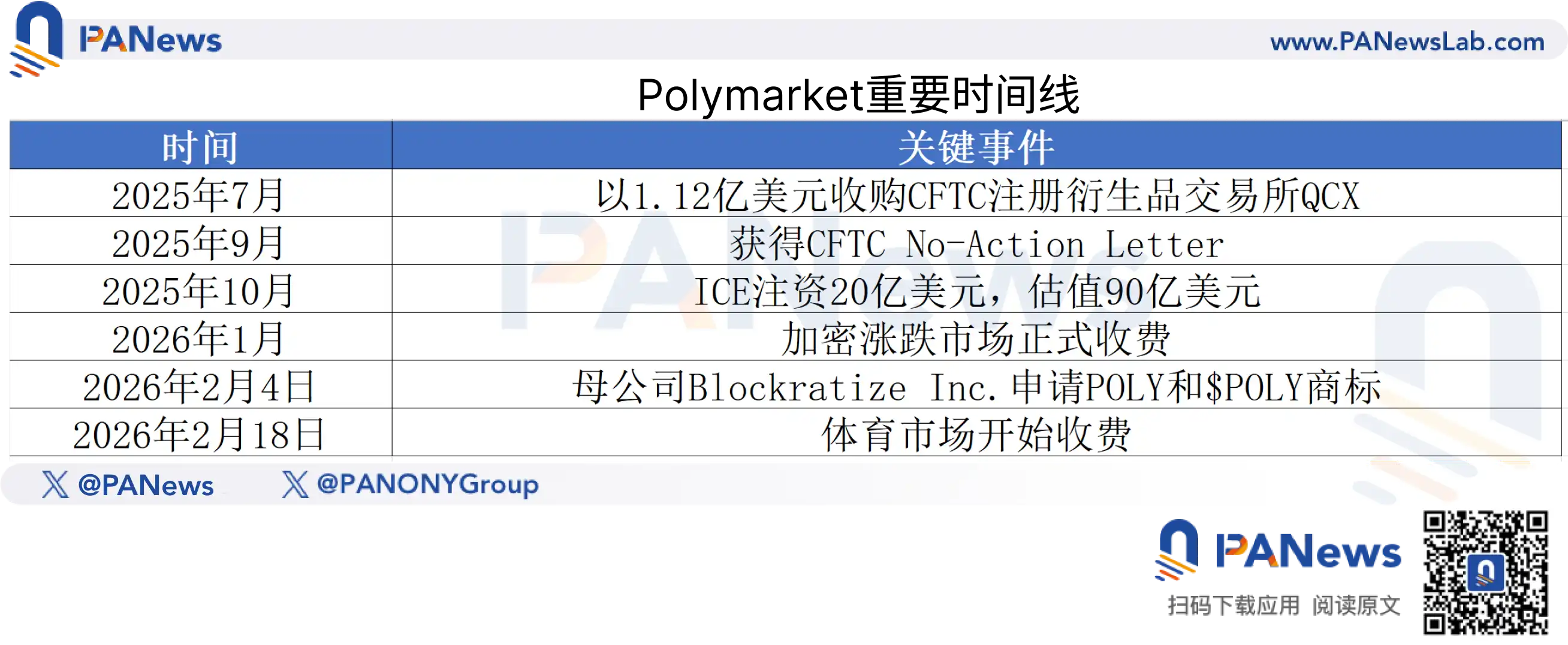
However, with the upcoming token listing this year, the zero-revenue model clearly could not match its valuation. Its valuation had already reached $9 billion in the latest funding round. In October 2025, Intercontinental Exchange (ICE), the parent company of the New York Stock Exchange, injected a massive $2 billion into Polymarket. According to data from PM Insights, as of January 19, 2026, the implied valuation of Polymarket equity in the secondary market had climbed to $11.6 billion, a nearly 29% increase from the previous funding round. There are reports that the valuation in subsequent funding rounds could reach $12 billion to $15 billion. Such a high valuation requires matching revenue to support it.

The turning point came in January 2026; it was evident that Polymarket had become eager since the start of the year.

In January, Polymarket formally introduced a "Taker Fee" for its high-frequency trading product, the 15-minute cryptocurrency up/down markets, with a maximum rate of 3%. The data showed immediate results: in early February 2026, weekly fee revenue broke through $1.08 million, with the 15-minute up/down markets alone contributing $787,000 in a certain week in January, accounting for 28.4% of the total platform's prediction market fee revenue ($2.7 million) during the same period. To date, Polymarket has generated over $4.7 million in fees, ranking among the top in revenue charts.

The Ingenious Design Behind 0.45%: A Fee Model Not Just for Profit

The fee introduced by Polymarket for the sports market is a carefully designed dynamic fee model.

According to Polymarket's official documentation and community analysis, the sports market fee is only charged on market orders (Taker). Limit orders (Maker) are not only free but also receive a 25% rebate from the Taker fees. Similar to the crypto market fee model, the rate is not a fixed value but fluctuates with changes in event probability:
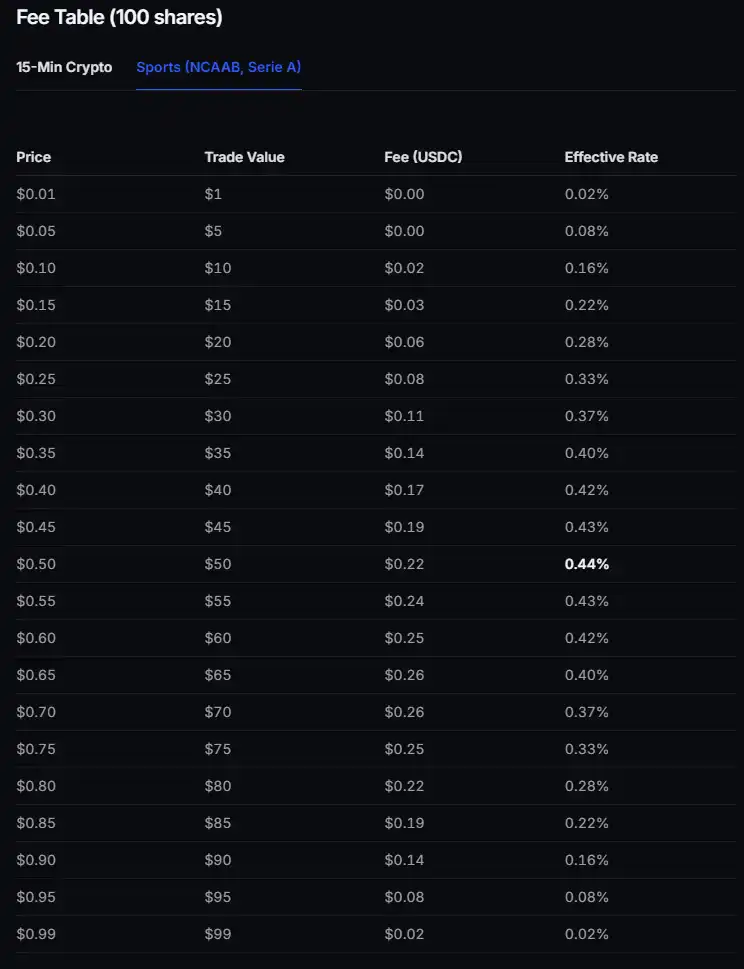
Simply put, the more uncertain the market, the higher the fee, peaking at 0.44% at a 50% probability, and dropping to only 0.13%-0.16% at probabilities of 10% or 90%.

However, by standard, the sports market fee rate is significantly lower than that of the crypto market. Nevertheless, this does not diminish the revenue potential of the sports market.
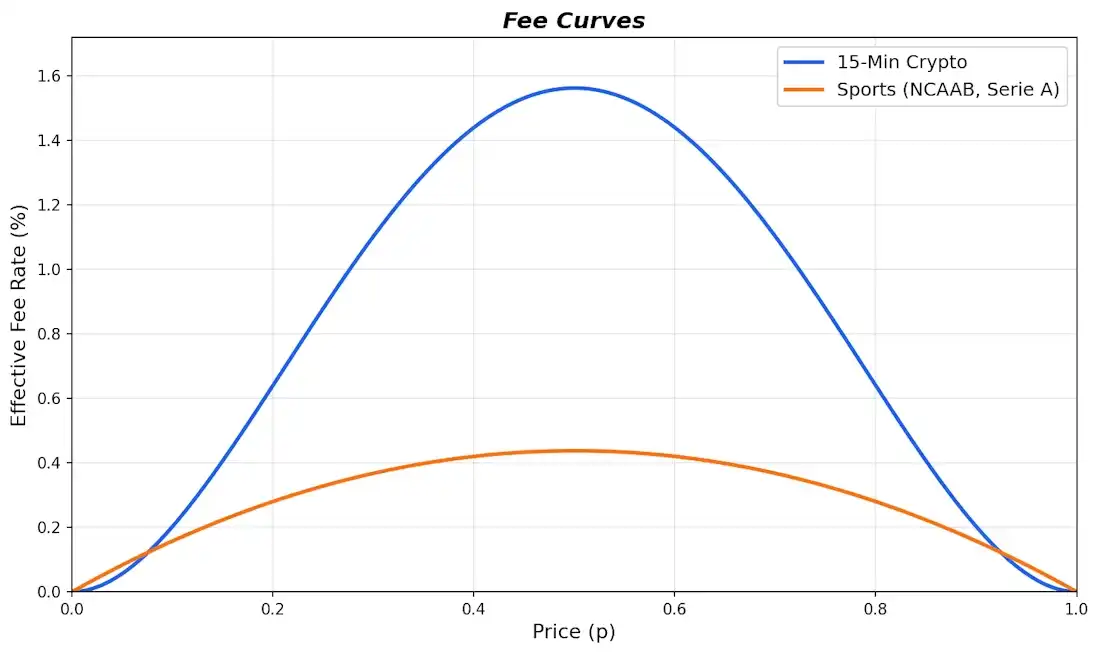
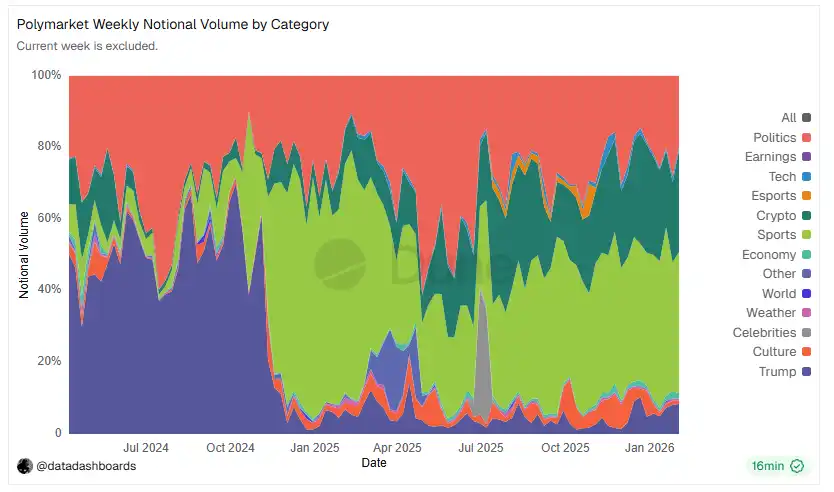
Data shows that sports markets currently account for 39% of Polymarket's total trading activity, surpassing political (20%) and crypto (28%) categories. More crucially, according to previous PANews analysis data, the average trading volume of short-term sports markets on Polymarket ($1.32 million) is 30 times that of short-term crypto markets ($44,000). This means that if fees are fully rolled out in the sports market, revenue will experience massive growth.
Taking the 2026 Super Bowl as an example, Polymarket's total trading volume in related markets reached approximately $795 million, covering various sub-markets such as game outcome, player performance, and halftime show predictions. The total weekly prediction market volume was once driven by sports events to break $6.3 billion.

Based on existing data, PANews constructed three profit forecast scenarios (assuming an average effective fee rate of 0.25% for sports markets, considering probability distribution and free limit orders):
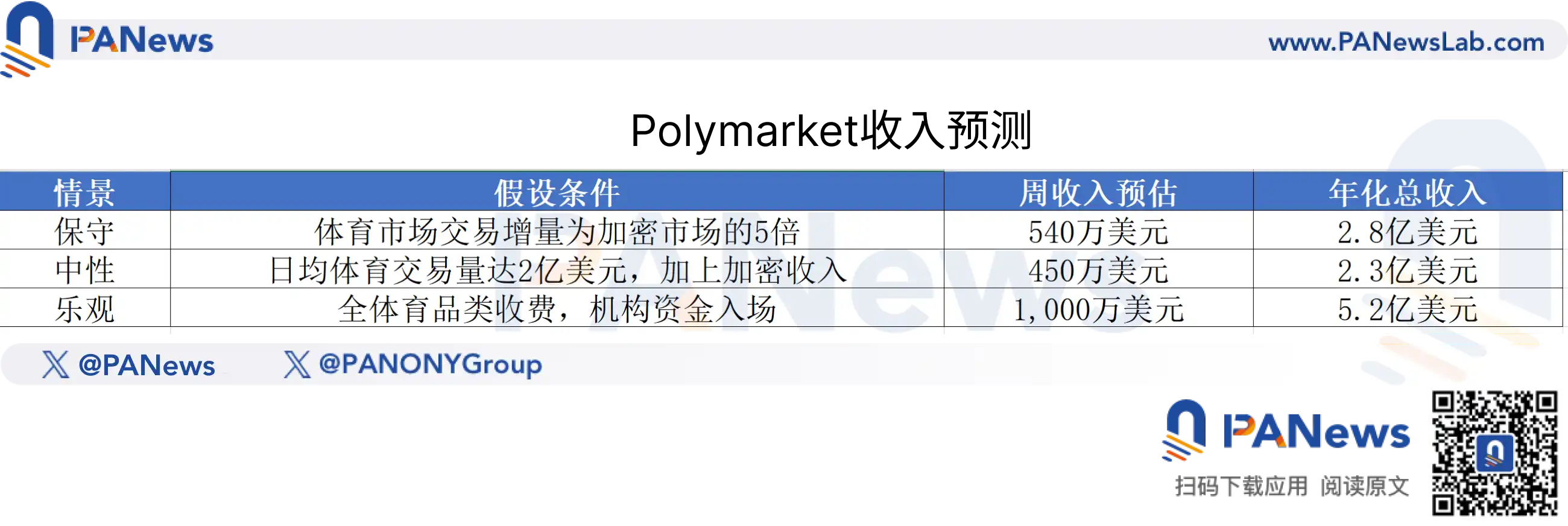
Even under the most conservative estimate, Polymarket's annualized revenue after full fee implementation would exceed $200 million, enough to place it among the highest-revenue protocols in the Web3 space.

While surpassing Tether's treasury interest income or Ethereum mainnet gas fees might be unrealistic, at the application layer, Polymarket has the full potential to compete for the title of "most profitable dApp." Especially considering its user retention rate is as high as 85%, far exceeding that of general DeFi protocols, this high stickiness implies higher quality revenue.

POLY Token and Airdrop: A "Wealth Feast" Worth Billions?

Polymarket's high valuation and massive user base make its token airdrop one of the most anticipated events of 2026.

Polymarket's Chief Marketing Officer, Matthew Modabber, has clearly stated: "There will be a token, there will be an airdrop." Market predictions indicate a 62%-70% probability that Polymarket will issue its token before December 31, 2026. Considering the progress of restarting U.S. operations, the Token Generation Event (TGE) is likely to be completed around mid-2026.

On February 4, 2026, its parent company, Blockratize Inc., applied for the trademarks "POLY" and "$POLY," which is also considered by the industry as a significant milestone for TGE. According to general practices in the crypto industry, it typically takes 3-6 months from trademark registration to TGE.
Airdrop Scale May Surpass Hyperliquid; The Era of Volume Farming is Over

Referring to recent airdrop ratios of top projects (Arbitrum, Jupiter, Hyperliquid), the community allocation usually ranges between 5%-15% of the total supply. PANews calculated based on different valuation assumptions:
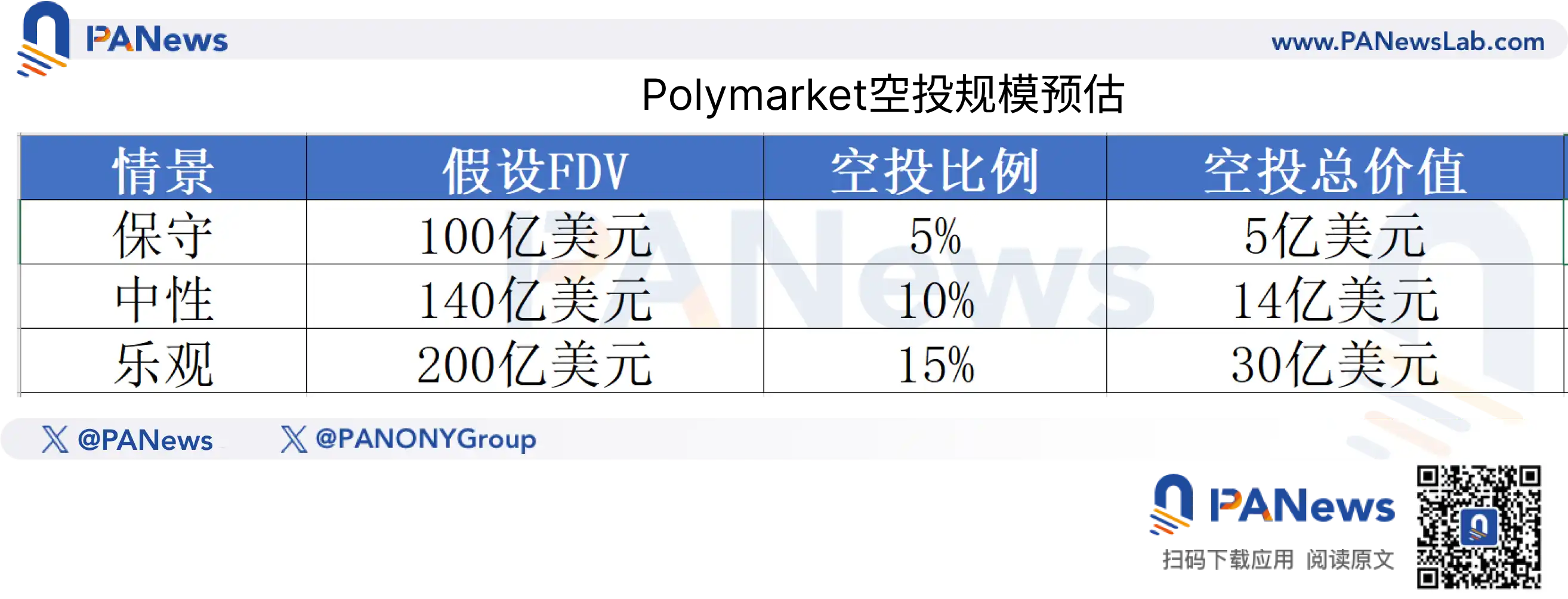
If the total airdrop is $1.4 billion, and assuming there are 500,000 eligible active addresses, the average airdrop value per account could be around $2,800. However, according to the "Pareto principle," top users might reap rewards ranging from hundreds of thousands to even millions of dollars, so ordinary retail users need to manage their expectations reasonably.

It is worth noting that, simultaneously with the fee launch, Polymarket introduced a 4% annualized holding reward, with hourly snapshots and daily distributions. This mechanism reveals the project's clear preference: the duration funds are held is far more important than trading frequency.

Moat and Concerns: Where are the Risks for This "Money Printer"?

Charging fees means users incur additional costs. So, what gives Polymarket the confidence to sustain this?

A triple moat is clearly visible: First, the platform possesses unmatched liquidity depth in the prediction market space, which is crucial for large-volume traders. Second, compared to the 5%-10% rake in traditional betting and Kalshi's 1%-3.5%, the peak fee rate of 0.45% still holds an overwhelming cost advantage. Third, ICE's involvement not only brought capital but also data distribution capabilities. ICE plans to integrate Polymarket's real-time prediction data for its global institutional clients, constituting a "second growth curve" beyond trading fees.

However, risks should not be overlooked:

Short-term trading volume fluctuations: Polymarket's monthly trading volume once dropped from a peak of $1.026 billion in November 2025 to $543 million in December 2025. Will fee introduction exacerbate this trend? However, considering the positive effects of increased order book depth and reduced spreads after introducing the Maker Rebate, long-term trading volume might actually increase.

Competitive landscape: Kalshi holds a first-mover advantage in the U.S. compliant market (2025 revenue approximately $260 million). Hyperliquid is attempting to enter the prediction market赛道 through "Outcome Trading" (FDV approx. $16 billion). Predict.fun attracts users with DeFi yield叠加.

Regulatory uncertainty: Although it has obtained a No-Action Letter from the CFTC and acquired the compliant exchange QCX, changes in the U.S. regulatory environment remain the sword of Damocles hanging over the prediction market.

Postscript

From free to fee-based, from crypto up/down markets to global sports events, Polymarket is undergoing a meticulously planned business model upgrade. It already earns millions weekly just from the crypto market, and the sports market—this behemoth accounting for nearly 40% of the platform's volume with liquidity 30 times that of crypto—has only just begun charging. Polymarket's story provides a model worth pondering: a platform's true value might not lie in how much money it is making at the moment, but in its proven ability to charge fees whenever it decides to. When the cake is big enough and the moat deep enough, opening the fee floodgates is only a matter of time.

And for this money printer that's warming up, February 18th was just the start button being pressed.


Tiền kỹ thuật số thịnh hành

Câu hỏi Liên quan

QWhat is the main reason Polymarket is introducing fees for sports markets, and when did this initiative begin?

APolymarket is introducing fees for sports markets to generate revenue that matches its high valuation, which reached $90 billion in recent funding. This initiative began on February 18, 2026, starting with NCAA basketball and Serie A leagues, with plans to expand to all sports events.

QHow does Polymarket's dynamic fee model for sports markets work, and what is the peak fee rate?

APolymarket's dynamic fee model charges only market orders (Taker), while limit orders (Maker) are free and receive a 25% rebate from Taker fees. The fee rate fluctuates based on event probability, peaking at 0.44% when the probability is 50%, and decreasing to 0.13%-0.16% at probabilities of 10% or 90%.

QWhat is the estimated annual revenue for Polymarket if sports markets are fully monetized, according to PANews' analysis?

AAccording to PANews' analysis, if sports markets are fully monetized, Polymarket's annualized revenue is estimated to exceed $200 million, based on a conservative scenario with an average effective fee rate of 0.25% for sports markets.

QWhat are the key factors contributing to Polymarket's competitive advantages or 'moat' in the prediction market space?

APolymarket's competitive advantages include unmatched liquidity depth in prediction markets, a cost advantage with peak fees of 0.45% compared to traditional betting (5%-10%) or competitors like Kalshi (1%-3.5%), and data distribution capabilities through its partnership with ICE, which plans to integrate Polymarket's real-time prediction data for institutional clients.

QWhat is the expected timeline for Polymarket's token generation event (TGE), and what evidence supports this prediction?

AThe token generation event (TGE) for Polymarket is expected around mid-2026, supported by the high probability (62%-70%) of a token launch by December 31, 2026, and the trademark application for 'POLY' and '$POLY' by its parent company Blockratize Inc. on February 4, 2026, which typically precedes a TGE by 3-6 months in the crypto industry.

Nội dung Liên quan

OpenAI không bán tiền dựa trên mô hình đắt nhất

OpenAI đã điều chỉnh giá, giảm 80% cho mô hình GPT-5.6 Luna và 20% cho Terra, đồng thời giới thiệu chế độ Fast cho mô hình mạnh nhất Sol. Động thái này, cùng với việc Anthropic giới thiệu Claude Opus 5 với giá bằng một nửa so với flagship Fable 5, đánh dấu sự thay đổi chiến lược quan trọng: các hãng không còn chỉ tập trung bán mô hình mạnh nhất. Thay vào đó, họ khuyến nghị người dùng kết hợp các mô hình theo nhiệm vụ: dùng Sol (đắt, mạnh) để phân tích và lập kế hoạch phức tạp, sau đó giao cho Luna (rẻ, hiệu quả) thực thi. Điều này cho thấy trọng tâm thương mại đang chuyển từ các mô hình flagship (chứng minh năng lực kỹ thuật) sang các mô hình tầm trung, phục vụ cho lượng truy vấn API khổng lồ hàng ngày của doanh nghiệp, nơi hiệu quả chi phí (ROI) và độ ổn định là yếu tố quyết định. Một yếu tố then chốt giúp giảm chi phí là việc chính các mô hình AI (như Sol) tham gia tối ưu hóa mã nguồn và quy trình vận hành của chính chúng, tạo ra một vòng lặp tự thúc đẩy giảm chi phí. Điều này có thể đẩy nhanh hơn nữa đà giảm giá trong tương lai. Cạnh tranh đang chuyển từ "mô hình thông minh nhất" sang "hệ sinh thái hiệu quả nhất". OpenAI muốn biến các mô hình như Luna thành lựa chọn mặc định cho các tác vụ thường ngày, từ đó gia tăng độ phụ thuộc và chi phí chuyển đổi cho doanh nghiệp. Tương tự như ngành điện hay điện toán đám mây, mục tiêu cuối cùng là AI trở thành một tiện ích phổ biến, hoạt động âm thầm và không thể thiếu trong mọi quy trình, thay vì chỉ là một sản phẩm công nghệ đình đám.

marsbit4 phút trước

OpenAI không bán tiền dựa trên mô hình đắt nhất

marsbit4 phút trước

Lương trăm nghìn đô la săn thợ điện, Meta vội vàng tự mở trường dạy nghề

Cuộc đua AI đang vấp phải nút thắt mới: thiếu hụt nghiêm trọng lao động lành nghề như thợ điện và công nhân xây dựng để xây dựng các trung tâm dữ liệu quy mô lớn. Tại Mỹ, dự báo cần thêm 130.000 thợ điện và 240.000 công nhân xây dựng từ 2023-2030 cho hạ tầng AI, trong khi mỗi năm có 80.000 vị trí thợ điện không thể lấp đầy. Các công ty AI sẵn sàng trả lương cao (thợ điện giỏi có thể kiếm 240.000-280.000 USD/năm), nhưng sự chậm trễ xây dựng vẫn gây thiệt hại hàng chục triệu USD. Độ phức tạp của các trung tâm dữ liệu AI, với công suất điện khổng lồ, hệ thống phân phối điện và làm mát phức tạp, đòi hỏi lao động có kỹ năng đặc biệt. Để giải quyết, các gã khổng lồ công nghệ như Meta và Google đang đầu tư hàng trăm triệu USD vào đào tạo. Meta mở trường dạy nghề miễn phí, cung cấp cả trợ cấp sinh hoạt, trong khi OpenAI hợp tác với công đoàn xây dựng. Chiến dịch tuyển dụng nhắm đến cả học sinh trung học, góp phần làm tăng mạnh tỷ lệ Gen Z theo học trường nghề. Tuy nhiên, nhu cầu điện cho AI tiếp tục bùng nổ, chiếm phần ngày càng lớn trong tổng tiêu thụ điện và đẩy giá điện lên cao. Một nghịch lý tồn tại: các dự án xây dựng cần hàng nghìn lao động cùng lúc, nhưng khi hoàn thành chỉ cần số ít vận hành, dẫn đến rủi ro dư thừa lao động lành nghề trong tương lai.

marsbit4 phút trước

Lương trăm nghìn đô la săn thợ điện, Meta vội vàng tự mở trường dạy nghề

marsbit4 phút trước

Cục Dự trữ Liên bang tháng 9 nhất định tăng lãi suất? Tiền mã hóa và chứng khoán Mỹ sẽ chịu áp lực thế nào?

Tỷ lệ thị trường kỳ vọng Fed tăng lãi suất vào tháng 9 đã tăng vọt từ dưới 50% lên hơn 80% chỉ trong một tuần, chủ yếu do lo ngại lạm phát trỗi dậy từ giá dầu leo thang sau các căng thẳng địa chính trị ở eo biển Hormuz. Cuộc bỏ phiếu 9-3 tại cuộc họp FOMC tháng 7, với 3 thành viên ủng hộ tăng lãi suất ngay lập tức, đã củng cố kỳ vọng này. Mốc then chốt tiếp theo là báo cáo CPI tháng 7 vào ngày 12/8. Đối với tài sản tiền mã hóa, kỳ vọng tăng lãi suất gây áp lực lên Bitcoin, vốn có mối tương quan cao với chu kỳ thanh khoản toàn cầu và thể hiện đặc tính tài sản rủi ro beta cao. Tuy nhiên, tác động có thể không kéo dài nếu thị trường coi đây là bước tăng cuối cùng trong chu kỳ thắt chặt. Trên thị trường chứng khoán Mỹ, các cổ phiếu liên quan đến tiền mã hóa như Coinbase có thể biến động mạnh hơn. Cổ phiếu công nghệ tăng trưởng nói chung phải đối mặt với áp lực định giá do lãi suất chiết khấu tăng. Báo cáo thu nhập quý 2 của các gã khổng lồ công nghệ cho thấy thị trường đang chuyển trọng tâm từ quy mô chi tiêu vốn sang khả năng tạo ra doanh thu và dòng tiền thực tế. Việc tăng lãi suất có thể làm gia tăng chi phí vốn, khiến thị trường khắt khe hơn với câu chuyện tăng trưởng dựa trên việc "đốt tiền" đầu tư.

marsbit14 phút trước

Cục Dự trữ Liên bang tháng 9 nhất định tăng lãi suất? Tiền mã hóa và chứng khoán Mỹ sẽ chịu áp lực thế nào?

marsbit14 phút trước

Thợ đào Bitcoin từ từ đầu hàng, nhưng cổ phiếu của họ lại tăng vọt

Tình trạng đầu hàng của thợ đào Bitcoin đang diễn ra, với hash rate và độ khó khai thác giảm mạnh trong nhiều tháng liên tục. Tuy nhiên, có một nghịch lý: trong khi hoạt động khai thác trở nên kém kinh tế và BTC giảm giá khoảng 46%, cổ phiếu của các công ty khai thác niêm yết lại tăng mạnh, thậm chí có mã tăng hơn 430%. Nguyên nhân chính được cho là nhờ câu chuyện về AI, khiến các cổ phiếu này thoát ly khỏi mối tương quan truyền thống với Bitcoin. Thu nhập từ phần thưởng khối (block reward) tính bằng BTC đã chạm mức thấp kỷ lục hàng ngày, phản ánh chu kỳ giảm nửa phần thưởng định kỳ. Hệ số Puell Multiple cho thấy thu nhập hiện tại của thợ đào chỉ bằng khoảng 3/4 mức trung bình năm. Trong khi đó, nguồn thu từ phí giao dịch vẫn rất thấp, chưa đủ để bù đắp cho phần thưởng khối đang teo lại. Sự phân kỳ lần này – thợ đào gặp khó khăn nhưng cổ phiếu ngành lại tăng – cho thấy một động lực mới. Các công ty có thể đang chuyển hướng sang các cơ hội khác như AI. Vấn đề cơ cấu lâu dài vẫn tồn tại: phần thưởng khối sẽ tiếp tục giảm, đặt ra câu hỏi về việc phí giao dịch trong tương lai sẽ đảm bảo an ninh mạng như thế nào. Những thách thức này thường được nhìn nhận nghiêm túc hơn trong thị trường giá xuống.

marsbit15 phút trước

Thợ đào Bitcoin từ từ đầu hàng, nhưng cổ phiếu của họ lại tăng vọt

marsbit15 phút trước

Giao dịch

Giao ngay

Bài viết Nổi bật

Làm thế nào để Mua F

Chào mừng bạn đến với HTX.com! Chúng tôi đã làm cho mua Synfutures (F) trở nên đơn giản và thuận tiện. Làm theo hướng dẫn từng bước của chúng tôi để bắt đầu hành trình tiền kỹ thuật số của bạn.Bước 1: Tạo Tài khoản HTX của BạnSử dụng email hoặc số điện thoại của bạn để đăng ký tài khoản miễn phí trên HTX. Trải nghiệm hành trình đăng ký không rắc rối và mở khóa tất cả tính năng. Nhận Tài khoản của tôiBước 2: Truy cập Mua Crypto và Chọn Phương thức Thanh toán của BạnThẻ Tín dụng/Ghi nợ: Sử dụng Visa hoặc Mastercard của bạn để mua Synfutures (F) ngay lập tức.Số dư: Sử dụng tiền từ số dư tài khoản HTX của bạn để giao dịch liền mạch.Bên thứ ba: Chúng tôi đã thêm những phương thức thanh toán phổ biến như Google Pay và Apple Pay để nâng cao sự tiện lợi.P2P: Giao dịch trực tiếp với người dùng khác trên HTX.Thị trường mua bán phi tập trung (OTC): Chúng tôi cung cấp những dịch vụ được thiết kế riêng và tỷ giá hối đoái cạnh tranh cho nhà giao dịch.Bước 3: Lưu trữ Synfutures (F) của BạnSau khi mua Synfutures (F), lưu trữ trong tài khoản HTX của bạn. Ngoài ra, bạn có thể gửi đi nơi khác qua chuyển khoản blockchain hoặc sử dụng để giao dịch những tiền kỹ thuật số khác.Bước 4: Giao dịch Synfutures (F)Giao dịch Synfutures (F) dễ dàng trên thị trường giao ngay của HTX. Chỉ cần truy cập vào tài khoản của bạn, chọn cặp giao dịch, thực hiện giao dịch và theo dõi trong thời gian thực. Chúng tôi cung cấp trải nghiệm thân thiện với người dùng cho cả người mới bắt đầu và người giao dịch dày dạn kinh nghiệm.

Tổng lượt xem 480Xuất bản vào 2024.12.21Cập nhật vào 2026.06.02

Làm thế nào để Mua F

Thảo luận

Chào mừng đến với Cộng đồng HTX. Tại đây, bạn có thể được thông báo về những phát triển nền tảng mới nhất và có quyền truy cập vào thông tin chuyên sâu về thị trường. Ý kiến ​​của người dùng về giá của F (F) được trình bày dưới đây.

活动图片












