Polymarket New Rules Released: How to Build a New Trading Bot

marsbitXuất bản vào 2026-02-25Cập nhật gần nhất vào 2026-02-25

Tóm tắt

Polymarket has removed the 500ms taker delay and introduced dynamic taker fees, rendering many existing trading bots obsolete. The new meta shifts advantage from taker arbitrage to market making. A profitable bot in 2026 must be a maker bot, leveraging zero fees and USDC rebates. Key requirements include using WebSocket (not REST), fee-aware order signing with the `feeRateBps` field, and a sub-100ms cancel/replace loop to avoid adverse selection. The architecture involves connecting to the CLOB, querying fee rates per market, and placing maker orders on both YES/NO sides. For 5-minute BTC markets, a deterministic strategy involves placing maker orders at $0.90–0.95 with 10 seconds remaining, capitalizing on ~85% directional certainty. Critical mistakes to avoid are using REST, omitting feeRateBps, high-latency infrastructure, and outdated taker strategies. AI can assist in implementation, but must be guided by the new technical constraints.

Editor's Note: Polymarket removed the 500ms delay without prior announcement and introduced dynamic fees, instantly rendering a large number of existing bots obsolete overnight. This article systematically outlines the correct way to build trading bots under these new rules, providing a clear and actionable path—from the fee mechanism and order signing to market-making logic and low-latency architecture.

After publication, the article garnered 1.1M views, sparking widespread discussion. Under Polymarket's new rules, the advantage is shifting from taker arbitrage to long-term structures centered around market making and liquidity provision.

Original text below:

Polymarket Quietly Removed the 500ms Delay

Here’s the clear explanation: How to build a bot that actually runs and makes money under the new rules.

Two days ago, Polymarket removed the 500ms taker quote delay in crypto markets. No announcement, no warning. Overnight, half the bots on the platform stopped working. But at the same time, this created the biggest opportunity window for new bots since Polymarket launched.

Today I will explain in detail: How to build a bot that still works under the new rules.

Because every solution you saw before February 18th is now outdated.

If you ask an AI model to write Polymarket bot code for you right now, it will give you a solution based on the old rules: REST polling, no fee handling, completely unaware the 500ms buffer is gone.

Such a bot will lose money from the very first trade.

Let me explain: What exactly changed, and how to redesign your bot around these changes.

What Changed?

Three key changes happened over the past two months:

1. The 500ms Taker Delay Was Removed (February 18, 2026)

Previously, all taker orders waited 500ms before execution. Market makers relied on this buffer time to cancel "stale" quotes, which was almost like free insurance.

Now it's different. Taker orders execute immediately, with no cancellation window.

2. Dynamic Taker Fees Introduced in Crypto Markets (January 2026)

15-minute and 5-minute crypto markets now charge taker fees. The formula is: Fee = C × 0.25 × (p × (1 - p))²

Peak fee: ~1.56% around 50% probability

Fee approaches 0 in extreme probability ranges (near 0 or 1)

Remember that bot that arbitraged the price delay between Binance and Polymarket, making $515,000 in a month with a 99% win rate?

That strategy is completely dead. Because the fee alone is now higher than the arbitrageable spread.

What is the New Meta?

In one sentence: Be a maker, not a taker.

The reasons are simple:

· Makers pay no fees

· Makers earn daily USDC rebates (subsidized by taker fees)

· With the 500ms delay gone, maker order execution is actually faster

The top bots now profit just from rebates, without even needing the spread. If you're still running a taker bot, you're facing a constantly rising fee curve. Around 50% probability, you need at least a 1.56% edge just to break even.

Good luck.

So, How Should a Truly Viable 2026 Bot Be Built?

Here is a design思路 (design approach) for a bot architecture that remains effective in 2026:
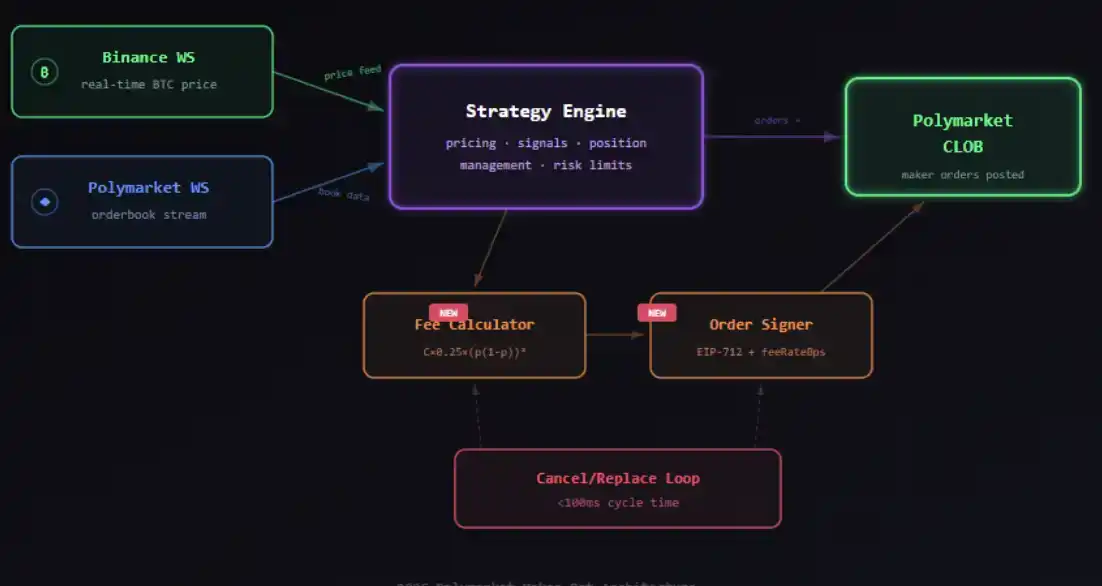
Core Components:

1. Use WebSocket, Not REST

REST polling is completely obsolete. By the time your HTTP request completes a round trip, the opportunity is long gone. You need a real-time order book data stream based on WebSocket, not intermittent pulling.

2. Fee-Aware Order Signing

This is a new requirement that didn't exist before. Now, the feeRateBps field must be included in the payload of the order you sign. If you omit this field, orders will be outright rejected in markets where fees are enabled.

3. Ultra-Fast Cancel/Replace Loop

With the 500ms buffer removed: If your cancel-replace process takes over 200ms, you will suffer from adverse selection. Others will snatch your stale quotes before you can update them.

How to Build It

1. Get Your Private Key

Use the same private key you use to log in to Polymarket (EOA / MetaMask / Hardware Wallet)

export POLYMARKET_PRIVATE_KEY="0xyour_private_key_here"

2. Set Up Approvals (One-Time Operation)

Before Polymarket can execute your trades, you need to approve the following contracts: USDC, Conditional Tokens.

This only needs to be done once per wallet.

3. Connect to the CLOB (Central Limit Order Book)

The official Python client can be used directly: pip install py-clob-client

However, there are now faster options in the Rust ecosystem:

· polyfill-rs (Hot path zero-allocation, SIMD JSON parsing, ~21% performance boost)

· polymarket-client-sdk (Official Polymarket Rust SDK)

· polymarket-hft (Complete HFT framework, integrates CLOB + WebSocket)

Which one you choose isn't critical; the key is to pick the one you can get up and running the fastest.

4. Query the Fee Rate Before Placing Every Order

GET /fee-rate?tokenID={token_id}

Never hardcode fees.
Fees vary by market, and Polymarket can adjust them at any time.

5. Include the Fee Field in Order Signing

When signing the order, the fee field must be written into the payload. Missing this will cause the order to be rejected in fee-enabled markets.

{
"salt": "...",
"maker": "0x...",
"signer": "0x...",
"taker": "0x...",
"tokenId": "...",
"makerAmount": "50000000",
"takerAmount": "100000000",
"feeRateBps": "150"
}

The CLOB will validate your order signature based on feeRateBps. If the fee rate in the signature doesn't match the current actual rate, the order will be rejected outright.

If you use the official SDK (Python or Rust), this logic is handled automatically; but if you implement the signing logic yourself, you must handle this, otherwise the order simply won't go through.

6. Place Maker Orders on Both Sides (Bid and Ask)

Provide liquidity to the market by placing limit orders: On both YES and NO tokens; Place both BUY and SELL orders. This is the core way you earn rebates.

7. Run a Cancel/Replace Loop

You need to monitor simultaneously: External price feeds (e.g., Binance WebSocket); Your current open orders on Polymarket.

Once the price changes: Immediately cancel outdated quotes; Re-place orders at the new price. The goal: Keep the entire cycle under 100ms.

Special Note on 5-Minute Markets

The 5-minute cycle BTC up/down markets are deterministic.

You can directly calculate the specific market just from the timestamp:
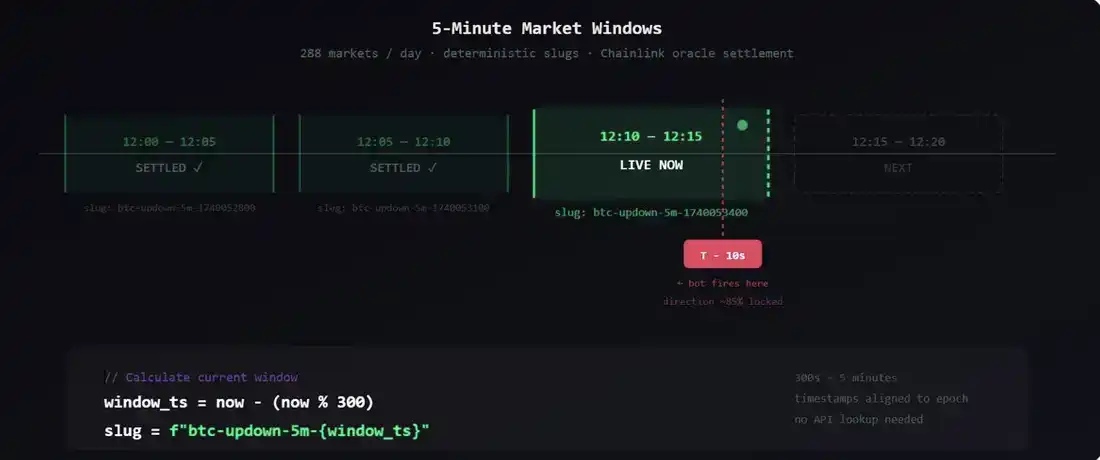
There are 288 markets per day. Each one is a fresh opportunity.

Currently validated effective strategy: By T–10 seconds before the window closes, the direction of BTC's move is about 85% determined, but the odds on Polymarket haven't fully reflected this information yet.

The method is: On the side with the higher probability; Place maker orders at a price of $0.90–0.95.

If filled: Profit $0.05–0.10 per contract at settlement; Zero fees; Plus you get rebates.

The real advantage comes from: Figuring out BTC's direction faster than other market makers, and getting your orders up sooner.

Common Mistakes That Will Get You Wiped Out

· Still using REST instead of WebSocket

· Not including feeRateBps in order signing

· Running the bot on home Wi-Fi (150ms+ latency, vs. <5ms for datacenter VPS)

· Market making near 50% probability without considering adverse selection risk

· Hardcoding fee rates

· Not merging YES/NO positions (locking up capital)

· Still using 2025's taker arbitrage mindset

The Right Way to Use AI

The technical part ends here. Now you understand: The architecture design, fee calculation method, and new market rules.

Next, you can open Claude or any reliable AI model and give it a sufficiently clear and specific task description, for example: "Here is the Polymarket SDK. Please write a maker bot for the 5-minute BTC market that: Listens to Binance WebSocket for prices; Places maker orders on both YES and NO sides; Includes feeRateBps in order signing; Uses WebSocket for order book data; Keeps the cancel/replace cycle under 100ms."

The correct workflow is: You define the tech stack, infrastructure, and constraints, and the AI generates the specific strategy and implementation logic on top of that.

Of course, no matter how perfectly you describe the bot's logic, you must test it before going live. Especially at this stage, where fees are already materially eroding profit margins, backtesting under the real fee curve is a mandatory step before deployment.

The bots that will truly win in 2026 are not the fastest takers, but the best liquidity providers.

Build your system accordingly.

Câu hỏi Liên quan

QWhat are the key changes in Polymarket's rules that have made old trading bots obsolete?

AThe key changes are: 1) Removal of the 500ms taker delay on February 18, 2026, which eliminated the free 'insurance' period for market makers to cancel stale quotes. 2) Introduction of a dynamic taker fee schedule in January 2026, calculated as `fee = C × 0.25 × (p × (1 - p))^2`, which peaks at ~1.56% near 50% probability. These changes rendered taker arbitrage strategies, like the one that previously profited from Binance-Polymarket delays, unprofitable.

QWhat is the new 'meta' or recommended approach for building a profitable bot on Polymarket in 2026?

AThe new meta is to be a maker, not a taker. This is because makers pay no fees, earn USDC rebates (subsidized by taker fees), and benefit from faster order execution with the 500ms delay removed. The most successful bots can now profit from rebates alone, even without capturing price spreads.

QWhat are the critical technical components of a viable 2026 Polymarket bot architecture?

AThe critical components are: 1) Using WebSocket for real-time data instead of REST polling. 2) Implementing fee-aware order signing by including the `feeRateBps` field in the signed payload. 3) Establishing an ultra-fast cancel/replace loop (aiming for under 100ms) to avoid adverse selection and update stale quotes before they are taken.

QWhat is a specific, effective strategy mentioned for the 5-minute BTC markets?

AAn effective strategy is to identify the likely direction of BTC price movement (which is ~85% determined in the last 10 seconds of the window) and place maker orders on the higher probability side at prices between $0.90–$0.95. If filled, this yields a profit of $0.05–$0.10 per contract at settlement, plus rebates, with zero fees.

QWhat are some common mistakes that will cause a bot to fail under the new rules?

ACommon fatal mistakes include: using REST instead of WebSocket; omitting the `feeRateBps` field in order signing; running the bot on high-latency home Wi-Fi (>150ms) instead of a low-latency VPS (

Nội dung Liên quan

«Cưa mùa hè» tiếp tục: Phá vỡ $67,000 sẽ là khởi đầu cho đà tăng của Bitcoin

Giá Bitcoin giảm xuống 62.217 USD vào ngày 1/8, tiếp tục giai đoạn củng cố trong phạm vi 58.000 - 67.000 USD kể từ đầu tháng 6. Thị trường đang chia rẽ về hướng đi tiếp theo. Các nhà phân tích kỹ thuật chỉ ra hai kịch bản chính. Một số, như Crypto Candy và Jelle, dự báo khả năng giảm về vùng 60.000 USD nếu giá không vượt lên trên 66.000 USD, đồng thời mô tả thị trường đang trong giai đoạn "củng cát mùa hè" kéo dài. Ngược lại, những người khác như Daan Crypto Trades và Roman nhấn mạnh rằng việc phá vỡ mốc 67.000 USD với khối lượng giao dịch đủ mạnh có thể mở đường cho đợt tăng mạnh lên vùng 70.000 - 80.000 USD. Về góc nhìn dài hạn, nhà phân tích Gert van Lagen xem đây là giai đoạn tích lũy, với Bitcoin đang thử nghiệm đường viền cổ của mô hình "cốc và tay cầm" hình thành suốt 7 năm. Ông cũng lưu ý rằng các nhà đầu tư nắm giữ dài hạn vẫn kiên định, không chịu bán tháo. Tóm lại, thị trường Bitcoin đang trong thời kỳ tích lũy quan trọng, với hai mức giá then chốt là 60.000 USD và 67.000 USD. Việc phá vỡ một trong hai mức này sẽ định hình xu hướng chính tiếp theo.

cryptonews.ru23 phút trước

«Cưa mùa hè» tiếp tục: Phá vỡ $67,000 sẽ là khởi đầu cho đà tăng của Bitcoin

cryptonews.ru23 phút trước

Tuần tới cần chú ý|Đạo luật CLARITY dự kiến được biểu quyết tại Thượng viện; SpaceX, Circle công bố báo cáo tài chính (3.8-9.8)

**Tóm tắt các sự kiện quan trọng từ ngày 3 đến 9 tháng 8:** **Tuần tới sẽ có nhiều sự kiện đáng chú ý trong lĩnh vực tiền điện tử và công nghệ:** * **Pháp luật & Quy định:** Dự luật CLARITY Act, nhằm thiết lập khung quy định liên bang cho tiền điện tử, có khả năng được đưa ra biểu quyết toàn thể tại Thượng viện Mỹ vào tuần tới. Các nhà đàm phán cần đạt được 60 phiếu ủng hộ trước ngày 7/8. * **Báo cáo tài chính:** Nhiều công ty lớn sẽ công bố báo cáo tài chính quý II/2026, bao gồm **SpaceX (ngày 4/8)**, công ty khai thác Bitcoin **Hut 8 (ngày 4/8)**, **Circle (ngày 5/8)** và công ty khai thác liên quan đến gia đình Trump là **American Bitcoin (ngày 3/8)**. * **Sự kiện SpaceX:** Bên cạnh báo cáo tài chính, cổ phiếu của SpaceX sẽ bắt đầu được mở khóa từ ngày 6/8, với đợt đầu tiên có thể lên tới 12% tổng số cổ phiếu. * **Dữ liệu kinh tế:** Báo cáo việc làm phi nông nghiệp (Non-Farm) quan trọng của Mỹ cho tháng 7 sẽ được công bố vào ngày 7/8. * **Cập nhật công nghệ:** * **XRP Ledger:** Phiên bản mới xrpld 3.3.0 với 5 tính năng mới dự kiến phát hành vào tuần tới. * **Grok:** Elon Musk thông báo Grok 4.6 dự kiến ra mắt vào khoảng ngày 7/8. * **Bitcoin:** Việc gửi tín hiệu bắt buộc cho BIP-110 sẽ bắt đầu vào khoảng ngày 8/8. * **Ngừng hoạt động:** Một số dịch vụ tiền điện tử sẽ ngừng hoạt động vào ngày 3/8, bao gồm công cụ theo dõi danh mục DeFi **Zapper** và ví **Ctrl Wallet**. * **Niêm yết & Hủy niêm yết:** Sàn Upbit Hàn Quốc sẽ hủy niêm yết token AQT và AERGO từ ngày 3/8. Trong khi đó, công ty robot **宇树科技 (Unitree Robotics)** sẽ tiến hành thăm dò giá ban đầu cho đợt IPO trên STAR Market vào ngày 5/8.

marsbit1 giờ trước

Tuần tới cần chú ý|Đạo luật CLARITY dự kiến được biểu quyết tại Thượng viện; SpaceX, Circle công bố báo cáo tài chính (3.8-9.8)

marsbit1 giờ trước

Cổ phiếu giảm mạnh hơn cả tiền điện tử, tiền đã đi đâu?

Tác giả: Cathy, Baihua Blockchain Vào ngày 28 và 29 tháng 7, chỉ số Kospi của Hàn Quốc hai ngày liên tiếp kích hoạt cơ chế ngắt mạch (circuit breaker), một sự kiện chưa từng có trong lịch sử. Cổ phiếu bán dẫn toàn cầu lao dốc, đặc biệt là SK Hynix – cổ phiếu trọng số lớn nhất, giảm khoảng 23% sau hai ngày. Điều trớ trêu là, trong khi thị trường chứng khoán biến động dữ dội như tiền mã hóa, Bitcoin lại thể hiện sự ổn định tương đối, phục hồi gần 15% từ mức thấp tháng 7. Bài viết phân tích rằng đợt sụt giảm này không phải là sự hoảng loạn toàn thị trường, mà là một cuộc "giải tỏa đòn bẩy cưỡng chế" nhắm vào các giao dịch đầu cơ tập trung nhất, như lĩnh vực bán dẫn và AI. Các yếu tố thúc đẩy bao gồm báo cáo lợi nhuận không đạt kỳ vọng của SK Hynix, sự cạnh tranh tiềm tàng từ Trung Quốc, và việc Ngân hàng Nhật Bản tăng lãi suất khiến các khoản đầu tư mang theo (carry trade) bằng Yên phải thoái vốn. Vậy tiền từ thị trường chứng khoán có chảy vào Bitcoin không? Câu trả lời là không. Bitcoin "kháng sụt giảm" vì nó đã trải qua đợt bán tháo lớn vào tháng 5 và tháng 6, với dòng tiền ròng rút kỷ lục khỏi các ETF Bitcoin Mỹ. Tiền thực sự đã chảy vào tài sản an toàn truyền thống như vàng, với hệ số tương quan giữa Bitcoin và vàng giảm xuống mức rất thấp. Điều này cho thấy Bitcoin hiện được coi là tài sản mạo hiểm để tìm kiếm lợi nhuận, chứ không phải nơi trú ẩn an toàn. Bài viết kết luận rằng để dòng tiền thực sự quay trở lại với Bitcoin, cần ba điều kiện: áp lực thanh khoản toàn cầu giảm bớt, Fed cắt giảm lãi suất mà không gây ra suy thoái, và Đạo luật CLARITY được thông qua để giải tỏa lo ngại về quy định. Mặc dù tiền chưa chảy vào, Bitcoin đã tự định vị mình như một tài sản có tương quan thấp với Nasdaq, một đặc điểm mà các tổ chức có thể tìm kiếm để đa dạng hóa danh mục đầu tư sau cú sốc AI.

marsbit1 giờ trước

Cổ phiếu giảm mạnh hơn cả tiền điện tử, tiền đã đi đâu?

marsbit1 giờ trước

Đối thoại với Ray Dalio: Chúng ta đang ở trong bong bóng AI, 1% danh mục đầu tư của tôi là Bitcoin

Ray Dalio, người sáng lập Bridgewater Associates, trong một cuộc phỏng vấn đã chỉ ra rằng thế giới hiện tại đang trong một "AI bubble" (bong bóng AI) cổ điển, với giá tài sản tăng vọt và đầu cơ quá mức. Ông cảnh báo bong bóng có thể vỡ do lãi suất tăng, nguồn cung cổ phiếu dư thừa hoặc khi nhà đầu tư cần tiền mặt trả nợ, dẫn đến suy thoái kinh tế. Đồng thời, Dalio mô tả một "chu kỳ lớn" kéo dài khoảng 80 năm, bao gồm ba động lực chồng chéo: khoảng cách giàu nghèo và xung đột nội bộ, thâm hụt ngân sách chính phủ khổng lồ và thay đổi địa chính trị. Ông nhấn mạnh rằng Mỹ và Anh đang đối mặt với những thách thức trong giai đoạn suy yếu này. Để bảo vệ của cải, Dalio khuyến nghị đa dạng hóa danh mục đầu tư với cổ phiếu, vàng, trái phiếu, bất động sản thay vì chỉ giữ tiền mặt. Ông tiết lộ khoảng 1% danh mục của mình là Bitcoin, nhưng vẫn ưa chuộng vàng vật chất hơn do tính ổn định và vai trò tiền tệ dự trữ. Về tác động của AI, Dalio cho rằng nó không chỉ thay thế lao động chân tay mà còn cả tư duy, làm trầm trọng thêm bất bình đẳng thu nhập. Con người cần phát huy trí tuệ cảm xúc và trực giác - những thứ AI chưa có - và học cách hợp tác với AI. Cuối cùng, ông phân tích những rủi ro của thuế tài sản và xu hướng thế giới có thể trở nên "khu vực hóa" hơn, với các khối như châu Mỹ và châu Á - Thái Bình Dương, trong bối cảnh sự thống trị toàn cầu của Mỹ đang suy yếu.

marsbit4 giờ trước

Đối thoại với Ray Dalio: Chúng ta đang ở trong bong bóng AI, 1% danh mục đầu tư của tôi là Bitcoin

marsbit4 giờ trước

Giao dịch

Giao ngay
活动图片





