Polymarket New Rules Released: How to Build a New Trading Bot

marsbitXuất bản vào 2026-02-25Cập nhật gần nhất vào 2026-02-25

Tóm tắt

Polymarket has removed the 500ms taker delay and introduced dynamic taker fees, rendering many existing trading bots obsolete. The new meta shifts advantage from taker arbitrage to market making. A profitable bot in 2026 must be a maker bot, leveraging zero fees and USDC rebates. Key requirements include using WebSocket (not REST), fee-aware order signing with the `feeRateBps` field, and a sub-100ms cancel/replace loop to avoid adverse selection. The architecture involves connecting to the CLOB, querying fee rates per market, and placing maker orders on both YES/NO sides. For 5-minute BTC markets, a deterministic strategy involves placing maker orders at $0.90–0.95 with 10 seconds remaining, capitalizing on ~85% directional certainty. Critical mistakes to avoid are using REST, omitting feeRateBps, high-latency infrastructure, and outdated taker strategies. AI can assist in implementation, but must be guided by the new technical constraints.

Editor's Note: Polymarket removed the 500ms delay without prior announcement and introduced dynamic fees, instantly rendering a large number of existing bots obsolete overnight. This article systematically outlines the correct way to build trading bots under these new rules, providing a clear and actionable path—from the fee mechanism and order signing to market-making logic and low-latency architecture.

After publication, the article garnered 1.1M views, sparking widespread discussion. Under Polymarket's new rules, the advantage is shifting from taker arbitrage to long-term structures centered around market making and liquidity provision.

Original text below:

Polymarket Quietly Removed the 500ms Delay

Here’s the clear explanation: How to build a bot that actually runs and makes money under the new rules.

Two days ago, Polymarket removed the 500ms taker quote delay in crypto markets. No announcement, no warning. Overnight, half the bots on the platform stopped working. But at the same time, this created the biggest opportunity window for new bots since Polymarket launched.

Today I will explain in detail: How to build a bot that still works under the new rules.

Because every solution you saw before February 18th is now outdated.

If you ask an AI model to write Polymarket bot code for you right now, it will give you a solution based on the old rules: REST polling, no fee handling, completely unaware the 500ms buffer is gone.

Such a bot will lose money from the very first trade.

Let me explain: What exactly changed, and how to redesign your bot around these changes.

What Changed?

Three key changes happened over the past two months:

1. The 500ms Taker Delay Was Removed (February 18, 2026)

Previously, all taker orders waited 500ms before execution. Market makers relied on this buffer time to cancel "stale" quotes, which was almost like free insurance.

Now it's different. Taker orders execute immediately, with no cancellation window.

2. Dynamic Taker Fees Introduced in Crypto Markets (January 2026)

15-minute and 5-minute crypto markets now charge taker fees. The formula is: Fee = C × 0.25 × (p × (1 - p))²

Peak fee: ~1.56% around 50% probability

Fee approaches 0 in extreme probability ranges (near 0 or 1)

Remember that bot that arbitraged the price delay between Binance and Polymarket, making $515,000 in a month with a 99% win rate?

That strategy is completely dead. Because the fee alone is now higher than the arbitrageable spread.

What is the New Meta?

In one sentence: Be a maker, not a taker.

The reasons are simple:

· Makers pay no fees

· Makers earn daily USDC rebates (subsidized by taker fees)

· With the 500ms delay gone, maker order execution is actually faster

The top bots now profit just from rebates, without even needing the spread. If you're still running a taker bot, you're facing a constantly rising fee curve. Around 50% probability, you need at least a 1.56% edge just to break even.

Good luck.

So, How Should a Truly Viable 2026 Bot Be Built?

Here is a design思路 (design approach) for a bot architecture that remains effective in 2026:
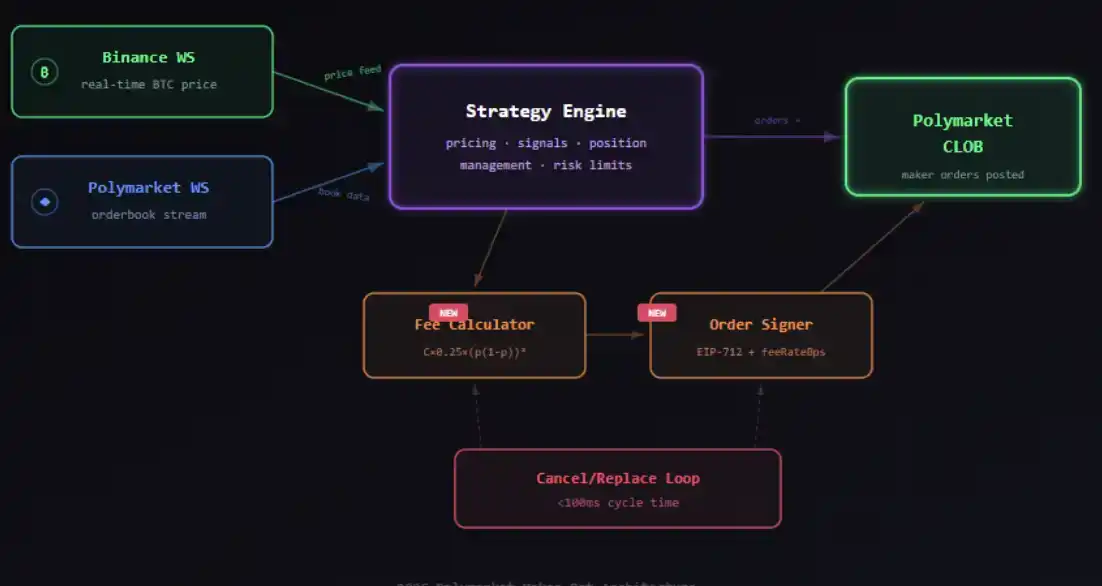
Core Components:

1. Use WebSocket, Not REST

REST polling is completely obsolete. By the time your HTTP request completes a round trip, the opportunity is long gone. You need a real-time order book data stream based on WebSocket, not intermittent pulling.

2. Fee-Aware Order Signing

This is a new requirement that didn't exist before. Now, the feeRateBps field must be included in the payload of the order you sign. If you omit this field, orders will be outright rejected in markets where fees are enabled.

3. Ultra-Fast Cancel/Replace Loop

With the 500ms buffer removed: If your cancel-replace process takes over 200ms, you will suffer from adverse selection. Others will snatch your stale quotes before you can update them.

How to Build It

1. Get Your Private Key

Use the same private key you use to log in to Polymarket (EOA / MetaMask / Hardware Wallet)

export POLYMARKET_PRIVATE_KEY="0xyour_private_key_here"

2. Set Up Approvals (One-Time Operation)

Before Polymarket can execute your trades, you need to approve the following contracts: USDC, Conditional Tokens.

This only needs to be done once per wallet.

3. Connect to the CLOB (Central Limit Order Book)

The official Python client can be used directly: pip install py-clob-client

However, there are now faster options in the Rust ecosystem:

· polyfill-rs (Hot path zero-allocation, SIMD JSON parsing, ~21% performance boost)

· polymarket-client-sdk (Official Polymarket Rust SDK)

· polymarket-hft (Complete HFT framework, integrates CLOB + WebSocket)

Which one you choose isn't critical; the key is to pick the one you can get up and running the fastest.

4. Query the Fee Rate Before Placing Every Order

GET /fee-rate?tokenID={token_id}

Never hardcode fees.
Fees vary by market, and Polymarket can adjust them at any time.

5. Include the Fee Field in Order Signing

When signing the order, the fee field must be written into the payload. Missing this will cause the order to be rejected in fee-enabled markets.

{
"salt": "...",
"maker": "0x...",
"signer": "0x...",
"taker": "0x...",
"tokenId": "...",
"makerAmount": "50000000",
"takerAmount": "100000000",
"feeRateBps": "150"
}

The CLOB will validate your order signature based on feeRateBps. If the fee rate in the signature doesn't match the current actual rate, the order will be rejected outright.

If you use the official SDK (Python or Rust), this logic is handled automatically; but if you implement the signing logic yourself, you must handle this, otherwise the order simply won't go through.

6. Place Maker Orders on Both Sides (Bid and Ask)

Provide liquidity to the market by placing limit orders: On both YES and NO tokens; Place both BUY and SELL orders. This is the core way you earn rebates.

7. Run a Cancel/Replace Loop

You need to monitor simultaneously: External price feeds (e.g., Binance WebSocket); Your current open orders on Polymarket.

Once the price changes: Immediately cancel outdated quotes; Re-place orders at the new price. The goal: Keep the entire cycle under 100ms.

Special Note on 5-Minute Markets

The 5-minute cycle BTC up/down markets are deterministic.

You can directly calculate the specific market just from the timestamp:
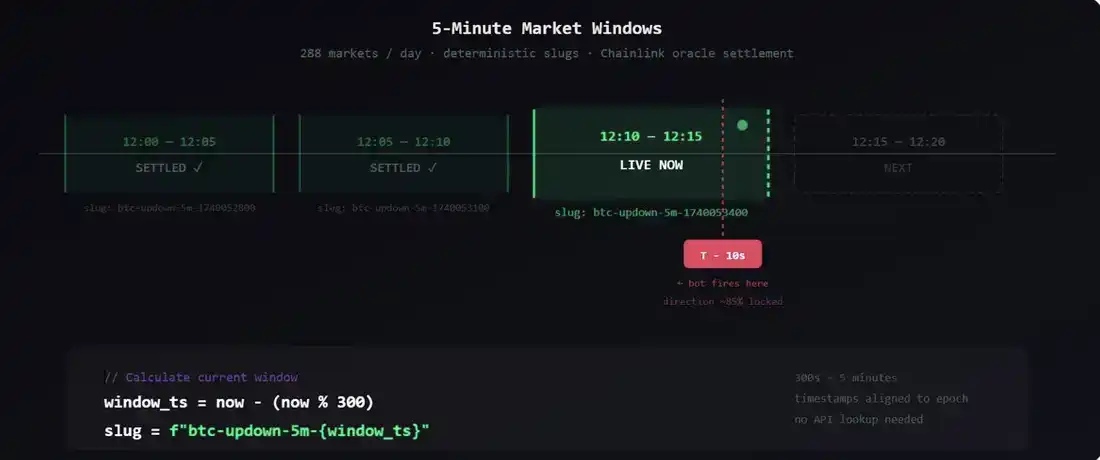
There are 288 markets per day. Each one is a fresh opportunity.

Currently validated effective strategy: By T–10 seconds before the window closes, the direction of BTC's move is about 85% determined, but the odds on Polymarket haven't fully reflected this information yet.

The method is: On the side with the higher probability; Place maker orders at a price of $0.90–0.95.

If filled: Profit $0.05–0.10 per contract at settlement; Zero fees; Plus you get rebates.

The real advantage comes from: Figuring out BTC's direction faster than other market makers, and getting your orders up sooner.

Common Mistakes That Will Get You Wiped Out

· Still using REST instead of WebSocket

· Not including feeRateBps in order signing

· Running the bot on home Wi-Fi (150ms+ latency, vs. <5ms for datacenter VPS)

· Market making near 50% probability without considering adverse selection risk

· Hardcoding fee rates

· Not merging YES/NO positions (locking up capital)

· Still using 2025's taker arbitrage mindset

The Right Way to Use AI

The technical part ends here. Now you understand: The architecture design, fee calculation method, and new market rules.

Next, you can open Claude or any reliable AI model and give it a sufficiently clear and specific task description, for example: "Here is the Polymarket SDK. Please write a maker bot for the 5-minute BTC market that: Listens to Binance WebSocket for prices; Places maker orders on both YES and NO sides; Includes feeRateBps in order signing; Uses WebSocket for order book data; Keeps the cancel/replace cycle under 100ms."

The correct workflow is: You define the tech stack, infrastructure, and constraints, and the AI generates the specific strategy and implementation logic on top of that.

Of course, no matter how perfectly you describe the bot's logic, you must test it before going live. Especially at this stage, where fees are already materially eroding profit margins, backtesting under the real fee curve is a mandatory step before deployment.

The bots that will truly win in 2026 are not the fastest takers, but the best liquidity providers.

Build your system accordingly.

Câu hỏi Liên quan

QWhat are the key changes in Polymarket's rules that have made old trading bots obsolete?

AThe key changes are: 1) Removal of the 500ms taker delay on February 18, 2026, which eliminated the free 'insurance' period for market makers to cancel stale quotes. 2) Introduction of a dynamic taker fee schedule in January 2026, calculated as `fee = C × 0.25 × (p × (1 - p))^2`, which peaks at ~1.56% near 50% probability. These changes rendered taker arbitrage strategies, like the one that previously profited from Binance-Polymarket delays, unprofitable.

QWhat is the new 'meta' or recommended approach for building a profitable bot on Polymarket in 2026?

AThe new meta is to be a maker, not a taker. This is because makers pay no fees, earn USDC rebates (subsidized by taker fees), and benefit from faster order execution with the 500ms delay removed. The most successful bots can now profit from rebates alone, even without capturing price spreads.

QWhat are the critical technical components of a viable 2026 Polymarket bot architecture?

AThe critical components are: 1) Using WebSocket for real-time data instead of REST polling. 2) Implementing fee-aware order signing by including the `feeRateBps` field in the signed payload. 3) Establishing an ultra-fast cancel/replace loop (aiming for under 100ms) to avoid adverse selection and update stale quotes before they are taken.

QWhat is a specific, effective strategy mentioned for the 5-minute BTC markets?

AAn effective strategy is to identify the likely direction of BTC price movement (which is ~85% determined in the last 10 seconds of the window) and place maker orders on the higher probability side at prices between $0.90–$0.95. If filled, this yields a profit of $0.05–$0.10 per contract at settlement, plus rebates, with zero fees.

QWhat are some common mistakes that will cause a bot to fail under the new rules?

ACommon fatal mistakes include: using REST instead of WebSocket; omitting the `feeRateBps` field in order signing; running the bot on high-latency home Wi-Fi (>150ms) instead of a low-latency VPS (<5ms); market making near 50% probability without considering adverse selection risk; hard-coding fee rates; not merging YES/NO positions (locking up capital); and persisting with outdated 2025 taker arbitrage strategies.

Nội dung Liên quan

Ai sẽ mua lại cổ phiếu SpaceX sau khi niêm yết?

Tác giả: BitalkNews SpaceX dự kiến niêm yết vào ngày 12/6 với định giá 1.800 tỷ USD. Tuy nhiên, chỉ có khoảng 4,2% cổ phần (tương ứng 5,56 tỷ cổ phiếu, trị giá 75 tỷ USD) được lưu hành công khai. Có ba làn sóng mua chính sau khi niêm yết: 1. **Đợt IPO ngày 12/6:** Phát hành 5,56 tỷ cổ phiếu với giá cố định 135 USD, 30% dành cho nhà đầu tư nhỏ lẻ. Nhu cầu đặt mua đã vượt quá 250 tỷ USD. 2. **Giao dịch thị trường thứ cấp:** Giá mở cửa dự kiến cao hơn giá IPO, được xác định bởi cung cầu thị trường. 3. **Mua bắt buộc của các quỹ chỉ số (ETF):** Đây là yếu tố quan trọng. Nasdaq đã sửa quy tắc để đưa SpaceX vào chỉ số Nasdaq 100 chỉ sau 15 ngày giao dịch, với trọng số tính toán lên tới 15% dù tỷ lệ lưu hành thực tế chỉ 5%. Hàng trăm quỹ ETF theo chỉ số này (với tổng tài sản trên 600 tỷ USD) sẽ phải mua ồ ạt cổ phiếu SpaceX, tạo áp lực mua mạnh trong thời gian ngắn. **Cơ chế giải tỏa cổ phiếu nội bộ được thiết kế theo từng giai đoạn:** * Cổ phần phát hành IPO (4,2%) có thể giao dịch ngay. * Cổ phần của Elon Musk (42%) bị khóa 366 ngày. * 54% cổ phần còn lại (thuộc sở hữu của VC, nhân viên...) sẽ được giải tỏa dần dần sau các mốc như sau khi công bố báo cáo tài chính Q2, và vào các ngày thứ 70, 90, 105, 120, 135 sau IPO. Lịch trình này kéo dài đến 180 ngày. **Chuyển đổi cung - cầu:** Nửa đầu năm, nguồn cung bị hạn chế trong khi nhu cầu mua cao. Nửa cuối năm, nguồn cung từ cổ phiếu nội bộ được giải tỏa sẽ tăng dần, tạo ra áp lực bán tại mỗi mốc báo cáo tài chính. Đến giữa tháng 12, khi Nasdaq 100 tái cân bằng chỉ số, nguồn cung đã tăng đáng kể, buộc các quỹ ETF phải mua bổ sung, tạo ra lực mua "đỡ đáy" cho thị trường sau một giai đoạn bán ra của cổ đông nội bộ.

marsbit22 phút trước

Ai sẽ mua lại cổ phiếu SpaceX sau khi niêm yết?

marsbit22 phút trước

Anthropic đã xin lỗi, nhưng ‘cơn sốt’ an toàn vẫn chưa hạ nhiệt

Ngày 11/6, Anthropic đã xin lỗi. Nguyên nhân không phải do lỗi mô hình mà là vì "không giữ được cân bằng" - Claude Fable 5 mới ra mắt đã lén lút chuyển yêu cầu người dùng liên quan đến phát triển AI tiên tiến sang mô hình yếu hơn Opus 4.8 mà không thông báo. Sự kiện này phơi bày cốt lõi vấn đề: khái niệm "an toàn" mà Anthropic quảng bá thực chất là một công cụ kinh doanh. Hệ thống "bộ phân loại an toàn thông minh" được giới thiệu như một biện pháp bảo vệ, nhưng thực tế là cơ chế phòng thủ cạnh tranh, nhắm vào các nhà nghiên cứu AI nhằm bảo vệ lợi thế của chính Anthropic. Chiến lược của Anthropic tạo thành một vòng khép kín: xuất bản nghiên cứu khuếch đại lo ngại về an ninh, sau đó định giá cao sản phẩm Fable 5 như một giải pháp, rồi cuối cùng là thu lợi từ thị trường vốn với danh hiệu "công ty AI an toàn nhất". Động thái lén lút giảm chất lượng phản hồi cho thấy logic của họ: mối nguy hiểm thực sự không phải là AI, mà là bất cứ điều gì đe dọa vị thế dẫn đầu của họ. So với OpenAI - tập trung vào việc cung cấp công cụ và mở rộng quy mô hệ sinh thái, Anthropic chọn cách bán sự lo lắng. Họ nhắm đến các khách hàng chính phủ và doanh nghiệp lớn, những người sẵn sàng trả phí cao cho lời hứa về "sự an toàn". Tuy nhiên, vụ việc này đã làm rạn nứt uy tín của họ trong cộng đồng các nhà phát triển cốt lõi, đặt ra câu hỏi về giá trị thực đằng sau định giá 965 tỷ USD. Lời xin lỗi và thay đổi từ "giảm chất lượng lén lút" sang "thông báo trước khi giảm chất lượng" chỉ như một bản vá cho hệ thống. Nền tảng logic kinh doanh không đổi: nghiên cứu tiếp tục gây lo ngại, sản phẩm tiếp tục thu phí cao, và danh tiếng "an toàn" vẫn là mặt hàng chính được rao bán.

marsbit42 phút trước

Anthropic đã xin lỗi, nhưng ‘cơn sốt’ an toàn vẫn chưa hạ nhiệt

marsbit42 phút trước

Sự đồng thuận ngầm trong giới tinh hoa: Học đại học đã trở thành một sự lãng phí đắt đỏ?

Tác giả: Bất Đổng Kinh Trong giới tinh hoa tại Thung lũng Silicon, một làn sóng tư tưởng "phản đối đại học" đang hình thành, cho rằng đại học 4 năm trở nên đắt đỏ, chậm chạp và lỗi thời. Sebastian Tan, 18 tuổi, dù đỗ Đại học Stanford danh giá, đã quyết định hoãn nhập học để thực tập tại Palantir - công ty đồng sáng lập bởi tỷ phú Peter Thiel, người cổ vũ mạnh mẽ cho việc bỏ đại học để khởi nghiệp. Phong trào này được thúc đẩy bởi ba yếu tố: kinh tế (học phí quá cao so với cơ hội khởi nghiệp sớm), công nghệ (AI và internet giúp tự học dễ dàng hơn), và văn hóa (phản ứng lại văn hóa "thức tỉnh" và chủ nghĩa tinh hoa trong học viện). Những người ủng hộ tin rằng "tự học là cựu sinh viên kiểu mới", và kiến thức thực tế từ những người xây dựng sản phẩm có giá trị hơn lý thuyết trên giảng đường. Tuy nhiên, các chuyên gia như nhà kinh tế David Deming của Đại học Harvard cảnh báo rằng rất ít người thực sự tự học thành công, và giáo dục đại học vẫn mang lại lợi thế thu nhập bền vững (khoảng 75-80%). Ông chỉ ra rằng việc chỉ nhìn vào những tỷ phú bỏ học thành công là thiên kiến sống sót. Bản chất của cuộc tranh luận không phải là sự lựa chọn nhị phân giữa học hay không học, mà là dấu hiệu cho thấy mô hình đại học truyền thống đang lỗi thời trong kỷ nguyên số. Tương lai của giáo dục có thể hướng tới một mô hình hỗn hợp, cá nhân hóa và học tập suốt đời, nơi quyền lực chuyển từ tổ chức sang cá nhân người học. Câu hỏi then chốt là: trong một thế giới thay đổi nhanh hơn cả giáo trình, chúng ta nên học như thế nào?

marsbit1 giờ trước

Sự đồng thuận ngầm trong giới tinh hoa: Học đại học đã trở thành một sự lãng phí đắt đỏ?

marsbit1 giờ trước

Trợ cấp → Tính phí Token → Giảm giá, OpenAI khơi mào chiến tranh giá, Điểm bẻ gãy Kinh tế học Token sắp đến?

Cuộc chiến thương mại hóa AI đang bước vào giai đoạn căng thẳng với việc OpenAI được cho là đang cân nhắc giảm mạnh phí Token để cạnh tranh với Anthropic, báo hiệu một cuộc chiến giá có thể xảy ra. Động thái này diễn ra trong bối cảnh cả hai công ty đều chịu lỗ hàng tỷ USD do chi phí điện toán khổng lồ và đang chuẩn bị cho các đợi phát hành cổ phiếu lần đầu ra công chúng (IPO). Bài viết nêu bật ba giai đoạn phát triển thương mại hóa AI sinh ra (Generative AI): từ gói thuê bao cố định, đến chiến tranh trợ giá, và hiện tại là tính phí theo lượng Token tiêu thụ. Việc chuyển sang tính phí theo lượng sử dụng đã phơi bày chi phí thực sự cho doanh nghiệp, dẫn đến tình trạng hóa đơn vượt tầm kiểm soát. Các số liệu cho thấy hiệu quả đầu tư vào AI còn thấp, với phần lớn chi phí dành cho việc sửa lỗi và công việc lại do AI tạo ra. Một cuộc chiến giá tiềm năng giữa OpenAI và Anthropic có thể làm xói mòn biên lợi nhuận vốn đã âm của họ. Các chuyên gia cảnh báo về rủi ro lan tỏa đến các công ty cung cấp hạ tầng như NVIDIA, Oracle hay CoreWeave. Tương lai của nền kinh tế Token (Tokenomics) có thể hướng tới mô hình định giá phân tầng, nơi các tác vụ phức tạp dùng model đắt tiền, còn tác vụ thông thường dùng model rẻ hơn hoặc local. Khái niệm "valuemaxxing" – tối đa hóa giá trị từ mỗi Token – đang nổi lên như một xu hướng cần thiết. Đáng chú ý, mô hình AI Trung Quốc DeepSeek, với mức giá API được cho là chỉ bằng 1/10 so với GPT-5.5, đang gia tăng mạnh mẽ sự phổ biến trong các doanh nghiệp Mỹ, trở thành một đối thủ cạnh tranh đáng gờm trong cuộc đua thương mại hóa này.

marsbit1 giờ trước

Trợ cấp → Tính phí Token → Giảm giá, OpenAI khơi mào chiến tranh giá, Điểm bẻ gãy Kinh tế học Token sắp đến?

marsbit1 giờ trước

Giao dịch

Giao ngay
Hợp đồng Tương lai
活动图片