On the Eve of the Quantum Computing Wave: Why Nvidia Might Emerge as the Biggest Winner?

比推Xuất bản vào 2026-02-09Cập nhật gần nhất vào 2026-02-09

Tóm tắt

Amidst the prevailing market perception that quantum computing remains a distant, sci-fi concept, Barclays' latest research challenges this view, arguing that the technology is on the verge of transitioning from a "lab toy" to a commercial tool. The report highlights several key misconceptions: First, quantum computing is not "too early"; the industry is approaching a watershed moment around 2026–2027 when "quantum advantage" is expected to be demonstrated, requiring stable operation of 100 logical qubits. Second, quantum computers will not replace classical systems like GPUs but instead complement them. Each logical qubit may require a GPU for error correction and control, potentially driving significant demand for chips from companies like NVIDIA and AMD, with projected incremental value exceeding $100 billion by 2040. Third, hardware approaches are not equal. Trapped ions currently lead in precision, silicon spin offers scalability potential, and neutral atoms excel in qubit count. Fourth, quantum computers are not yet powerful enough to break modern encryption, requiring thousands of logical qubits—far beyond current capabilities. Finally, the investment landscape is broader than often assumed, with opportunities across quantum processors, supply chains, semiconductor manufacturing, and enabling infrastructure, spanning both public and private companies.

Author: Long Yue

Original Title: The Biggest Misconception About "Quantum Computing": It's Still "Too Early"


Investors generally believe that quantum computing is still in the realm of science fiction, but Barclays' latest research note points out that this "too early" illusion might cause you to miss the most critical trend in the next 12 months.

According to news from the trading desk, Barclays' analyst team has recently released a research report titled "Quantum Computing: Correcting Investors' Biggest Misconception".

The core logic is very straightforward: Wall Street is underestimating the speed of the technology explosion and completely misunderstanding the relationship between quantum and classical computing power (like Nvidia's). Barclays believes we are on the eve of transitioning from a "lab toy" to a "commercial tool".

Misconception 1: Quantum Computing is "Too Early"

Barclays' first correction is: Don't treat quantum computing as a purely long-term theme that "won't yield results for another decade".

The current market consensus is that perfectly functioning "Fault-Tolerant Quantum Computing" (FTQC) won't arrive until after 2030. This is correct, but Barclays reminds investors not to ignore the intermediate "tipping point".

Barclays points out that 2026 to 2027 will be the industry's watershed moment, achieving "Quantum Advantage".

More importantly is "how to define advantage". Barclays believes that "advantage is only proven when a system targets 100 logical qubits". It also cautions that any "claim of advantage" needs to be backed by "strong technical data"; otherwise, it's more like marketing than an inflection point.

"We expect major announcements within the next 12 months...... Quantum advantage will be proven when a system can stably run 100 logical qubits."

This is like the Wright brothers' first flight; although it couldn't carry passengers (commercialization), it proved that airplanes were better than horse-drawn carriages (quantum advantage). Once this signal appears, the valuation logic of the capital market will be instantly reshaped.
Misconception 2: Quantum is coming, it will replace classical computing, so Nvidia is finished?

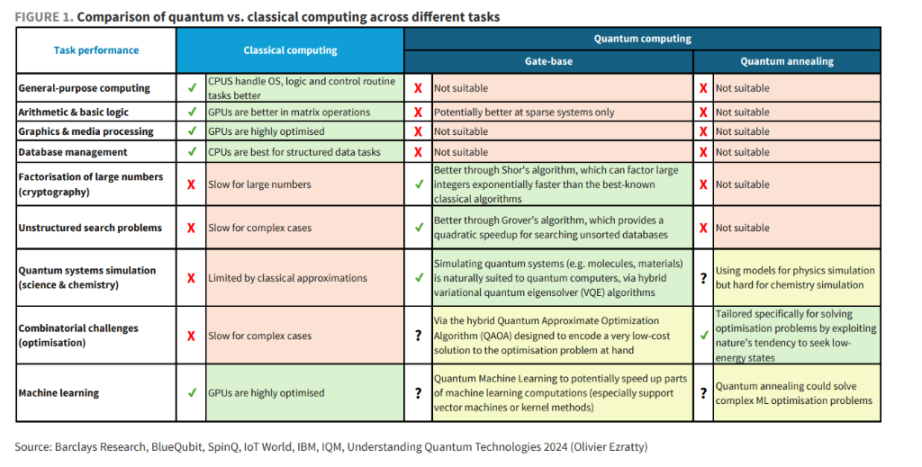
This is the market's biggest cognitive bias. The report points out that many people think quantum computers are so powerful they will replace current CPUs and GPUs. Barclays refutes this: it's not a replacement relationship, but a "strongest assistant" relationship.

"Quantum computers will not replace classical computers as general-purpose machines but will complement them."

The core logic behind this is "error correction": Qubits are very fragile and unstable (prone to errors). To make them work properly, an extremely powerful classical computing system is needed to monitor and correct them in real-time.

Barclays' research reveals a startling data relationship:

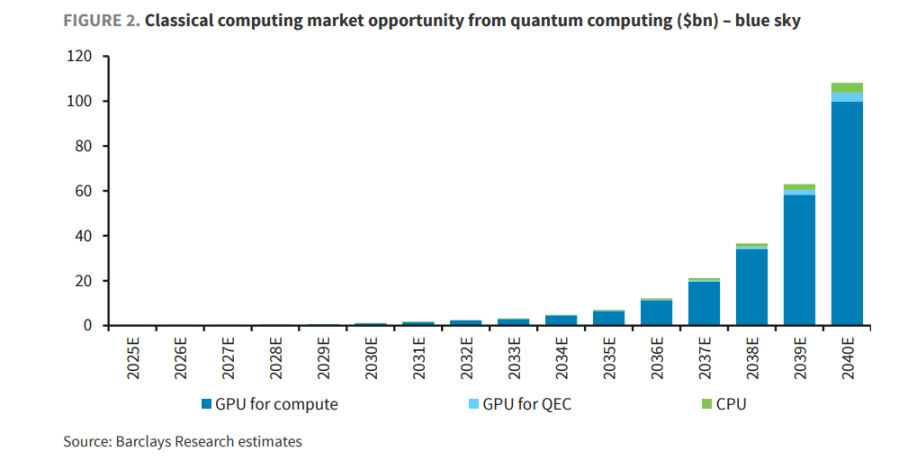
"Each logical qubit might require one GPU for error correction and control."

What does this mean? If you build a quantum computer with 1000 logical qubits, you would need to purchase 500 to 2000 GPUs to support it.

This is no longer competition; it's symbiosis. The stronger the quantum computer, the more explosive the demand for chips from Nvidia and AMD. Barclays calculates that this "derived demand" could bring over $100 billion in incremental value to the classical computing market by 2040 in a blue-sky scenario.
Misconception 3: Quantum hardware is all similar, like buying a lottery ticket?

The truth about this misconception is that the field has already diverged, with clear leaders and laggards.

Quantum hardware paths are not singular. Barclays categorizes mainstream physical qubit paths into electronic (superconducting, electron spin), atomic (trapped ions, neutral atoms), and photonic, among others, noting that their pros and cons stem from trade-offs between speed, accuracy, coherence time, external infrastructure (cryogenics, lasers, vacuum), and scalability.

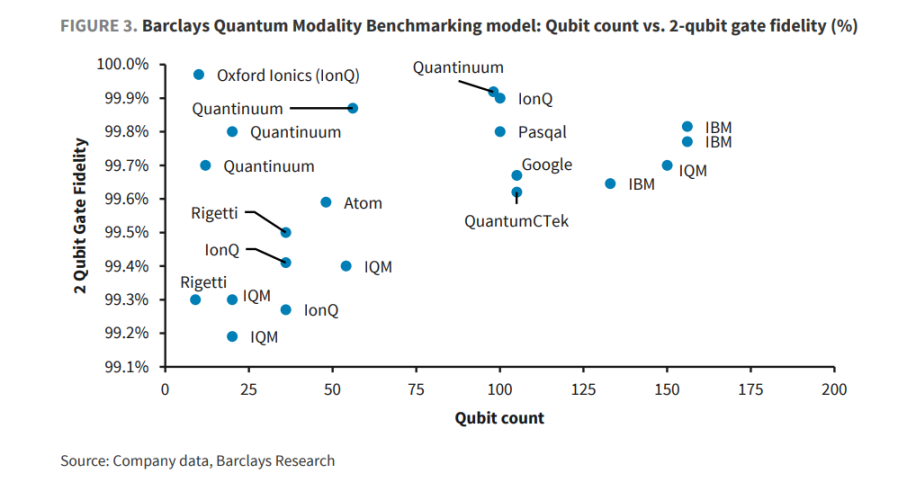
Using a "quantum benchmarking model," Barclays highlights the key points in the currently chaotic hardware landscape:

  • Current "Accuracy King" — Trapped Ions: Represented by companies like Quantinuum and IonQ. Their advantage is accuracy, low error rates, and relatively mature technology.

  • Future "Mass Production Dark Horse" — Silicon Spin: The direction Intel is pursuing. Although performance is currently average, it can leverage existing semiconductor fabs for manufacturing. Once it breaks through, it's the easiest to mass-produce.

  • Winning by Numbers — Neutral Atoms: Have a natural advantage in stacking large numbers of qubits.

Barclays concludes:

"Our testing indicates that trapped ions are currently in the lead...... but the scalability of silicon spin deserves long-term attention."
Misconception 4: Passwords are about to be cracked?

Regarding the panic that "quantum computers will crack bank passwords tomorrow," Barclays pours cold water on it: Think again, the computing power isn't there yet.

Cracking current RSA encryption requires thousands of perfect logical qubits, while humanity's top equipment currently only has a few dozen. Barclays states bluntly:

"Quantum computers are not yet powerful enough...... modern encryption standards are not yet under threat."

Misconception 5: The quantum theme has "only two or three companies worth investing in"

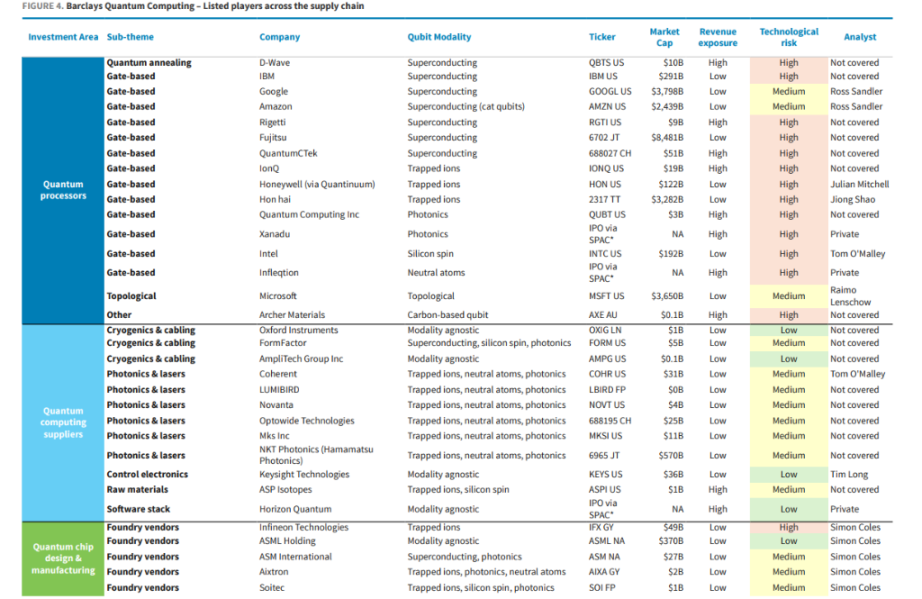
The market often believes investment targets in this field are scarce, limited to a few well-known companies. But Barclays梳理ed the entire industry chain, identifying 45 listed companies and over 80 private companies. They are mainly distributed across four areas:

1) Quantum Processors (system sales or QCaaS cloud access)

2) Quantum Supply Chain (cryogenics, lasers/optics, control electronics, materials, etc.)

3) Quantum Chip Design and Manufacturing (overlap with traditional semiconductor manufacturing)

4) Ecosystem Enablers (cloud, data center infrastructure, quantum simulators, quantum-classical integration: GPU/CPU/servers, etc.)

The framework provided by the report leans more towards "risk pricing": short-term often means "higher revenue exposure" corresponds to "higher technical risk". It roughly categorizes technical risk as high (single path), medium (few paths), low (path agnostic) based on whether the business model is tied to a single path.

This also explains why the quantum narrative easily "focuses solely on pure quantum hardware stocks": their revenue exposure is most direct, but their path uncertainty is also greatest; whereas the supply chain, semiconductor equipment & EDA, cloud & data centers, and hybrid integration segments might better capture the transmission of "quantum progress → capital expenditure and supporting demand".

Twitter:https://twitter.com/BitpushNewsCN

Bitpush TG Discussion Group:https://t.me/BitPushCommunity

Bitpush TG Subscription: https://t.me/bitpush

Original link:https://www.bitpush.news/articles/7610362

Câu hỏi Liên quan

QWhat is the core argument of Barclays' report regarding the timeline for quantum computing?

ABarclays argues that the market underestimates the speed of quantum computing's development, with the 'quantum advantage' expected to be demonstrated between 2026 and 2027 when systems can stably run 100 logical qubits, a critical inflection point that is not a distant future event.

QAccording to Barclays, what is the relationship between quantum computers and classical computing hardware like GPUs?

AIt is a symbiotic, not competitive, relationship. Quantum computers require powerful classical systems for error correction and control, with each logical qubit potentially needing one GPU. This creates massive demand for GPUs from companies like NVIDIA and AMD as quantum computing scales.

QWhich quantum hardware technology is currently leading in terms of 'precision' according to the Barclays benchmark model?

ATrapped ions, represented by companies like Quantinuum and IonQ, are currently the 'precision king' due to their low error rates and relative technological maturity.

QDoes Barclays report suggest that current encryption standards are immediately threatened by quantum computers?

ANo, it states that quantum computers are not yet powerful enough to threaten modern encryption standards like RSA, as this would require thousands of perfect logical qubits, far beyond current capabilities of a few dozen.

QHow does Barclays categorize the investment landscape for quantum computing beyond just hardware companies?

ABarclays identifies a broad ecosystem of over 45 public and 80 private companies across four main areas: quantum processors, the quantum supply chain (cryogenics, lasers, etc.), quantum chip design/manufacturing, and ecosystem enablers (cloud, data centers, integration hardware like GPUs).

Nội dung Liên quan

Top Crypto Coins With Real Use Cases To Watch in June 2026: NEAR, HYPE, Humanity Protocol, và BlockDAG So Sánh

Tháng 6/2026 chứng kiến nhiều dự án tiền mã hóa nổi bật với các trường hợp sử dụng thực tế khác nhau. Hyperliquid (HYPE) là nền tảng giao dịch phái sinh DeFi mạnh mẽ, hoạt động hiệu quả khi thị trường biến động. NEAR Protocol tập trung tích hợp blockchain với AI, cung cấp cơ sở hạ tầng có khả năng mở rộng cho các ứng dụng phi tập trung. Humanity Protocol giải quyết vấn đề nhận dạng kỹ thuật số trong thời đại AI, cung cấp giải pháp xác minh con người mà không tiết lộ dữ liệu cá nhân. BlockDAG nổi bật với cơ hội rõ ràng nhờ chênh lệch giá đáng chú ý giữa đợt bán Legacy (0.00000044 USD/coin) và Chương trình Mua lại (0.05 USD/coin). Dự án sở hữu hệ sinh thái đang hoạt động với hơn 100 trò chơi casino trực tuyến, tốc độ xử lý 10.000+ TPS, hơn 1 tỷ USD giá trị trên chuỗi và hơn 8 tỷ BDAG đang được stake. Việc hơn 1 tỷ coin đã được mua lại và có mặt trên 13 sàn giao dịch làm thắt chặt nguồn cung. Trong khi cả bốn dự án đều có tiềm năng, BlockDAG được cho là cung cấp cơ hội có thể tính toán cụ thể nhất tại thời điểm hiện tại.

TheNewsCrypto3 giờ trước

Top Crypto Coins With Real Use Cases To Watch in June 2026: NEAR, HYPE, Humanity Protocol, và BlockDAG So Sánh

TheNewsCrypto3 giờ trước

Những người mua ETH lớn cuối cùng còn có thể chống đỡ được bao lâu nữa?

Trong bối cảnh thị trường tiền mã hóa tiếp tục giảm mạnh, với BTC và ETH lao dốc, Bitmine - nhà mua ETH liên tục và mạnh mẽ nhất thị trường - vẫn kiên trì tích lũy dù lỗ nổi hơn 100 tỷ USD. Công ty vừa phát hành cổ phiếu ưu đãi vĩnh viễn với lợi tức 9.5% để huy động khoảng 274 triệu USD, bổ sung vào "cỗ máy" mua ETH nhằm đạt mục tiêu sở hữu 5% tổng nguồn cung ETH. Bitmine hiện nắm giữ khoảng 5.66 triệu ETH, đã hoàn thành hơn 90% mục tiêu và dự kiến đạt đủ 5% vào cuối năm 2026. Gánh nặng rõ ràng: giá ETH hiện tại (~1,650 USD) thấp hơn nhiều so với giá mua trung bình (~3,500 USD), khiến công ty lỗ nặng. Để duy trì hoạt động, Bitmine dựa vào doanh thu từ staking ETH (ước tính 2.3-2.96 tỷ USD/năm) để chi trả cổ tức cho cổ phiếu ưu đãi. Tuy nhiên, nếu quy mô phát hành cổ phiếu ưu đãi mở rộng, lợi suất staking chỉ 3-4% khó có thể đáp ứng nghĩa vụ cổ tức 9.5%, và chỉ có việc ETH tăng giá mới duy trì được logic này. Câu hỏi then chốt được đặt ra: Khi Bitmine đạt mục tiêu 5% và có thể ngừng mua, ai sẽ là lực lượng mua kế tiếp để hỗ trợ giá ETH? Các quỹ ETF đang có dòng tiền ra ròng, một số tổ chức truyền thống như Quỹ tài trợ Harvard đã thoái vốn, trong khi nhu cầu từ stablecoin hay RWA (tài sản thế giới thực) vẫn là biến số chậm. Tương lai giá ETH vì thế phụ thuộc vào thời điểm xuất hiện của các lực mua biên mới và điểm xoay chuyển thanh khoản thị trường.

marsbit5 giờ trước

Những người mua ETH lớn cuối cùng còn có thể chống đỡ được bao lâu nữa?

marsbit5 giờ trước

Người mua ETH cuối cùng, còn có thể chịu đựng được bao lâu?

Thị trường tiền điện tử đang suy thoái, với ETH giảm xuống khoảng 1.500 USD. Bitmine, công ty mua ETH mạnh mẽ nhất và kiên định nhất thị trường hiện nay, đang phải đối mặt với khoản lỗ thả nổi hàng trăm tỷ USD với mức giá mua vào trung bình ~3.500 USD. Dù vậy, họ vẫn tiếp tục mua vào và đã nắm giữ khoảng 5,66 triệu ETH, đạt hơn 90% mục tiêu sở hữu 5% tổng nguồn cung ETH vào cuối năm 2026. Để tài trợ cho việc mua hàng, Bitmine vừa phát hành cổ phiếu ưu đãi vĩnh viễn với cổ tức 9,5%/năm, huy động được 274 triệu USD. Lợi thế của Bitmine so với các công ty tương tự nắm giữ BTC là có thể dựa vào thu nhập từ staking ETH (~2,3-2,96 tỷ USD/năm) để chi trả cổ tức, thay vì phải bán tài sản. Tuy nhiên, nếu quy mô phát hành cổ phiếu ưu đãi mở rộng, lợi suất staking chỉ 3-4% sẽ không đủ trang trải cổ tức 9,5%, và việc ETH tăng giá là cần thiết để duy trì mô hình. Câu hỏi then chốt là: Khi Bitmine đạt mục tiêu 5% và dừng mua vào, ai sẽ là lực lượng mua mới hỗ trợ giá ETH? Quỹ ETF ETH đang có dòng tiền ròng rút ra, một số tổ chức lớn như Goldman Sachs và Quỹ tài trợ Harvard đã giảm mạnh hoặc thoái vốn. Các yếu tố tiềm năng khác như quy định stablecoin hay token hóa RWA (tài sản trong thế giới thực) vẫn cần thời gian. Tương lai giá ETH có thể diễn ra theo các kịch bản: Bi quan (giảm xuống 1.000 USD nếu Bitmine chậm lại), Cơ sở (dao động 1.500-2.000 USD), hoặc Lạc quan (phục hồi mạnh nhờ dòng tiền thụ động từ chỉ số Russell 1000 và cải thiện cơ bản). Cuối cùng, câu chuyện phụ thuộc vào việc liệu dòng tiền mới có xuất hiện để thay thế Bitmine với tư cách là người mua biên chính hay không.

链捕手5 giờ trước

Người mua ETH cuối cùng, còn có thể chịu đựng được bao lâu?

链捕手5 giờ trước

Giao dịch

Giao ngay
Hợp đồng Tương lai
活动图片