Not Just USDT: Tether Wallet Is Attempting to Take Over the Payment System for Ordinary People

marsbitXuất bản vào 2026-04-15Cập nhật gần nhất vào 2026-04-15

Tóm tắt

Tether, the issuer of the world's largest stablecoin USDT, has launched Tether Wallet, branded as "The People's Wallet," marking a strategic shift from being primarily an asset issuer to directly engaging with end-users. This move aims to capture retail traffic and create a closed-loop ecosystem by offering a simplified payment interface. The wallet eliminates key barriers to crypto adoption: complex hexadecimal addresses are replaced with human-readable usernames (e.g., username@tether), transaction fees (gas) are abstracted and paid directly in the transferred asset, and self-custody is combined with an encrypted cloud backup system for easier recovery. Supported assets include USDT on Ethereum, Polygon, and other networks, as well as Bitcoin and Tether’s gold-backed XAUT. Notably, it does not yet support Tron, where nearly half of all USDT is issued. By drastically reducing friction in cross-border payments—enabling instant, low-cost transfers via email-like addresses—Tether is positioning USDT to dominate small-value international settlements, particularly in emerging markets. This challenges traditional remittance services and competing stablecoins like USDC by leveraging its first-mover advantage and network effects. The piece also highlights underlying tensions: while promoting financial inclusion for the unbanked, Tether’s centralized infrastructure creates potential regulatory vulnerabilities. The wallet’s design also anticipates future use by AI agents for machi...

In the power landscape of Web 3, Tether has long played the role of a silent yet immensely wealthy shadow dollar printing machine.

On the evening of April 14, Tether announced the official launch of Tether Wallet, calling it "The People's Wallet." The emergence of this product essentially represents the "interface sinking" of this stablecoin giant, directly reaching end users.

From an asset issuer to a user gateway. Previously, Tether only "printed money"; now it wants to define how people transfer assets and how they hold them. By directly controlling C-end traffic, Tether is transforming into a closed-loop ecosystem with traffic sovereignty.

This is also a defense of its shadow dollar status. In emerging markets, USDT has already become the de facto standard substitute. But as Circle continues to strengthen its compliance narrative and squeeze the market, Tether must lower the physical barriers to use, firmly locking the billions of users abandoned by traditional finance into its official gateway.

What Is the True Core of Tether Wallet?

In the product logic of Web 3, user experience has always been a false proposition. When you ask a user on a street in Latin America trying to transfer $10 to hand-copy 12 illogical English words and warn them that "losing them means bankruptcy," financial inclusivity dies at the starting line.

The core highlight of Tether Wallet is its attempt to use a transparent, white-box approach to dismantle the three major hurdles of self-custody wallets: addresses, fees, and seed phrases, focusing on "simplicity" and "convenience," compressing the experience to the extreme.
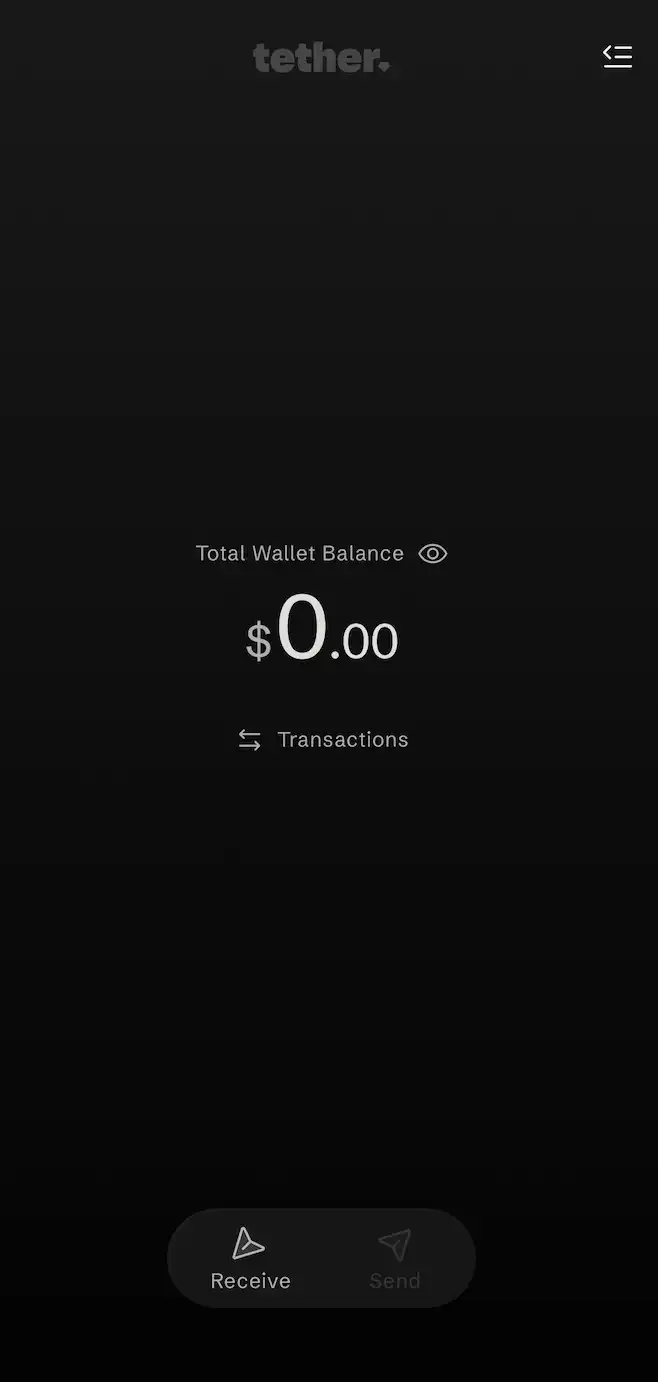
First, it makes on-chain addresses identity-based.

For a long time, long hexadecimal string addresses have been the biggest obstacle to mass adoption. Tether Wallet introduces a payment username system (e.g., [email protected]). This means that in cross-border transfer scenarios, USDT completely sheds the obscurity of crypto assets and becomes as simple as sending an email or a message.

Based on actual testing, Tether Wallet requires an email to log in and register. Currently, payment usernames must and only support lowercase letters and numbers, with a length limit of 4 to 15 characters.

Second, true Gas abstraction, with fees directly deducted from the transferred assets.

Tether Wallet itself does not charge fees and supports using the transferred assets to directly deduct network fees.

The technology is not innovative, but being natively integrated by Tether changes everything: it completes the payment experience loop at the protocol layer. This "Gas abstraction," natively integrated by the issuer, means it completes the payment experience loop at the underlying protocol level. Users only need to care about how much to transfer, not the "road toll."

Third, self-custody design and cloud backup solution

Tether Wallet uses a self-custody design; all transactions are signed and confirmed on the user's own device before being sent to the blockchain. Tether Wallet also provides an encrypted cloud backup solution (Cloud Backup), where wallet data is encrypted and stored on Tether's servers, while the key is stored in the user's own iCloud/Google Drive. Neither party can unlock it alone; they are only combined when the user logs in on the device. To restore the wallet on a new device, simply log in with the email.

Of course, users can still choose to back up manually.

Currently, Tether Wallet supports assets and networks including:

· USDT: Ethereum, Polygon, Plasma, Arbitrum

· XAUT: Same as above

· USAT: Ethereum

· Bitcoin: On-chain + Lightning Network

It is worth noting that currently 45% of the circulating USDT supply is on Tron, but Tether Wallet does not currently support Tron.

When Stablecoins Transition into High-Frequency Payment Assets

When the threshold for payment is as low as needing just an email and a username, USDT is no longer just an anchor of value in the crypto world; it begins to exert a terrifying gravitational effect, attempting to devour the entire real-world small-value cross-border settlement market.

First, it is a dimensional打击 (dimensional strike) against traditional cross-border payment intermediaries. Before tether.wallet, workers in emerging markets had to pay high fees and endure settlement cycles lasting several days to send money to their families. The logic of Tether Wallet is: Since USDT is already the shadow standard currency in these regions, instant, low-cost transfers can be achieved through the Lightning Network or other blockchains.

There is also the生存挤压 (survival squeeze) on competing stablecoins. In the past, Circle (USDC) or PayPal (PYUSD) tried to capture the market through compliance and institutional endorsement.

But Tether realized that at the retail end, liquidity inertia is greater than everything. When a user gets used to smoothly transferring money with an @username in Tether's official wallet, they have no incentive to switch to a payment tool with higher fees and a smaller circle. Tether is turning its first-mover advantage into irreversible usage inertia.

A deeper impact is that Tether is redefining financial inclusion. This self-custody wallet allows Southeast Asian farmers and Latin American vendors who have never had a bank account to, for the first time, obtain an equal, unilaterally unclosable seat in the global financial infrastructure.

Power Boundaries and Protocol Vitality in the AI Era

In the tether.wallet documentation, one word is mentioned twice: Left behind. However, as these groups forgotten by the traditional financial system flock into the new infrastructure built by Tether, a series of unsolved questions about power also emerge.

First is the regulatory暗战 (shadow war) disguised under self-custody. Although Tether emphasizes that users own the private keys, when it natively integrates cloud backup functionality and supports the @username system, it naturally leaves nodes that can be介入 (intervened) by regulation.

If regulators require marking specific accounts or pressuring cloud data, Tether will have to choose between "decentralized creed" and "commercial survival." This will be a key battleground for the future博弈 (game) between crypto and sovereignty.

Second, AI Agents are the second growth curve. Paolo Ardoino's statement is highly预见性 (prescient): this wallet is also prepared for AI Agents. In the interconnected future, human biological identity may no longer be the core of financial accounts.

When an AI agent needs to instantly pay for computing power, a stablecoin wallet that can be调度 (dispatched) through a simple interface will become the "blood" of machine civilization.

Finally, we need to face that ultimate contradiction. Tether is a complex综合体 (complex): it has a centralized core, yet it is spreading extremely decentralized tools outward.

This contradiction may be a true reflection of the current evolution of global finance. The old order is difficult to shake, and the new order only grows in the cracks. Tether Wallet is not trying to create a utopia; it is merely opening a window in the wall of reality, allowing people to discover that dollar transfers can be as simple as sending a text message.

An era of global value transmission, dominated by a stablecoin giant, silent yet powerful, is accelerating its arrival. However, the premise of all this is: we must清醒地认识到 (clearly recognize) that convenience is never free. We cannot avoid a fundamental question: while pursuing efficiency and inclusion, how do we find a truly sustainable balance between the walls of the old order and the野蛮生长 (wild growth) of the new order?


Câu hỏi Liên quan

QWhat is the core innovation of Tether Wallet in terms of user experience?

ATether Wallet's core innovation lies in removing the major barriers of self-custody wallets: complex addresses, gas fees, and seed phrases. It introduces a payment username system (like an email), abstracts gas fees by allowing them to be paid with the transferred asset, and offers a secure cloud backup solution for easy recovery.

QHow does Tether Wallet aim to impact cross-border payments, especially in emerging markets?

ATether Wallet aims to revolutionize cross-border payments by offering instant, low-cost transfers using USDT, which acts as a shadow currency in many emerging markets. It eliminates high fees and long settlement times associated with traditional systems, providing financial inclusion tool for the unbanked.

QWhat strategic advantage does Tether gain by launching its own wallet and directly engaging with end-users?

ABy launching its own wallet, Tether transitions from being just an asset issuer to controlling the user interface and flow. This allows it to lock users into its ecosystem, create usage inertia, and defend its market dominance against competitors like Circle (USDC) by making switching costly and inconvenient.

QWhat are the potential regulatory challenges or power dynamics mentioned regarding Tether Wallet's design?

AThe wallet's design, while self-custodial, incorporates centralized elements like usernames and cloud backups. This creates potential regulatory attack vectors, where authorities could pressure Tether to monitor accounts or freeze funds, forcing a choice between decentralization ideals and operational survival.

QHow does Tether Wallet envision its role in the future with AI agents, according to the article?

ATether Wallet is designed to serve AI agents' needs in an interconnected future. It provides a simple interface for machines to make instant micropayments (e.g., for compute resources), positioning USDT as the 'blood' for machine-to-machine transactions in a new digital economy.

Nội dung Liên quan

Cái giá của lợi nhuận hàng năm 11.5%: STRK của MicroStrategy có đối mặt với thời điểm phản tác dụng?

Michael Saylor và MicroStrategy (MSTR) đã tạo ra một công cụ tài chính phức tạp có tên STRC để tăng mức độ tiếp xúc với Bitcoin. Công cụ này đã thu hút 8,5 tỷ USD, góp phần đẩy giá BTC lên nhưng đồng thời cũng tạo ra nghĩa vụ chi trả cổ tức hàng năm khoảng 400 triệu USD. Bài viết cảnh báo rằng cấu trúc này giống như "con quái vật Frankenstein" - một sáng tạo có thể quay lại hủy diệt chính người tạo ra nó. Rủi ro chính nằm ở áp lực ngày càng tăng từ nghĩa vụ trả cổ tức. Dự trữ chi trả cổ tức hiện có thể bị thu hẹp từ 25 tháng xuống còn 18 tháng do đợt phát hành mới. Nếu thị trường Bitcoin đi ngang hoặc giảm, áp lực này sẽ gia tăng. Một kịch bản xấu có thể xảy ra: nhà đầu tư nhận ra cổ phiếu MSTR được dùng để tài trợ cho cổ tức thay vì mua thêm BTC, khiến giá cổ phiếu giảm dưới giá trị tài sản ròng (mNAV < 1). Điều này có thể buộc Saylor phải bán BTC, dẫn đến một vòng xoáy đi xuống và hoảng loạn thị trường. Điểm "bẻ gãy", nơi gánh nặng cổ tức vượt quá lợi ích, có thể đạt được trong vòng 6 tháng nếu tiếp tục phát hành. Saylor có thể phải đối mặt với lựa chọn khó khăn: bán BTC hoặc ngừng trả cổ tức cho các cổ đông ưu đãi, điều này sẽ làm tổn hại nghiêm trọng đến uy tín của công cụ STRC.

marsbit1 giờ trước

Cái giá của lợi nhuận hàng năm 11.5%: STRK của MicroStrategy có đối mặt với thời điểm phản tác dụng?

marsbit1 giờ trước

Tài Khoản Bitcoin Có Thể Xác Minh cho Bitcoin Thể Chế. Quyền Quản Lý của Bạn, Điều Khoản của Bạn.

Ngưỡng Network công bố Tài khoản Bitcoin có thể Xác minh (VBA), một khuôn khổ mới cho việc triển khai Bitcoin thể chế. VBA được xây dựng dựa trên cơ sở hạ tầng ký đã vận hành với Bitcoin trong sáu năm, xử lý hơn 5 tỷ USD khối lượng giao dịch tích lũy và không có tổn thất nào. VBA là một khuôn khổ tài khoản dựa trên Bitcoin Script và PSBT, cho phép các nhà phân bổ vốn sử dụng các chiến lược onchain được hỗ trợ bởi Bitcoin trong khi vẫn duy trì quy trình quản lý riêng biệt và các đường thanh toán có thể xác minh. Bitcoin vẫn nằm trong sự sắp xếp quản lý hiện có của người nắm giữ, tương thích với các nhà quản lý đủ tiêu chuẩn, mạng quản lý dựa trên MPC hoặc thiết lập tự quản lý. Được xây dựng cho tài chính Bitcoin, VBA biến bất kỳ hình thức quản lý hiện có nào thành cơ sở hạ tầng cho vay cấp thể chế. Mỗi tuyến đường thanh toán được thỏa thuận khi thiết lập và được thực thi trong Bitcoin Script, đảm bảo giải quyết đáng tin cậy. Các tính năng chính bao gồm chi tiêu được thực thi bởi sự đồng thuận, kiểm soát đa bên, khôi phục được xác định trước và triển khai vào các thị trường cho vay onchain đã được phê duyệt. Tài khoản Bitcoin có thể Xác minh có sẵn cho các tổ chức đủ điều kiện.

TheNewsCrypto6 giờ trước

Tài Khoản Bitcoin Có Thể Xác Minh cho Bitcoin Thể Chế. Quyền Quản Lý của Bạn, Điều Khoản của Bạn.

TheNewsCrypto6 giờ trước

Giao dịch

Giao ngay
Hợp đồng Tương lai

Bài viết Nổi bật

Làm thế nào để Mua PEOPLE

Chào mừng bạn đến với HTX.com! Chúng tôi đã làm cho mua ConstitutionDAO (PEOPLE) trở nên đơn giản và thuận tiện. Làm theo hướng dẫn từng bước của chúng tôi để bắt đầu hành trình tiền kỹ thuật số của bạn.Bước 1: Tạo Tài khoản HTX của BạnSử dụng email hoặc số điện thoại của bạn để đăng ký tài khoản miễn phí trên HTX. Trải nghiệm hành trình đăng ký không rắc rối và mở khóa tất cả tính năng. Nhận Tài khoản của tôiBước 2: Truy cập Mua Crypto và Chọn Phương thức Thanh toán của BạnThẻ Tín dụng/Ghi nợ: Sử dụng Visa hoặc Mastercard của bạn để mua ConstitutionDAO (PEOPLE) ngay lập tức.Số dư: Sử dụng tiền từ số dư tài khoản HTX của bạn để giao dịch liền mạch.Bên thứ ba: Chúng tôi đã thêm những phương thức thanh toán phổ biến như Google Pay và Apple Pay để nâng cao sự tiện lợi.P2P: Giao dịch trực tiếp với người dùng khác trên HTX.Thị trường mua bán phi tập trung (OTC): Chúng tôi cung cấp những dịch vụ được thiết kế riêng và tỷ giá hối đoái cạnh tranh cho nhà giao dịch.Bước 3: Lưu trữ ConstitutionDAO (PEOPLE) của BạnSau khi mua ConstitutionDAO (PEOPLE), lưu trữ trong tài khoản HTX của bạn. Ngoài ra, bạn có thể gửi đi nơi khác qua chuyển khoản blockchain hoặc sử dụng để giao dịch những tiền kỹ thuật số khác.Bước 4: Giao dịch ConstitutionDAO (PEOPLE)Giao dịch ConstitutionDAO (PEOPLE) dễ dàng trên thị trường giao ngay của HTX. Chỉ cần truy cập vào tài khoản của bạn, chọn cặp giao dịch, thực hiện giao dịch và theo dõi trong thời gian thực. Chúng tôi cung cấp trải nghiệm thân thiện với người dùng cho cả người mới bắt đầu và người giao dịch dày dạn kinh nghiệm.

Tổng lượt xem 568Xuất bản vào 2024.12.12Cập nhật vào 2025.03.21

Làm thế nào để Mua PEOPLE

Thảo luận

Chào mừng đến với Cộng đồng HTX. Tại đây, bạn có thể được thông báo về những phát triển nền tảng mới nhất và có quyền truy cập vào thông tin chuyên sâu về thị trường. Ý kiến ​​của người dùng về giá của PEOPLE (PEOPLE) được trình bày dưới đây.

活动图片












