Morgan Stanley Remains Bullish on SK Hynix and Samsung, Memory Market to Shift in Q4

marsbitXuất bản vào 2026-08-07Cập nhật gần nhất vào 2026-08-07

Tóm tắt

Morgan Stanley maintains its bullish outlook on SK Hynix and Samsung Electronics, keeping their target prices at 2.6 million won and 381,000 won respectively. The report expects the memory industry to transition into a late-cycle phase by Q4 2026, as price growth decelerates. Despite this, three key factors underpin the positive view: continued upward revisions in AI capital expenditure, improved earnings visibility from long-term agreements (LTAs), and recent valuation pullbacks reflecting cycle-top concerns. While DRAM and NAND contract prices are still rising, their quarterly growth rates have peaked and are slowing. AI-related demand remains robust, prompting major cloud providers to forecast continued supply tightness into 2027. LTAs with key customers provide some downside protection but do not fully lock in future profits. High current DRAM margins near 90% could attract new supply, posing a long-term risk. The report highlights potential challenges from rising channel inventory, new capacity coming online, and expansion by Chinese manufacturers. Ultimately, the high target prices hinge on AI demand extending the profitability cycle and LTAs mitigating volatility, with future performance depending on these factors holding through potential price corrections post-2028.

In its Asia Tech report 'Memory – A Small Wrinkle' released on August 6, Morgan Stanley continues to be optimistic about leading Korean memory chipmakers, maintaining its price targets for SK Hynix and Samsung Electronics. The price target for SK Hynix is set at 2.6 million Korean won, and for Samsung Electronics common stock at 381,000 Korean won. Based on the benchmark stock price used in the research report, these imply potential upside of approximately 74% and 65%, respectively.

Such a high implied upside does not mean Morgan Stanley believes memory prices will continue to rise at their previous pace. On the contrary, the report already observes narrowing price increases, rising channel inventory, and new production capacity gradually entering the market. It judges that the memory industry will transition into the late stage of the cycle in the fourth quarter of 2026.

Morgan Stanley remains bullish, primarily betting on three key themes: continued upward revisions in AI capital expenditure, improved profit visibility due to long-term supply agreements, and the recent pullback in memory stock valuations, which already reflects some concerns about a cyclical peak.

Earnings forecasts also reflect this caution. Morgan Stanley raised its 2026 EPS forecast for SK Hynix by 13%, mainly due to including a one-time investment gain of KRW 63.27 trillion in Q2. However, its 2026 operating profit forecast was lowered by 7%. The 2026 EPS forecast for Samsung Electronics was cut by 10%, mainly reflecting weaker consumer businesses such as smartphones.

The adjustments to earnings forecasts for both companies for 2027-2028 are relatively minor. Based on the revised forecasts in the report, SK Hynix's 2027 EPS is expected to grow by about 25%, and Samsung Electronics' by about 49%, roughly corresponding to the report's stated range of 25% to 50%.

Prices Still Rising, But the Memory Cycle Begins to Decelerate

Product price increases have been the most direct driver behind the recent memory stock rally. AI server demand has boosted demand for HBM, server DRAM, and enterprise SSDs, while capacity expansion has struggled to keep pace, driving significant price increases for DRAM and NAND.

Citing TrendForce data, Morgan Stanley notes that the sequential increase in overall DRAM and NAND contract prices peaked in Q1 2026 at 96% and 88%, respectively. It is expected to be 61% and 58% in Q2, but forecasts fall to 16% and 13% in Q3, and further to 6% and 3% in Q4.

The report's latest channel checks indicate early Q3 DRAM contract price settlements are up about 15% sequentially, slightly below the previous expectation of 20%. NAND contract prices are up about 20%. PC DRAM contract prices are expected to rise 15% to 20% sequentially in Q3, a significant slowdown from the 45% to 50% increase in Q2.

Therefore, a more accurate description is not that 'memory prices have peaked,' but that prices are still rising, albeit at a decelerating pace. Morgan Stanley expects the industry to gradually transition into the late stage of the cycle by Q4 2026. At that point, the operating leverage from price increases will weaken, and the potential for further earnings beats will also decrease.

It is important to note that the slowdown in price increases may not be entirely due to improved supply. The report points out that the slowdown in price increases for some consumer DRAM is partly because buyers are nearing their cost tolerance limits. Meanwhile, demand from AI-related customers remains robust, and suppliers are shifting some consumer-grade capacity to products like enterprise SSDs.
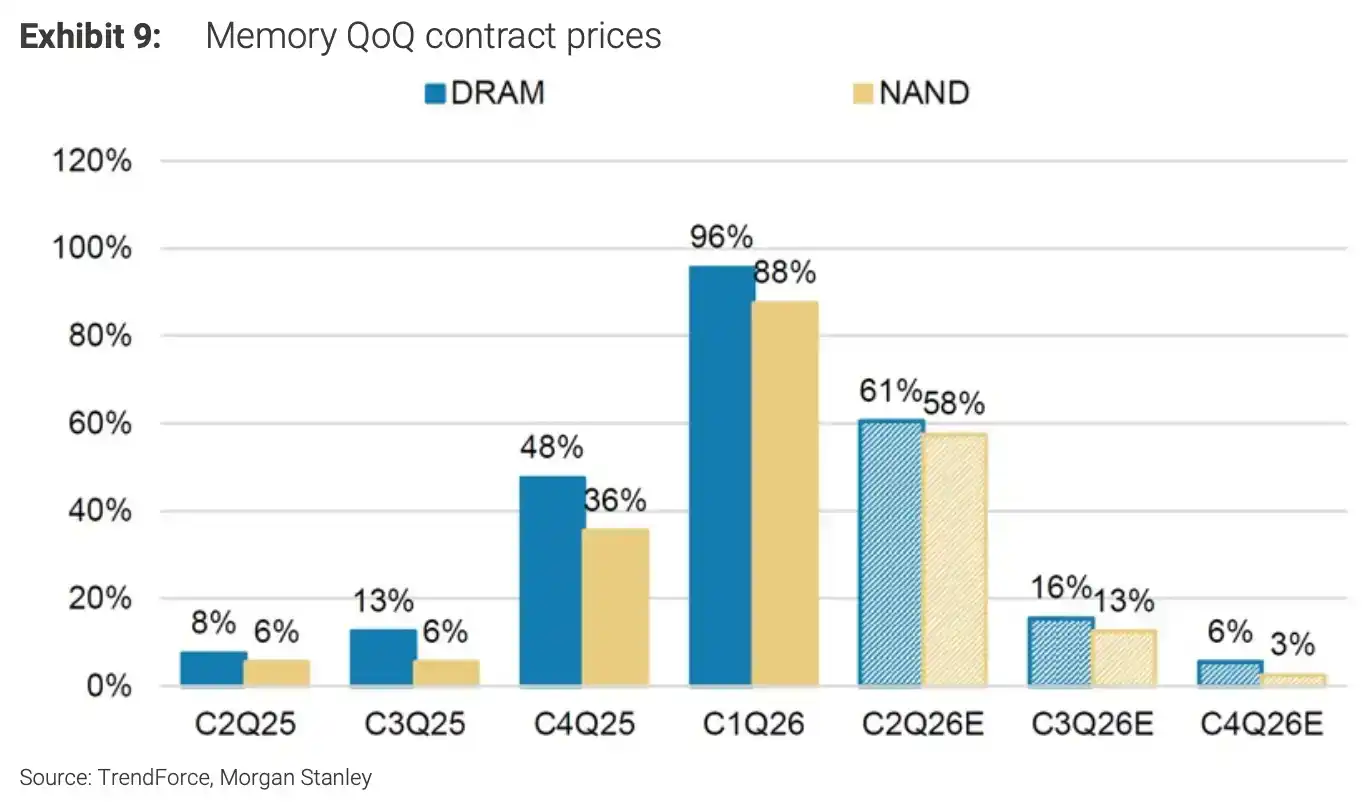
Sequential Change in Memory Contract Prices. Sequential increases in DRAM and NAND contract prices are declining quarter-over-quarter from their peaks.

AI Computing Power Still in Short Supply, Cloud Capex Continues to Be Revised Upwards

The first theme supporting Morgan Stanley's continued bullish view is that AI data center computing power demand is still not fully satisfied.

The report cites earnings reports and management commentary from four major US cloud providers. It states that Alphabet and Microsoft's cloud computing demand still exceeds their internal available capacity; Amazon expects capacity to remain insufficient in 2026, with a significant portion of 2027 capacity already booked; Meta anticipates industry computing power supply will remain tight for the foreseeable future.

This information does not prove that all AI investments will ultimately achieve expected returns, but it at least indicates that major cloud providers have not significantly scaled back infrastructure construction. Therefore, Morgan Stanley's cloud capital expenditure tracking model has raised its 2027 year-on-year growth forecast from 14% a month ago to 29%.

This is crucial for memory manufacturers. AI servers require not only GPUs but also HBM, server DRAM, and enterprise SSDs. As long as cloud providers continue to build data centers, memory demand will not be entirely dictated by the traditional consumer electronics cycle of PCs and smartphones.

However, 'structural AI demand' and 'cyclical price adjustments' can coexist. Morgan Stanley's core judgment is precisely that: AI demand may prolong the profit cycle for memory companies but will not eliminate memory price and inventory cycles entirely.
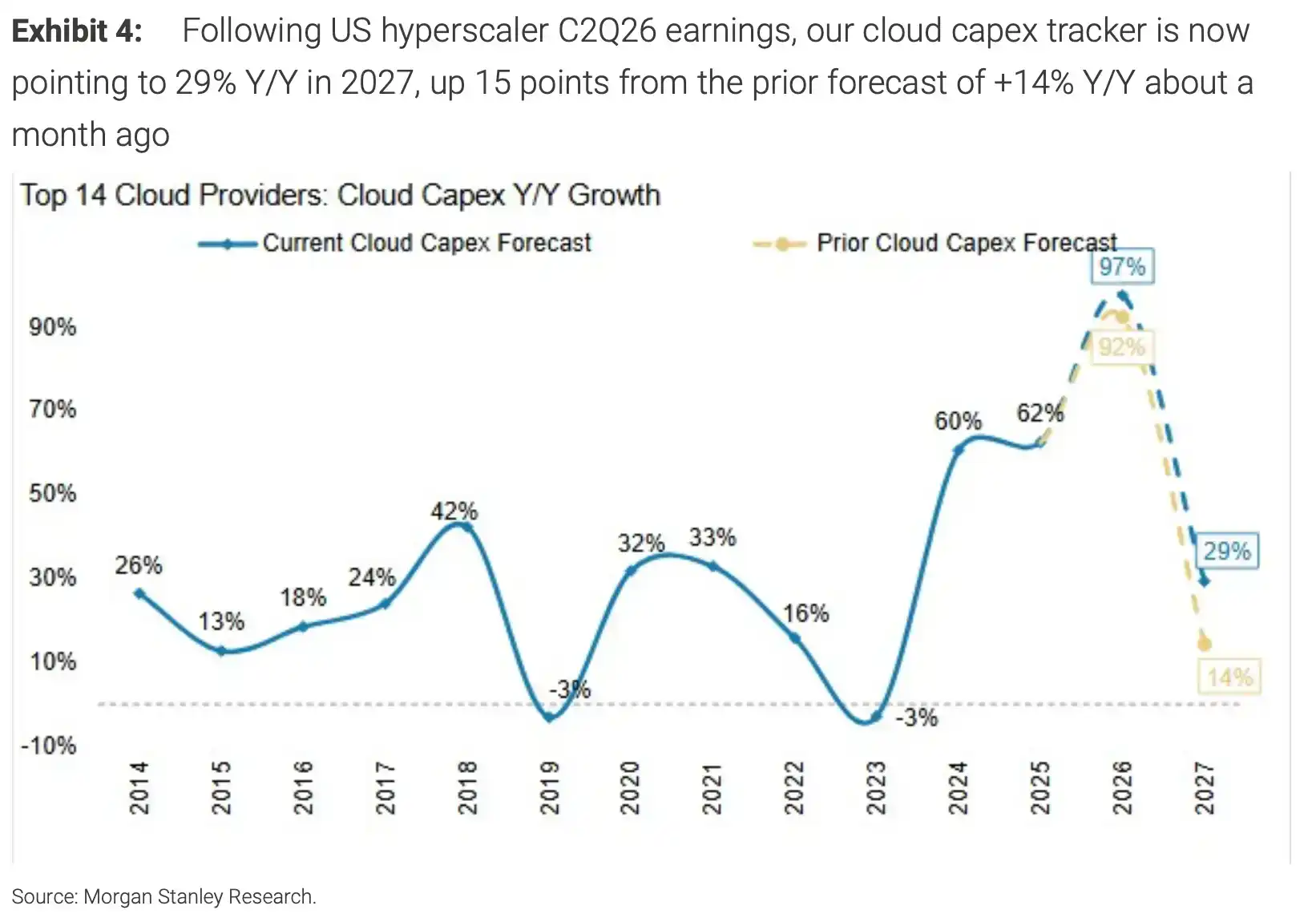
Cloud Provider Capital Expenditure Growth Forecasts. The chart shows the 2027 cloud capex growth forecast being revised up from 14% to 29%.

Long-Term Agreements Improve Order Visibility, But Cannot Lock in Future Profits

The second source of support comes from Long-Term Agreements (LTAs). Compared to traditional quarterly purchasing, multi-year contracts can help suppliers lock in some demand in advance and plan capacity and capital expenditures accordingly.

SK Hynix's official Q2 earnings announcement shows the company has completed LTA negotiations with about 10 key customers and continues discussions with others. Morgan Stanley further summarizes the company's earnings call, stating these agreements typically last about five years, but terms and pricing mechanisms vary by customer and product. Some agreements include deposits, and prices also adjust with market fluctuations.

SK Hynix did not disclose the specific proportion of capacity or revenue covered by LTAs, stating only that it aims to keep agreements at an 'appropriate level' to improve downside protection while reserving capacity for new demand. Therefore, it is not appropriate to describe its LTAs as having already locked in most future revenue.

The specific terms for Samsung Electronics mainly come from Morgan Stanley's summary of its Q2 earnings call. According to the report, Samsung plans to cover 60% to 70% of its capacity with long-term agreements, has reached agreements with five global large-scale data center customers, and has another five in final negotiations. The agreements use a rolling five-year structure, require prepayments from customers, and set price floors for some mainstream products.

The report's table listing potential clients like AWS, Microsoft, Google, Meta, and Oracle is clearly marked as based on media reports and should not be written as officially confirmed counterparties by Samsung.

The significance of LTAs lies mainly in improving demand visibility, supporting capacity investment, and reducing some price volatility, not in completely locking in future profits. The coverage, duration, price adjustment mechanisms, and default protections vary across contracts. If AI construction slows, product specifications change, or market prices adjust significantly, the protection these agreements can provide has limits.
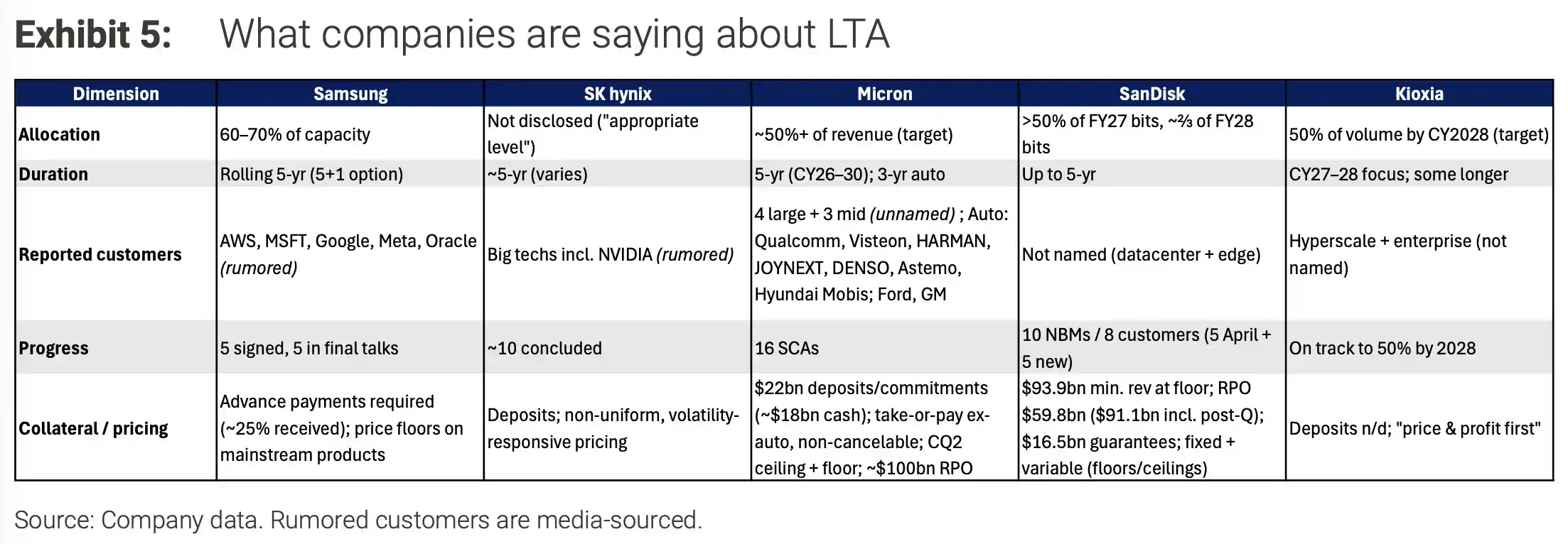
Comparison of LTA Among Major Memory Manufacturers. The chart compares the LTA coverage, duration, and pricing arrangements of Samsung, SK Hynix, Micron, SanDisk, and Kioxia.

High Price Target Bets on Extended Cycle; New Supply to Determine Upside

The market has already begun pricing in a slowdown in memory earnings growth. Morgan Stanley notes that the forward 12-month P/E ratio for DRAM-related stocks typically leads forward 12-month EPS by about two months. Recent valuations have declined significantly, reflecting investors pricing in lower earnings growth.

This also explains why memory companies' current strong earnings may not lead to continued synchronous stock price increases. Investor focus is shifting from 2026 profits to the sustainability in 2027-2028: whether AI capex can continue growing, whether LTAs can withstand a downturn, and whether prices can hold after new capacity comes online.

High profits themselves attract supply. Morgan Stanley points out that current DRAM gross margins, nearing 90%, are at historically abnormal highs. If high returns incentivize leading manufacturers to accelerate expansion or attract new suppliers, current margins may revert toward their long-term averages.

Here, it's important to distinguish between two metrics: the nearly 90% figure discussed in the report refers to DRAM gross margins, while SK Hynix's Q2 76% figure is the company's overall operating margin—they are not directly comparable. SK Hynix officially disclosed Q2 2026 revenue of KRW 79.3187 trillion and operating profit of KRW 60.5426 trillion, resulting in an operating margin of 76%.

Capacity expansion by Chinese manufacturers is also listed as a long-term risk. The report states that new supply from CXMT (ChangXin Memory Technologies) and YMTC (Yangtze Memory Technologies) could weaken the tightness of some products. Among them, CXMT's roadmap includes supplying HBM to the Chinese market as early as 2027. This is Morgan Stanley's description of the company's roadmap and does not equate to Chinese HBM achieving large-scale mass production or being able to immediately replace high-end Korean products.

Furthermore, the report expects new capacity from major manufacturers to start production from 2027-2028. If AI demand continues to grow rapidly, this new supply may not cause immediate oversupply in the short term. However, if cloud provider capex slows, the release of supply could accelerate price declines.

Therefore, the key assumptions behind the 2.6 million won price target are not that memory prices will rise indefinitely, but that AI demand can extend the profit cycle, LTAs can reduce volatility, and recent valuation declines have already priced in a significant portion of cyclical risk. What truly needs verification going forward is whether these long-term agreements can endure a price downturn and whether memory companies can find new drivers for EPS growth beyond 2028.
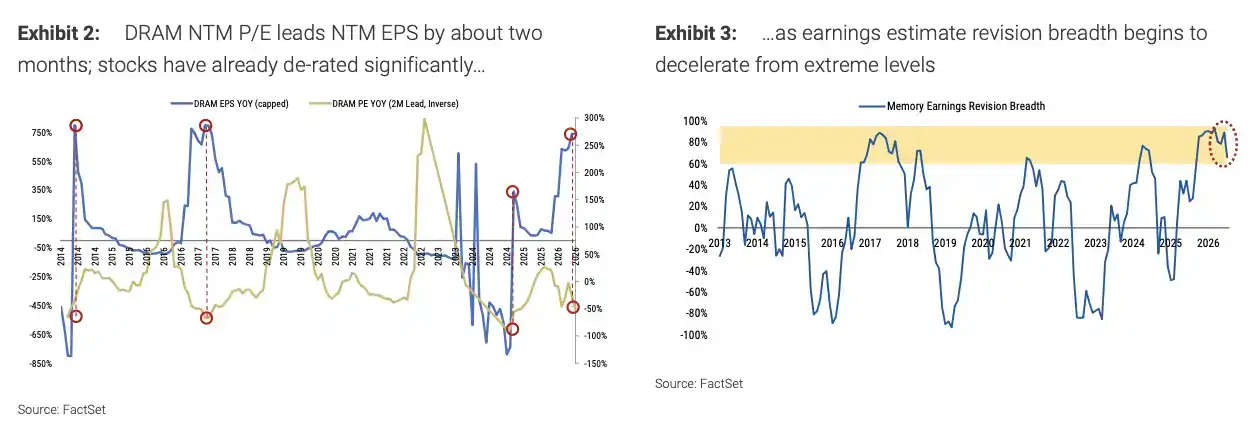
DRAM Valuation and Earnings Expectations. This chart shows that valuations typically change ahead of earnings expectations. It should not be interpreted as indicating a stable, mechanical causal relationship between the two.

Câu hỏi Liên quan

QWhat are the three main reasons Morgan Stanley remains bullish on SK Hynix and Samsung despite signs of a memory cycle slowdown?

AMorgan Stanley's continued optimism is based on three key factors: 1) AI capital expenditure continues to be revised upwards, sustaining demand. 2) Long-Term Agreements (LTAs) improve earnings visibility and provide some demand stability. 3) Recent valuation pullbacks in memory stocks already reflect some concerns about the cycle peaking.

QAccording to the report, what is the expected trend for DRAM and NAND contract price growth rates in Q3 and Q4 2026?

AThe report, citing TrendForce data, expects DRAM and NAND contract price growth to decelerate significantly. For Q3 2026, DRAM price is forecast to rise ~16% quarter-over-quarter (QoQ) and NAND ~13% QoQ. By Q4 2026, growth is expected to slow further to ~6% for DRAM and ~3% for NAND.

QHow do Long-Term Agreements (LTAs) benefit memory suppliers like SK Hynix and Samsung, and what are their limitations?

ALTAs benefit suppliers by providing better demand visibility, supporting capacity investment plans, and reducing some price volatility through mechanisms like minimum price floors and prepayments. However, their limitations include: they do not completely lock in future profits, coverage of total capacity is often partial (e.g., Samsung targets 60-70%), terms vary by client, and their protective value has boundaries if AI demand slows, product specs change, or market prices adjust significantly.

QWhat is the report's view on the relationship between high current profitability and future supply in the DRAM market?

AThe report highlights that current DRAM gross margins near 90% are historically high and could incentivize increased supply. High returns may prompt leading manufacturers to accelerate capacity expansion or attract new suppliers, which could eventually pressure profit margins to revert toward long-term averages. This is cited as a key factor for the future sustainability of earnings.

QWhat potential risk does the report associate with Chinese memory manufacturers like CXMT and YMTC?

AThe report identifies new supply from Chinese manufacturers, specifically ChangXin Memory (CXMT) and Yangtze Memory Technologies Corp (YMTC), as a long-term risk that could alleviate shortages for some products. It mentions that CXMT's roadmap includes potentially supplying HBM in the China market starting from 2027, though it clarifies this is not equivalent to mass production or immediate substitution of Korean high-end products.

Nội dung Liên quan

Cùng BlockBeats Xây Dựng Nền Tảng Thông Tin Tài Chính Thế Hệ Tiếp Theo

BlockBeats cam kết giúp người dùng hiểu rõ sự phát triển của công nghệ toàn cầu và biến động thị trường vốn thông qua thông tin thời gian thực, nghiên cứu chuyên sâu, phân tích dữ liệu và công cụ thông minh. Trong 7 năm, BlockBeats đã trở thành nền tảng tài chính công nghệ có ảnh hưởng tại thị trường Hoa ngữ. Chúng tôi đang xây dựng cổng thông tin tài chính cá nhân thế hệ tiếp theo, kết hợp dữ liệu thị trường tài chính toàn cầu, tin tức & sự kiện thời gian thực, nội dung nghiên cứu chuyên nghiệp và khả năng phân tích AI. **CƠ HỘI TUYỂN DỤNG:** BlockBeats tuyển dụng nhiều vị trí toàn thời gian và thực tập, với cơ hội làm việc từ xa. Văn phòng chính đặt tại Bắc Kinh. **Các nhóm và vị trí tuyển dụng:** 1. **Nhóm Tin tức Nóng:** Biên tập viên Thông tin Thị trường Toàn cầu - Theo dõi động thái thị trường tài chính, công nghệ; phân tích sự kiện quan trọng về AI, tài sản số, chính sách vĩ mô. 2. **Nhóm Báo chí & Nghiên cứu Chuyên sâu:** Nghiên cứu viên Tài chính Công nghệ - Thực hiện nghiên cứu, phân tích ngành, phỏng vấn chuyên gia về AI, tài sản số, các ngành công nghiệp mới. 3. **Nhóm Vận hành:** Chuyên viên Vận hành - Phụ trách vận hành mạng xã hội (Twitter, Telegram, Xiaohongshu), tăng trưởng người dùng, quản lý cộng đồng và phân tích dữ liệu. 4. **Nhóm Thương mại:** * Chuyên viên Thương mại: Thực thi hợp tác khách hàng, lập kế hoạch. * Chuyên viên Phát triển Thương mại Hải ngoại: Mở rộng thị trường nước ngoài, tìm kiếm đối tác và KOL. 5. **Nhóm Sản phẩm:** * Lập trình viên Front-end: Phát triển giao diện web với Vue.js/Next.js. * Lập trình viên Back-end: Phát triển hệ thống máy chủ với PHP/Python/Go. 6. **Nhóm Thị trường Dự đoán:** Nhà nghiên cứu/Tác giả Nội dung - Phân tích sự kiện thị trường dự đoán, hành vi trên chuỗi, tác động của sự kiện vĩ mô, địa chính trị, AI, Crypto. **Ứng tuyển:** Gửi CV và sản phẩm liên quan (nếu có) qua email hoặc Telegram trực tiếp cho HR, nêu rõ vị trí quan tâm (toàn thời gian/thực tập) và hình thức làm việc (từ xa/không). * Email: [email protected] * Telegram HR: @Jhy10vewh0

marsbit7 phút trước

Cùng BlockBeats Xây Dựng Nền Tảng Thông Tin Tài Chính Thế Hệ Tiếp Theo

marsbit7 phút trước

Một trong những người mua Bitcoin lớn đầu tiên, mua với giá 15 USD, đã hoạt động trở lại sau 10 tháng!

Một trong những nhà đầu tư Bitcoin đầu tiên, người đã mua BTC khi giá chỉ từ 10-15 USD, đã hoạt động trở lại sau khoảng 10 tháng không có động thái. Theo dữ liệu từ nền tảng phân tích on-chain Onchain Lens, "cá voi" này vừa chuyển 50 BTC (tương đương khoảng 3,22 triệu USD) sang một địa chỉ ví mới. Giao dịch này không trực tiếp là một lệnh bán, nhưng nó có đặc điểm tương tự các lần chuyển tiền trước đây của cùng nhà đầu tư. Trong quá khứ, nhà đầu tư này từng chuyển tài sản tới các dịch vụ tiền mã hóa tổ chức như FalconX hoặc các sàn giao dịch tập trung (CEX) sau các bước tương tự. Do đó, động thái mới nhất được xem là một dấu hiệu có thể cho thấy sự chuẩn bị cho một thương vụ bán OTC (giao dịch phi tập trung). Giao dịch OTC là phương pháp được các tổ chức và "cá voi" ưa chuộng để mua/bán khối lượng tài sản lớn mà không gây ảnh hưởng đáng kể đến giá thị trường. Tuy nhiên, các chuyên gia lưu ý rằng không nên đưa ra kết luận chắc chắn chỉ từ một lần di chuyển tài sản. Các nhà đầu tư lớn cũng có thể chuyển tiền vì lý do bảo mật, cập nhật chiến lược lưu trữ hoặc hợp nhất ví. Do vậy, việc chuyển tiền này không nhất thiết báo hiệu một đợt bán sắp diễn ra.

cryptonews.ru11 phút trước

Một trong những người mua Bitcoin lớn đầu tiên, mua với giá 15 USD, đã hoạt động trở lại sau 10 tháng!

cryptonews.ru11 phút trước

Bridge, công ty con của Stripe, gia nhập sổ đăng ký MiCA của EU sau khi được Luxembourg chấp thuận

Công ty Bridge Building, thực thể tại Luxembourg đứng sau công ty cơ sở hạ tầng stablecoin Bridge thuộc sở hữu của Stripe, đã chính thức tham gia sổ đăng ký Quy định về Thị trường Tài sản Crypto (MiCA) của Liên minh Châu Âu sau khi nhận được phê duyệt quy định từ Luxembourg. Việc bổ sung này nâng tổng số tổ chức phát hành token tiền tệ điện tử (EMT) được ủy quyền theo MiCA trong sổ đăng ký EU lên 42. Động thái này diễn ra vài tuần sau khi Bridge thông báo vào ngày 2/7 về việc đã đạt được ủy quyền Nhà cung cấp Dịch vụ Tài sản Crypto (CASP) theo MiCA và giấy phép Tổ chức Tiền tệ Điện tử (EMI) từ cơ quan quản lý tài chính Luxembourg. Các giấy phép này cho phép các doanh nghiệp trong EU xây dựng sản phẩm stablecoin và thanh toán trong khuôn khổ được quy định. Cùng bản cập nhật từ Cơ quan Quản lý Chứng khoán và Thị trường Châu Âu (ESMA) cũng bổ sung ba nhà cung cấp CASP mới từ Đức, nâng tổng số CASP được ủy quyền lên 324. Không có thay đổi nào đối với việc ủy quyền token tham chiếu tài sản (ART) và danh sách các công ty không tuân thủ. ESMA gần đây đã công bố các bản cập nhật sổ đăng ký MiCA thường xuyên hơn.

cointelegraph51 phút trước

Bridge, công ty con của Stripe, gia nhập sổ đăng ký MiCA của EU sau khi được Luxembourg chấp thuận

cointelegraph51 phút trước

Công bố đoạn phim bắt giữ nhân viên các sàn giao dịch tiền mã hóa lừa đảo tại Moskva

Hình ảnh về việc bắt giữ các nhân viên làm việc tại các điểm giao dịch tiền mã hóa giả mạo ở Moskva đã được công bố. Theo Trung tâm Liên lạc Cộng đồng (ЦОС) của FSB Nga, các điểm giao dịch này tại "Moscow-City" bị các trung tâm cuộc gọi từ Ukraine sử dụng để rửa tiền bị đánh cắp từ công dân Nga. Các đối tượng này đã ép buộc chính nạn nhân của mình làm việc như nhân viên bán thời gian. Một nạn nhân cho biết bọn lừa đảo, giả danh cơ quan chức năng Nga, thông báo rằng có một ủy quyền đứng tên anh ta và yêu cầu chuyển toàn bộ tiền trong tài khoản để hủy bỏ. Sau đó, chúng thuyết phục anh ta phải "làm việc" như một nhân viên bán thời gian để hỗ trợ bắt giữ những kẻ lừa đảo. Anh này thừa nhận hành vi vì đã hành động theo chỉ dẫn của những kẻ tự xưng là Cơ quan Giám sát Tài chính (Rosfinmonitoring) và điều tra viên FSB. Các bị can khác khai nhận nhiệm vụ của họ là gặp khách hàng tại các điểm giao dịch, nhận tiền mặt, đếm tiền và báo cáo cho cấp trên. Số tiền sau đó được chuyển đổi sang tiền mã hóa và gửi đến các ví điện tử chỉ định. Theo lời khai của một bị can, trung bình mỗi ngày có khoảng 30 khách hàng giao dịch tại một điểm, với doanh thu hàng ngày có thể lên tới 1-2 triệu USD. Một bị can khác cho biết doanh thu tiền mặt trung bình có thể lên tới 30 triệu USD. FSB cho biết đã ngăn chặn hoạt động của 9 kênh chuyển tiền ra nước ngoài thông qua tiền mã hóa và bắt giữ hơn 20 nhân viên tại các điểm giao dịch ở "Moscow-City". Các nạn nhân, bao gồm cả người già, liên tục giữ liên lạc với trung tâm cuộc gọi, làm theo hướng dẫn từng bước mà không nhận thức được hành vi của mình. Họ bị thuyết phục mua tiền mã hóa và chuyển cho các giám sát viên người Ukraine. Các điểm giao dịch này đã tuyển dụng từ xa những người trẻ tuổi từ các vùng của Nga, thiếu hiểu biết tài chính và muốn kiếm tiền dễ dàng, để làm việc.

cryptonews.ru52 phút trước

Công bố đoạn phim bắt giữ nhân viên các sàn giao dịch tiền mã hóa lừa đảo tại Moskva

cryptonews.ru52 phút trước

Giao dịch

Giao ngay
活动图片