Memory Card Prices Double in Four Months: How Long Will the Surge Last?

marsbitXuất bản vào 2026-04-16Cập nhật gần nhất vào 2026-04-16

Tóm tắt

NAND flash memory prices have entered a rapid upward cycle, with consumer-grade storage products like microSD cards seeing significant retail price increases. For example, a SanDisk Extreme 128GB microSD card rose from $17 in October 2025 to nearly $40 by February 2026—a 130% surge in under four months. This price surge is driven by structural shifts in the NAND market, primarily due to soaring demand from AI data centers. These large-scale buyers are securing the majority of NAND wafer supply through long-term contracts, leaving limited inventory for the consumer market. According to TrendForce, NAND contract prices rose 55–60% in Q1 2026, with enterprise SSD prices climbing 53–58%. Retail prices rose even more sharply due to constrained supply in the distribution channel. Unlike the 2016–2017 price cycle caused by production transitions, the current spike is demand-led. AI data centers are consuming NAND capacity at an unprecedented rate, with 2026 demand growth estimated at 20–22% against supply growth of only 15–17%. Manufacturers are prioritizing high-margin enterprise products over consumer-grade storage, further tightening retail availability. New production capacity from major suppliers like Samsung, Micron, and Kioxia is not expected until late 2027 or 2028. Until then, consumer storage prices are likely to remain high, with no significant price relief anticipated in the near term.

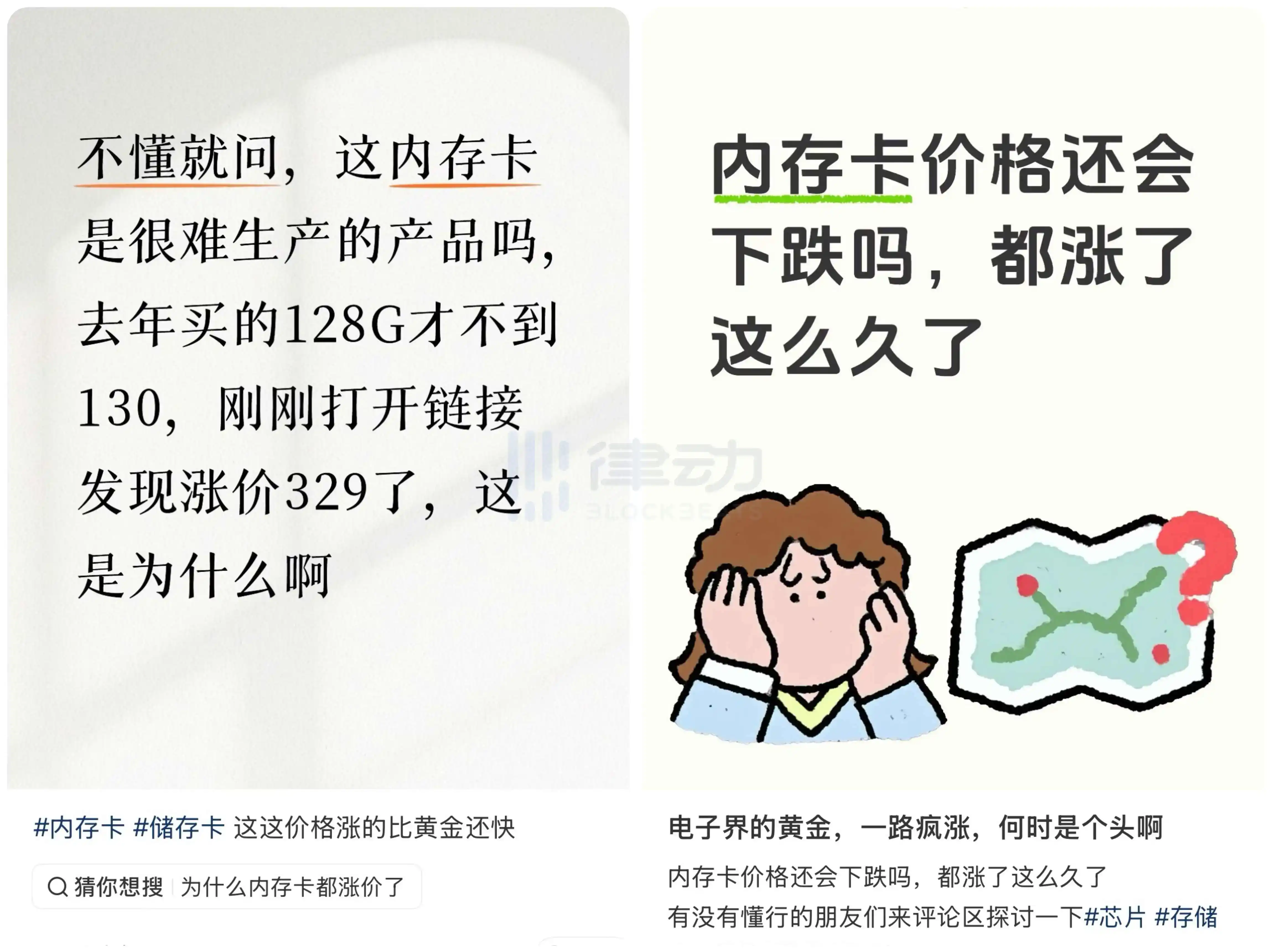
Since the beginning of this year, NAND flash prices have entered a new round of rapid increases, with retail prices of consumer storage products being the first to be affected. In October 2025, a SanDisk Extreme 128GB microSD card was sold for $17 on Amazon. By February of this year, the price of the same card had risen to nearly $40. In less than four months, the price increased by 130%.
First, it is important to clarify the difference between memory modules (RAM) and memory cards, as they are not the same type of product. Memory modules (RAM) are temporary storage inside computers, used for reading and writing data when programs are running; data is lost when power is cut off. Memory cards (such as microSD cards) are external expandable storage used for long-term preservation of files like photos and videos; data is not lost when power is cut off. The price increase discussed in this article refers to the latter—memory cards and the underlying NAND flash chips.

The continuous rise in memory card prices is driven by a systemic repricing of the entire NAND flash market. The starting point of this repricing is AI data centers competing for the same wafers.

Contract Prices Rose 50%, but Retail Prices Rose 130% by the Time They Reach You

First, let’s discuss what is happening.

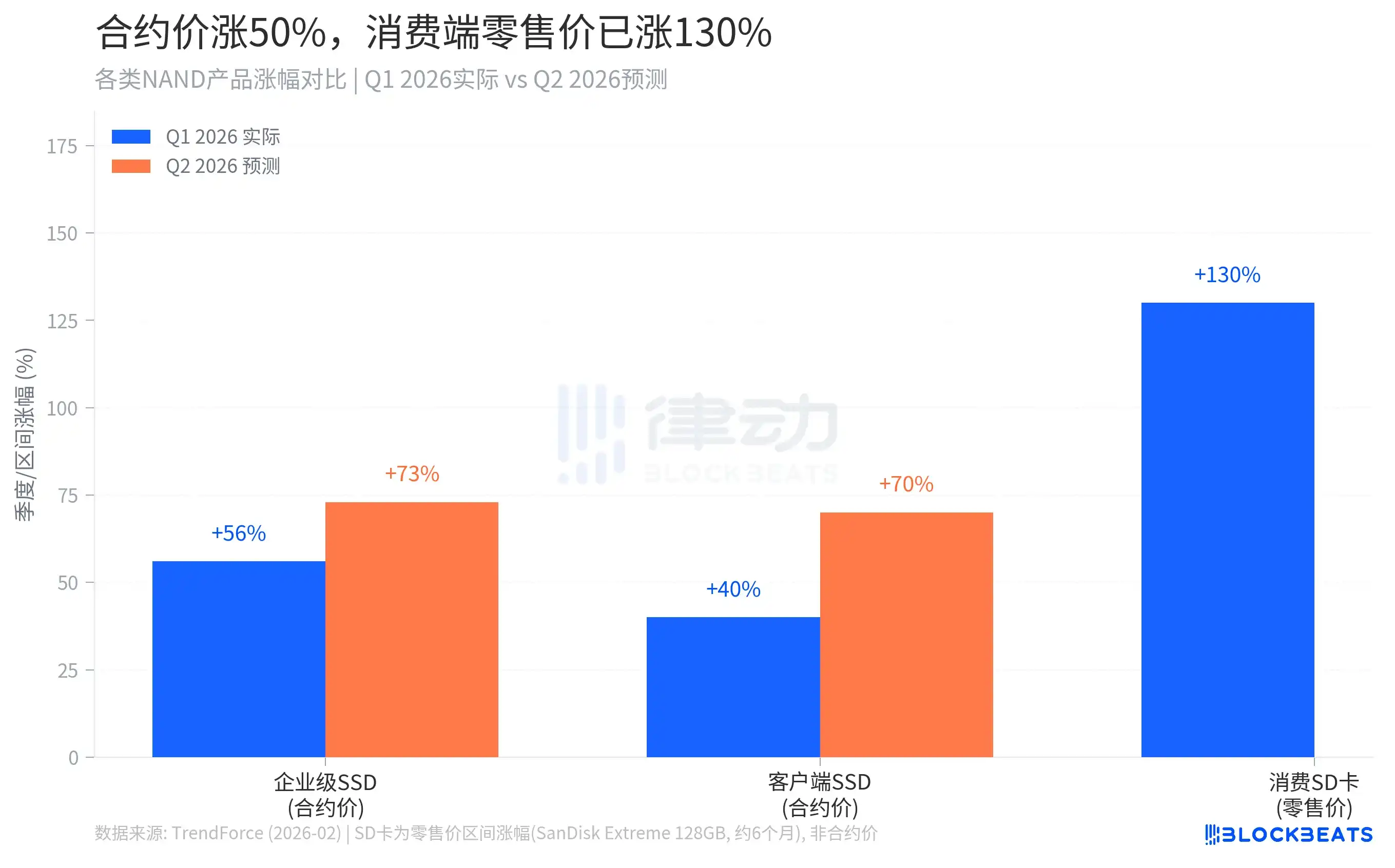
Global NAND flash contract prices began climbing rapidly at the end of last year. According to a February report by market research firm TrendForce, overall NAND contract prices in the first quarter of 2026 increased by approximately 55–60% compared to the fourth quarter of last year, with enterprise SSD prices rising by 53–58%, setting a new record for quarterly growth. TrendForce also predicted that overall NAND contract prices would rise by another 70–75% in the second quarter.

These numbers represent the bulk contract unit prices agreed upon between large customers and do not directly equate to the retail prices on e-commerce platforms. However, retail prices on the consumer side have risen even more sharply than contract prices. The rightmost bar in Figure 1, showing a 130% increase, represents the actual price shock felt by ordinary consumers.
Why are retail price increases far exceeding contract price increases? Because the consumer market is a "residual allocation market." When NAND manufacturers set delivery plans, they prioritize fulfilling orders for large customers with long-term framework agreements, including AI data center operators and hyperscale cloud service providers. Only after these orders are fulfilled do the remaining inventories enter the distribution channels of the consumer market. With supply compressed, the spot market has almost no buffer capacity against price increases, leading to steeper retail price hikes than contract price hikes.

Kingston has publicly confirmed that its procurement cost for NAND wafers has increased by 246% compared to a year ago. This is a cost shock at the raw material level, which is ultimately passed down to consumers through product prices.

How AI Is Pushing Up the Price of a Memory Card

There are two key points in this graph worth highlighting.

The first is around October 2025, when relatively low-priced memory cards were available on the market. That period marked the end of the previous cycle of oversupply. From 2023 to 2024, major storage manufacturers accumulated large inventories amid weakening demand, leading to continuously declining prices. Photographers, creators, and gamers took advantage of this window to stock up on memory cards at historically low prices.

The second key point is the fourth quarter of 2025. Samsung, Kioxia, Micron, and SK Hynix successively announced production cuts and price increases, completely reversing the situation in a short period. Samsung raised prices for enterprise customers by over 100%, while Kioxia explicitly stated that its entire 2026 production capacity had been pre-sold to large customers, effectively cutting off supply to the consumer market.
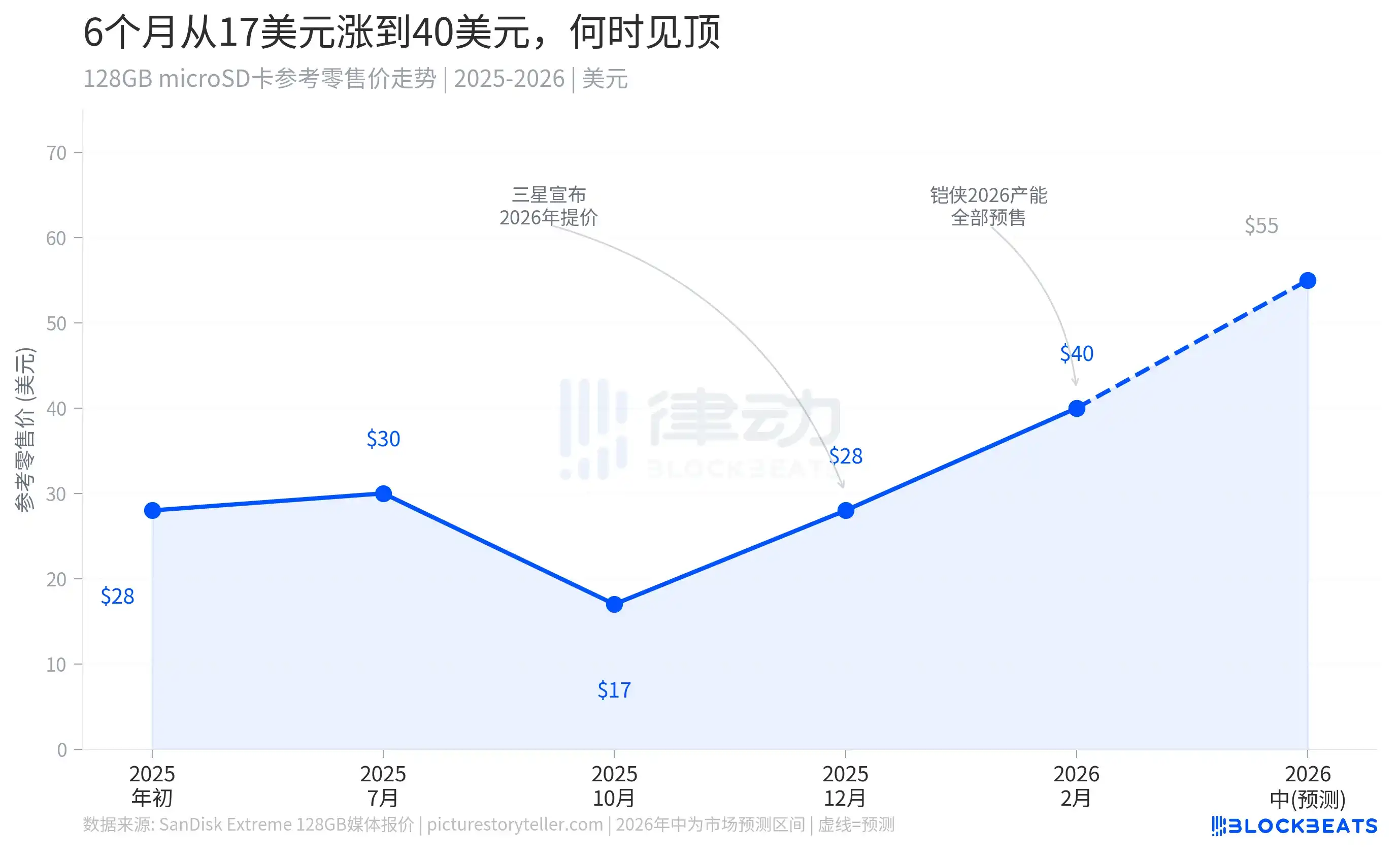
Since then, retail prices for memory cards have been climbing steadily and are expected to reach the $50–$60 range by mid-2026, with no window for a price correction throughout the year. This is not market speculation but a structural adjustment in the supply allocation mechanism. Before AI data centers became the top-priority buyers in the NAND market, consumer and enterprise products participated more or less equally in capacity allocation. Now, the consumer end is at the very bottom of the allocation chain.

This Time, It’s Completely Different from 2017

The NAND industry experiences a price cycle approximately every three to four years. The last significant price increase occurred in 2016–2017 and lasted nearly two years. That round was triggered by the technological transition from 2D NAND to 3D NAND. The new stacking process slowed effective output during the yield ramp-up phase, tightening supply and driving up costs. However, once 3D NAND production lines stabilized for various manufacturers, Samsung, SK Hynix, and Micron simultaneously expanded production significantly. Inventories quickly shifted from shortage to surplus, and prices plummeted in early 2018.

This time, the driving force is entirely different, and the path to recovery will also be截然不同.
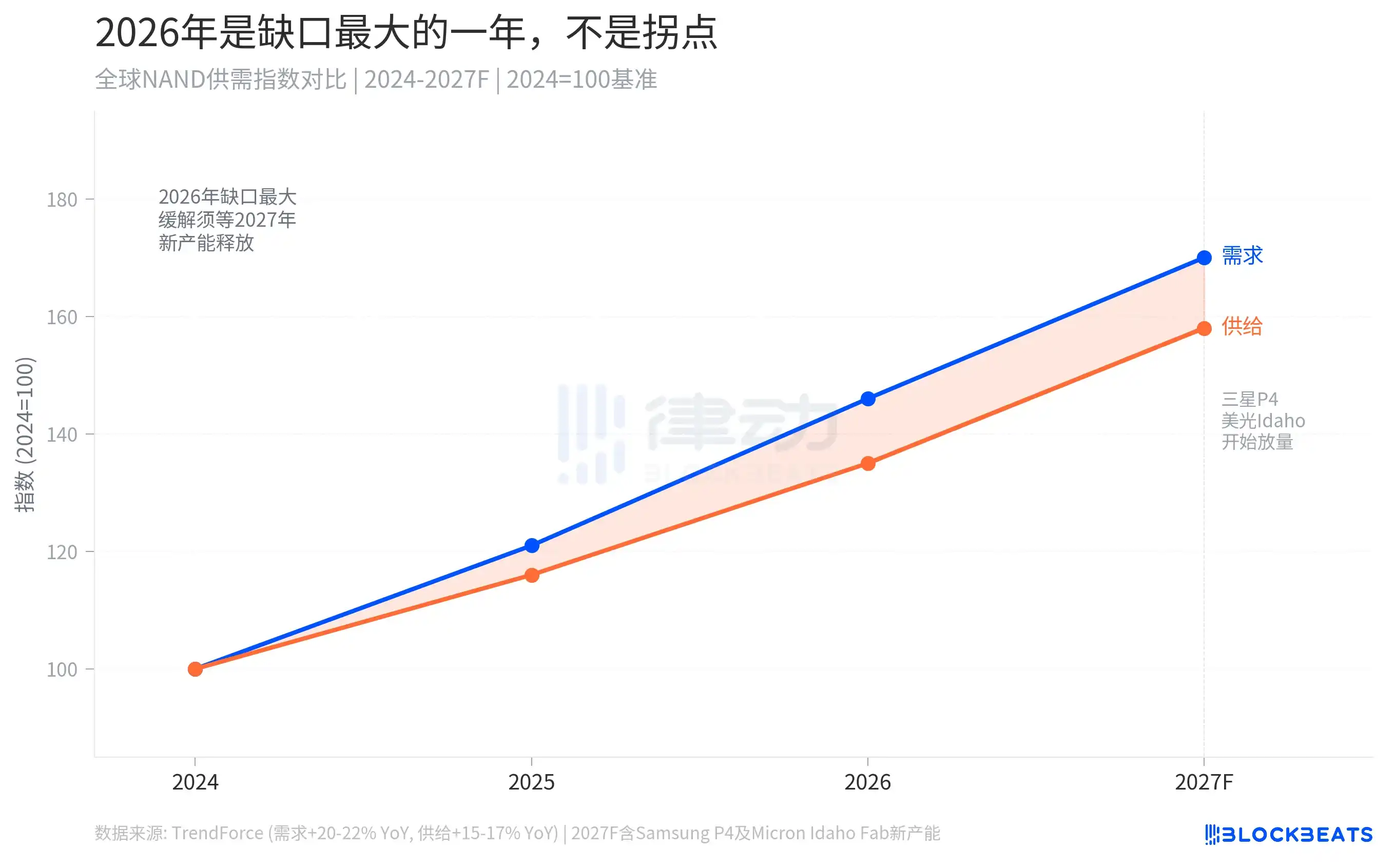
According to TrendForce data, global NAND demand growth is expected to reach 20–22% in 2026, while supply-side growth is only 15–17%. The absolute gap is not large, but in a market of this scale, a few percentage points of supply-demand disparity can trigger extremely sharp price reactions. More importantly, this gap is not caused by technical issues but by a structural shift in demand. AI data centers are consuming NAND capacity in a sustained, massive, and high-priority manner, and the scale of this demand has no ceiling.

New production capacity to alleviate supply constraints will not arrive until late 2027 to 2028. Samsung’s NAND production lines at its P4 facility in Pyeongtaek, Gyeonggi Province; Micron’s new wafer fab in Idaho, USA; and Kioxia’s expansion of its Iwate factory all point to this timeframe. 2026 is the year with the largest supply-demand gap, not the turning point for prices.

Manufacturers Aren’t Lacking Capacity; They’re Actively Selling It to the Highest Bidder

The following graph illustrates the essential mechanism behind this price surge. In the NAND industry’s revenue structure, the share of enterprise products (AI data center SSDs, general server storage) is rapidly expanding. According to comprehensive estimates by industry agencies, the share of enterprise products in overall NAND revenue has risen from about 45% in 2024 to about 62% in 2026, while the share of the consumer and client market has been compressed from 55% to about 38%.
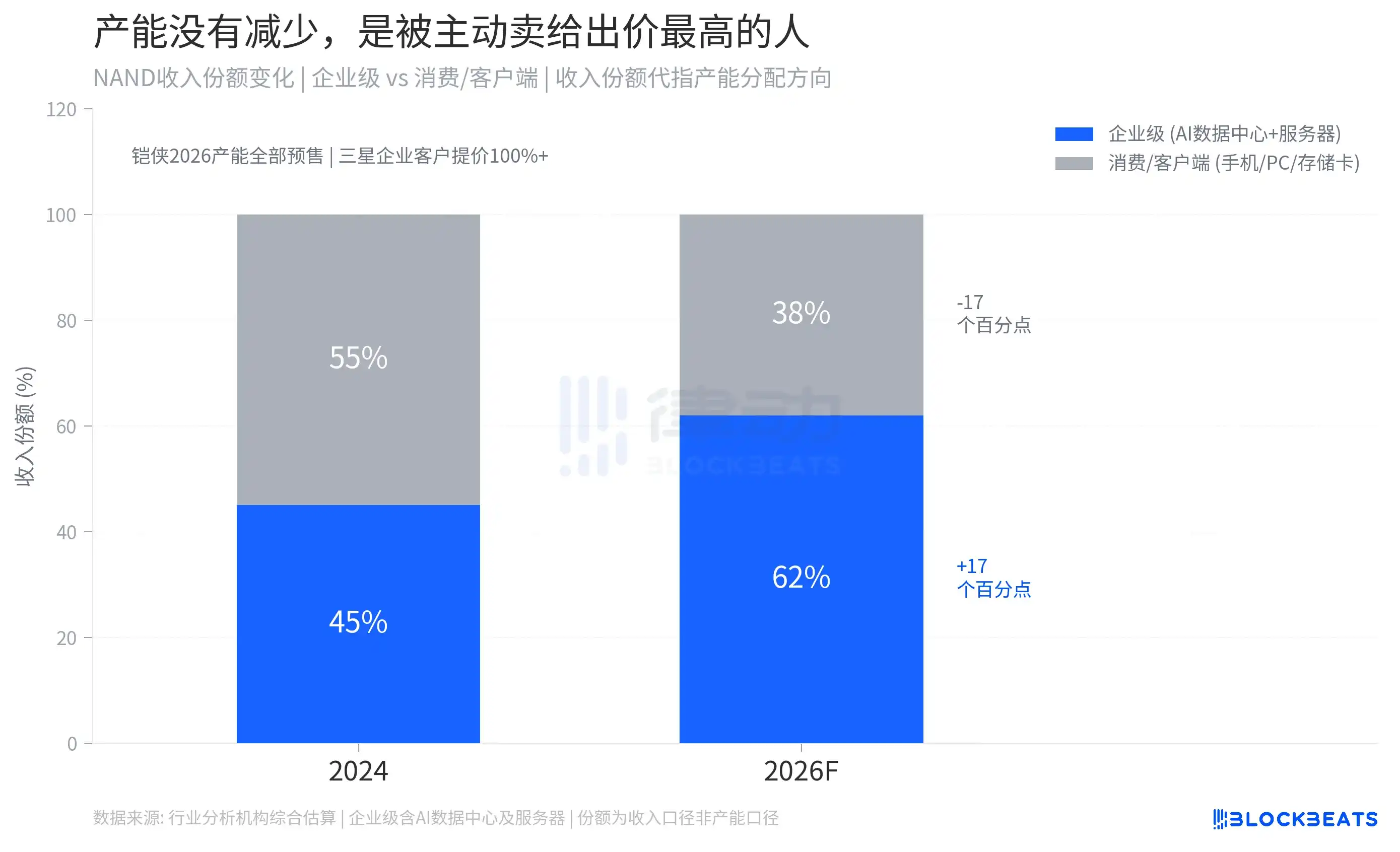
The logic driving this shift is straightforward: for the same wafer area, producing enterprise-grade high-density QLC SSDs yields 3–5 times the unit profit compared to producing consumer-grade memory cards. Capacity allocation by manufacturers like Kioxia and Samsung follows the principle of maximizing commercial利益, allocating the best wafers to the highest bidders.

This mechanism also has a hidden effect. As available inventory in the consumer market decreases, distributors and retailers accelerate their stocking pace to hedge against future price increases, further accelerating inventory drawdown on the consumer end and creating a self-reinforcing cycle of price hikes.

For consumers, memory card prices will remain high for a considerable period. This is not due to a lack of wafer capacity but because the allocation priority of the consumer market has been systematically lowered. Only when the construction pace of AI computing infrastructure slows down will excess wafer capacity return to the consumer product supply chain, but that won’t happen until after 2027.

The SD card in your camera and the world’s largest AI data center are using the same wafer. Now you know who wins.


Câu hỏi Liên quan

QWhat is the main reason for the sharp price increase in memory cards over the past four months?

AThe price surge is primarily driven by structural demand shifts, with AI data centers consuming NAND flash capacity at a high priority, leaving limited supply for the retail consumer market.

QHow does the retail price increase of memory cards compare to the NAND flash contract price rise?

AThe retail price increased by about 130%, which is significantly higher than the contract price rise of 55-60% in Q1 2026, due to the consumer market being a 'residual allocation market' with minimal buffer against supply constraints.

QWhy is the current NAND price cycle different from the one in 2016-2017?

AThe 2016-2017 cycle was caused by technical transitions (2D to 3D NAND) and resolved with improved yields and expanded production, while the current cycle is driven by structural AI demand, with no quick supply fix until 2027-2028.

QWhat role do AI data centers play in the NAND market supply chain?

AAI data centers are the highest-priority buyers, securing most of the NAND产能 through long-term contracts, which reduces the allocation for consumer products like memory cards and pushes retail prices higher.

QWhen is the NAND supply shortage expected to ease, and why?

AThe shortage is expected to ease around late 2027 to 2028, when new产能 expansions from major manufacturers like Samsung, Micron, and Kioxia become operational, increasing overall supply.

Nội dung Liên quan

Nếu bong bóng AI đã vỡ, ai sẽ thực sự ở lại?

Bong bóng AI rõ ràng đang tồn tại, nhưng như lịch sử bong bóng dot-com những năm 2000 cho thấy, nó không chỉ là sự hủy diệt. Bong bóng xảy ra khi đầu tư vốn quá mức chạy trước sự phát triển của cơ sở hạ tầng thực tế và doanh thu ứng dụng. Tuy nhiên, chính những khoản đầu tư "thừa" này lại xây dựng nền tảng vật chất (như cáp quang, trung tâm dữ liệu) cho kỷ nguyên tiếp theo. Hiện tại, ngành AI đang trong tình trạng tương tự: các gã khổng lồ công nghệ đổ hàng nghìn tỷ USD vào cơ sở hạ tầng (GPU, điện, làm mát), trong khi doanh thu từ các công ty AI thuần túy còn thấp. Sự chênh lệch này là bong bóng. Nhưng đồng thời, chi phí triển khai AI (giá token) đã giảm hơn 99.7% trong hai năm, giống như "Nghịch lý Jevons": chi phí giảm không làm giảm chi tiêu, mà mở ra lượng nhu cầu mới khổng lồ, khiến tổng chi tiêu của doanh nghiệp cho AI tăng vọt. AI không còn là công cụ trò chuyện. Với chi phí cực thấp, nó đang xâm nhập vào quy trình làm việc thực tế: viết mã, nghiên cứu y sinh, phân tích pháp lý, giao dịch tài chính và sản xuất. Thị trường đang tự thanh lọc, loại bỏ các công ty "bọc vỏ" (wrap-around) chỉ dựa trên API. Giá trị đang chuyển dần từ lớp cơ sở hạ tầng (CapEx - như NVIDIA) sang lớp ứng dụng (OpEx) - những công ty AI bản địa thực sự giải quyết vấn đề cho ngành dọc. Tóm lại, bong bóng có thể vỡ, các công ty đầu cơ sẽ biến mất, nhưng xu hướng AI+ là không thể đảo ngược. Giống như internet sau năm 2000, năng lực sản xuất cốt lõi do AI mang lại là có thật và sẽ định hình lại mọi ngành công nghiệp. Bong bóng ồn ào, nhưng động năng của lực lượng sản xuất mới ở bên dưới không hề có nước.

marsbit18 phút trước

Nếu bong bóng AI đã vỡ, ai sẽ thực sự ở lại?

marsbit18 phút trước

Nếu bong bóng AI thực sự đã vỡ, ai sẽ là người ở lại?

Bong bóng AI đang trở thành điểm đồng thuận gây chia rẽ nhất trên thị trường toàn cầu. Một bên là cảnh báo về sự quá nóng từ Ray Dalio, một bên là tầm nhìn về cuộc cách mạng sản xuất mới bắt đầu từ Jensen Huang. Vấn đề thực sự không phải là có bong bóng hay không, mà là sau khi bong bóng tan, thứ gì sẽ còn lại. Giống như bong bóng dot-com năm 2000 đã để lại cơ sở hạ tầng cáp quang, băng thông rộng và điện toán đám mây - nền tảng cho Amazon, Netflix và kỷ nguyên di động sau này, làn sóng AI hiện nay cũng đang ở vị trí tương tự. Hàng nghìn tỷ USD đang được đổ vào trung tâm dữ liệu, điện năng, làm mát bằng chất lỏng, module quang và GPU, trong khi doanh thu từ các ứng dụng vẫn chưa bắt kịp. Rõ ràng có sự chênh lệch, nhưng tiềm năng tăng năng suất cơ bản là có thật. Chi phí xử lý token (token cost) đã giảm hơn 99.7% từ năm 2023 đến 2025. Khi trí thông minh trở nên rẻ như điện nước, AI không còn là công cụ trò chuyện đơn thuần mà đang thâm nhập vào các quy trình công việc thực tế trong lập trình, y tế, tài chính, pháp lý và sản xuất. Thị trường sẽ thanh lọc các công ty "bọc vỏ" (shell companies) và startup chỉ dựa trên slide thuyết trình, nhưng không thể đảo ngược xu hướng AI+. Các gã khổng lồ công nghệ dự kiến chi 6900 tỷ USD cho cơ sở hạ tầng vào năm 2026, nhưng doanh thu tổng hợp từ các công ty AI thuần túy ước tính chưa đến 400 tỷ USD. Sự mất cân đối này là dấu hiệu của bong bóng. Tuy nhiên, theo nghịch lý Jevons, việc chi phí giảm mạnh không làm giảm chi tiêu của doanh nghiệp cho AI, mà ngược lại, mở ra lượng cầu khổng lồ trước đây bị hạn chế bởi chi phí, dẫn đến tổng mức tiêu thụ tăng theo cấp số nhân. Thị trường đang trong giai đoạn tự thanh lọc, loại bỏ những dự án thiếu giá trị thực. Xu hướng sâu xa là sự dịch chuyển giá trị từ chi tiêu vốn (CapEx - cho hạ tầng) sang chi tiêu vận hành (OpEx - cho ứng dụng tối ưu hóa quy trình). Lợi nhuận siêu ngạch cuối cùng sẽ chảy về phía những doanh nghiệp AI gốc (AI-native) thực sự giải quyết được điểm đau trong các ngành dọc. Giống như tất cả các ngành hiện nay đều không thể tách rời internet, tương lai tất cả các ngành cũng sẽ không thể tách rời AI. Sự hỗn loạn của bong bóng rồi sẽ qua đi, nhưng động lực tăng năng suất cơ bản mà AI mang lại là hoàn toàn có thật và sẽ định hình thời đại thịnh vượng thông minh tiếp theo.

链捕手25 phút trước

Nếu bong bóng AI thực sự đã vỡ, ai sẽ là người ở lại?

链捕手25 phút trước

CEO Microsoft: Trong kỷ nguyên AI, làm thế nào để xác định hào bảo vệ của một công ty?

CEO của Microsoft Satya Nadella cho rằng, trong thời đại AI, lợi thế cạnh tranh bền vững của một doanh nghiệp không nằm ở việc lựa chọn mô hình mạnh nhất, mà ở khả năng xây dựng một "vòng lặp học tập" — một hệ thống tích lũy và không ngừng tiến hóa từ quy trình làm việc, kiến thức chuyên môn, phán đoán tổ chức và kinh nghiệm của nhân viên. Theo đó, doanh nghiệp cần tích lũy đồng thời hai loại vốn: Vốn nhân lực (kiến thức, khả năng phán đoán, sáng tạo của con người) và Vốn Token (năng lực AI riêng được doanh nghiệp xây dựng và sở hữu). AI không làm giảm giá trị vốn nhân lực, mà trái lại, nó càng đề cao vai trò định hướng, kết nối đa ngành và nhận diện mẫu hình then chốt của con người. Điểm cốt lõi là doanh nghiệp phải biến tri thức ngầm của tổ chức thành năng lực hệ thống có thể tái sử dụng, mở rộng và lặp lại thông qua các đánh giá riêng tư, môi trường học tăng cường riêng và cơ sở tri thức có thể truy vấn. Thành trì thực sự chính là hệ thống học tập này: ngay cả khi thay thế mô hình AI tổng quát, doanh nghiệp vẫn giữ lại được kinh nghiệm chuyên môn đã tích lũy như một "nhân viên kỳ cựu" của công ty. Tương lai ổn định cần một hệ sinh thái tiên phong, nơi mọi công ty, ngành nghề và quốc gia đều có thể sở hữu vòng lặp học tập của riêng mình, chứ không phải để giá trị bị một vài mô hình tổng quát thâu tóm. Bằng cách này, doanh nghiệp vừa tạo ra giá trị cho chính mình, vừa khuếch đại năng lực nhân viên và giữ lại lợi ích kinh tế từ AI trong nội bộ ngành và cộng đồng của mình.

marsbit1 giờ trước

CEO Microsoft: Trong kỷ nguyên AI, làm thế nào để xác định hào bảo vệ của một công ty?

marsbit1 giờ trước

ETF Chỉ Là Vé Vào Cửa: Sự Thể Chế Hóa Thực Sự Của Bitcoin Đang Diễn Ra Ở Nơi Bạn Không Nhìn Thấy

ETF đã giải quyết cách các tổ chức sở hữu Bitcoin, nhưng sự chuyển mình thực sự nằm ở việc Bitcoin đang trở thành "nguyên liệu tài chính" - thứ được dùng để xây dựng các sản phẩm phức tạp. Bài viết chỉ ra các ví dụ: công ty bảo hiểm Tabit dùng Bitcoin làm dự trữ cho hợp đồng bảo hiểm trị giá 40 triệu USD; Ledn phát hành trái phiếu được xếp hạng đầu tư (BBB- bởi S&P) dựa trên một danh mục cho vay thế chấp bằng Bitcoin; và các mạng lưới như Atlas của Anchorage Digital đang biến Bitcoin thành tài sản thế chấp thông thường cho các giao dịch phái sinh. Hệ thống này đã vượt qua bài kiểm tra áp lực trong đợt bán tháo tháng 2/2026, khi giá giảm 27% kích hoạt các lệnh gọi ký quỹ tự động. Tuy nhiên, nó cũng bộc lộ rủi ro khi nhiều bên cùng bán tháo một lúc, có thể tạo hiệu ứng domino đẩy giá xuống sâu hơn. Dù vậy, xu hướng đã rõ ràng: từ giao dịch chênh lệch giá (basis trade), bảo hiểm, đến trái phiếu và cả kho bạc doanh nghiệp (như MicroStrategy), Bitcoin đang dần đảm nhận vai trò cốt lõi trong cơ chế tài chính, tương tự trái phiếu chính phủ hay vàng. Sự chấp nhận thực sự không nằm ở dòng tiền vào ETF, mà ở những lớp hạ tầng vô hình nơi Bitcoin trở thành một phần cỗ máy.

marsbit1 giờ trước

ETF Chỉ Là Vé Vào Cửa: Sự Thể Chế Hóa Thực Sự Của Bitcoin Đang Diễn Ra Ở Nơi Bạn Không Nhìn Thấy

marsbit1 giờ trước

Người sáng lập ZEC phản hồi về lỗ hổng Orchard: Chưa có dấu hiệu bị đánh cắp, sẽ đóng bể Orchard

Đồng sáng lập ZEC trả lời về lỗ hổng Orchard: Chưa có dấu hiệu bị đánh cắp, sẽ đóng bể Orchard Gần đây, mô-đun Orchard của Zcash phát hiện lỗ hổng bảo mật, dấy lên lo ngại về tổng nguồn cung ZEC và sự an toàn tài sản người dùng. Lỗ hổng này đặt ra bốn câu hỏi chính: 1. Lỗ hổng đã bị khai thác chưa? 2. Tài sản hợp pháp trong Orchard có rút ra được không? 3. Người dùng có thể tự xác minh tổng nguồn cung Zcash không? 4. Có lỗ hổng tạo giả tương tự khác không? **Lỗ hổng đã bị khai thác?** Khả năng thấp. Lỗ hổng rất phức tạp, được phát hiện chủ động bởi chuyên gia. Nhóm phát triển nhanh chóng phối hợp với các mining pool để đóng bể Orchard và vá lỗi, thu hẹp cơ hội tấn công. Chưa có bằng chứng nào về việc khai thác để trục lợi. **Tài sản trong Orchard có an toàn?** Nếu lỗ hổng chưa bị khai thác, tài sản hợp pháp có thể rút ra bình thường. Nếu đã bị khai thác, việc rút tiền có thể bị ảnh hưởng nếu mã giả được rút trước. Tuy nhiên, tình huống này được đánh giá là ít xảy ra. Người dùng có thể chọn giữ tài sản trong ví Orchard hiện tại (được coi là an toàn) hoặc chuyển sang địa chỉ minh bạch (mất tính riêng tư) hoặc sang bể Sapling (vẫn giữ một mức độ riêng tư). **Người dùng có thể tự xác minh nguồn cung?** Hiện tại thì không thể. Tuy nhiên, bản nâng cấp mạng Ironwood sắp tới sẽ giải quyết vấn đề này bằng cách đóng vĩnh viễn bể Orchard. Khi đó, tổng số ZEC rút ra sẽ chính xác bằng tổng số ZEC hợp pháp đã gửi vào, cho phép bất kỳ ai cũng có thể tự xác minh nguồn cung. **Có lỗ hổng tạo giả khác không?** Chưa phát hiện thêm lỗ hổng nào tương tự. Shielded Labs và các đối tác đã tiến hành kiểm tra toàn diện, sử dụng cả công cụ AI tiên tiến, và không tìm thấy lỗ hổng tạo giả mới. Các cuộc kiểm tra bổ sung đang được thực hiện để tăng cường bảo mật. **Tóm tắt** Lỗ hổng Orchard có khả năng chưa bị khai thác, tài sản người dùng về cơ bản an toàn và chưa phát hiện lỗi tạo giả khác. Điểm then chốt là người dùng hiện chưa thể tự xác minh nguồn cung, nhưng bản nâng cấp Ironwood sắp tới sẽ khôi phục khả năng này bằng cách đóng bể Orchard vĩnh viễn.

Foresight News1 giờ trước

Người sáng lập ZEC phản hồi về lỗ hổng Orchard: Chưa có dấu hiệu bị đánh cắp, sẽ đóng bể Orchard

Foresight News1 giờ trước

Giao dịch

Giao ngay
Hợp đồng Tương lai
活动图片




