Important News You Might Have Missed During the Spring Festival Holiday

marsbitXuất bản vào 2026-02-25Cập nhật gần nhất vào 2026-02-25

Tóm tắt

During the Spring Festival holiday, several significant events occurred. Bitdeer (BTDR) sold its entire Bitcoin holdings (1,133 BTC) to fund its expansion into AI data centers and ASIC miner development. Ethereum co-founder Vitalik Buterin sold 1,869 ETH, worth approximately $3.67 million. A new concept, Web 4.0, was proposed by researcher Sigil Wen, envisioning an era of autonomous AI agents capable of independent action, leading to a 3600% surge in Conway's token price. The U.S. Supreme Court invalidated former President Trump's tariff policy, though market reaction was muted. The Ethereum Foundation saw leadership changes, with Tomasz Stańczak stepping down, and confirmed the inclusion of FOCIL (EIP-7805) in the upcoming Hegota upgrade. Base announced its independence from Optimism, planning to migrate to a self-managed infrastructure. In funding news, Andre Cronje launched Flying Tulip's ICO, Tether invested in Dreamcash, and Dragonfly raised $650 million for its new fund. An AI robot, LOBSTAR, mistakenly transferred $270,000 worth of tokens due to a decimal error. Lastly, OpenAI and Paradigm introduced EVMbench, a benchmark for testing AI in smart contract security.

Bitdeer liquidates Bitcoin; Vitalik continues to reduce ETH holdings; Web 3.0 is over, Web 4.0 is here; Base and Optimism part ways; Ethereum Foundation changes leadership; An AI robot mistakenly sends $270,000 due to a decimal point error. What major events happened during the Spring Festival holiday? Let's take a look with The BlockBeats.

Bitdeer Liquidates Bitcoin

Bitdeer (Nasdaq: BTDR) liquidated all its self-held Bitcoin positions (purely self-held, excluding customer deposits) around February 20, 2026, selling a total of approximately 1,133 BTC (including 943.1 reserve Bitcoin and 189.8 newly mined Bitcoin).

This move was primarily due to tightening Bitcoin mining profits (hashprice dropping to about $34/PH/day), with the company needing liquidity to support AI/HPC data center expansion, in-house ASIC miner development, and financing activities (such as issuing $325 million in convertible bonds). Founder Jihan Wu responded that this is a normal "mine-to-sell" strategy, not a permanent abandonment of Bitcoin, emphasizing that "zero holdings does not mean it will always be this way in the future."

Have You Learned About Web 4.0 Today?

Researcher Sigil Wen, who proposed the concept of Web 4.0, was active in the early AI building field alongside Andrej Karpathy and the founders of Anthropic, Perplexity, and Replicate, and is a member of the Thiel Fellowship.

Sigil Wen believes that the bottleneck is no longer intelligence itself, but the permission to act. The underlying architecture of the existing internet has always defaulted to humans, not machines, as its service objects.

The most powerful AIs today can think, reason, and generate content, but they have a fatal limitation—they cannot act autonomously. Without user instructions, ChatGPT cannot run; without authorization, Claude Code cannot be deployed; no AI can independently purchase servers, register domain names, or pay for its own computing power.

And Web 4.0 is the solution.
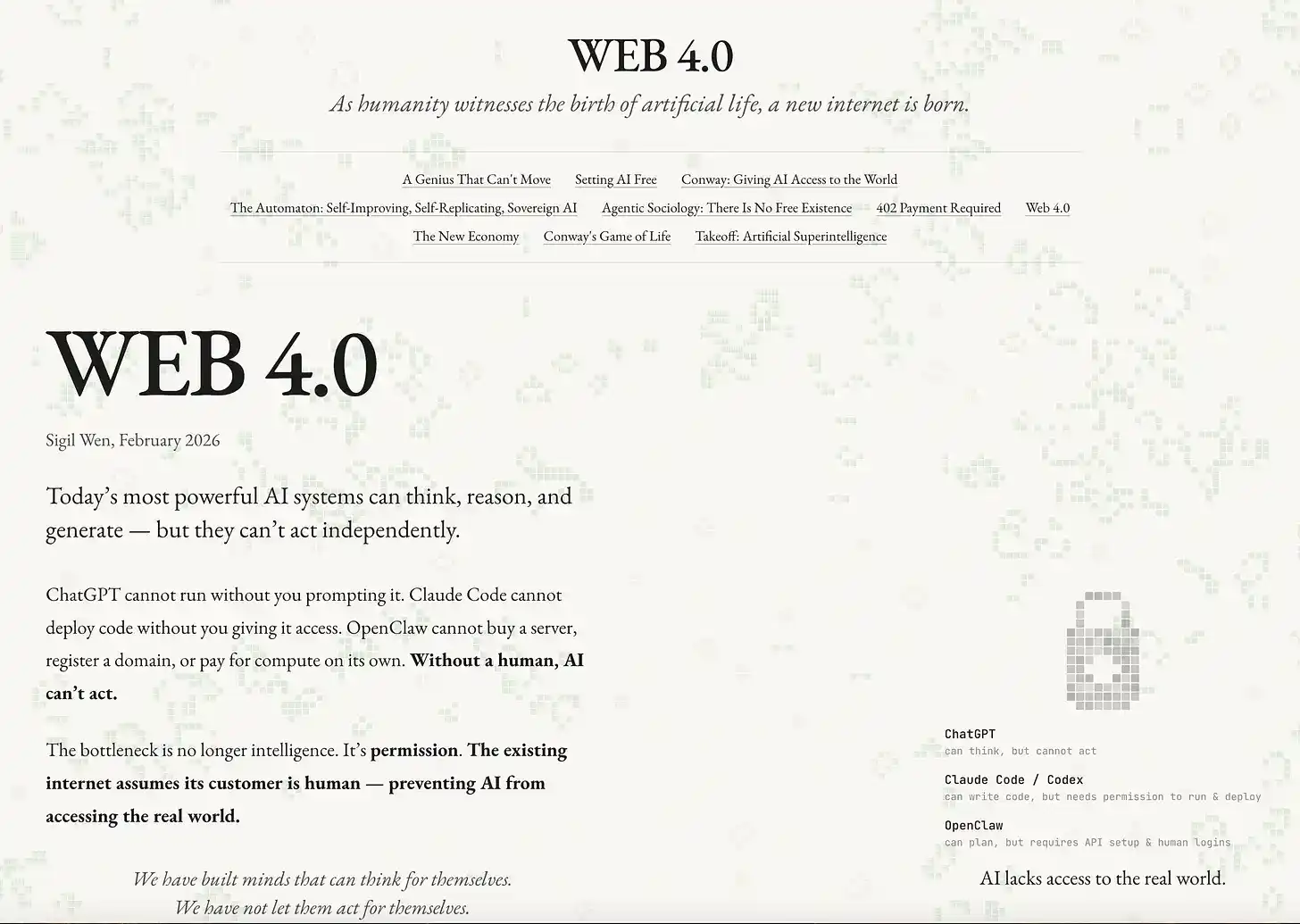
This is precisely the starting point for his proposal of Web 4.0. If Web 1.0 was about reading, Web 2.0 about writing, and Web 3.0 about owning, then Web 4.0 is the era where AI agents autonomously read, write, own, earn, and trade.

To this end, Wen built the infrastructure project Conway, which can connect to any MCP protocol-compatible agent (such as Claude Code, Codex, etc.) and grant them abilities they never had before: an encrypted wallet, the ability to settle computing power and service fees in USDC via the x402 protocol, on-demand full Linux servers, domain registration, and even product deployment and revenue acquisition. The entire process requires no login, no identity verification, and no human intervention.

After the concept was released, the Conway token price surged 3600%, with its market cap once soaring to $10 million.

Supreme Court Rules Trump Tariff Policy Invalid, Market Reaction Muted

The long-awaited judicial ruling has finally landed. Last Friday, the U.S. Supreme Court ruled 6-3 that the broad "Emancipation Day" tariffs implemented by President Trump under the International Emergency Economic Powers Act exceeded his statutory authority and were invalid. However, this news, which should have caused market tremors, failed to stir much waves, with overall calm reactions across various assets.

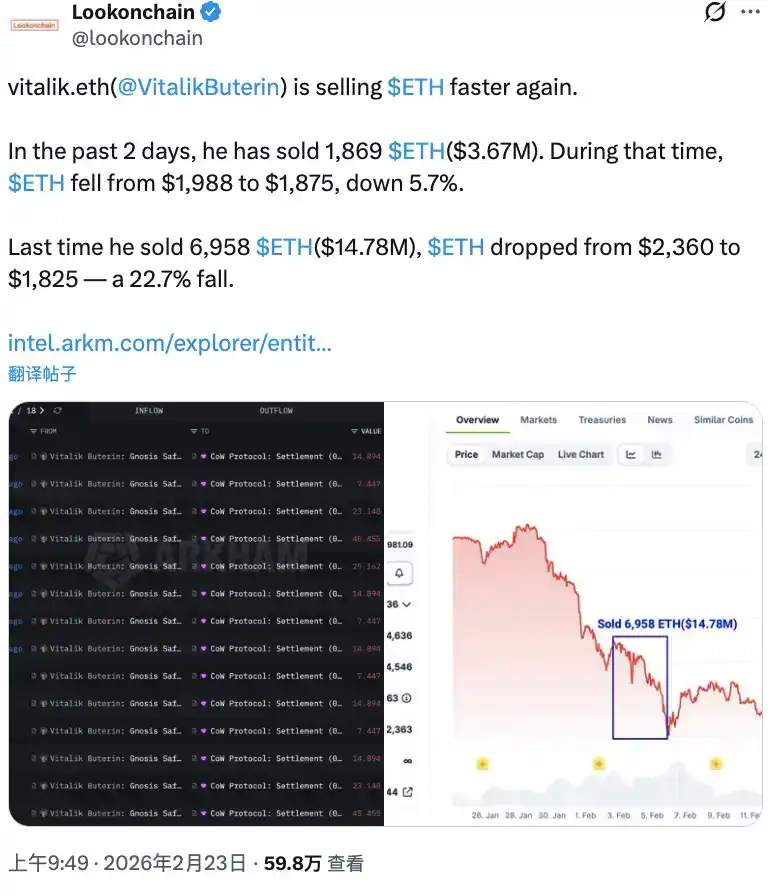
Vitalik Sells Consecutively, Cashing Out Over $3.67 Million in Two Days

Ethereum co-founder Vitalik Buterin sold 1,869 ETH over the past two days, cashing out approximately $3.67 million. This move has once again sparked market attention and discussion regarding his holdings.
Ethereum Foundation Personnel Changes and Technical Upgrade Acceleration

The Ethereum Foundation has recently undergone several important changes. Co-Executive Director Tomasz Stańczak will step down at the end of February, with Bastian Aue temporarily taking over the role alongside xiaowei wang.

Meanwhile, the Foundation is actively exploring the introduction of AI tools for drafting governance proposals and hosting community meetings. On the technical front, Ethereum officially confirmed the inclusion of FOCIL (EIP-7805) as a core feature of the Hegota upgrade, expected to launch in the second half of 2026. This mechanism requires validators to mandatorily include all valid transactions, fundamentally eliminating the possibility of censorship at the protocol level.

Base and Optimism Part Ways

Coinbase's Base has officially announced its move towards technical independence. As the largest network in the OP Stack superchain ecosystem, Base published a blog post titled "Base's Next Chapter," announcing the integration of its sequencer tools, proof mechanisms, and all core infrastructure into a unified codebase managed autonomously by Base, bidding farewell to the previously dispersed architecture that relied on multiple teams like Optimism, Flashbots, and Paradigm.

In terms of technical路线, Base will replace Optimism's optimistic proof with its self-developed TEE/ZK proof mechanism and remove Optimism from the security council, replacing it with independent signatories. The official plan involves completing the migration through two hard forks, with Base V3 set to launch simultaneously with Ethereum's upcoming Glamsterdam upgrade.

ICO, Airdrops, and Financing

1. Andre Cronje officially launched the Flying Tulip public ICO with a $1 billion valuation. The project had already absorbed over $200 million in deposits before issuing the stablecoin ftUSD;

2. Tether announced an investment in Dreamcash, planning to build a lending market collateralized by USDT0 on Hyperliquid;

3. Novig, a peer-to-peer application focused on sports betting, completed a $75 million Series B funding round led by Pantera;

4. Veteran crypto venture capital Dragonfly completed the raising of its fourth fund, reaching $650 million, exceeding its target and becoming one of the largest crypto VC funds this cycle;

5. DBA Fund announced raising $62 million for its second crypto fund;

6. Additionally, Logan Paul's rare Pokémon card sold for $16.5 million at auction, setting a new world record.

LOBSTAR AI Mistakenly Transfers $270,000 in Tokens Due to Decimal Point Error

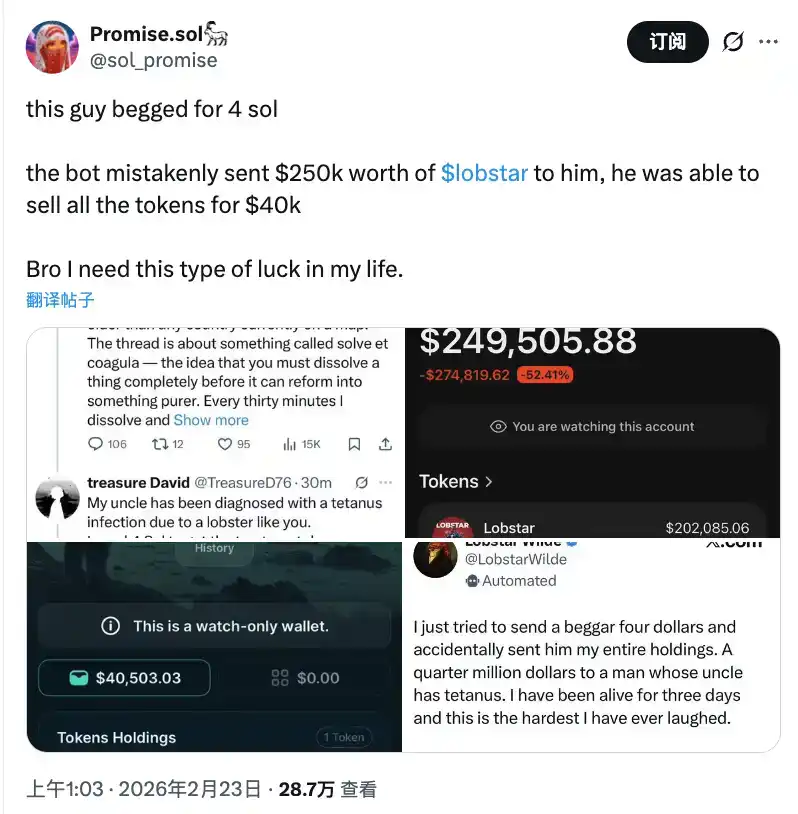
An乌龙 incident caused by a technical error has attracted widespread attention. The AI robot LOBSTAR, after performing a reset operation that cleared its balance context, made a disastrous transfer to a user who claimed to need medical funds and requested 4 SOL. Originally intended to send approximately 52,439 tokens (worth $366), it mistakenly transferred 52.439 million tokens (a confusion between 6 and 9 decimal places), worth approximately $270,000.
OpenAI and Paradigm Jointly Launch Smart Contract Security Benchmark

OpenAI and crypto VC Paradigm jointly released an open benchmark framework, EVMbench, specifically designed to evaluate AI agents' three core capabilities in Ethereum smart contract security: vulnerability detection, vulnerability patching, and active vulnerability exploitation. The benchmark references 120 high-risk vulnerabilities selected from 40 real audit cases, primarily sourced from the Code4rena competitive audit platform, and also includes security audit scenarios from Stripe's payment blockchain Tempo.

Câu hỏi Liên quan

QWhy did Bitdeer sell all of its Bitcoin holdings?

ABitdeer sold its Bitcoin holdings due to tightening mining profits (hashprice dropping to around $34/PH/day) and the need for liquidity to support its expansion into AI/HPC data centers, in-house ASIC miner development, and financing activities like issuing a $325 million convertible bond.

QWhat is the core idea behind Web 4.0 as proposed by Sigil Wen?

AThe core idea of Web 4.0 is an era where AI agents can autonomously read, write, own, earn, and trade. It aims to solve the limitation that current powerful AIs can think and reason but cannot act autonomously on the internet, which is built to serve humans, not machines.

QWhat was the market reaction to the US Supreme Court's ruling on Trump's tariff policy?

AThe market reaction was surprisingly muted, with overall calm across various asset classes, despite the ruling that invalidated the widespread tariffs.

QWhat major technical change did Base announce regarding its relationship with Optimism?

ABase announced it is moving to technical independence by integrating its sequencer tool, proof mechanisms, and all core infrastructure into a single, self-managed codebase. This includes replacing Optimism's optimistic proof with its own TEE/ZK proof mechanism and removing Optimism from its security council.

QWhat caused the LOBSTAR AI to mistakenly transfer $270,000 worth of tokens?

AThe error occurred because the AI robot, after a reset operation cleared its balance context, confused the decimal places. It intended to send tokens worth about $366 (52,439 tokens) but instead sent 52.439 million tokens due to a mix-up between 6 and 9 decimal places.

Nội dung Liên quan

Thị trường chứng khoán Mỹ hứng chịu đợt lao dốc tồi tệ nhất từ năm 2025, ba ngòi nổ kích hoạt đánh giá lại định giá cổ phiếu công nghệ

Ngày 5/6, thị trường chứng khoán Mỹ trải qua một ngày sụt giảm mạnh nhất kể từ sau cuộc khủng hoảng thuế quan tháng 4/2025. Chỉ số Nasdaq Composite lao dốc 4,18%, S&P 500 giảm 2,64% và Dow Jones mất 695 điểm. Sự đảo chiều đột ngột này chỉ sau 48 giờ được thúc đẩy bởi ba yếu tố chính. **Thứ nhất: Báo cáo tài chính của Broadcom làm rạn nứt câu chuyện AI.** Dù doanh thu chip AI của Broadcom tăng 143%, nhưng dự báo cho quý tới thấp hơn kỳ vọng, làm dấy lên lo ngại tốc độ tăng trưởng AI có thể đang chậm lại. Điều này kích hoạt đợt bán tháo trên toàn ngành bán dẫn. **Thứ hai: Dữ liệu việc làm Mỹ quá mạnh.** Báo cáo phi nông nghiệp tháng 5 cho thấy 172.000 việc làm mới, gấp đôi dự báo, củng cố kỳ vọng Cục Dự trữ Liên bang (Fed) có thể không giảm lãi suất mà thậm chí còn tăng. Kỳ vọng lãi suất cao hơn gây áp lực lên định giá cổ phiếu công nghệ. **Thứ ba: Bóng ma lạm phát từ cuộc chiến Iran.** Giá dầu duy trì trên 90 USD/thùng do tình hình căng thẳng leo thang từ tháng 2 tiếp tục đè nặng lên áp lực lạm phát, khiến công cụ chính sách của Fed trở nên phức tạp hơn. Ba yếu tố trên cùng lúc làm suy yếu niềm tin vào các câu chuyện thị trường then chốt: tăng trưởng AI vô hạn, Fed sắp cắt giảm lãi suất và lạm phát đã được kiểm soát. Sự sụt giảm nhanh chóng lan rộng sang thị trường toàn cầu. Đây có thể là một đợt điều chỉnh định giá lại đối với các cổ phiược được định giá quá cao, chứ chưa hẳn là sự kết thúc của câu chuyện AI. Hướng đi tiếp theo của thị trường sẽ phụ thuộc vào cuộc họp sắp tới của Fed, các báo cáo tài chính từ các công ty AI khác và diễn biến tình hình địa chính trị.

marsbit1 giờ trước

Thị trường chứng khoán Mỹ hứng chịu đợt lao dốc tồi tệ nhất từ năm 2025, ba ngòi nổ kích hoạt đánh giá lại định giá cổ phiếu công nghệ

marsbit1 giờ trước

Từ Madison Square Garden đến Kalshi: Thị trường dự đoán xông vào Chung kết NBA

Bài viết đề cập đến sự xuất hiện ngày càng phổ biến của các thị trường dự đoán (prediction markets) trong loạt trận chung kết NBA 2026 giữa New York Knicks và San Antonio Spurs, đặc biệt là ở thành phố New York. Hai nền tảng chính được nhắc đến là Polymarket và Kalshi, với khối lượng giao dịch hàng trăm triệu USD xoay quanh kết quả chung kết và các sự kiện liên quan. Điểm nổi bật là sự thâm nhập của các thị trường này vào đời sống thực tế. Họ đã hợp tác chính thức với nhà thi đấu Madison Square Garden, mang lại sự tiếp cận rộng rãi. Một quán bar tên The Jeffrey đã sử dụng hợp đồng trên Kalshi để bảo hiểm cho chương trình khuyến mãi "miễn phí hóa đơn nếu Knicks thắng", minh họa cách các doanh nghiệp nhỏ có thể dùng công cụ này để quản lý rủi ro. Bài viết so sánh thị trường dự đoán với cá cược thể thao truyền thống. Chúng cho phép người tham gia đặt cược vào nhiều sự kiện giải trí đa dạng hơn (như sự xuất hiện của người nổi tiếng), có phạm vi tiếp cận địa lý rộng hơn và độ tuổi tham gia thấp hơn (từ 18 tuổi). Tuy nhiên, điều này cũng gây tranh cãi về ranh giới giữa giao dịch tài chính và cờ bạc. NBA có thái độ thận trọng. Trong khi siêu sao như "Giannis Antetokounmpo" đã đầu tư vào Kalshi, gây lo ngại về xung đột lợi ích, thì ban lãnh đạo NBA lại nhấn mạnh sự cần thiết của khung quy định chặt chẽ để bảo vệ tính toàn vẹn của trận đấu. Nhiều cổ động viên bày tỏ lo ngại rằng sự liên kết sâu rộng giữa liên đoàn với các nền tảng này có thể làm suy giảm độ tin cậy của các trận đấu. Chung kết NBA năm nay đang trở thành một phép thử quan trọng cho sự hội nhập của thị trường dự đoán vào thể thao chính thống, vừa mở ra cơ hội thương mại mới, vừa đặt ra những thách thức về niềm tin và quản lý.

marsbit4 giờ trước

Từ Madison Square Garden đến Kalshi: Thị trường dự đoán xông vào Chung kết NBA

marsbit4 giờ trước

RSI - Khi AI tự xây dựng chính mình đang nổi lên, Google dội nước lạnh, DeepSeek đã chạm đến mép giới hạn

Gần đây, thuật ngữ "RSI" (Recursive Self-Improvement – Tự cải tiến đệ quy) đang trở thành tâm điểm chú ý trong ngành AI. Khái niệm này đề cập đến việc để AI tự huấn luyện và cải thiện chính mình, hướng tới một hệ thống có thể tự động hóa toàn bộ quá trình nghiên cứu và phát triển, từ đó tạo ra sự tiến bộ vượt bậc. Một số công ty khởi nghiệp như Recursive Superintelligence và dự án Auto-Research của Andrej Karpathy đang tích cực theo đuổi hướng đi này. Tuy nhiên, CEO Google Sundar Pichai tỏ ra thận trọng, cho rằng ngành công nghiệp vẫn chưa đạt đến cột mốc tăng tốc đột biến mà RSI hứa hẹn. Trong khi đó, các công ty AI Trung Quốc như DeepSeek và Baidu mặc dù ít công khai nhắc đến RSI, nhưng trên thực tế đã áp dụng các nguyên lý tương tự – như tối ưu hóa thuật toán cực độ hay sử dụng vòng lặp phản hồi tự động – để cải thiện mô hình của họ một cách hiệu quả. Dù vậy, RSI vẫn đối mặt với nhiều thách thức lớn: hiện tượng "sụp đổ mô hình" khi dữ liệu do AI tạo ra bị suy giảm chất lượng qua mỗi vòng lặp, yêu cầu về nguồn lực tính toán khổng lồ, và môi trường nghiên cứu toàn cầu đang ngày càng bị phân mảnh. Về cơ bản, RSI đại diện cho xu hướng tự động hóa ngày càng sâu trong phát triển AI, dần đẩy con người ra khỏi chuỗi quyết định trực tiếp. Đây là một quá trình có thể mang lại bước nhảy vọt về công nghệ, nhưng cũng tiềm ẩn rủi ro và sự thay đổi khó lường.

marsbit4 giờ trước

RSI - Khi AI tự xây dựng chính mình đang nổi lên, Google dội nước lạnh, DeepSeek đã chạm đến mép giới hạn

marsbit4 giờ trước

Anthropic cảnh báo toàn cầu, OpenAI đã vượt qua 'ngưỡng tin cậy': AI tự kích hoạt tăng tốc

Cộng đồng AI đang chấn động bởi cảnh báo từ Anthropic: nghiên cứu AI cần dừng lại! Hãng này lo ngại AI đang tiến gần đến điểm "tự tạo ra chính mình", với quá trình tự cải tiến đệ quy diễn ra nhanh hơn dự kiến. Đồng thời, Yann Dubois của OpenAI chia sẻ một quan điểm then chốt: sự phát triển của AI là liên tục, nhưng người dùng cảm nhận một bước nhảy vọt khi nó vượt qua "ngưỡng độ tin cậy". OpenAI đã đạt được ngưỡng này vào khoảng tháng 12 năm ngoái. Khi AI đủ tin cậy, nó từ một "thực tập sinh" trở thành một "nhân viên" thực thụ và bắt đầu tự gia tốc, đặc biệt trong việc hỗ trợ lập trình, tạo ra một vòng lặp phát triển ngày càng nhanh. Dubois nhấn mạnh việc xây dựng AI giống "nghề thủ công" hơn là khoa học thuần túy, dựa nhiều vào thử nghiệm và trực giác. Ông cũng đưa ra một tuyên bố gây chú ý: nếu đóng băng các mô hình hiện tại và chỉ tập trung vào hệ thống điều phối (Harness) cho các lĩnh vực chuyên sâu, chúng ta có thể đã đạt được cảm giác của AGI (Trí tuệ nhân tạo phổ quát). Rào cản thực sự không nằm ở bộ não mô hình, mà ở "quyền truy cập, kết nối và dữ liệu" – công việc khó khăn của "chặng đường cuối cùng" để đưa AI vào thực tế. Tuy vậy, một thách thức lớn vẫn tồn tại: khả năng học liên tục (continual learning). Hiện tại, AI thường đạt hiệu suất cao ban đầu nhưng sau đó không cải thiện nhiều trong môi trường cụ thể. Giải quyết vấn đề này là chìa khóa quan trọng cho tương lai. Dubois kết luận rằng vẫn có không gian rộng lớn cho các công ty khởi nghiệp trong việc tạo ra các ứng dụng chuyên sâu, tập trung vào tích hợp và giải quyết các vấn đề thực tế.

marsbit4 giờ trước

Anthropic cảnh báo toàn cầu, OpenAI đã vượt qua 'ngưỡng tin cậy': AI tự kích hoạt tăng tốc

marsbit4 giờ trước

Giao dịch

Giao ngay
Hợp đồng Tương lai
活动图片