Honeypot Finance: The New Full-Stack Perp DEX – Can It Challenge Hyperliquid?

marsbitXuất bản vào 2025-12-23Cập nhật gần nhất vào 2025-12-23

Tóm tắt

Honeypot Finance, a new full-stack perpetual DEX, is emerging as a potential challenger to established players like Hyperliquid. With a $35M valuation and backing from investors like Mask Network, it aims to reshape the Perp DEX landscape through a unique hybrid model combining order book efficiency with AMM resilience. Unlike traditional models, Honeypot integrates an order book (via Orderly Network) for low-slip execution during normal conditions and a proprietary AMM that activates during high volatility, ensuring continuous tradability. It also introduces a structured risk management system featuring layered vaults—allowing conservative capital to enter "Priority Vaults" for safer yields, while risk-tolerant users opt for "Secondary Vaults" for higher returns. The platform employs a multi-stage liquidation process to minimize unfair liquidations and avoid automatic deleveraging (ADL) unless absolutely necessary. The ecosystem is supported by a closed-loop tokenomics model. The $HPOT token (500M fixed supply) benefits from protocol fee buybacks and burns, tying its value to real revenue. HoneyGenesis NFTs act as yield-weight amplifiers, rewarding long-term stakers or offering permanent boost options when burned. Having already facilitated over $120M in total trading volume ($20M in perpetuals), Honeypot aims to create a synergistic system—from meme launchpad (Pot2Pump) to derivatives trading—that captures and sustains value through actual usage rather than inflationary ...

Author: momo, ChainCatcher

The decentralized perpetual futures (Perp DEX) market is currently in a new phase of reshuffling. Following Hyperliquid, protocols like Aster and Lighter have successively entered the market, breaking the old landscape. This indicates that competition is far from over before the infrastructure matures.

Against this backdrop, the newcomer Honeypot Finance provides a case study. It recently completed a new funding round at a $35 million valuation, receiving support from well-known institutions like Mask Network.

Unlike mainstream solutions, Honeypot's differentiation lies in its "full-stack" approach, which combines AMM and order book models. It goes beyond optimizing the trading experience, attempting to integrate token issuance, liquidity management, and derivatives trading into a synergistic system. The trading volume of its perpetual contracts has exceeded $20 million since launch.

This article will analyze Honeypot's product and mechanisms, exploring whether its full-stack integration model can build a sustainable, practical advantage in the current competition.

From Meme Launchpad to Full-Stack Perp DEX

Before entering the Perp DEX space, Honeypot's core focus was the Meme Launchpad. Through its star product Pot2Pump, the team directly addressed and attempted to solve the core pain points of the Memecoin economy at the time: how to capture and retain real, long-term value for the protocol during the狂热but short issuance cycles, rather than just one-off traffic.

Pot2Pump revolutionarily transformed early participants into native liquidity providers (LPs) from the token's inception, allowing the liquidity pool and the token to be born simultaneously. This design changed the恶性循环of early "scientist" arbitrage and rapidly depleting liquidity for Memecoins, turning high volatility into sustainable fee income for LPs.

Through Pot2Pump, Honeypot successfully validated an important model: in asset classes like Memecoins, characterized by high volatility and strong博弈, ingenious mechanism design can guide liquidity behavior, converting market hype into a stable stream of收益that can be shared by the protocol and the community.

However, Honeypot also quickly realized that Memecoins were more of an entry point for liquidity experiments, not the final form. The long-term viability of the protocol depends on whether capital can continuously trade, price, and be liquidated within the system.

Based on this judgment, the team expanded its perspective from单一发行to a complete structure encompassing market making, trading, and risk management, with perpetual contracts being the natural choice. Compared to spot trading or one-off发行, a Perp DEX can sustainably carry trading demand, generate stable fees, and transform volatility into manageable risk exposure.

Honeypot Finance's Differentiation and Innovation

When Honeypot Finance entered the perpetual contracts arena, it faced two mainstream paradigms, each with its own flaws.

On one side is the order book model reliant on market makers. It excels in efficiency during calm markets, but once volatility spikes, liquidity can evaporate instantly, leading to price gaps and users being liquidated under adverse conditions.

On the other side is the AMM model, exemplified by GMX. It uses oracle pricing to avoid information lag but makes liquidity providers the direct counterparty to all traders. In trending markets, these fund providers suffer continuous losses, often resulting in capital fleeing the protocol just when it needs support the most.

A deeper issue lies in the imbalance of risk and fairness: To ensure system stability, some protocols employ automatic deleveraging mechanisms (ADL), sacrificing some profitable traders' gains to cover losses in extreme situations, which raises widespread fairness concerns. Simultaneously, pooling all capital together without distinction hinders the entry of capital with different risk appetites, particularly large, conservative funds.

1. Building Full-Stack Liquidity: Order Book and AMM Working in Tandem

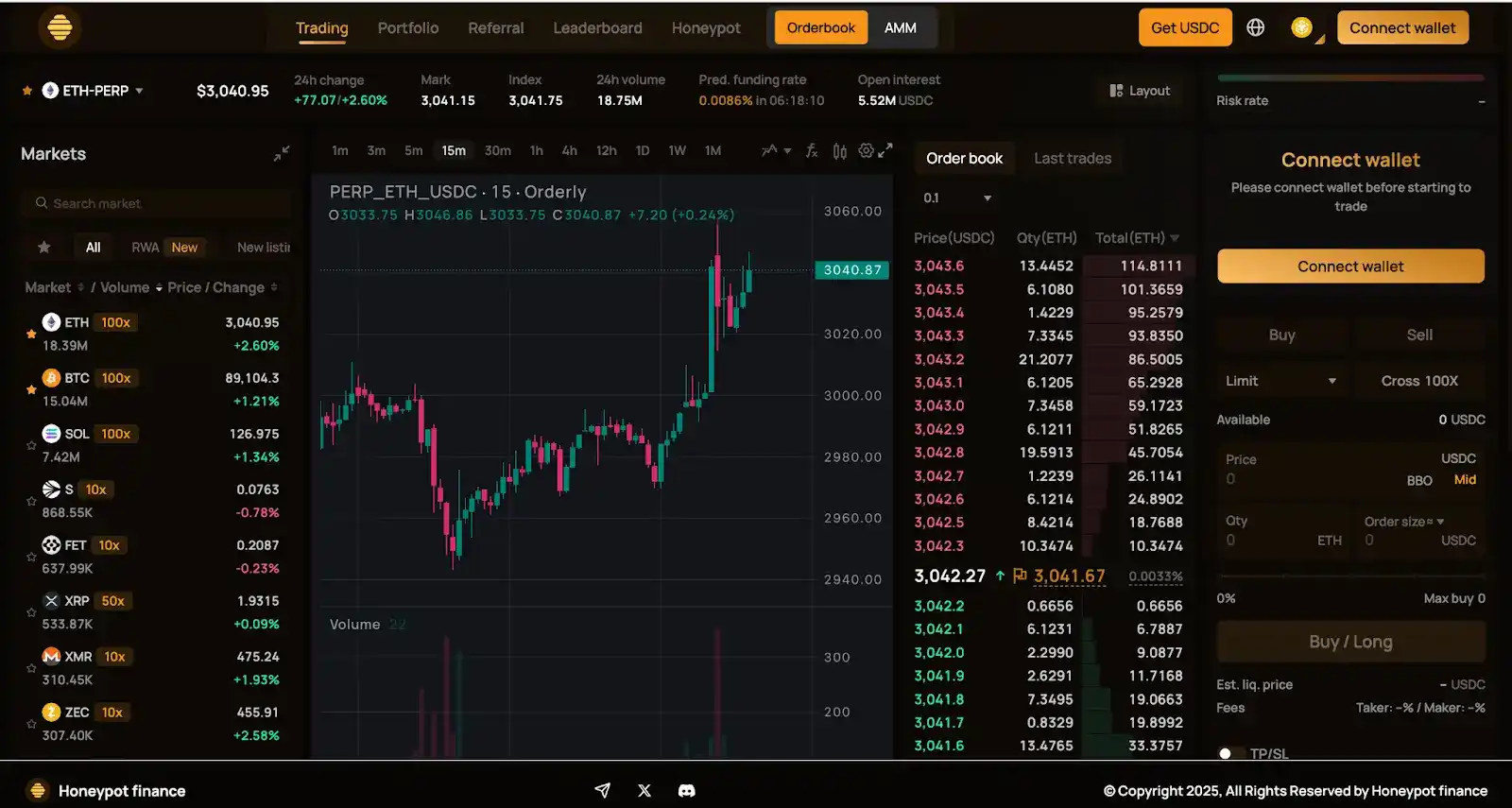
Addressing these structural issues, Honeypot did not choose to patch the old paradigms but proposed an integrated approach. Its core is building a "full-stack" perpetual DEX where the order book and AMM work协同, automatically adapting to different market conditions.

Order Book Handles Efficiency and Depth: By integrating a high-performance on-chain order book through a partnership with Orderly Network, Honeypot provides traders with a near-centralized exchange experience—low slippage, high speed—during stable market conditions, meeting the needs of高频and professional traders.

AMM Provides Resilience and Guarantee: Honeypot's self-developed AMM mechanism centers around a dynamic price band built around the oracle price. When the market experiences剧烈波动or black swan events, and order book liquidity dries up, the AMM acts as the final layer of executable guarantee, ensuring trades can be executed at any time.

The system automatically selects the optimal execution path (order book or AMM) for user trades based on market volatility and order book depth. Users get the best experience without manual intervention. This truly achieves "efficient trading in calm times, predictable execution in storms."
2. Implementing Structured Risk Control: Tiered Vaults and Fair Liquidation Process

In the core area of risk management, Honeypot's thinking is equally profound.

They started with the capital structure, introducing a tiered vault system.

This allows conservative capital seeking stable returns (like potential institutional capital) to enter the "Senior Vault," enjoying priority in fee distribution and being the last to bear losses, achieving risk isolation. Crypto-native players can voluntarily choose to enter the "Junior Vault," becoming the first line of defense to absorb losses in exchange for higher potential returns. This design transforms risk from a "passive, mixed burden" into an "active, clearly priced choice."

On this foundation, they redesigned the liquidation process, creating a "waterfall" sequence with multiple buffers.

When a position approaches liquidation, the system doesn't immediately liquidate it entirely. Instead, it sequentially attempts "Partial Liquidation," markets the position through a "Micro-Auction" for市场化处理, and has the Junior Vault absorb the loss. Following this, the Insurance Fund intervenes as a protocol-level buffer to cover extreme tail-risk events; only if all the above mechanisms are insufficient to stabilize the system is the minimally impactful and fully auditable ADL (Automatic Deleveraging) enabled as a last resort. This transparent design, which pushes punitive measures to the very end, aims to truly fulfill its promise of "procedural fairness."

Market feedback suggests this systemic design, from the foundational liquidity layer to the risk底层, is gaining initial validation. According to industry information, its platform's total trading volume has exceeded $120 million, and the perpetual contracts trading volume has surpassed $20 million since launch.

This data strongly indicates that the appeal of its risk-tiered structure to稳健capital has translated into real capital deposits. Through this series of designs, Honeypot not only attempts to solve existing pain points but also explores building a next-generation on-chain derivatives infrastructure capable of承载more complex capital and placing greater emphasis on fairness.

Token Economics and NFT Mechanism: How is the收益Closed Loop Achieved?

Honeypot Finance doesn't just aim to improve the trading experience; it attempts to build a self-sustaining收益system. Its token and NFT designs revolve around the same core goal: enabling the real revenue generated by the protocol to be continuously recaptured, redistributed, and, in turn, support the ecosystem itself.

1. HPOT: As a Vehicle for收益Bearing and Distribution

In many DeFi protocols, tokens primarily serve激励or governance functions, with limited connection to the protocol's actual revenue. Honeypot's token, $HPOT, with a fixed total supply of 500 million, is designed as a hub connecting trading activity and value distribution.

A portion of the trading fees generated by the protocol's products, like perpetual contracts, flows into the All-in-One Vault. Managed by the treasury and participating in on-chain strategies, these fees are converted into sustainable real yield. This yield is not simply retained; it is explicitly allocated:一部分is used to buy back and burn $HPOT, creating continuous supply contraction; another portion is distributed as claimable yield to users participating in the vaults.

In this structure, $HPOT is not just a speculative asset awaiting price fluctuations but a value carrier linked to the protocol's actual operational results. Its role is closer to a "收益relay" than a one-way incentive tool.

2. NFT: Transforming Long-Term Participation into收益Weight

Honeypot's HoneyGenesis NFT is not merely an identity or membership pass; it is a收益component designed around "long-term participation."

Holders can choose to stake the NFT, accumulating收益weight over time; or they can choose to burn the NFT in exchange for a permanent, higher收益multiplier. This design essentially incentivizes users to exchange time and commitment for higher long-term returns, rather than short-term arbitrage.

Here, the NFT de-emphasizes collectibility and instead functions as a "收益weight amplifier," making the act of participation itself a quantifiable, upgradable capital investment.

In summary, Honeypot attempts to avoid an "incentive consumption" model, instead basing ecosystem growth on real usage and revenue. The最终result is not one-way subsidies but a positive feedback system operating around收益recapture and redistribution.

Conclusion:

With the token即将上线, Honeypot Finance is transitioning from a project driven by early adopters and ecosystem builders to a broader, more complex public market.

Honeypot's current practice already provides a profound case study on structure, risk, and fairness for the on-chain derivatives track. Its core value lies not in the deepening of a single function but in a series of coherent design philosophies:

First, is the compatibility and scalability of the structure. The "full-stack" model is not just a hybrid solution born to cope with market volatility; it also reserves underlying interfaces to carry longer-term, more diverse capital and trading scenarios. The tiered vault design transforms risk from "passive sharing" into "active choice," paving the way for attracting traditional, conservative capital.

Second, is the long-term orientation of the economic mechanisms. Whether it's feeding protocol revenue back to users through token buyback/burns and claimable yield, or designing NFTs as upgradable "收益positions," the goal is to build a value closed loop of "participation equals accumulation." This logic aims to reduce reliance on one-off liquidity mining incentives and explore the possibility of continuing operation based on real use cases and sustainable收益distribution after incentives taper off.

Third, is the synergistic potential of the ecosystem. Honeypot's Perp DEX is not an isolated product but a key link in its full liquidity chain from asset issuance and spot trading to derivatives hedging. This deep integration means different products can potentially form a positive cycle of capital and user behavior, building a deeper moat.

However, after the initial hype subsides, can Honeypot translate its meticulously designed structural advantages into stable capital deposits, sustained real trading demand, and healthy protocol revenue? Can it prove that its advocated "procedural fairness" and risk tiering can truly protect users and maintain system stability in extreme market conditions? This still requires market validation.


Câu hỏi Liên quan

QWhat is the core innovation of Honeypot Finance's Perp DEX model compared to mainstream solutions like Hyperliquid?

AHoneypot Finance's core innovation is its 'full-stack' approach that synergistically combines an order book and an AMM model. It integrates with Orderly Network for a high-performance on-chain order book to provide low-slip, high-speed trading during stable conditions, while its proprietary AMM acts as a final execution layer with a price band around the oracle price to ensure trades can be executed during high volatility or black swan events when order book liquidity dries up. This aims to offer efficient trading in calm markets and guaranteed execution during storms.

QHow does Honeypot Finance's risk management system, specifically its 'Tiered Vaults', work to attract different types of capital?

AHoneypot's risk management system features a 'Tiered Vault' structure. It allows conservative capital seeking stable returns (e.g., potential institutional funds) to enter the 'Senior Vault,' which enjoys priority in fee sharing and is the last to absorb losses, achieving risk isolation. Crypto-native players can voluntarily choose the 'Junior Vault' to become the first line of defense against losses in exchange for higher potential returns. This design transforms risk from a passive, shared burden into an active, priced choice.

QWhat role does the HPOT token play in Honeypot's ecosystem, and how is it different from mere incentive tokens in other DeFi protocols?

AThe HPOT token is designed as a central hub connecting trading activity to value distribution, not just for incentives or governance. A portion of the protocol's revenue from trading fees is directed to an 'All-in-One Vault.' The revenue is then used to buy back and burn HPOT tokens (creating constant supply contraction) and is distributed as claimable earnings to users participating in the vaults. This structure makes HPOT a value carrier tied to the protocol's actual operational results, functioning more as a 'profit relay' than a simple incentive tool.

QHow does Honeypot Finance's 'waterfall' liquidation process aim to improve fairness for users?

AHoneypot's 'waterfall' liquidation process is a multi-buffered sequence designed for fairness. When a position nears liquidation, the system doesn't immediately liquidate it. Instead, it first attempts 'partial deleveraging,' then markets the position through a 'micro-auction' for the Junior Vault to absorb losses. The insurance fund acts as a protocol-level buffer for extreme tail risks. Only if all these mechanisms are insufficient does the protocol use Audited Automatic Deleveraging (ADL) as a last resort. This transparent, penalty-last design aims to fulfill its commitment to 'process fairness.'

QWhat was Honeypot's initial product, and how did the experience from it inform the development of their Perp DEX?

AHoneypot's initial core product was a Meme Launchpad called Pot2Pump. It addressed the pain point of capturing long-term value from memecoin launches by directly converting early participants into native liquidity providers (LPs), allowing the liquidity pool and token to be born simultaneously. This experience validated that clever mechanism design could guide liquidity behavior and convert market hype into a stable stream of fees for the protocol and community. It led them to expand into Perp DEX, recognizing that perpetual contracts could sustainably carry trading demand, generate steady fees, and transform volatility into manageable risk exposure, which is crucial for long-term protocol viability.

Nội dung Liên quan

Báo cáo Ethereum Q1 2026: Phí giảm, người dùng và khối lượng giao dịch lập kỷ lục mới

Báo cáo Q1/2026 của Ethereum cho thấy một xu hướng đối lập: lượng người dùng, số giao dịch và thông lượng mạng lưới đều đạt mức cao kỷ lục, trong khi phí giao dịch, tổng giá trị bị khóa (TVL), khối lượng giao dịch và vốn hóa pha loãng hoàn toàn (FDV) của ETH lại giảm. Hiện tượng này được giải thích là "Nghịch lý Jevons": việc giảm chi phí sử dụng mạng lưới sau đợt nâng cấp Fusaka đã giải phóng nhu cầu, thúc đẩy tăng trưởng quy mô. Báo cáo nhấn mạnh sự chuyển dịch trong định vị cốt lõi của Ethereum từ một blockchain DeFi sang một tầng thanh toán tài chính toàn cầu. Ethereum tiếp tục thống trị thị trường tài sản được mã hóa, chiếm phần lớn thị phần trong các lĩnh vực stablecoin (61,8%), quỹ được mã hóa (73%), hàng hóa được mã hóa (84%) và cổ phiếu được mã hóa. Sự tham gia của các tổ chức lớn như BlackRock, JPMorgan và Fidelity đang đẩy nhanh quá trình "thể chế lên chuỗi". Mặc dù phí giao dịch tầng cơ sở giảm mạnh (-47,9%), đây được xem là một sự đánh đổi có chủ đích để đổi lấy tăng trưởng mạng lưới dài hạn. Chiến lược này nhằm củng cố vị thế là nền tảng định sẵn cho việc thanh toán và quyết toán các tài sản tài chính ngày càng được mã hóa, từ đó tạo ra giá trị cơ bản cho ETH thông qua nhu cầu sử dụng mạng lưới.

marsbit7 phút trước

Báo cáo Ethereum Q1 2026: Phí giảm, người dùng và khối lượng giao dịch lập kỷ lục mới

marsbit7 phút trước

Anh ấy vừa gọi được 2,7 tỷ USD, Lý Phi Phi cũng rót tiền đầu tư

"Generalist AI", công ty khởi nghiệp trí tuệ thể hiện (embodied AI) do Pete Florence - cựu nhà khoa học nghiên cứu cốt cán của Google DeepMind và là một trong những người đặt nền móng cho kiến trúc mô hình VLA (Vision-Language-Action) - sáng lập, vừa huy động thành công 4 tỷ USD (tương đương 27 tỷ RMB) ở vòng gọi vốn mới, định giá 20 tỷ USD. Vòng đầu tư có sự tham gia của các tổ chức và cá nhân uy tín như NVentures (từ NVIDIA), NFDG, Bezos Expeditions, đồng sáng lập Xiaomi Lin Bin, người sáng lập Zoom Eric Yuan, và nhà khoa học nổi tiếng Fei-Fei Li. Mặc dù được coi là người tiên phong trong lĩnh vực "mô hình thế giới" (world model), Florence lại công khai phản đối việc dán nhãn này cho công ty mình. Triết lý của ông, chịu ảnh hưởng từ người thầy Russ Tedrake tại MIT, là ưu tiên "mục tiêu" cụ thể hơn các "nhãn" công nghệ chung chung. Mục tiêu tối thượng của Generalist AI là tạo ra những robot đa năng có thể thực hiện với độ tin cậy cực cao nhiều nhiệm vụ chưa từng thấy mà không cần dữ liệu huấn luyện riêng cho từng tác vụ. Để hiện thực hóa điều này, Generalist AI đã lần lượt ra mắt các mô hình GEN-0 và GEN-1. GEN-1, được công bố vào tháng 4/2026, được huấn luyện trên hơn 50 nghìn giờ dữ liệu tương tác vật lý thu thập qua một thiết bị đeo tay đặc biệt. Theo công ty, mô hình này đạt tỷ lệ thành công 99% trong một số nhiệm vụ thao tác lặp lại và tinh vi (như gấp hộp, đóng gói), với tốc độ nhanh gấp ba lần GEN-0 và chỉ cần khoảng một giờ để thích ứng với tác vụ mới. Thành tựu này chứng minh lộ trình phát triển rõ ràng của công ty và là lý do chính thu hút được sự ủng hộ mạnh mẽ từ các nhà đầu tư hàng đầu, đưa Generalist AI trở thành một trong những công ty được kỳ vọng nhất trong lĩnh vực robot và trí tuệ thể hiện.

marsbit15 phút trước

Anh ấy vừa gọi được 2,7 tỷ USD, Lý Phi Phi cũng rót tiền đầu tư

marsbit15 phút trước

Mất hai huyền thoại trong ba ngày: Con đập nhân tài AI của Google đang vỡ?

Chỉ trong ba ngày, Google đã chứng kiến hai huyền thoại AI rời đi: Noam Shazeer (đồng tác giả Transformer, lãnh đạo Gemini) gia nhập OpenAI, và John Jumper (người đoạt giải Nobel Hóa học 2024, lãnh đạo AlphaFold) chuyển sang Anthropic. Đây không phải là trường hợp cá biệt mà là một xu hướng rõ ràng, bổ sung cho việc cựu thành viên sáng lập OpenAI Andrej Karpathy gia nhập Anthropic trước đó. Các tài năng AI hàng đầu đang tập trung ngày càng nhiều vào OpenAI và Anthropic, khiến Google trở thành nguồn cung cấp chính trong cuộc tái cấu trúc nhân tài này. Sự dịch chuyển này bắt nguồn từ sự khác biệt cốt lõi về sứ mệnh. Google, với doanh thu chính phụ thuộc vào quảng cáo, thường đặt các dự án AI trong khuôn khổ phục vụ mục tiêu sản phẩm và lợi nhuận. Ngược lại, OpenAI (với sứ mệnh AGI) và Anthropic (tập trung vào AI an toàn) cho phép các nhà nghiên cứu tập trung hoàn toàn vào việc đẩy xa giới hạn năng lực mô hình. Ngoài ra, cơ hội thu lợi nhuận lớn từ cổ phiếu trước thềm IPO của hai công ty này là động lực hấp dẫn mà Google - một gã khổng lồ trưởng thành - khó có thể sánh được. Việc sáp nhập Google Brain và DeepMind vào năm 2023 cũng tạo ra những lực ly tâm mới, làm xói mòn văn hóa nghiên cứu dài hạn dưới áp lực phải phù hợp với lộ trình sản phẩm. Sự ra đi của các nhân vật then chốt như Jumper và Shazeer phản ánh điều này. Cuộc khủng hoảng nhân tài này mang tính cấu trúc. Google có thể sở hữu cơ sở hạ tầng máy tính khổng lồ và kho dữ liệu đồ sộ, nhưng việc thiếu những bộ óc xuất sắc nhất để khai thác chúng khiến lợi thế đó trở nên vô nghĩa. Trong khi OpenAI và Anthropic củng cố vị thế với đội ngũ tinh nhuệ ngày càng mạnh, Google đang mất dần hào quang là trung tâm hấp dẫn nhân tài AI toàn cầu. Trong cuộc đua mà mật độ tài năng quyết định năng lực mô hình và thị phần, đây là một thách thức tồn vong thầm lặng nhưng nghiêm trọng của Google.

marsbit2 giờ trước

Mất hai huyền thoại trong ba ngày: Con đập nhân tài AI của Google đang vỡ?

marsbit2 giờ trước

Phía sau bảng điểm AI, ẩn giấu một 'người ra đề' gốc Hoa

Mỗi khi một mô hình AI tiên tiến ra mắt, giới công nghệ lại dõi theo những “bảng điểm” quen thuộc như MMLU-Pro, MMMU hay MMMU-Pro. Đây là các tiêu chuẩn đánh giá quan trọng giúp so sánh năng lực của các mô hình lớn như GPT, Claude hay Gemini. Tuy nhiên, ít người biết rằng đằng sau những bộ đề thi này là một nhà nghiên cứu người Hoa: Chen Wenhu (Trần Văn Hổ), trợ lý giáo sư tại Đại học Waterloo, Canada. Ông cùng phòng thí nghiệm TIGERLab (còn gọi là Hổ Đầu Bang) đã tạo ra MMLU-Pro vào năm 2024 để giải quyết vấn đề “mất chuẩn” của bộ đánh giá MMLU cũ, khi nhiều mô hình tiên tiến đạt điểm gần tuyệt đối, khó phân biệt được sự khác biệt thực sự. MMLU-Pro với hơn 12.000 câu hỏi, mở rộng lựa chọn và tăng cường các câu đòi hỏi suy luận, đã giúp kéo giãn khoảng cách điểm số và đánh giá ổn định hơn. Trước đó, nhóm của Chen Wenhu cũng phát triển MMMU - bộ đánh giá đa phương thức (multimodal) yêu cầu mô hình kết hợp hiểu biết hình ảnh, biểu đồ với kiến thức chuyên môn để trả lời câu hỏi. Ngay cả các mô hình mạnh nhất thời điểm đó như GPT-4V cũng chỉ đạt độ chính xác khoảng 56%. Phiên bản MMMU-Pro sau này được thiết kế để đảm bảo mô hình không thể “bỏ qua” thông tin hình ảnh mà chỉ dựa vào văn bản để đoán đáp án. Nghiên cứu của Chen Wenhu tập trung vào việc hiểu thông tin phức tạp, hỏi đáp tri thức và suy luận. Ông từng làm việc tại Google Research và DeepMind, tham gia vào dự án Gemini, trước khi gia nhập Đại học Waterloo và thành lập TIGERLab. Phòng thí nghiệm không chỉ tạo ra các bộ đánh giá mà còn nghiên cứu phát triển mô hình, chẳng hạn trong lĩnh vực xử lý video. Hiện tại, Chen Wenhu làm việc tại Phòng thí nghiệm Siêu trí tuệ (Super Intelligent Lab) của Meta, tiếp tục tập trung vào dữ liệu huấn luyện và đánh giá đa phương thức. Công việc của ông và nhiều nhà nghiên cứu người Hoa khác đang đóng góp quan trọng vào sự phát triển chung của ngành AI, dù có thể không nằm dưới ánh đèn sân khấu.

marsbit2 giờ trước

Phía sau bảng điểm AI, ẩn giấu một 'người ra đề' gốc Hoa

marsbit2 giờ trước

Giao dịch

Giao ngay
Hợp đồng Tương lai
活动图片