From Outcast to Priceless Target: Mastercard Acquires BVNK for $1.8 Billion

marsbitXuất bản vào 2026-03-18Cập nhật gần nhất vào 2026-03-18

Tóm tắt

Mastercard has announced its acquisition of stablecoin infrastructure provider BVNK for up to $1.8 billion, including $300 million in contingent payments. The deal, expected to close by year-end, aims to strengthen Mastercard’s capabilities in digital assets and cross-border value transfers. Founded in 2021, BVNK has built a significant crypto settlement network, processing $25–30 billion in annual stablecoin transactions across 130+ countries. Despite earlier advanced acquisition talks with Coinbase—which ultimately fell through—Mastercard moved decisively to secure the startup. The acquisition is widely seen as a defensive strategy against the growing disruption stablecoins pose to traditional payment networks. With advantages like low cost, speed, and 24/7 operation, stablecoins are increasingly used in B2B and cross-border payments. By integrating BVNK, Mastercard aims to co-opt this technology rather than compete with it. The move is part of a broader trend: traditional financial giants like Visa, Citi, and Stripe are also aggressively investing in or acquiring crypto infrastructure firms. These established players are consolidating fragmented stablecoin liquidity under regulated, centralized frameworks, reinforcing their dominance in the evolving payments landscape.

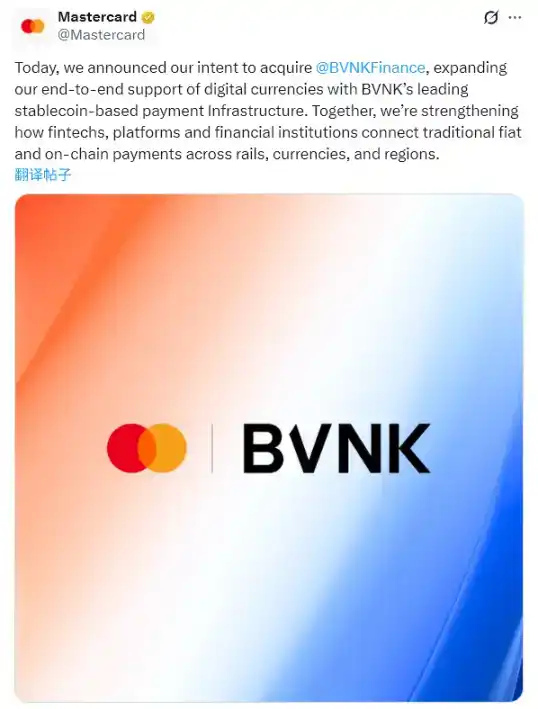
On March 17, global payment giant Mastercard announced the acquisition of stablecoin infrastructure provider BVNK. The deal is valued at up to $1.8 billion, including a $300 million contingent payment clause. Mastercard expects to complete the transaction by the end of this year, thereby expanding its end-to-end support capabilities in the digital assets and cross-currency value transfer fields.
The Value of the Outcast: Coinbase's Hesitation and Mastercard's Decisiveness

BVNK was founded in 2021 and is headquartered in London. In May 2022, BVNK completed a $40 million Series A funding round, reaching a post-money valuation of $340 million. Two years later, in December 2024, it completed a $50 million Series B funding round, raising its valuation to approximately $750 million.

BVNK is led by three South African founders, including CEO Jesse Hemson-Struthers (a serial entrepreneur who previously founded e-commerce and gaming companies acquired by Naspers and Sportradar, respectively), CTO Donald Jackson (a blockchain and enterprise systems expert), and CBO Chris Harmse (a CFA charterholder and former macro/crypto fund partner focused on foreign exchange and cross-border payments).

This startup has quietly built a vast settlement network for crypto assets.

Currently, the platform processes an annual stablecoin payment volume of about $25–30 billion. It provides businesses with a seamless channel connecting fiat currency and stablecoins, supporting payment activities across major blockchain networks in over 130 countries and regions.

But before Mastercard made its move, the real potential buyer for BVNK was actually crypto giant Coinbase.

In November 2025, acquisition talks between Coinbase and BVNK, valued at up to $2 billion, entered the deep due diligence phase, and the two parties even signed an exclusivity agreement at one point.

Coinbase was an investor in its Series B round. Had the deal gone through, it would have been a landmark event for a crypto-native company expanding into the core of global payment infrastructure. However, the two parties ultimately called off the deal that same month without disclosing any substantive reasons for the breakdown.

As Coinbase stepped back, Mastercard swiftly moved in to fill the gap precisely.

For a startup with annual revenue of only about $40 million, the $1.8 billion price tag appears extremely expensive from a financial model perspective. But this sky-high price was never about current profitability; it was about buying a monopoly-level ticket to the next-generation settlement network.

Defensive Counterattack: Buying Out the Possibility of 'Bypassing Card Networks'

Mastercard's move is actually a strategic counterattack with strong defensive overtones.

Stablecoins are visibly eroding the market share of traditional cross-border settlements. With their 24/7 operation, low friction costs, and extremely fast settlement speeds, blockchain-based digital dollars are beginning to show their edge in B2B payments and cross-border remittance scenarios.

In the global financial network, traditional credit card organizations are the payment channels most threatened by the disruption of stablecoins. If multinational corporations and business institutions become accustomed to peer-to-peer on-chain settlements, the centralized fiat routing network that Mastercard relies on for survival faces the risk of being completely marginalized.

If you can't beat them, decisively buy them.

Mastercard's Chief Product Officer, Jorn Lambert, was unequivocal about this. In the acquisition announcement, he stated that he expects most financial institutions and fintech companies to offer digital currency services in the future.

Mastercard's calculation is very clear: it is determined to directly integrate BVNK's ready-made stablecoin rails and compliance engine into its vast global fiat network. Stablecoins are no longer competitors to card networks; instead, they have been forcibly incorporated as a highly complementary business subset of its underlying network.

Traditional giants are building high walls with capital barriers that are difficult to surmount.

Land Grab: Wall Street's Payment Table Has No New Players

This is by no means an isolated action by Mastercard alone; the entire traditional finance sector is frantically scrambling for access to on-chain infrastructure.

Even before this acquisition was finalized, BVNK's backers already included a豪华 (luxury) lineup of Wall Street capital. In May 2025, Mastercard's arch-rival Visa made a strategic investment in BVNK through its venture arm, Visa Ventures.

Then, in October, Citi Ventures, the venture capital department of Citigroup, also invested real money to join the game. Although Citi declined to disclose the specific investment amount and BVNK's valuation, the company stated in an interview that its valuation was higher than the $750 million from the Series B round.

Even just two months before Mastercard announced the acquisition, Visa高调 (high-profile) announced it would integrate BVNK's stablecoin settlement capabilities into its core Visa Direct platform to support cross-border fund disbursement to global digital wallets.

This is both a hard technological integration and a默契 (tacit) capital collusion.

Looking across the entire payments industry, Silicon Valley's current darling, Stripe, had previously acquired stablecoin startup Bridge for $1.1 billion. And before finalizing the BVNK deal, Mastercard was also reported by the market to be in acquisition talks with another crypto infrastructure startup, Zerohash (founded in 2017, headquartered in Chicago), for as much as $1.5 to $2 billion.

Traditional payment giants are using疯狂且密集 (frenzied and密集 intensive) mergers and acquisitions to重新聚拢 (re-aggregate) the originally decentralized, fragmented stablecoin liquidity within the highly familiar business frameworks and regulatory channels they control.

At this highly lucrative table, the ones who ultimately sit down are still the old rulers holding heavy capital.


Câu hỏi Liên quan

QWhat is the significance of Mastercard's acquisition of BVNK for the digital asset and cross-border payment industry?

AMastercard's acquisition of BVNK, valued at up to $1.8 billion, is significant as it aims to expand the company's end-to-end support capabilities in digital assets and cross-currency value transfer. It represents a strategic move by a traditional payment giant to integrate stablecoin infrastructure, counter the threat of blockchain-based settlements, and secure a dominant position in the next-generation payment network.

QWhy did Coinbase's potential acquisition of BVNK fall through, and how did Mastercard capitalize on this?

ACoinbase's acquisition talks with BVNK, which reached an advanced stage including due diligence and an exclusivity agreement, were called off in November 2025 without public disclosure of the specific reasons. Mastercard swiftly moved in to acquire BVNK after Coinbase's withdrawal, seizing the opportunity to secure a key player in the stablecoin infrastructure space.

QHow does BVNK's business model and network pose a threat to traditional card networks like Mastercard?

ABVNK's platform, which processes $25-30 billion in annual stablecoin payment volume, provides a seamless channel for businesses to convert between fiat and stablecoins, supporting payments across 130+ countries. Its blockchain-based, peer-to-peer settlement offers 24/7 operation, low friction costs, and fast clearing, threatening to marginalize the centralized fiat routing networks that traditional card organizations like Mastercard rely on.

QWhat defensive strategic motive does Mastercard have for acquiring BVNK?

AMastercard's acquisition is a defensive strategic move to counter the disruptive threat of stablecoins to traditional cross-border settlement. By acquiring BVNK, Mastercard aims to co-opt the technology, integrating its stablecoin轨道 and compliance engine into its global fiat network, thereby turning a potential competitor into a complementary subset of its business and building high capital barriers to maintain its dominance.

QHow are other major traditional financial institutions involved in the stablecoin infrastructure space, as indicated in the article?

AOther major traditional financial institutions are heavily investing in stablecoin infrastructure. Visa's venture arm, Visa Ventures, made a strategic investment in BVNK in May 2025, and Citi Ventures also invested later that year. Furthermore, Visa integrated BVNK's stablecoin settlement capabilities into its Visa Direct platform. Stripe also acquired stablecoin startup Bridge for $1.1 billion, indicating a trend of traditional payment giants consolidating the fragmented stablecoin liquidity within their familiar commercial and regulatory frameworks.

Nội dung Liên quan

Ngân hàng Ý không nhìn thấy lợi thế hệ thống của stablecoin trong chuyển tiền

Một nghiên cứu của Ngân hàng Ý kết luận rằng stablecoin không mang lại lợi thế hệ thống bền vững về chi phí và tốc độ trong chuyển tiền quốc tế so với các dịch vụ tiêu chuẩn. Các ưu điểm tiềm năng bị mất đi bởi phí chuyển đổi sang/và từ tiền pháp định và hiệu quả của cơ sở hạ tầng thanh toán địa phương. Nghiên cứu so sánh việc chuyển 200 USDC qua 10 hành lang giữa Ý và các nước như Brazil, Argentina, Nhật Bản, UAE và Nam Phi. Tổng chi phí chuyển stablecoin dao động từ 0,3% đến gần 9%, tùy tuyến. Thời gian giải quyết giao dịch dưới 20 phút ở những nơi có hệ thống thanh toán tức thời, nhưng có thể kéo dài 1-2 ngày làm việc ở khu vực không có. Chi phí và độ trễ chủ yếu đến từ việc trao đổi, chuyển đổi tiền tệ và chất lượng hạ tầng địa phương, không phải từ phí blockchain. Dù stablecoin rẻ hơn mức trung bình toàn cầu là 6,65%, chúng chỉ rẻ hơn dịch vụ Wise ở 3/7 tuyến so sánh được. Các tác giả cho rằng lợi ích sẽ rõ ràng hơn nếu stablecoin có thể được chi tiêu trực tiếp mà không cần đổi sang tiền địa phương. Họ cũng lưu ý rằng các quy định cấm đoán không làm giảm nhu cầu với stablecoin, trong khi quy định quá chặt chẽ lại gây khó khăn cho người dùng phổ thông.

cryptonews.ru1 giờ trước

Ngân hàng Ý không nhìn thấy lợi thế hệ thống của stablecoin trong chuyển tiền

cryptonews.ru1 giờ trước

Cơn sốt Bitcoin đang bùng nổ: Tuyên bố mới của Saylor gây nên những đồn đoán về việc mua vào

Giám đốc điều hành của Strategy Inc. (Nasdaq: MSTR), Michael Saylor, một lần nữa khơi dậy những đồn đoán về việc công ty sẽ thông báo mua Bitcoin mới vào thứ Hai, sau khi đăng thông điệp "Bitcoin Drive engaged" vào ngày 2 tháng 8. Thông báo này đi kèm với biểu đồ mua hàng quen thuộc của công ty, phù hợp với thói quen báo hiệu thay đổi kho bạc trước các báo cáo hàng tuần của Saylor. Báo cáo kèm theo cho thấy dự trữ Bitcoin của Strategy là 843.775 BTC, trị giá khoảng 53,25 tỷ USD. Giá mua trung bình được ghi nhận là 75.653 USD/BTC, với lỗ chưa thực hiện là 10,58 tỷ USD (-16,58%). Một tín hiệu tương tự vào Chủ nhật tuần trước đã dẫn đến thông báo vào ngày 27/7 về việc công ty gia tăng dự trữ tiền mặt. Sổ cái thời gian thực của Strategy hiển thị 116 giao dịch đã đăng ký với tổng số 843.775 BTC được mua, đồng thời ghi nhận hai đợt bán Bitcoin gần đây tổng cộng 3.588 BTC (giảm từ 847.363 BTC), nhằm mục đích tài trợ cho cổ tức ưu đãi và bổ sung dự trữ USD. Công ty được báo cáo là đã không mua BTC trong tuần kết thúc ngày 26/7, đồng thời tăng dự trữ USD lên khoảng 3,75 tỷ USD. Bối cảnh tài chính đầy thách thức khi Strategy báo lỗ hoạt động 8,33 tỷ USD trong quý II/2026, chủ yếu do lỗ chưa thực hiện trên tài sản kỹ thuật số. Ban lãnh đạo có thể bán thêm tới 1,25 tỷ USD Bitcoin để củng cố dự trữ USD. Thông báo cập nhật dự kiến vào thứ Hai sẽ cho thấy liệu "Bitcoin Drive" có đánh dấu việc tái tích lũy hay không, khi Strategy cân bằng giữa kho dự trữ Bitcoin khổng lồ và các nghĩa vụ tiền mặt ngày càng tăng.

cryptonews.ru1 giờ trước

Cơn sốt Bitcoin đang bùng nổ: Tuyên bố mới của Saylor gây nên những đồn đoán về việc mua vào

cryptonews.ru1 giờ trước

Cổ phiếu các công ty trí tuệ nhân tạo được giao dịch như 'meme coin', trong khi Bitcoin hầu như không thay đổi giá - Tổng quan tuần

**Tóm tắt:** Bài viết phân tích các diễn biến chính trên thị trường tài chính và tiền điện tử trong tuần, với trọng tâm là sự biến động mạnh ở lĩnh vực AI và sự trầm lặng tương đối của Bitcoin. **Thị trường chứng khoán & AI:** * Cổ phiếu AI được giao dịch như "meme coin" với biến động cực đoan. Thị trường Hàn Quốc lao dốc 8% trong một phiên, chịu ảnh hưởng từ đợt bán tháo chip toàn cầu. * Quỹ "Situational Awareness" của Leopold Aschenbrenner bị thua lỗ nặng, dẫn đến thanh lý tài sản lớn, góp phần gây ra biến động. Citadel được cho là đã mua lại phần lớn danh mục của quỹ này. * Các chuyên gia như Ram Ahluwalia và Flood khuyên nên kiên nhẫn, trong khi Jim Bianco lưu ý thị trường thường tìm đáy sau khi một sự kiện lớn (như sự sụp đổ của một quỹ) xảy ra. **Macro & Tiền tệ:** * Các phát biểu của Chủ tịch Fed Kevin Warsh được cho là đã góp phần gây ra biến động, với một số ý kiến cho rằng ông thiếu năng lực. * Bộ Tài chính Nhật Bản can thiệp để hỗ trợ đồng Yên, nhưng hiệu quả hạn chế. * Có dấu hiệu về việc giảm thanh khoản toàn cầu và đà tăng trưởng sản xuất Mỹ chậm hơn kỳ vọng. **Thị trường Tiền điện tử:** * Bitcoin ít biến động, dao động quanh mức 64,000 USD, trong khi sự chú ý đổ dồn sang thị trường truyền thống. * Nhiều công ty tiền điện tử gặp khó khăn: BitMart và Storj Labs tuyên bố đóng cửa/phá sản; Coinbase (COIN) lao dốc sau báo cáo tài chính yếu; Uphold và các sàn khác cắt giảm nhân sự. * MicroStrategy tiếp tục tích lũy Bitcoin và mua lại cổ phiếu của chính mình, một chiến lược bị chỉ trích là "vòng xoáy Ponzi". * Cảnh báo bảo mật nghiêm trọng về lỗ hổng trên ví phần cứng Coldcard có thể làm lộ khóa riêng tư, đòi hỏi người dùng hành động ngay. **Các chủ đề khác:** * **DeFi/Blockchain:** Trade.xyz trên Hyperliquid và Pump.fun trên Solana cực kỳ thành công, đặt ra câu hỏi liệu họ có tự khởi chạy blockchain riêng hay không. Nghi ngờ giao dịch nội gián trên Hyperliquid. * **AI & Crypto:** Jason Calacanis và Barry Silbert nhiệt tình ủng hộ dự án Bittensor (TAO), coi đó là mô hình AI phi tập trung. Tác giả cảnh báo nên thận trọng trước sự cổ xúy của các nhà đầu tư mạo hiểm. * Các tranh cãi trong ngành: Kyle Samani chỉ trích Multicoin Capital; Charles Hoskinson khó chịu vì câu hỏi về quá khứ đồng sáng lập Ethereum. **Thông điệp chính:** Thị trường đang trải qua giai đoạn biến động mạnh, đặc biệt ở mảng AI, trong khi tiền điện tử chịu áp lực. Tính kỷ luật, sự kiên nhẫn và cảnh giác cao độ (đặc biệt về bảo mật) là cần thiết trong bối cảnh hiện tại.

cryptonews.ru2 giờ trước

Cổ phiếu các công ty trí tuệ nhân tạo được giao dịch như 'meme coin', trong khi Bitcoin hầu như không thay đổi giá - Tổng quan tuần

cryptonews.ru2 giờ trước

Giao dịch

Giao ngay
活动图片




