From Gas Limit to 'Keyed Nonces', How to Understand the Next Step in Ethereum Scalability?

marsbitXuất bản vào 2026-05-13Cập nhật gần nhất vào 2026-05-13

Tóm tắt

Ethereum’s scalability efforts are shifting toward a user-centric approach—focusing not only on higher TPS, but on translating technical upgrades into lower costs, smoother operations, and better wallet experiences. Two recent developments highlight this direction: - **Raising the Gas Limit to 200 million**: Following the Fusaka upgrade that increased it to 60 million, a consensus has formed around a potential future increase to 200 million. This would boost Ethereum’s execution capacity, but it is planned alongside other upgrades—such as ePBS, Block-Level Access Lists (BAL), and EIP-8037—to manage state growth and keep node operation viable for average participants. - **Keyed Nonces (EIP-8250)**: This proposal aims to improve how transactions are queued. Instead of a single linear nonce per account, it introduces multiple independent nonce domains. This prevents different types of transactions—such as private payments, session keys, or batch operations—from blocking each other. Vitalik Buterin views this as a foundational step toward better privacy support and more flexible state scalability. Together, these upgrades are part of a broader move to push complexity from wallets, DApps, and relays back into the protocol layer. For everyday users, this means future Ethereum interactions could become less congested, more intuitive, and safer—especially as core improvements in account abstraction, cross-L2 interoperability, and node decentralization continue to progress. Ultima...

Objectively speaking, in recent times, many users' intuitive perception of Ethereum often doesn't come from roadmap updates or developer meetings, but from specific on-chain operations.

For example, in the past couple of years, people have tangibly felt lower Gas fees during transfers and improved experiences with cross-chain interoperability. This is precisely why Ethereum's scaling has never been purely a "performance race" issue—for ordinary users, higher TPS, larger blocks, and more complex underlying architectures are only meaningful when they genuinely translate into lower costs, smoother operations, and a more secure wallet experience.

A series of recent developments in Ethereum happen to be pointing towards its attempt to systematically shift complexities previously borne by wallets, DApps, third-party relayers, and users themselves, forward to the protocol layer.

Among these are Vitalik's involvement with Keyed Nonces, the directional consensus formed around the 200 million Gas Limit floor during the Glamsterdam upgrade, and the continuing threads highlighted in the 2026 roadmap, including native account abstraction, cross-L2 interoperability, and L1 security reinforcement.
One: Gas Limit Increase to 200 Million?

First, let's look at the aspect most easily perceived by users: Gas Limit.

As is well known, in the Ethereum network, every transaction (whether a transfer or contract interaction) consumes a certain amount of Gas, and each Ethereum block has a fixed Gas Limit capacity, meaning limited slots: more slots allow more "passengers" to be carried in the same timeframe; more competition for the same seat drives up Gas fees.

Theoretically, increasing the block Gas limit would directly and significantly boost Ethereum mainnet performance. However, in the past, against the backdrop of significant developments like L2, Ethereum has been relatively cautious and restrained in this regard. Most scaling pressure has been intentionally directed toward the L2 track.

Looking at the history of Ethereum's Gas Limit expansion reveals that after first surpassing 10 million from 8 million in September 2019, it took until this year—seven years—for the Gas Limit to increase from 8 million to 60 million. Notably, acceleration truly began in 2025—increasing from 30 million to 36 million in February, to 45 million in July, and then to 60 million after the Fusaka upgrade in December.

It can be said that most of the expansion was crammed into the year 2025. As we've mentioned before, 2025 was also a crucial year in Ethereum's development history. The Fusaka upgrade, just 7 months after the May Pectra upgrade, proved that the Ethereum Foundation (EF), despite major leadership changes, retained the ability to push major updates. It also marked Ethereum's official entry into an accelerated development rhythm of "two hard forks per year" (Extended reading: "Ethereum 2026: Interpreting EF's Latest Protocol Roadmap, Officially Entering the 'Engineering Upgrade' Era?").
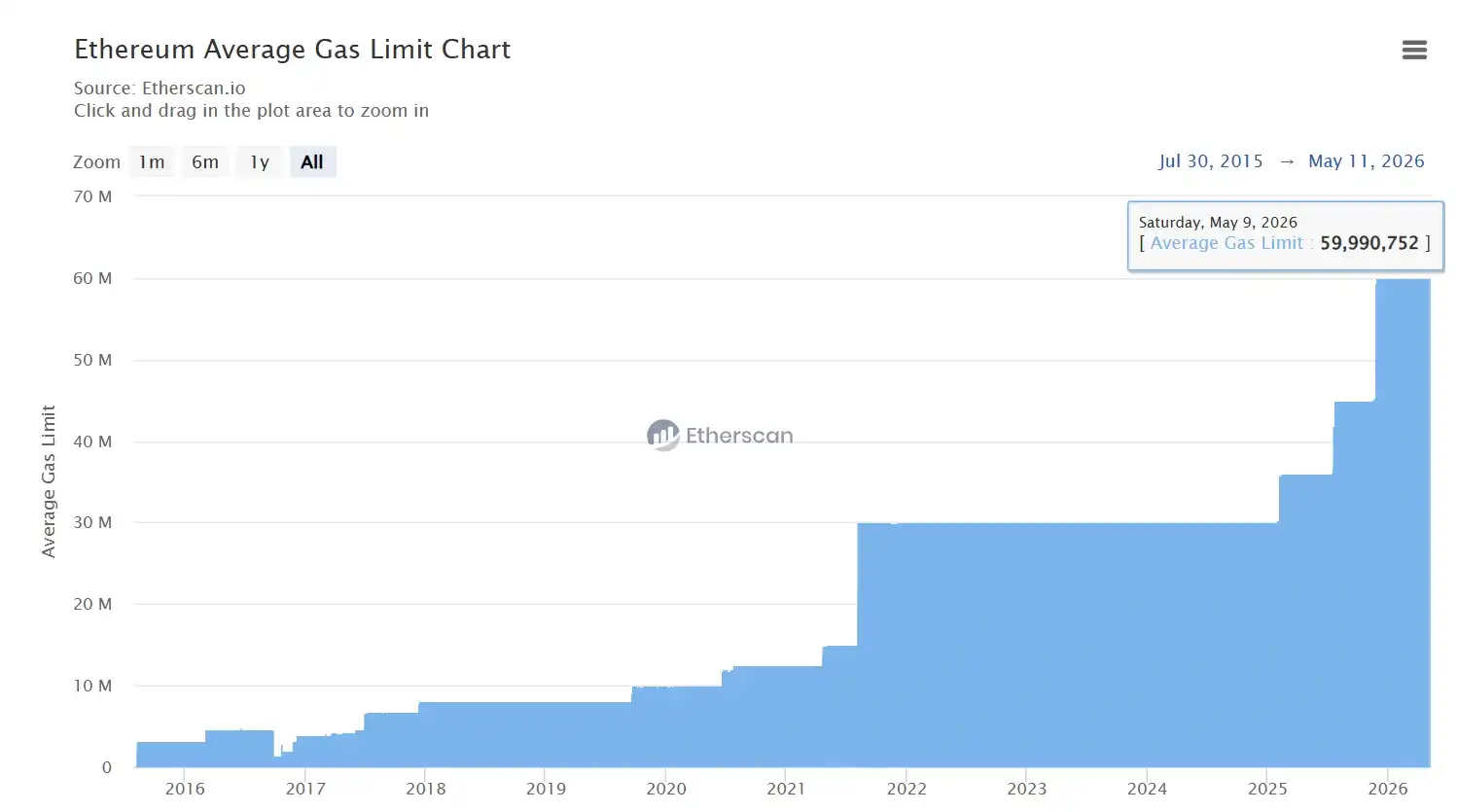
Source: Etherscan

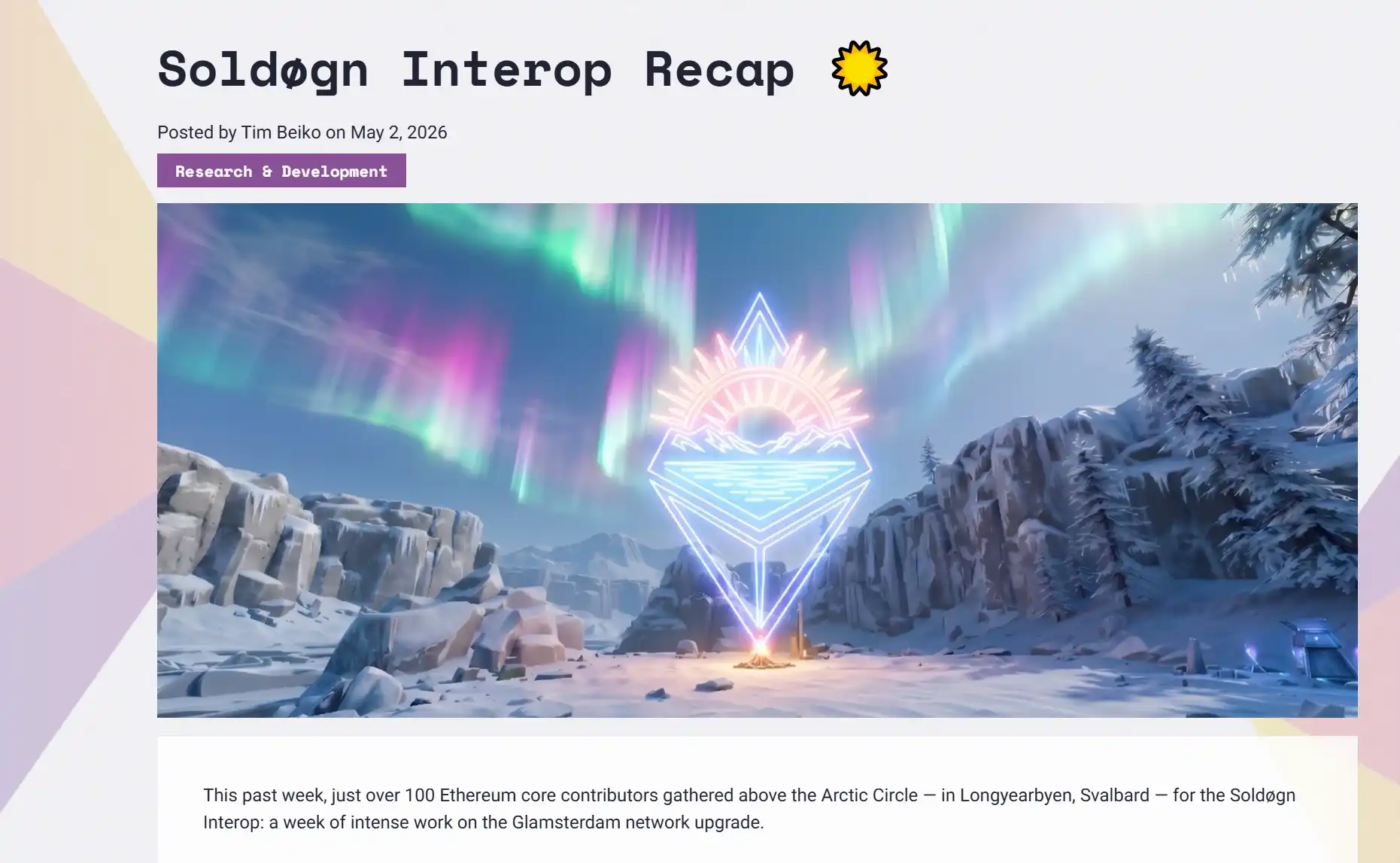
According to the Ethereum Foundation's Soldøgn Interop Recap released on May 2nd, over 100 core Ethereum contributors participated in an interoperability meeting in Svalbard, Norway, centered on the Glamsterdam upgrade. The key goals were advancing multi-client implementation, testing, and parameter alignment for Glamsterdam. By the meeting's end, developers had reached a directional consensus regarding a 200 million Gas Limit post-Glamsterdam.

This means that if subsequent processes proceed smoothly, Ethereum L1's execution capacity is expected to increase from the current ~60 million Gas Limit to around 200 million. Over a longer timeframe, the Ethereum ecosystem's publicly discussable stance on the Gas Limit has clearly become much more "aggressive." EIP-9698 even proposes "doubling every two years," aiming to raise the Gas Limit to 3.6 billion by 2029, which would be 50 times the current level.

However, it's crucial to emphasize that increasing the Gas Limit isn't simply about making blocks bigger.

If we merely brute-force increased the computational load each block can handle, in the short term it might lower fees, but long-term it would lead to heavier node burdens and state data bloat. This also means it becomes more difficult for ordinary users to run nodes, ultimately undermining Ethereum's core decentralized foundation.

Therefore, Glamsterdam's scaling approach is a combination of measures:

  • ePBS (enshrined Proposer-Builder Separation) more clearly incorporates block building and validation processes into protocol rules, allowing validators to process larger blocks more securely;
  • Block-Level Access Lists (BAL) pre-record the accounts and storage locations to be accessed during block execution, enabling parallel disk reads, parallel transaction validation, and parallel state root calculations;
  • EIP-8037, by increasing the cost of state creation-related operations, aims to prevent excessive state growth after the Gas Limit increase.

Ultimately, Ethereum doesn't just want to "fit more transactions," but is also thinking about how to do so without making node operation increasingly inaccessible.

This is the fundamental distinction between Ethereum's scaling roadmap and many high-performance chain narratives. Ethereum has consistently pursued not sacrificing verification costs for superficial throughput, but rather increasing the mainnet's own carrying capacity while preserving ordinary node participation and system verifiability as much as possible.

Two: Keyed Nonces: Turning 'One Line' into 'Multiple Channels'

If Gas Limit addresses "how much can fit in a block," then Keyed Nonces focuses on another more detailed yet crucial question: how should transactions queue up?

As is well known, in Ethereum, a nonce can be simply understood as the "sequence number" for an account's transactions. Its role is to prevent the same transaction from being executed repeatedly and to ensure transactions from the same account are processed in order.

This mechanism is easy to understand in simple transfer scenarios: the first transaction, second transaction, third transaction, and so on, queued sequentially.

The problem arises when account capabilities become more complex, involving private transactions, smart wallets, session keys, batch operations, third-party payment sponsors, etc. In these cases, a single linear nonce can become a bottleneck. Therefore, the core idea of EIP-8250's Keyed Nonces is to change from an account having only one nonce queue to having multiple nonce domains.

Specifically, it replaces the single sender nonce from EIP-8141 Frame Transactions with a (nonce_key, nonce_seq) structure. Here, nonce_key == 0 corresponds to the traditional account nonce, while non-zero keys can opt for independent protocol-managed nonce sequences. Transactions under different keys are independent of each other, preventing replay and not affecting one another.

This sounds technical, but it can be understood with a real-life analogy: Before, an account was like a bank with only one window; all business had to queue in the same line. Keyed Nonces is like assigning different services to different windows—transfers, private withdrawals, session authorizations, batch executions can each take their own channel.
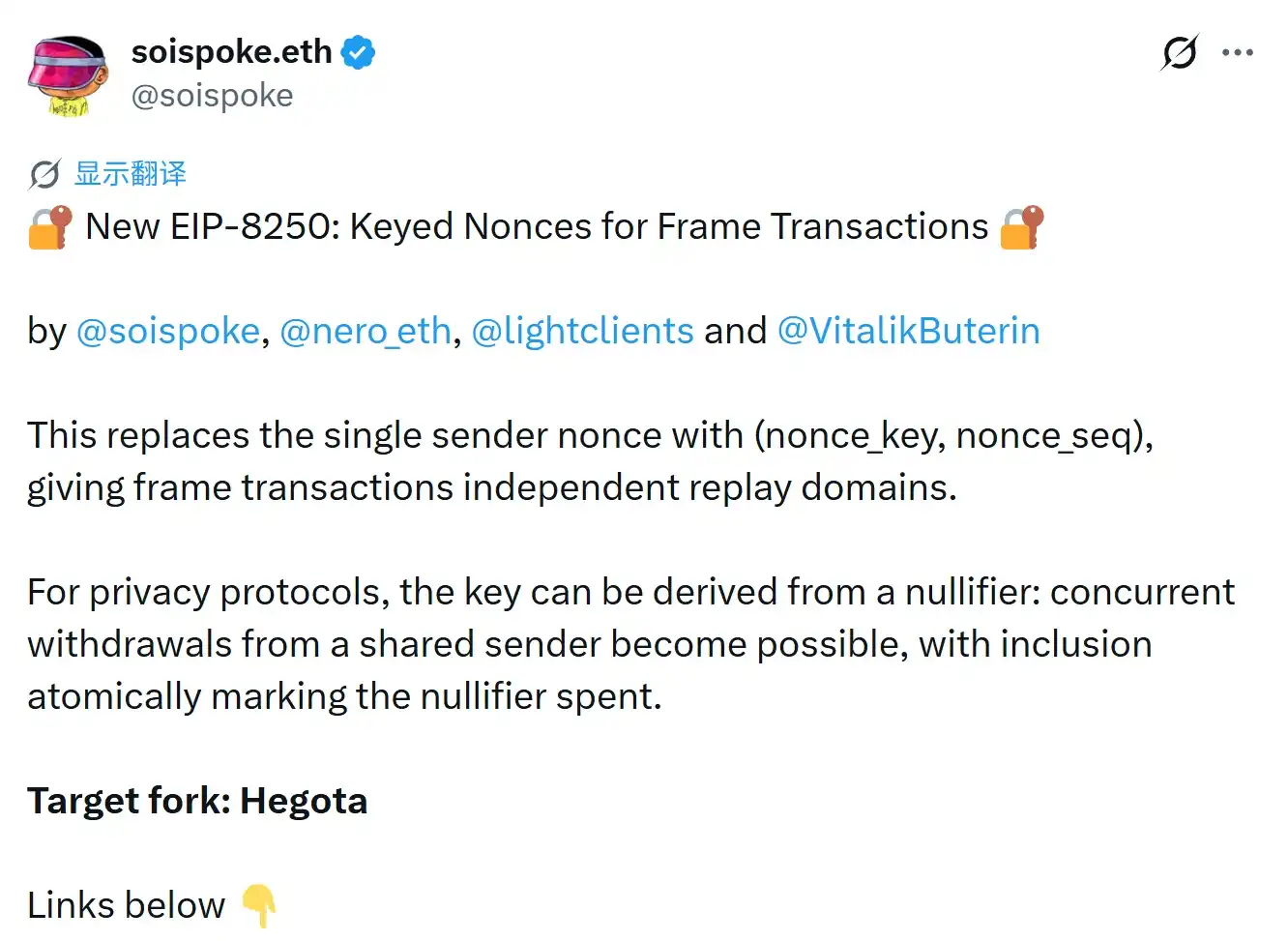
This is particularly important for privacy protocols. To avoid directly linking a user's on-chain activity to a single public address, privacy protocols might have multiple users initiate transactions through a shared sender address. However, under a single nonce mechanism, once one user's transaction gets packaged, it could cause other users' pending transactions to become invalid or blocked.

Keyed Nonces allows each spending action to choose its own nonce domain, for example, derived from a privacy nullifier, reducing this queuing conflict at the protocol layer.

Vitalik himself positions it even more grandly. When introducing EIP-8250, he explicitly stated that Keyed Nonces "is not only stronger support for protocol-layer privacy solutions, but could also be the first step in a new Ethereum state scaling strategy—achieving ultimate scalability while maintaining protocol decentralization by creating specialized, optimized storage types for different use cases."

In other words, one could simply understand it as: Gas Limit solves "block size," while Keyed Nonces explores the "shape of state." Ethereum aims to carry not just more transactions, but more *kinds* of transactions in the future.

Three: How Will This Affect Ordinary Users?

For the Ethereum ecosystem, many protocol upgrades may seem distant from ordinary users, but they ultimately manifest in the wallet experience.

Because the real entry point for users interacting with Ethereum isn't EIPs, clients, or developer meetings, but every transfer, authorization, signature, cross-chain, and DApp interaction within a wallet. That is to say, changes at the protocol layer only truly complete the transition from technical upgrade to user experience upgrade when they are translated into clearer, smoother, and more secure operational experiences at the wallet layer.

For instance, the now-familiar concept of account abstraction isn't about making users understand more technical terms, but about enabling users to use on-chain accounts more naturally in the future. That's why in recent years, features like batch transactions, Gas sponsorship, recovery mechanisms, different signature methods, session authorizations, and more flexible security policies have gradually become basic wallet capabilities.

Similarly, taking Keyed Nonces as an example, it sounds like a very low-level optimization of account queuing mechanisms. But from the user's perspective, its potential impact is not abstract. Many users today may have encountered scenarios during on-chain operations where a transaction is pending for too long, blocking subsequent ones; wanting to cancel or speed up a transaction but not understanding the relationship between nonce, Gas, and replacement transactions; especially during multi-step parallel operations, one failed step can disrupt the entire subsequent flow.

For ordinary users, these issues might seem like "the wallet is bad" or "the chain is bad," but in fact, they are related to the design of the single linear nonce in Ethereum's account model. The direction represented by Keyed Nonces is to allow accounts to no longer execute all operations sequentially in one queue, but to split into multiple parallel channels according to different usage scenarios.

In the future, operations like regular transfers, DApp authorizations, privacy transactions, batch transactions, and Gas sponsorship could theoretically have more independent execution spaces, reducing the probability of mutual blocking and conflicts.

This will undoubtedly further expand the design space for smart wallets.

More importantly, in the past, these capabilities often required wallets, DApps, relay services, and users to share the complexity. Users had to understand authorization scopes, judge if Gas was reasonable, know exactly what they were signing, and repeatedly confirm multi-step operations across bridging, swapping, staking, claiming rewards, etc. Any misunderstanding could lead to operational failure and asset loss risks.

What Ethereum is now attempting to do is shift some of this complexity forward to the protocol layer, allowing wallets to provide better interaction abstractions for users based on more standardized, more native underlying capabilities.

This is also why Gas Limit, BAL, ePBS, Keyed Nonces, Frame Transactions, native account abstraction, and cross-L2 interoperability, while seemingly belonging to different technical modules, are all serving the same goal: enabling Ethereum to carry more complex on-chain usage scenarios without sacrificing decentralization and security.

Looking specifically, putting these developments together reveals that Ethereum's recent focus is not scattered:

  • Gas Limit increase addresses mainnet execution capacity and fee pressure.
  • BAL, ePBS, EIP-8037 address how to maintain node verifiability and controlled state growth during scaling.
  • Keyed Nonces and Frame Transactions address bottlenecks at the protocol layer for account models, privacy protocols, and smart wallets.
  • Native account abstraction and cross-L2 interoperability further point towards tangible experience improvements for ordinary users.

This also signifies that Ethereum is entering a new phase.

After all, in recent years, the market has focused more on L2 scaling, Blob fee reductions, and modular narratives. Users have also gradually become accustomed to moving assets between different L2s and seeking lower-cost interaction environments. However, as mainnet Gas Limits continue to rise, upgrades like Glamsterdam progress, and account abstraction and interoperability solutions evolve, the question Ethereum is now answering is no longer just "how to make transactions cheaper," but "how to make the on-chain experience more like a cohesive whole."

In this process, the importance of wallets will undoubtedly be further amplified.

Because wallets are not just the entry point for users into Ethereum; they are also the interface through which protocol capabilities are truly understood and utilized by users. In the future, the more complex the underlying upgrades, the more they will need to be translated by wallets into clearer signature prompts, more understandable transaction paths, more upfront risk identification, and smoother on-chain interaction experiences.

Let's work towards this together.

Tiền kỹ thuật số thịnh hành

Câu hỏi Liên quan

QWhat is the significance of potentially increasing Ethereum's Gas Limit to 200 million, and what are the main concerns associated with simply raising it?

AIncreasing the Gas Limit to 200 million would significantly boost Ethereum's mainnet execution capacity and user-perceived performance by allowing more transactions per block. The main concern with simply raising the limit is that it could overly burden node operators by increasing state data bloat, raising hardware requirements, and ultimately threatening Ethereum's core decentralization by making it harder for average users to run nodes.

QHow does the Keyed Nonces proposal (EIP-8250) aim to improve the user experience on Ethereum?

AThe Keyed Nonces proposal aims to improve user experience by moving away from a single, linear transaction queue (nonce) per account. It introduces multiple independent nonce domains or channels. This allows different types of transactions (e.g., regular transfers, privacy withdrawals, session authorizations) to proceed in parallel without blocking each other, reducing congestion, failed transactions, and the complexity users face when managing transaction sequences.

QAccording to the article, what is the fundamental difference between Ethereum's scaling approach and that of many high-performance blockchains?

AThe fundamental difference is that Ethereum's scaling approach does not prioritize sacrificing verification cost and decentralization for superficial throughput. Instead, it focuses on increasing the mainnet's承载能力 (carrying capacity) while striving to maintain low node participation门槛 (barriers), system verifiability, and the network's decentralized foundation.

QWhat role does the wallet play in the context of Ethereum's recent protocol-level upgrades like Keyed Nonces and native account abstraction?

AThe wallet plays a crucial role as the primary user interface and translator of protocol-level upgrades. It absorbs the underlying complexity (e.g., from Keyed Nonces, account abstraction) and presents it to users as clearer, smoother, and safer operational experiences—such as better签名提示 (signature prompts), understandable transaction paths, and streamlined interactions—making the technical upgrades meaningful for end-users.

QWhat broader question is Ethereum attempting to answer with its current suite of upgrades (Gas Limit, ePBS, Keyed Nonces, Account Abstraction), beyond just reducing transaction costs?

ABeyond reducing transaction costs, Ethereum is attempting to answer the broader question of 'how to make the on-chain experience feel more like a cohesive whole.' This involves improving主网 (mainnet) capacity, maintaining node health, enabling more complex use cases (e.g., via Keyed Nonces), and enhancing user experience through native account abstraction and cross-L2 interoperability, ultimately creating a more integrated and user-friendly ecosystem.

Nội dung Liên quan

Stablecoin là 'phe bảo hoàng' của thế giới tiền mã hóa: Open USD đưa hệ thống tiền tệ cũ tự thân tham chiến

Tác giả Hồ Dật Lâm phân tích sự ra mắt của Open USD, cho rằng stablecoin không phải là lực lượng cách mạng thực sự trong thế giới crypto, mà giống như "phe bảo hoàng cải cách" trong hệ thống tiền tệ cũ. Nó kế thừa hiệu quả của blockchain nhưng vẫn giữ nguyên vị trí trung tâm của đồng USD và Cục Dự trữ Liên bang Mỹ. Open USD, với sự tham gia của hơn 140 tổ chức truyền thống như Visa, Mastercard, BlackRock và Google, đánh dấu sự chuyển dịch từ cạnh tranh sản phẩm giữa các startup crypto sang cuộc chiến cơ sở hạ tầng liên minh do chính hệ thống tài chính cũ dẫn dắt. Điều này tạo ra thách thức mang tính mỉa mai cho các công ty stablecoin gốc như Circle: nếu sứ mệnh của stablecoin chỉ là cải thiện hiệu quả cho hệ thống cũ, thì khi hệ thống đó tự triển khai mạng lưới stablecoin của mình, tính chính đáng cách mạng của những người tiên phong sẽ bị lung lay. Tác giả so sánh stablecoin với hệ thống vũ trụ của Tycho trong cách mạng Copernicus: nó tiếp thu các ưu điểm kỹ thuật mới (blockchain) nhưng từ chối điểm cốt lõi là "để Trái đất chuyển động" – tức là loại bỏ vị trí trung tâm của đồng USD. Stablecoin có thể là một công cụ chuyển tiếp hữu ích, nhưng nó ngăn cản cuộc cách mạng tiến sâu hơn. Thành công của stablecoin, đặc biệt là các stablecoin gắn với USD, có thể củng cố thêm quyền bá chủ của đồng USD hơn là thúc đẩy một trật tự tiền tệ thực sự mới mẻ. Bài viết nhấn mạnh rằng thời khắc Copernicus thực sự của cách mạng tiền mã hóa sẽ đến khi thị trường nhận ra rằng đời sống kinh tế không nhất thiết phải phụ thuộc vào một ngân hàng trung ương cố định làm trung tâm trật tự tiền tệ. Giá trị tiền tệ có thể được xác định một cách tự phát bởi thị trường. Do đó, trong khi ủng hộ sự phát triển của stablecoin như một công cụ thực tế, tác giả vẫn kiên định rằng lý tưởng cốt lõi của crypto, được đại diện bởi chế độ bản vị Bitcoin, mới hướng tới một sự chuyển đổi mang tính nền tảng thực sự.

marsbit1 giờ trước

Stablecoin là 'phe bảo hoàng' của thế giới tiền mã hóa: Open USD đưa hệ thống tiền tệ cũ tự thân tham chiến

marsbit1 giờ trước

Stablecoin là "Phe Bảo Hoàng" trong thế giới mã hóa: Open USD khiến hệ thống tiền tệ cũ trực tiếp xuống tay

Open USD - một stablecoin mới do liên minh hơn 140 tổ chức như Visa, Mastercard, BlackRock, Google, Coinbase, Solana... phát triển - đánh dấu bước chuyển: từ cạnh tranh sản phẩm giữa các startup crypto sang cuộc chiến cơ sở hạ tầng có sự tham gia trực tiếp của hệ thống tài chính truyền thống. Theo học giả Hồ Dật Lâm, sự kiện này làm rõ hơn vị trí lịch sử của stablecoin: chúng không phải là "phe ôn hòa" của cuộc cách mạng crypto, mà giống "phe bảo hoàng cải cách" bên trong chế độ tiền tệ cũ. Stablecoin kế thừa hiệu quả của blockchain nhưng vẫn giữ nguyên vị trí trung tâm của đồng USD và Cục Dự trữ Liên bang Mỹ (Fed), chỉ nhằm cải thiện hệ thống thanh toán, ngân hàng kém hiệu quả chứ không thách thức chính đồng tiền định chế. Khi chính các gã khổng lồ thanh toán, ngân hàng và nền tảng công nghệ tự tổ chức mạng lưới stablecoin, các công ty stablecoin gốc như Circle (USDC) sẽ đối mặt với nghịch lý: nếu sứ mệnh của họ chỉ là phục vụ hệ thống USD, thì khi hệ thống cũ tự nâng cấp, họ mất đi tính chính đáng cách mạng không thể thay thế. Để phân biệt, các nhà đổi mới crypto gốc phải giữ lại phần "không tuân thủ" thực sự, như bản vị Bitcoin, quản trị phi tập trung hoặc kháng kiểm duyệt. Stablecoin càng thành công, hệ thống USD càng được củng cố, trở thành "bản nâng cấp blockchain cho bá quyền USD". Điều này có thể làm đứt gãy logic "hoạt động trên chuỗi càng thịnh vượng thì đồng bản địa càng tăng giá". Nếu mọi giao dịch trên chuỗi đều định giá bằng USD stablecoin, tài sản thế chấp là trái phiếu Mỹ, thì sự thịnh vượng có thể chỉ làm giàu thêm cho tài sản ngoài chuỗi. Hồ Dật Lâm cho rằng, thời khắc Copernicus thực sự của cách mạng tiền tệ crypto không nằm ở chuyển tiền xuyên biên giới rẻ hơn, mà là khi người ta nhận ra trật tự tiền tệ không nhất thiết phải xoay quanh một ngân hàng trung ương cố định. Stablecoin có ý nghĩa lịch sử như một công cụ chuyển tiếp, nhưng nếu thế giới trên chuỗi cuối cùng vẫn lấy USD làm thước đo giá trị, thì "cách mạng blockchain" chỉ là một tiện ích bổ sung cho hệ thống USD mà thôi.

链捕手1 giờ trước

Stablecoin là "Phe Bảo Hoàng" trong thế giới mã hóa: Open USD khiến hệ thống tiền tệ cũ trực tiếp xuống tay

链捕手1 giờ trước

Tuần Lựa Chọn Tinh Túy: Robinhood Ra Mắt L2, 140 Gã Khổng Lồ Tung Ổn Định OUSD, MicroStrategy Phát Hành Kịch Bản Tự Cứu

Tóm tắt nội dung tuần: **AI & Công nghệ:** Meta mở ránh kinh doanh điện toán đám mây bán sức mạnh AI, gây lo ngại về dư thừa năng lực và ảnh hưởng đến các cổ phiếu cơ sở hạ tầng AI. Các công ty như Broadcom và Marvell được chú ý trong kiến trúc trung tâm dữ liệu AI. Hiện tượng "Token không kinh tế" xuất hiện khi công cụ lập trình AI tiêu tốn nhiều token nhưng hiệu suất không cao. Hàn Quốc công bố kế hoạch đầu tư khổng lồ vào bán dẫn và AI. **Thị trường & Chiến lược:** Các bài viết phân tích xu hướng tháng 7, bao gồm dự báo về thị trường lưu trữ, động thái của USD và cổ phiếu châu Á. Các chuyên gia chia sẻ góc nhìn: Bitwise dự đoán thị trường bullrun vào mùa thu, trong khi Primitive cho rằng cơn sốt AI đang hạ nhiệt. a16z nhận định robot là chủ đề chính của chu kỳ AI mới. **Cơ hội & Rủi ro:** Bài viết hướng dẫn cách người bình thường có thể phát hiện cơ hội đầu tư từ thông tin hàng ngày và tham gia vào lĩnh vực robot thông qua ETF. Đồng thời cảnh báo về các mô hình kiếm tiền như "Collector Crypt" và chia sẻ hướng dẫn quản lý danh mục đầu tư. **Tin tức Web3 nổi bật:** 1. **Robinhood Chain** ra mắt mainnet, thu hút nhiều giao thức, trong khi dYdX gây tranh cãi khi ra mắt Arcus. 2. Liên minh **Open Standard (OUSD)** với 140 tập đoàn lớn phát hành stablecoin, thách thức vị thế của USDC và USDT, khiến giá cổ phiếu Circle giảm mạnh. 3. **MicroStrategy** công bố kế hoạch "tự cứu" mới, bao gồm bán 1.25 tỷ USD Bitcoin và mua lại 2 tỷ USD cổ phiếu. 4. Vụ airdrop **Ansem** làm nổi lại hiệu ứng shilling của KOL. 5. Dự án **Venice AI** huy động 65 triệu USD với cấu trúc vốn hỗn hợp (cổ phần + token), gây tranh luận. **Thông tin quan trọng khác:** * ETF Bitcoin ghi nhận dòng tiền ròng sau 10 ngày rút. * Michael Burry báo cáo short cổ phiếu Micron. * Dữ liệu việc làm Mỹ tháng 6 thấp hơn kỳ vọng. * EU bắt đầu sửa đổi MiCA ngay khi nó có hiệu lực. * Hơn 20 công ty bán dẫn đồng loạt tăng giá từ 1/7. * Circle bị loại khỏi chỉ số Russell, giá cổ phiếu giảm 17.55%.

marsbit2 giờ trước

Tuần Lựa Chọn Tinh Túy: Robinhood Ra Mắt L2, 140 Gã Khổng Lồ Tung Ổn Định OUSD, MicroStrategy Phát Hành Kịch Bản Tự Cứu

marsbit2 giờ trước

Standard Chartered tiếp quản cửa vào USDC, Circle nhường quyền để đổi lấy quy mô

Ngân hàng Standard Chartered (SCB) đã hợp tác với Circle để triển khai dịch vụ mới: khách hàng tổ chức có thể phát hành (mint) hoặc đổi lấy (redeem) USDC trực tiếp thông qua hệ thống tài khoản của SCB, mà không cần mở tài khoản riêng tại Circle. Dịch vụ này đầu tiên được cung cấp tại Trung tâm Tài chính Quốc tế Dubai (DIFC). Đây là lần đầu tiên một ngân hàng toàn cầu quan trọng (G-SIB) chính thức tiếp quản "chìa khóa" điểm vào/ra quan trọng của một stablecoin hàng đầu. Điều này giúp các quỹ hưu trí, quỹ tài sản có chủ quyền và các tổ chức lớn khác - vốn chỉ tin tưởng ngân hàng truyền thống - có lối vào hợp pháp và quen thuộc để tiếp cận USDC. Với Circle, đây là một thỏa thuận chiến lược: nhượng lại mối quan hệ khách hàng trực tiếp để đổi lấy mạng lưới phân phối rộng lớn của SCB, nhằm mở rộng đáng kể quy mô lưu hành USDC vào nhóm vốn tổ chức khó tiếp cận nhất. Mô hình kinh doanh chính của Circle là thu lợi nhuận từ lãi suất trên dự trữ tài sản, vì vậy việc tăng lượng lưu hành là ưu tiên hàng đầu. Đối với SCB, họ tận dụng uy tín, giấy phép và mạng lưới khách hàng sẵn có để cung cấp thêm một sản phẩm số cho khách hàng mà không cần tự phát hành stablecoin, qua đó thu phí dịch vụ. Sự hợp tác này đánh dấu sự phân công rõ ràng trong ngành stablecoin: Circle tập trung vào hạ tầng kỹ thuật và quy mô, trong khi các ngân hàng như SCB đảm nhận vai trò cổng kết nối với thế giới tài chính truyền thống. Việc chọn DIFC làm điểm triển khai đầu tiên là một bước đi chiến lược nhằm thử nghiệm mô hình trong môi trường quy định thuận lợi, trước khi mở rộng sang các thị trường khác. Sự kiện này cho thấy stablecoin như USDC không còn là một thực thể song song cần được "thuần hóa" bởi tài chính truyền thống, mà đã chính thức trở thành một lựa chọn trên kệ sản phẩm của các ngân hàng lớn. Câu chuyện chuyển từ "liệu stablecoin có thể gia nhập hệ thống tài chính chính thống?" sang "ai nắm quyền định giá khi các mối quan hệ giữa nhà phát hành, ngân hàng và giấy phép được sắp xếp lại?".

marsbit4 giờ trước

Standard Chartered tiếp quản cửa vào USDC, Circle nhường quyền để đổi lấy quy mô

marsbit4 giờ trước

Giao dịch

Giao ngay

Bài viết Nổi bật

Làm thế nào để Mua GAS

Chào mừng bạn đến với HTX.com! Chúng tôi đã làm cho mua GAS (GAS) trở nên đơn giản và thuận tiện. Làm theo hướng dẫn từng bước của chúng tôi để bắt đầu hành trình tiền kỹ thuật số của bạn.Bước 1: Tạo Tài khoản HTX của BạnSử dụng email hoặc số điện thoại của bạn để đăng ký tài khoản miễn phí trên HTX. Trải nghiệm hành trình đăng ký không rắc rối và mở khóa tất cả tính năng. Nhận Tài khoản của tôiBước 2: Truy cập Mua Crypto và Chọn Phương thức Thanh toán của BạnThẻ Tín dụng/Ghi nợ: Sử dụng Visa hoặc Mastercard của bạn để mua GAS (GAS) ngay lập tức.Số dư: Sử dụng tiền từ số dư tài khoản HTX của bạn để giao dịch liền mạch.Bên thứ ba: Chúng tôi đã thêm những phương thức thanh toán phổ biến như Google Pay và Apple Pay để nâng cao sự tiện lợi.P2P: Giao dịch trực tiếp với người dùng khác trên HTX.Thị trường mua bán phi tập trung (OTC): Chúng tôi cung cấp những dịch vụ được thiết kế riêng và tỷ giá hối đoái cạnh tranh cho nhà giao dịch.Bước 3: Lưu trữ GAS (GAS) của BạnSau khi mua GAS (GAS), lưu trữ trong tài khoản HTX của bạn. Ngoài ra, bạn có thể gửi đi nơi khác qua chuyển khoản blockchain hoặc sử dụng để giao dịch những tiền kỹ thuật số khác.Bước 4: Giao dịch GAS (GAS)Giao dịch GAS (GAS) dễ dàng trên thị trường giao ngay của HTX. Chỉ cần truy cập vào tài khoản của bạn, chọn cặp giao dịch, thực hiện giao dịch và theo dõi trong thời gian thực. Chúng tôi cung cấp trải nghiệm thân thiện với người dùng cho cả người mới bắt đầu và người giao dịch dày dạn kinh nghiệm.

Tổng lượt xem 368Xuất bản vào 2024.12.12Cập nhật vào 2026.06.02

Làm thế nào để Mua GAS

Thảo luận

Chào mừng đến với Cộng đồng HTX. Tại đây, bạn có thể được thông báo về những phát triển nền tảng mới nhất và có quyền truy cập vào thông tin chuyên sâu về thị trường. Ý kiến ​​của người dùng về giá của GAS (GAS) được trình bày dưới đây.

活动图片