From Exchanges to Hotels: USDT is Penetrating Real-World Consumption Scenes

比推Xuất bản vào 2025-12-26Cập nhật gần nhất vào 2025-12-26

Tóm tắt

Trip.com, the overseas version of Chinese travel giant Ctrip, has begun accepting stablecoin payments in USDT and USDC for global users. A real-world test in Vietnam confirmed the functionality, allowing a hotel booking to be completed in under 10 minutes using USDT. Notably, payments with USDT offered significant savings, with flight bookings being approximately 18% cheaper and hotel bookings around 2.35% cheaper compared to traditional payment methods. The service, powered by Singapore-based licensed payment gateway Triple-A, supports multiple blockchains including Ethereum, Tron, and Solana. A key privacy benefit was noted: booking a hotel with USDT required only a name and email, minimizing personal data collection. This development is particularly significant for the vast global population without access to international credit cards. The article contextualizes this move within a broader trend of major corporations, from PayPal and Ant Group to automakers like BYD and Toyota, adopting stablecoins. This shift is often driven by practical necessity in countries experiencing severe local currency devaluation, where stablecoins like USDT have become a critical tool for maintaining financial stability and facilitating cross-border commerce.

Original Author: Joe Zhou, Foresight News

Original Title: Save 18% on Hotel Bookings with USDT, Trip.com's Overseas Version Strongly Promotes Stablecoin Payments


Trip.com, the overseas version of Ctrip, is quietly entering the stablecoin payment track.

On December 25, 2025, Foresight News learned that Trip.com, the overseas version of Ctrip, has launched a stablecoin payment function for global users, currently supporting two USD stablecoins: USDT and USDC. Two sources close to Trip confirmed this information to Foresight News.

After downloading and logging into Trip.com in Vietnam, the author successfully completed a hotel reservation in Nha Trang, Vietnam, using USDT payment in less than 10 minutes.

More notably, after checking the prices of several local hotels, it was found that the price of some hotels on the Trip.com App when paying with USDT was even lower than using the Ctrip official website or traditional payment methods.

Trip.com Overseas Version Already Supports USDT/USDC

On December 24, 2025, the author booked a hotel in Nha Trang, Vietnam, using USDT on the Trip.com overseas version APP, and on December 25, purchased a plane ticket from Nha Trang to Ho Chi Minh City with USDT, both showing successful payment. The author has now successfully checked into the hotel.

The author found that the flight ticket purchased with USDT on Trip.com saved approximately 18% of the cost compared to the ticket purchased on Ctrip. The hotel booked with USDT saved 2.35% of the cost.
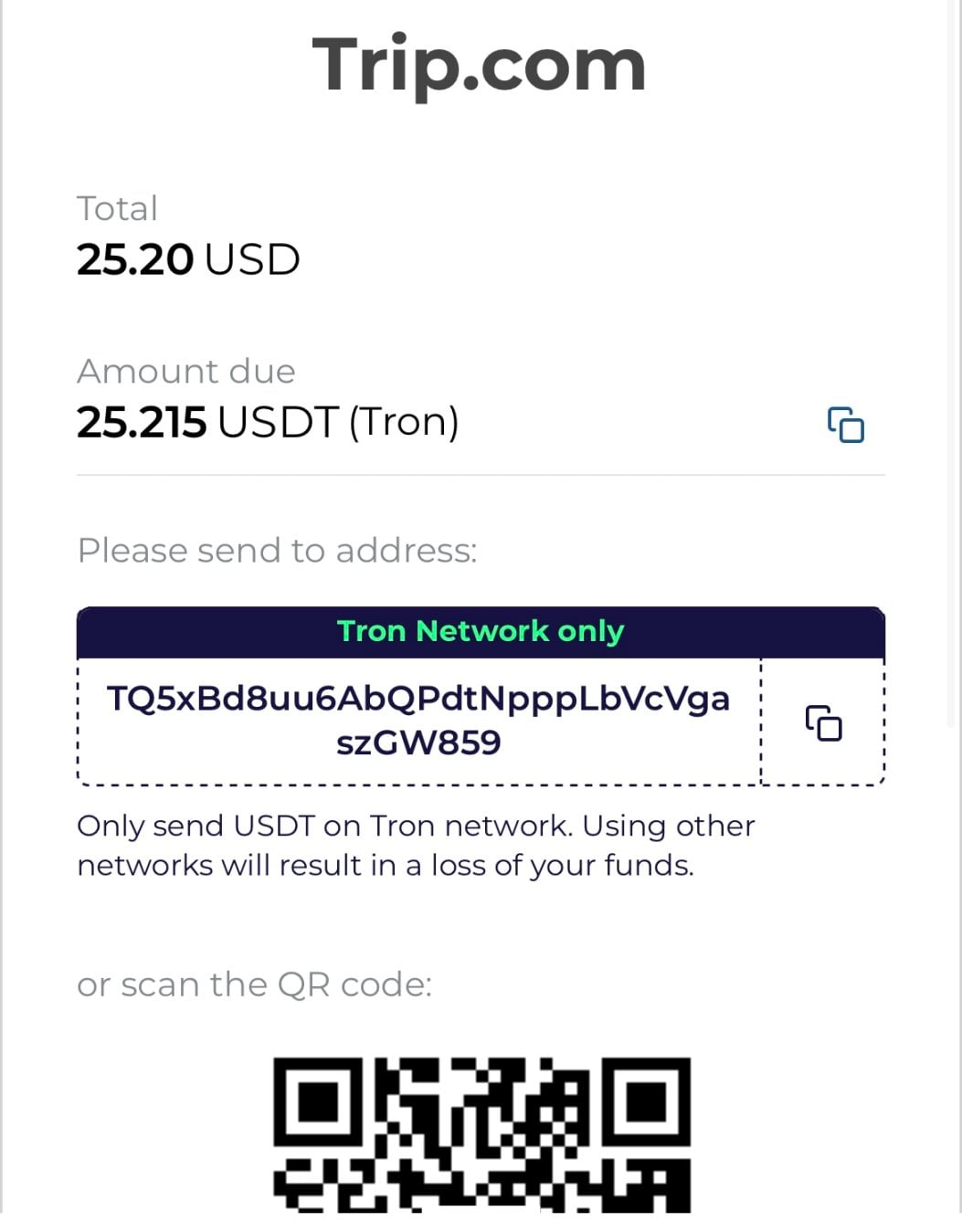
Trip has enabled USDT and USDC payments

Currently, Trip.com's crypto payments support multiple public chains including Ethereum, Tron, Polygon, Solana, Arbitrum One, and TON.

During the actual payment process, the author noticed the presence of another payment company, Triple-A. This company provides crypto payment-related services to Trip.com. Public information shows that Triple-A is a licensed crypto payment institution headquartered in Singapore, mainly providing payment gateway and settlement services for cryptocurrencies and stablecoins.

Furthermore, the author learned that Triple-A is also cooperating with Singapore's internet giant Grab as a technical partner for the crypto payment channel, enabling GrabPay users to directly use crypto assets to top up their wallet balance within the Grab app.

Additionally, the author noticed a detail:

When booking a hotel on Trip.com using USDT, there is no need to fill in detailed personal information; only a name and email are required to complete the order. This means that when using USDT for payment in hotel scenarios, the platform can hardly obtain the user's complete privacy information. Of course, if purchasing a flight ticket, information such as nationality, passport number, and phone number are still required—this is a compliance requirement of the aviation industry itself.

Privacy and data security have become major social issues.

Just this month, the Ctrip Group encountered a relatively significant "public trust incident." In December, Ctrip Group and the Cambodia National Tourism Administration signed a marketing cooperation agreement in Shanghai. After the news was announced, it sparked concerns among some users about local security, telecom fraud risks, and personal information security. A large number of screenshots of uninstalling the Ctrip App appeared on social media.

In many overseas regions, users are far more sensitive to privacy and information security than in the domestic market. This may also be an important practical background for Trip.com's promotion of stablecoin payments.

For travelers around the world without international credit cards, stablecoin payment is a new path. According to public information, the number of people globally who own credit cards is approximately 125 million to 130 million, and the number of people with international credit cards is even lower, which also means that over 80% of the global population cannot smoothly use the international credit card system.

Credit cards are not merely "payment tools" but an entry point to the credit system; however, most people globally are not within this system. In many countries and regions, such as Southeast Asia, Latin America, Africa, and India, many people cannot be incorporated into the credit system. This also prevents them from having credit cards.

Stablecoin payments are providing these people with a global payment path that bypasses the credit system.

Of course, the practical problems of stablecoins still exist: transaction fees remain relatively high and unstable.

During the actual payment process, the author found significant differences in fees between different wallets. When paying to Trip.com's USDT收款码 (receiving QR code) via Binance, a fee of 1 USDT was required, with a minimum transfer threshold of 10 USDT; whereas when using Bitget Wallet, the first transaction showed a fee of 0, the second showed a fee of 2.39 USDT, and no minimum transfer amount was set. The differences may be related to the public chain used (Tron) and its fee mechanism.

Why Are Giants Entering the Stablecoin Space One After Another?

Ctrip Group is not the first company to enter the stablecoin track.

Previously, several global internet and payment giants have clearly布局 (laid out plans for) stablecoins, including Ant Group, JD.com, Paypal, Stripe, Meta (Facebook), Grab, and TADA.

Several banking giants have also publicly stated their entry into the stablecoin field, for example, Bank of America and Morgan Stanley.

Some实体制造业企业 (physical manufacturing companies) are also接入 (integrating) stablecoin payments. Public reports show that some dealers of BYD (Build Your Dreams) in Bolivia already support USDT payments; manufacturing companies like Toyota and Yamaha also accept stablecoin settlements in overseas markets. Tether CEO Paolo Ardoino has publicly confirmed this.

Advertisement for cooperation between BYD dealers and USDT

Internet giants,实体制造业巨头 (physical manufacturing giants), banking giants are all布局 (laying out plans for) stablecoins... Their use cases for stablecoins vary.

An obvious trend is that payment giants like PayPal and Ant Group are no longer satisfied with仅仅作为 (merely being) the payment entry for stablecoins but hope to directly become the issuers of stablecoins. PayPal has already launched PYUSD; Ant Group is also promoting the application for a Hong Kong dollar stablecoin license. The boundary between payment institutions and currency issuance is being reshaped.

For实体制造业企业 (physical manufacturing enterprises) like BYD and Toyota, there is no ideological judgment about stablecoins or crypto payments, only one practical question: which method are users more willing to pay with.

Fiat Currency Continues to Depreciate, Stablecoins Become the "Practical Solution"

In Bolivia, the official fiat currency, the Boliviano (BOB), depreciated against the US dollar by 65%–137% from the end of 2024 to mid-2025. It can be said that Bolivia's fiat currency depreciates every day.

In this environment, any company expanding overseas cannot long bear the exchange losses brought by settlement in the local currency. USDT has gradually become the de facto payment tool locally.

And Bolivia is not an isolated case but a phenomenon simultaneously上演 (playing out) in multiple countries around the world.

The author visited Iran, Turkey, Egypt, and other countries this year and found that the cumulative depreciation of these economies' national currencies against the US dollar over the past three years generally exceeded 80%; stretched over a five-year周期 (cycle), the currencies of Iran, Turkey, and Egypt have all depreciated by more than 200% against the US dollar.

Currency depreciation is evolving from a "local risk" in a few countries to a broader, more structural global phenomenon.
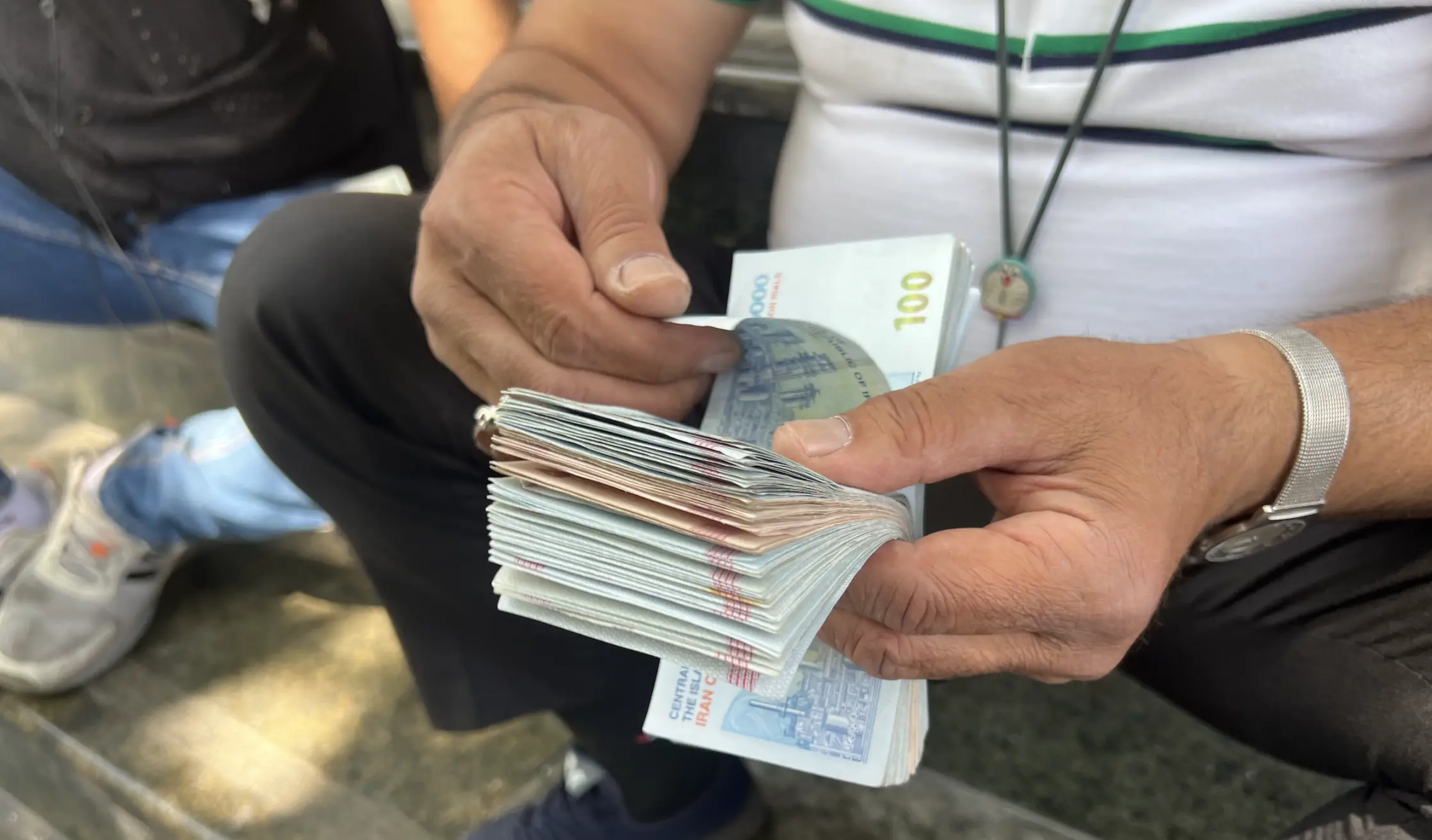
At the black market in Tehran, Iran's capital, the author is witnessing a currency transaction

More残酷的是 (cruelly), in the aforementioned countries (the countries mentioned above), the speed of local currency depreciation has long far exceeded the income growth rate of ordinary people. In real transactions, monetary disorder is directly changing people's payment methods.

This is precisely why consumer internet platforms like Trip.com Overseas Version and Grab; payment giants like PayPal and Ant Group; and physical manufacturing companies like BYD and Toyota have begun to尝试引入 (try to introduce) USDT and other stablecoins in different markets.

The world is partially collapsing, with some regions率先失衡 (becoming unbalanced first).

When the existing financial system can no longer perform the functions of stability, settlement, and trust, a new economic system is pushed to the forefront by reality.

The new economic system is not designed but is "forced" out by reality where the old system fails. The spread of stablecoins is not because they are ideal enough, but because in some places, they are already the least bad choice available.


Twitter:https://twitter.com/BitpushNewsCN

Bitpush TG Discussion Group:https://t.me/BitPushCommunity

Bitpush TG Subscription: https://t.me/bitpush

Original Article Link:https://www.bitpush.news/articles/7598412

Câu hỏi Liên quan

QWhat is the main development announced regarding Trip.com and stablecoins?

ATrip.com, the overseas version of Ctrip, has globally launched a stablecoin payment feature, supporting both USDT and USDC for hotel and flight purchases.

QWhich payment processing company is mentioned as providing crypto payment services for Trip.com?

ATriple-A, a licensed crypto payment institution based in Singapore, is the payment company providing crypto payment gateway and settlement services for Trip.com.

QWhat practical benefit did the author experience when using USDT to book a flight on Trip.com?

AThe author saved approximately 18% on a flight ticket purchased with USDT on Trip.com compared to the price when using traditional payment methods on the Ctrip website.

QAccording to the article, what is a major global issue that is driving the adoption of stablecoins like USDT?

ARapid and severe devaluation of national currencies in many countries (e.g., Bolivia, Iran, Turkey, Egypt) is making stablecoins a more reliable payment and store of value, as they are pegged to the US dollar.

QBesides Trip.com, name two other types of major companies that are adopting or exploring stablecoin payments.

APayment giants like PayPal and Ant Group, as well as manufacturing companies like BYD and Toyota, are adopting or exploring stablecoin payments in various markets.

Nội dung Liên quan

Bitcoin Hướng Tới Mốc 64,000 USD Khi Xác Suất Thông Quan Đạo Luật CLARITY Giảm Xuống 27%

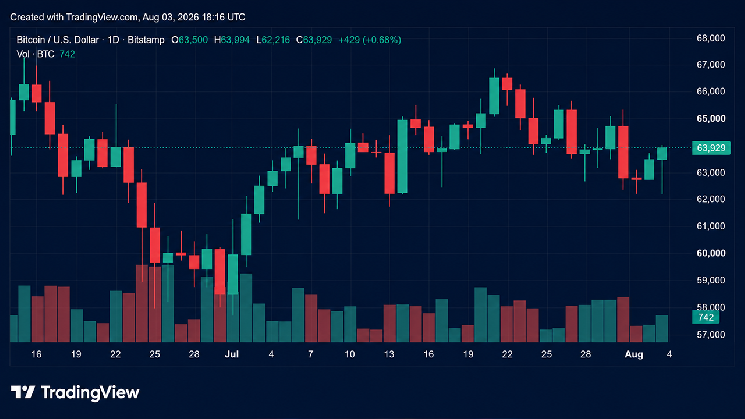
Bitcoin đã tiến gần mốc 64.000 USD vào thứ Hai, khởi đầu tuần mới với xu hướng tích cực sau khi kết thúc tháng 7 với mức tăng trưởng vừa phải. Tuy nhiên, hành trình này không hề suôn sẻ. Giá trước đó đã giảm xuống mức thấp trong ngày khoảng 62.216 USD, một phần do tin tức về việc công ty Strategy đã bán 1.638 Bitcoin để tài trợ cho cổ tức và mua lại cổ phiếu. Đà giảm sau đó đã đảo ngược nhờ các báo cáo về việc chính quyền Trump nối lại đàm phán với Iran, đẩy giá Bitcoin tăng hơn 1.000 USD lên mức cao trong ngày gần 63.920 USD. Dù có điều chỉnh nhẹ, Bitcoin vẫn ghi nhận mức tăng 0.7% trong ngày, nâng vốn hóa thị trường tổng thể lên khoảng 2.28 nghìn tỷ USD. Biến động giá cũng dẫn đến việc thanh lý các vị thế đòn bẩy trị giá gần 82 triệu USD. Mặc dù vậy, triển vọng tăng trưởng dài hạn của Bitcoin vẫn bị hạn chế do bế tắc lập pháp tại Thượng viện Hoa Kỳ xung quanh Đạo luật CLARITY. Khả năng đạo luật này được thông qua trước kỳ nghỉ quốc hội vào ngày 7 tháng 8 đã giảm mạnh. Dữ liệu từ Polymarket cho thấy xác suất thông qua đã giảm từ 38% xuống chỉ còn 27% trong tuần qua. Các bất đồng về các biện pháp đạo đức và quy định đối với stablecoin là những trở ngại chính. Nếu bị trì hoãn đến mùa thu, cơ hội thông qua đạo luật này sẽ còn giảm thêm trong bối cảnh các cuộc bầu cử giữa kỳ sắp diễn ra.

cryptonews.ru14 phút trước

Bitcoin Hướng Tới Mốc 64,000 USD Khi Xác Suất Thông Quan Đạo Luật CLARITY Giảm Xuống 27%

cryptonews.ru14 phút trước

ETF trên Ethereum tiếp tục tăng trưởng tuần nhờ dòng vốn đổ vào 27 triệu USD, trong khi Bitcoin mất 61.5 triệu USD

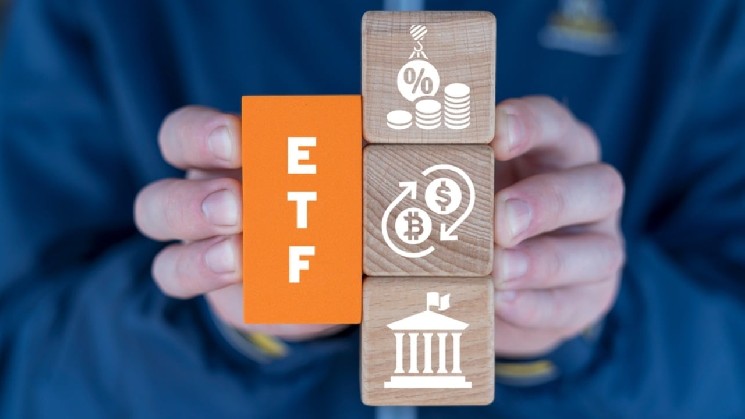
Tuần qua chứng kiến dòng tiền vào các quỹ ETF tiền mã hóa diễn biến trái chiều. Trong khi ETF Ethereum duy trì đà tăng trưởng với dòng tiền ròng 27,42 triệu USD, mở rộng chuỗi dòng vào tuần thứ tư liên tiếp, thì ETF Bitcoin lại ghi nhận dòng tiền ròng âm 61,53 triệu USD, chấm dứt ba tuần tăng liên tiếp. Dù vậy, tháng Bảy vẫn khép lại với dòng vào ròng 172,8 triệu USD đối với Bitcoin. Các ETF Bitcoin trải qua tuần biến động mạnh, với dòng ra lớn vào thứ Hai, thứ Ba và đặc biệt là thứ Sáu (265 triệu USD), lấn át hoàn toàn dòng vào mạnh ghi nhận vào thứ Năm. Trong khi đó, ETF Ethereum thể hiện sự ổn định hơn với dòng tiền dương ở bốn trong năm phiên. Ở nhóm altcoin, ETF XRP thu hút 14,86 triệu USD, ETF Solana hút vào 2,82 triệu USD. Ngược lại, quỹ HYPE tiếp tục thất bát với dòng ra ròng 14,75 triệu USD. Dữ liệu cho thấy nhà đầu tư vẫn duy trì vị thế tiền mã hóa thông qua các quỹ được quản lý, nhưng ngày càng có chọn lọc. Họ ưu tiên tính ổn định của Ethereum và cơ hội từ các tài sản cụ thể như XRP hay Solana, đồng thời giảm bớt các vị thế nhạy cảm với yếu tố vĩ mô như Bitcoin hoặc các quỹ đã bão hòa như HYPE. Quyết định của Fed giữ nguyên lãi suất cũng tác động đến tâm lý thị trường.

cryptonews.ru26 phút trước

ETF trên Ethereum tiếp tục tăng trưởng tuần nhờ dòng vốn đổ vào 27 triệu USD, trong khi Bitcoin mất 61.5 triệu USD

cryptonews.ru26 phút trước

Dự báo thị trường tiền điện tử tháng 8 năm 2026: Yếu tố vĩ mô sẽ quyết định tất cả

Theo dự báo từ Happy Coin News phối hợp với công cụ AI Gemini, tháng 8/2026 sẽ củng cố thị trường tiền mã hóa trong giai đoạn chuyển đổi cấu trúc. Các yếu tố vĩ mô như lãi suất cao của Fed và lạm phát dai dẳng sẽ hạn chế dòng vốn bán lẻ chảy vào các tài sản số rủi ro, đồng thời thị trường ngày càng nằm dưới sự kiểm soát của các tổ chức đầu tư. Bối cảnh pháp lý đang thay đổi mạnh mẽ với việc Luật MiCA ở EU chính thức có hiệu lực đầy đủ và đạo luật FIT21 được thúc đẩy tại Mỹ, tạo ra khuôn khổ rõ ràng hơn. Xu hướng chính trong tháng sẽ tiếp tục là mã hóa tài sản thực (RWA), khi quá trình chuyển các công cụ tài chính truyền thống lên blockchain ngày càng gia tăng. Về thị trường, vốn hóa toàn cầu duy trì quanh mức 2,221 nghìn tỷ USD, với Bitcoin chiếm ưu thế 56.35%. "Mùa Altcoin" toàn diện chưa xuất hiện, thay vào đó, sự tăng trưởng sẽ có chọn lọc, tập trung vào các dự án liên quan đến cơ sở hạ tầng AI, DeFi thế hệ mới và RWA. Nhu cầu về bảo mật, lưu ký và tuân thủ từ các nhà đầu tư tổ chức sẽ tiếp tục gia tăng, đánh dấu sự kết thúc của thời đại các nền tảng không được kiểm soát.

cryptonews.ru29 phút trước

Dự báo thị trường tiền điện tử tháng 8 năm 2026: Yếu tố vĩ mô sẽ quyết định tất cả

cryptonews.ru29 phút trước

‘Cá voi Bitcoin’ 2013 thức giấc, chuyển 500 BTC trong bối cảnh lo ngại gia tăng về Coldcard

Cách đây hai ngày, Bitcoin.com News đưa tin lỗ hổng bảo mật trên ví phần cứng Coldcard đang khiến người nắm giữ Bitcoin chuyển sang sử dụng các sàn giao dịch tập trung và dịch vụ lưu ký, đồng thời nhiều ví lâu năm không hoạt động cũng bắt đầu "thức giấc". Tính đến nay, khoảng 1.431,97 BTC đã bị đánh cắp thông qua các lỗ hổng trong phần mềm và bộ tạo số ngẫu nhiên của Coldcard. Ngày 5/8, một giao dịch lớn đã thu hút sự chú ý: 500 BTC (trị giá 31,32 triệu USD) từ một ví không động đến từ năm 2013 đã được chuyển đi. Địa chỉ gốc dạng P2PKH được tạo vào ngày 6/12/2013, thời điểm Bitcoin lần đầu vượt mốc 1.000 USD. Với mức giá khi đó, số Bitcoin này ban đầu có giá trị khoảng 521.000 USD. Dữ liệu từ Arkham Intelligence cho thấy địa chỉ nhận tiền (dạng P2WPKH) không liên kết với bất kỳ sàn giao dịch, tổ chức lưu ký hay thực thể nhận dạng nào được biết đến. Hoạt động này phản ánh một tình thế tiến thoái lưỡng nan về bảo mật. Những người nắm giữ Bitcoin từ thuở sơ khai thường tuân thủ triết lý tự lưu trữ, dựa vào ví phần cứng thay vì trao niềm tin cho các sàn tập trung. Lỗ hổng của Coldcard đe dọa trực tiếp đến nguyên tắc cốt lõi này: quyền kiểm soát độc quyền đối với khóa cá nhân. Việc di chuyển 500 BTC có vẻ không phải là một quyết định đầu cơ thời điểm thị trường, mà là một biện pháp bảo mật cần thiết, xuất phát từ nhận thức rằng ví được tạo từ nhiều năm trước có thể không còn đáp ứng được các tiêu chuẩn an ninh hiện đại. Bối cảnh hiện tại cho thấy xu hướng đáng lo ngại: hơn 1.400 BTC đã bị đánh cắp qua lỗ hổng Coldcard, và hàng trăm BTC khác từ các ví "ngủ đông" đã được chủ động chuyển đi kể từ ngày 30/7. Đối với nhiều người nắm giữ lâu năm, lựa chọn ngày càng rõ ràng: hoặc tin tưởng rằng thế hệ ví cũ của họ chưa từng bị xâm phạm, hoặc chủ động chuyển tiền trước khi có người khác làm điều đó thay họ. Giao dịch lớn này cho thấy ưu tiên của một số chủ sở hữu lâu đời nhất có lẽ đã chuyển sang bảo toàn vốn hơn là đầu cơ.

cryptonews.ru29 phút trước

‘Cá voi Bitcoin’ 2013 thức giấc, chuyển 500 BTC trong bối cảnh lo ngại gia tăng về Coldcard

cryptonews.ru29 phút trước

Giao dịch

Giao ngay
活动图片