Following the Clues: Guess What Projects a16z with $15 Billion Will Invest In?

marsbitXuất bản vào 2026-01-12Cập nhật gần nhất vào 2026-01-12

Tóm tắt

a16z Raises $15 Billion, Signaling Major Crypto Investments Ahead Venture capital giant Andreessen Horowitz (a16z) has raised $15 billion in new funding, its largest round to date. The firm emphasized that winning the next century of technological competition hinges on advancements in AI and crypto. The capital will be allocated across six funds, with significant implications for the crypto sector: * **App Fund ($1.7B):** Targets consumer applications, including Web3, fintech, and AI apps. * **Infrastructure Fund ($1.7B):** Focuses on foundational tech, including blockchain protocols (L1s, L2s), developer tools, and AI infrastructure. * **Growth Fund ($6.75B):** Will back mature, late-stage companies, such as established crypto exchanges and unicorns (e.g., Coinbase). A review of a16z's 2025 investments revealed heavy bets on prediction markets (Kalshi), wallet services, privacy blockchains, stablecoins, and AI-crypto intersections. Looking to 2026, a16z's published "big ideas" highlight key areas of excitement, suggesting these will be prime investment targets. These include: * Enhanced privacy as a core crypto feature. * The expansion of smarter prediction markets. * "Crypto-native" stablecoins and real-world asset (RWA) tokenization. * Improved on/off-ramps for stablecoins. * The convergence of AI and crypto, specifically around agentic systems ("know your agent"). * The concept of the internet evolving into a bank. In summary, a16z's massive new war...

Original | Odaily Planet Daily (@OdailyChina)

Author | Azuma (@azuma_eth)

On January 9, amidst a highly active cryptocurrency market, the venture capital giant Andreessen Horowitz (a16z) announced the completion of a new $15 billion fundraising round. This is the largest fundraising effort in the firm's history, accounting for over 18% of the total venture capital raised in the United States in 2025.

In the relatively brief official announcement, a16z mentioned cryptocurrency twice. The most critical statement, "Our mission is to ensure that the United States wins the technological competition of the next 100 years, which begins with winning the key architectures of the future—artificial intelligence and cryptocurrency technology," indicates that a16z, now well-funded, will continue to actively invest in the cryptocurrency market.

Breakdown of Six Major Directions

According to a16z's plan, this batch of funds will be allocated across six major directions: the American Dynamism fund will receive $1.176 billion, the App fund $1.7 billion, the Bio + Health fund $700 million, the Infrastructure fund $1.7 billion, the Growth fund $6.75 billion, and the Other Venture Strategies fund $3 billion.

Although a16z did not explicitly designate a dedicated cryptocurrency fund in this fundraising, these six directions actually have significant overlap with cryptocurrency.

First is the American Dynamism fund. This is a direction with a clear "political" focus that a16z has been promoting in recent years. Its core goal is to use venture capital to rebuild America's "hard power" and national competitiveness. The fund will primarily invest in aerospace, defense, public safety, education, housing, supply chain, industry, and manufacturing—objectively speaking, this fund has little crossover with cryptocurrency.

Next is the App fund. This is one of a16z's most traditional and VC-centric funds. Its core goal is to focus on application-layer products that can be directly used by consumers. The fund will mainly invest in consumer internet products, AI applications, creator tools, social products, content services, gaming, fintech, and Web3 applications—this is also the direction where a16z's cryptocurrency narrative is most easily realized.

Then comes the Bio + Health fund. This is a long-term bet for a16z beyond "pure technology." Its core goal is to use software, data, and engineering thinking to transform the life sciences and healthcare systems. The fund's main investment areas include biotechnology, drug development platforms, gene editing, synthetic biology, medical data and AI diagnostics, and healthcare infrastructure software—this part has little direct overlap with cryptocurrency, but DeSci could be a potential intersection point.

The Infrastructure fund focuses on infrastructure. Its core goal is to provide an irreplaceable technological foundation for the next generation of applications and platforms. The fund's main investment areas are cloud computing and distributed systems, AI infrastructure, data platforms, developer tools, network protocols, and blockchain underlying protocols (L1, L2, other tools)—this is another core battleground for a16z in the cryptocurrency space, alongside the App fund.

The Growth fund primarily invests in Series C and later stages, as well as Pre-IPO stages. Its core goal is not to find new opportunities but to amplify returns by supporting proven winners. The fund mainly invests in mature tech companies, AI platforms, fintech unicorns, and mature Web3 infrastructure or applications—a16z's official website shows that Coinbase, Kalshi, and others are explicitly categorized here.

The Other Venture Strategies fund is relatively special. It does not have a single theme but is more like a flexible "tactical capital pool," often used for special structure transactions, cross-fund collaborative investments, emerging field experimentation, secondary market opportunities, regional or thematic experimental funds, etc.—this fund has little direct crossover with cryptocurrency, but it cannot be ruled out that temporary associations may occur at special junctures, such as responsive moves during certain policy windows.

Looking at the six intended directions for this $15 billion, the App fund, Infrastructure fund, and Growth fund will be the main channels for a16z to inject capital into the cryptocurrency primary market. Among them, the App fund and Infrastructure fund will focus more on native application-layer and protocol-layer projects in the cryptocurrency market, respectively; while the Growth fund will focus more on platform-type services such as exchanges and prediction markets, and its investments will tend to favor leading players in sectors that have already shown advantages.

a16z's Investment Review for 2025

According to incomplete statistics from Odaily Planet Daily, a16z made a total of 31 investments in the broader cryptocurrency field over the past year, with two investments each in prediction market Kalshi, AI security company Doppel, and privacy blockchain Seismic—especially Kalshi. a16z first co-led a $300 million Series D funding round for the company in October with Sequoia, at a valuation of $5 billion; it invested again in November, participating in the company's $1 billion Series E funding round at a valuation of $11 billion—this was a16z's biggest bet in the cryptocurrency field last year.
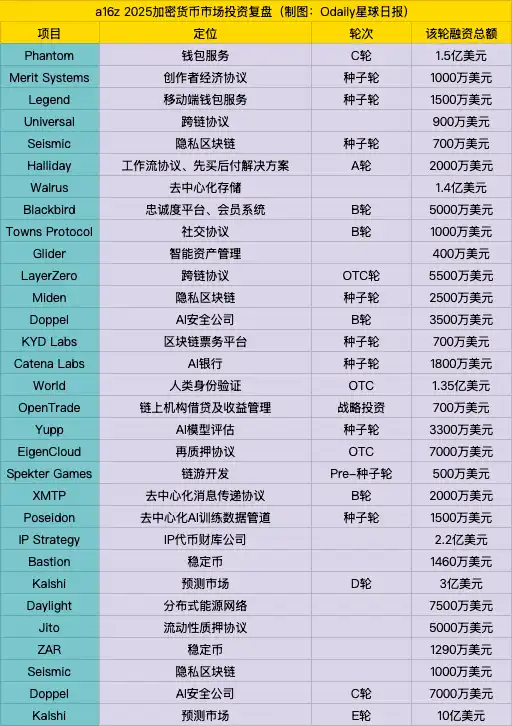
As can be seen from the statistics in the chart above, aside from the heavy bet on prediction markets, wallet services, privacy blockchains, stablecoins, and the intersection of AI and cryptocurrency were the focus of a16z's布局 in 2025. These sub-sectors can be categorized into the blockchain underlying protocols and tools covered by the Infrastructure fund, and the fintech and AI applications covered by the App fund.

a16z's Predictions for 2026

On New Year's Day 2026, a16z Crypto officially published a New Year's outlook article. In the article, a16z mentioned 17 potential developments they are excited about for 2026, which may contain clues to the firm's focus areas for future investments.
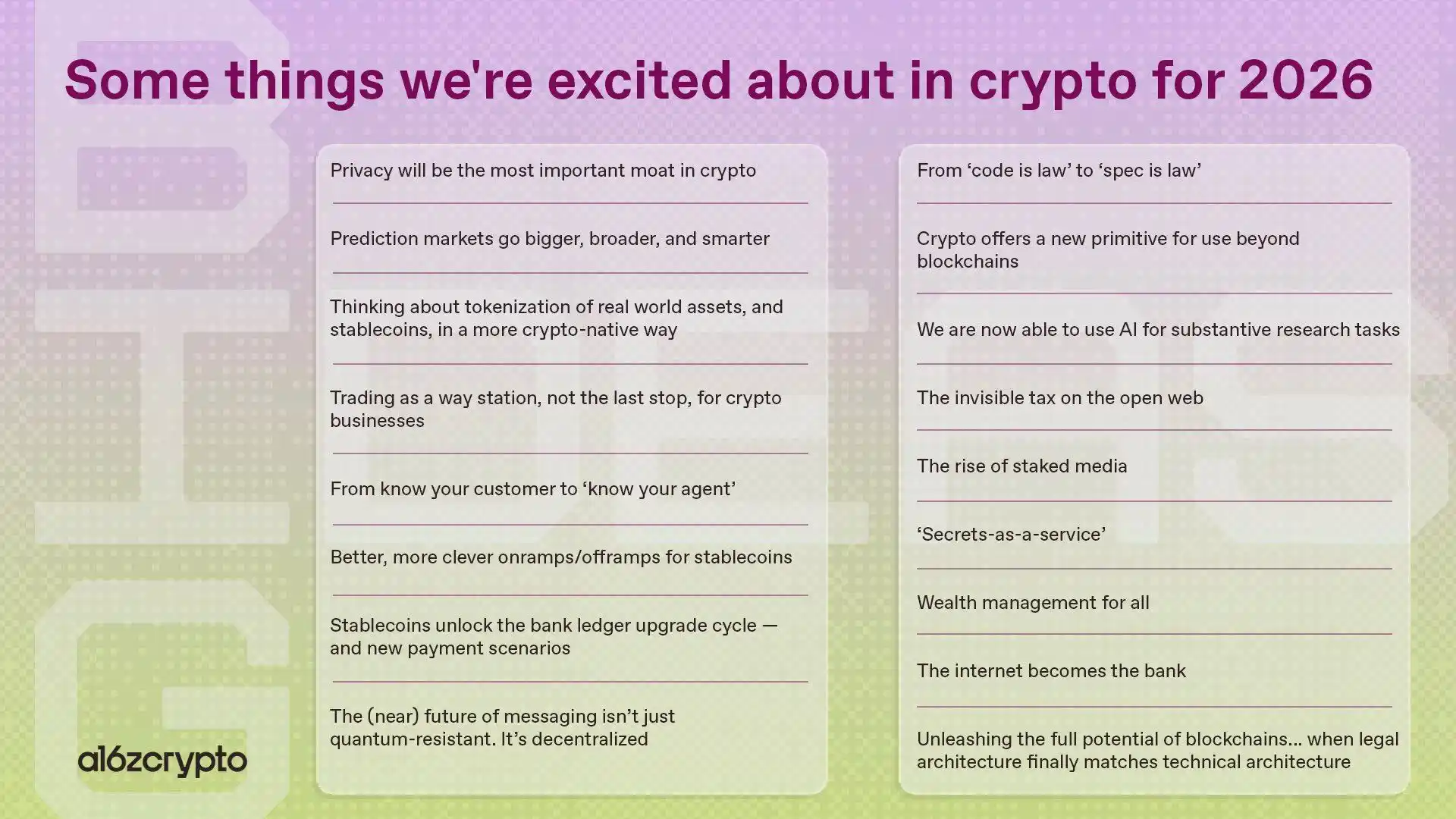
These 17 potential developments are:

  • Privacy will become the most important moat in crypto;
  • Prediction markets will become larger, broader, and smarter;
  • Thinking more "crypto-natively" about real-world asset tokenization and stablecoins;
  • Trading is just a waystation for crypto businesses, not the final destination;
  • From "Know Your Customer" (KYC) to "Know Your Agent";
  • Better, smarter on-ramps and off-ramps for stablecoins;
  • Stablecoins will kick off a bank ledger upgrade cycle and spawn new payment scenarios;
  • The future of instant messaging is not just quantum-resistant, but also decentralized;
  • From "code is law" to "norms are law";
  • Crypto is providing a new kind of foundational primitive whose uses go beyond blockchains themselves;
  • We can now use AI to perform substantive research tasks;
  • The "invisible tax" of the open internet;
  • The rise of Staked Media;
  • "Secrets-as-a-Service";
  • Wealth management for everyone;
  • The internet is becoming the bank;
  • When the legal framework finally matches the technical framework, the full potential of blockchains will be unleashed.

Among these 17 potential developments, some explicitly mention specific business models, including the sectors a16z has already heavily invested in, such as privacy, prediction markets, stablecoins, and AI. a16z also directly provided optimization paths for related models, such as the need for smarter on-ramp and off-ramp solutions for stablecoins.

At the same time, another part of the potential developments belongs to imaginings of future states, such as the internet eventually becoming the bank. However, how these imaginings will be realized is not clearly answered by a16z—this question needs to be left to entrepreneurs who can bring innovative solutions, and they are precisely the targets that a16z's $15 billion is most eager to find.


Câu hỏi Liên quan

QWhat are the six main directions a16z plans to allocate its new $15 billion funding, and which ones are most relevant to cryptocurrency?

AThe six directions are: American Dynamism ($1.176B), App ($1.7B), Bio + Health ($0.7B), Infrastructure ($1.7B), Growth ($6.75B), and Other Venture Strategies ($3B). The App, Infrastructure, and Growth funds are most relevant to cryptocurrency, focusing on Web3 applications, blockchain protocols, and mature crypto companies respectively.

QWhich cryptocurrency-related sectors did a16z focus on in 2025, and can you name a key company they invested in?

AIn 2025, a16z focused on wallet services, privacy blockchains, stablecoins, and AI-crypto intersections. A key investment was Kalshi, a prediction market platform, where a16z participated in both a $300M Series D (at $5B valuation) and a $1B Series E (at $11B valuation).

QAccording to a16z's 2026 outlook, what are some specific areas they are excited about for cryptocurrency development?

Aa16z's 2026 outlook highlights 17 areas, including privacy as a key moat, expansion of prediction markets, improved stablecoin on/off ramps, 'crypto-native' RWA tokenization, AI agent verification, decentralized communication, and the evolution from 'code is law' to 'norms as law'.

QHow does a16z's Infrastructure fund specifically support the cryptocurrency ecosystem?

AThe Infrastructure fund ($1.7B) supports cryptocurrency by investing in blockchain底层协议 (L1s, L2s), distributed systems, network protocols, and developer tools that form the foundational technology for next-generation applications and platforms in crypto.

QWhat is the overarching mission statement a16z emphasized in their funding announcement regarding future technology competition?

Aa16z's mission is 'to ensure that America wins the next 100 years of technological competition, starting with winning the key architectures of the future—artificial intelligence and crypto technologies.'

Nội dung Liên quan

Đề xuất HIP-4 của Hyperliquid tiếp sức cho HYPE staking khi niềm tin dài hạn gia tăng

Hyperliquid đã đề xuất nâng cấp HIP-4 nhằm mở rộng giao thức vượt ra ngoài thị trường hợp đồng tương lai vĩnh viễn để trở thành một lớp cơ sở hạ tầng cho các ứng dụng trên chuỗi. Theo đề xuất, các nhà triển khai phải stake 500,000 token HYPE để tạo thị trường mới, với các biện pháp kiểm soát nhằm đảm bảo chất lượng. Sự tự tin của nhà đầu tư đang tăng lên, được phản ánh qua việc lượng HYPE được stake đã đạt khoảng 438.7 triệu token, chiếm 43.9% tổng nguồn cung. Một trader lớn cũng chọn stake số HYPE trị giá 15.5 triệu USD thay vì chốt lời. Điều này cho thấy sự tin tưởng dài hạn vào mạng lưới. Cấu trúc thị trường cũng cho thấy động lực tích cực, với lãi suất tài trợ cân bằng và thanh lý hạn chế, cho thấy cách tiếp cận đầu tư có đo lường. Tổng giá trị bị khóa (TVL) và doanh thu giao thức đang tăng, củng cố triển vọng tăng trưởng cơ bản. Tóm lại, việc mở rộng cơ sở hạ tầng, sự tham gia stake mạnh mẽ và cấu trúc thị trường lành mạnh đang củng cố vị thế của Hyperliquid như một nền tảng cho tài chính kỹ thuật số trong tương lai, phụ thuộc vào việc áp dụng của người dùng và triển khai thành công các bản nâng cấp sắp tới.

ambcrypto5 phút trước

Đề xuất HIP-4 của Hyperliquid tiếp sức cho HYPE staking khi niềm tin dài hạn gia tăng

ambcrypto5 phút trước

7 tháng sau sự sụp đổ của Huiwang, thị trường nền tảng ký quỹ Đông Nam Á đại phẫu thuật

Sau 7 tháng sụp đổ của Huiwang, một nền tảng bảo đảm thanh toán được mệnh danh là "Alipay Đông Nam Á", thị trường bảo đảm trong khu vực đang trải qua một cuộc đại tái cấu trúc. Sự sụp đổ của tập đoàn Thái Tử ở Campuchia và việc tịch thu 12.7 vạn Bitcoin (trị giá khoảng 150 tỷ USD) của Mỹ đã chặt đứt nguồn cung thanh khoản, khiến Huiwang phá sản, 90 vạn người dùng mất trắng. Tuy nhiên, khoảng trống quyền lực nhanh chóng bị lấp đầy bởi các nền tảng bảo đảm mới nổi, thường hoạt động trong bóng tối và gắn liền với các hoạt động bất hợp pháp. Các cái tên nổi bật bao gồm: * **Tân Tệ (XinBi/Newpay):** Thu hút lượng lớn người dùng từ Huiwang, tổng doanh thu đã vượt quá 1.6 tỷ USDT. * **Lĩnh Hàng/Tiger Bảo đảm:** Chuyên cung cấp dịch vụ bảo đảm cho các giao dịch liên quan đến buôn bán người và lao động cưỡng bức. * **Kim Bối/Kim Bác:** Ban đầu liên kết với tập đoàn Thái Tử và các sòng bạc, chuyên phục vụ ngành cờ bạc trực tuyến. * **Đạt Lợi/Thiên Thành:** Kế thừa nhiều nhóm giao dịch công khai từ Huiwang, có mức tăng trưởng người dùng đáng kể. * **Phúc Lợi Lai:** Gắn liền với tập đoàn tội phạm gia đình họ Lưu ở miền Bắc Myanmar, chủ yếu phục vụ các khu công viên lừa đảo. Báo cáo từ Elliptic cho thấy thị trường bảo đảm Huiwang đã xử lý hơn 31 tỷ USD, trở thành thị trường bất hợp pháp trực tuyến lớn nhất từ trước đến nay. Các nền tảng bảo đảm này, thường được ngụy trang dưới vỏ bọc dịch vụ tài chính, trên thực tế đã trở thành trung gian quan trọng cho mạng lưới tội phạm bao gồm lừa đảo, rửa tiền, cờ bạc và buôn bán người tại Đông Nam Á. Danh hiệu "Alipay Đông Nam Á" chỉ là cái cớ, che đậy cho một hệ sinh thái tài chính ngầm đầy rủi ro và nguy hiểm.

Odaily星球日报14 phút trước

7 tháng sau sự sụp đổ của Huiwang, thị trường nền tảng ký quỹ Đông Nam Á đại phẫu thuật

Odaily星球日报14 phút trước

Ngày Tươi Sáng Khó Trở Lại, Các Quỹ VC Crypto Đang Trải Qua Điều Gì?

Đầu tư mạo hiểm chuyên sâu vào tiền mã hóa đang trải qua một sự chuyển đổi lớn. Các quỹ chuyên biệt hàng đầu như Paradigm (vừa huy động 1,2 tỷ USD) và Framework Ventures (huy động 400 triệu USD) đang mở rộng danh mục đầu tư sang các lĩnh vực khác như AI, robot, hàng không vũ trụ, thậm chí xóa bỏ các tham chiếu về "tiền mã hóa" khỏi thông điệp của mình. Quý I/2026 chỉ có 8 quỹ VC thuần túy về tiền mã hóa mới được thành lập, mức thấp nhất kể từ năm 2020. Theo lý thuyết chu kỳ công nghệ của Carlota Perez, tiền mã hóa đang chuyển từ giai đoạn "xây dựng" sang "phổ cập". Các gã khổng lồ truyền thống như Stripe, BlackRock, VISA đã hiểu và tích hợp công nghệ blockchain vào hoạt động cốt lõi của họ, làm xói mòn lợi thế thông tin độc quyền trước đây của các quỹ chuyên sâu. Ngành VC đang phân cực thành hình dạng "tạ tạ": một bên là các nền tảng đầu tư tổng hợp khổng lồ (a16z, Sequoia) có thể bao trùm toàn bộ lĩnh vực; bên kia là các quỹ nhỏ, chuyên sâu dựa vào hiểu biết sâu để đầu tư mạo hiểm vào các dự án tiên phong. Các quỹ quy mô trung bình thuần túy về tiền mã hóa đang bị mắc kẹt trong "vùng chết", vì không đủ lớn để cạnh tranh ở các vòng tăng trưởng, cũng không thể chỉ dựa vào các khoản đầu tư hạt giống nhỏ để đạt mức thoái vốn cần thiết (thường gấp 3 lần quỹ). Áp lực từ các nhà đầu tư (LP) cũng thúc đẩy sự thay đổi. Với lợi nhuận thực tế (DPI) thấp từ các quỹ năm 2021 và làn sóng AI hút 70% vốn đầu tư mạo hiểm, các nhà quản lý quỹ buộc phải đa dạng hóa để đáp ứng kỳ vọng của LP. Đối với các startup tiền mã hóa, điều này có nghĩa là việc gọi vốn sẽ khó khăn hơn. Họ phải cạnh tranh với vô số dự án AI để thu hút sự chú ý của các quỹ tổng hợp. Hơn nữa, các quỹ tổng hợp ít có khả năng đầu tư vào cơ sở hạ tầng công cộng hoặc nghiên cứu cơ bản (như MEV, công cụ cross-chain) – vốn rất quan trọng cho sự phát triển của hệ sinh thái nhưng khó có lợi nhuận thương mại trực tiếp. Tóm lại, "nhà đầu tư tiền mã hóa" như một danh mục riêng biệt đang trở nên lỗi thời. Tiền mã hóa đang trở thành cơ sở hạ tầng tài chính cơ bản. Các quỹ chuyên sâu cỡ trung đang thu hẹp hoặc biến mất. Tương lai sẽ là sự phân công: các quỹ tổng hợp lớn nắm giữ các khoản đầu tư tăng trưởng vào cơ sở hạ tầng tài chính dựa trên blockchain, trong khi các quỹ nhỏ, chuyên biệt tiếp tục ươm mầm cho các thí nghiệm tiên phong và ngách mới như mã hóa tài sản (tokenization), chứng khoán trên chuỗi.

Foresight News34 phút trước

Ngày Tươi Sáng Khó Trở Lại, Các Quỹ VC Crypto Đang Trải Qua Điều Gì?

Foresight News34 phút trước

Khi Sự Đồng Thuận Diễn Ra Ngày Càng Nhanh, Các Nhà Đầu Tư Trẻ Đang Đánh Cược Vào Điều Gì?

Khi sự đồng thuận thị trường ngày càng nhanh, các nhà đầu tư trẻ đang tập trung vào đâu? Đầu tư công nghệ hiện nay đang trải qua sự chuyển dịch rõ rệt, với bốn xu hướng chính được các nhà đầu tư trẻ hàng đầu quan tâm. **Xu hướng 1: AI rời màn hình, bước vào thế giới vật lý.** Trọng tâm đầu tư đang chuyển từ mô hình lớn và ứng dụng sinh dữ liệu sang robot, thiết bị AI, xe tự lái và hệ thống công nghiệp. Thách thức lớn không còn là khả năng của mô hình, mà là năng lực triển khai, độ tin cậy và hiệu quả chi phí khi tích hợp vào môi trường vật lý. Ngành giao hàng tự động (ví dụ: Bạch Tê Ngưu với hơn 2000 xe) là minh chứng cho xu hướng này. **Xu hướng 2: Lợi nhuận từ mô hình lớn chưa hết, cạnh tranh chuyển sang "Bánh xe thông minh".** Thay vì chỉ tìm kiếm kiến trúc kế tiếp, các nhà đầu tư tập trung vào các công ty có thể nhúng khả năng AI hiện có vào quy trình làm việc thực tế, tạo ra vòng lặp phản hồi "bánh xe thông minh": dữ liệu người dùng -> cải thiện mô hình -> trải nghiệm tốt hơn -> nhiều người dùng hơn. Sự thành công của Zhipu AI và Kling AI của Kuaishou cho thấy giá trị của việc xây dựng hệ thống tự củng cố này. **Xu hướng 3: Nghẽn dữ liệu thúc đẩy công nghệ nền tảng mới, mô hình cơ bản khoa học trở thành hướng đi không đồng thuận.** Khi dữ liệu chất lượng cao từ internet trở nên khan hiếm, việc đào tạo AI cần các nguồn kiến thức mới. Các phương pháp như học tăng cường, tự đối kháng và đặc biệt là **Mô hình Cơ bản Khoa học** (Scientific Foundation Models) hứa hẹn sử dụng dữ liệu và quy luật từ các lĩnh vực chuyên sâu (sinh học, vật liệu) để mở rộng biên giới của AI, mặc dù đây vẫn là một lĩnh vực đầy thách thức. **Xu hướng 4: Càng tiến vào vùng nước sâu của công nghệ cứng, càng cần vốn kiên nhẫn.** Trong các lĩnh vực như hàng không vũ trụ thương mại, máy tính lượng tử và năng lượng tiên tiến, chu kỳ xác minh dài hơn và con đường thương mại hóa không rõ ràng. Các nhà đầu tư cần xây dựng phán đoán sớm, tập trung vào năng lực nghiên cứu cốt lõi, khả năng kỹ thuật và sự kiên cường của đội ngũ, thay vì kỳ vọng lợi nhuận ngắn hạn. Sự quan tâm đến robot không gian, điện toán không gian và vật liệu năng lượng không gian phản ánh tầm nhìn dài hạn này. Tóm lại, các nhà đầu tư trẻ ngày nay không chỉ theo đuổi các khái niệm nóng, mà đang chuyển sang phân tích sâu sắc con đường tích hợp công nghệ vào ngành công nghiệp, tìm kiếm các hệ thống tạo ra vòng lặp phản hồi bền vững và sẵn sàng đồng hành cùng các dự án công nghệ cứng trong hành trình dài hạn.

marsbit1 giờ trước

Khi Sự Đồng Thuận Diễn Ra Ngày Càng Nhanh, Các Nhà Đầu Tư Trẻ Đang Đánh Cược Vào Điều Gì?

marsbit1 giờ trước

Giải phóng 100 triệu USD thanh khoản? Chính sách mới của Pump.fun thử nghiệm chiến thuật bơm giá trong 5 phút

Bài viết thảo luận về cơ chế BOOST mới được Pump.fun công bố vào ngày 21/7, trở thành cơ chế phát hành mặc định cho các token mới. Cơ chế này nhắm giải quyết vấn đề "thanh khoản chết" - khoảng 20% vốn bị khóa vĩnh viễn trong nhóm thanh khoản (LP) sau khi token di chuyển từ bonding curve, gây lãng phí ước tính hơn 100 triệu USD mỗi năm. Thay vì khóa số vốn này, BOOST sẽ dùng nó (khoảng 17,6 SOL hoặc 2516 USDC) để mua token ngay trong 5 phút đầu sau khi di chuyển lên PumpSwap, thông qua cơ chế TWAP, và ngay lập tức đốt số token mua được. Điều này tạo áp lực mua tức thời và giảm nguồn cung vĩnh viễn. Mục tiêu của Pump.fun là tạo ra "pháo hoa" trong 5 phút đầu, kích thích giao dịch và cải thiện trải nghiệm cho nhà giao dịch meme - đối tượng thường quan tâm đến đợt "bứt phá" ngay khi token ra mắt. Cách tiếp cận này nhằm tăng tỷ lệ token tạo ra khối lượng giao dịch bền vững, từ đó củng cố doanh thu nền tảng và tính bền vững của việc mua lại token PUMP. Tuy nhiên, bài viết cũng nêu lo ngại: cơ chế có thể khiến các token chất lượng thấp dễ thành công hơn về mặt hình thức và làm tăng rủi ro sau 5 phút, khi áp lực mua biến mất và token có thể lao dốc nhanh hơn nếu gặp bán tháo.

Foresight News1 giờ trước

Giải phóng 100 triệu USD thanh khoản? Chính sách mới của Pump.fun thử nghiệm chiến thuật bơm giá trong 5 phút

Foresight News1 giờ trước

Giao dịch

Giao ngay
活动图片




