Author: Barry | Early Player (@0xBarrry)
Original Title: How I Found These Tokens While You Were Still Sleeping – A Small European's Perspective
The market always experiences "vacuum periods." When trading volume declines and narratives become repetitive, most people on Twitter say the same thing: "There's nothing to trade right now."
Over two years ago, like most people, my reaction during such phases was: either trade randomly out of boredom, or wait for someone else to give me a direction.
Let me be clear about the tools I use — they are all public tools. We, along with some Chinese degens, use them like the pencil cases we used as kids: basic, simple, and always at hand. Gradually, I realized one thing: the best stories never start during the loudest times, but when everything quiets down. Not when everyone is watching the charts wanting to trade, but when most people have already stopped looking.
Because of this, my thought process is now completely different. It doesn't start with charts, nor does it start with wallets. It starts with a question — one I ask myself every time:
In the future, will anyone besides me want to buy this token?
If I can't imagine that moment happening, then all subsequent analysis is essentially meaningless. Because any trade must ultimately end with a "sale."
Over the past year, I've mainly looked for opportunities through address signals — trading primarily on ETH and Base.
I would track smart wallets, monitor their behavior, and observe early entrants. Theoretically, this should give me an advantage.
But in practice, it often meant just one thing: I was already one step behind. The market back then was completely different from now.
A year ago, we could still track funding addresses on ETH and clearly see which KOLs invested in which projects. The real task then was just to understand what the project itself was doing.
But now it's different. Now we trade mainly on BNB, and only occasionally on Sol. And I deliberately avoid checking: whether someone has already entered. My job is: enter first, get a position, and then observe whether smart wallets and KOLs follow. For me, that is always just a confirmation signal, not the starting point.
So where exactly do I find these tokens that "seem to appear out of thin air"?
If I don't have any external signals, I start from a very specific place. I open @wallet (CEO @star_okx) and go to the Meme Pump page. You can do the same on Axiom (Solana-specific) or Jupiter, but I prefer OKX because its UI/UX is excellent.
I always use the same set of filters because they save me the most time and effort. I'm only interested in tokens that have already shown real activity: – Solid trading volume (I usually set it to $400K or more) – A relatively reasonable market cap ($250K or more) – The token has confirmed migration from internal markets I don't look at projects before migration. From my experience, the time回报率 at that stage is too low. I'd rather put more capital into things that already exist and are running, rather than gamble on extremely low market caps.
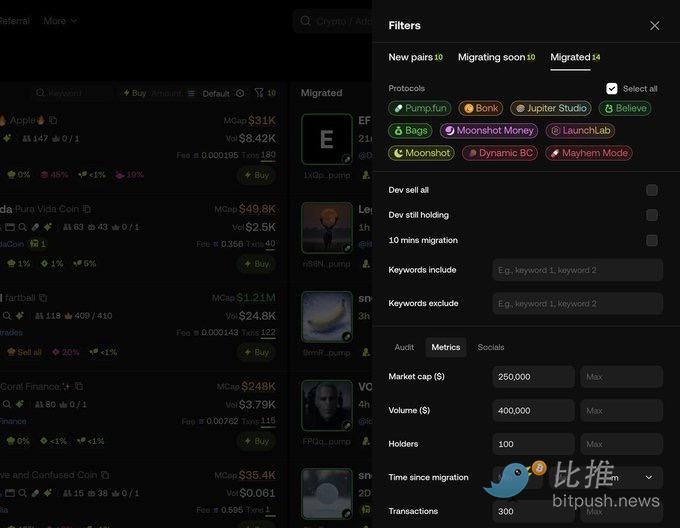
The results are actually clear: in the current market environment, I see about 3–5 tokens daily in the BNB ecosystem, and another 3–5 on Solana, totaling around 10 that need analysis. This is more than enough, as most of them will be filtered out very quickly.
The first 30 seconds that decide everything.
After clicking in, I don't do a full analysis. At this stage, I mainly look at one thing: Holder Cluster Overview. It allows me quickly understand the structure of wallet holdings and the strength of connections between wallets.
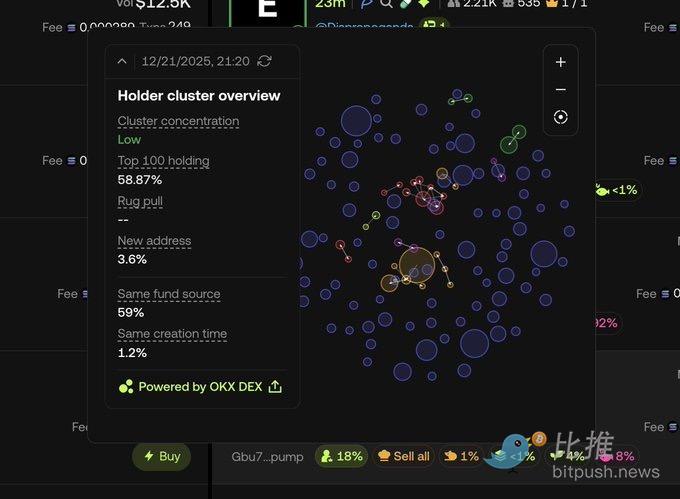
I also look at the holding distribution: internal holdings, bundlers, percentage of new wallets, and the proportion of suspicious addresses.
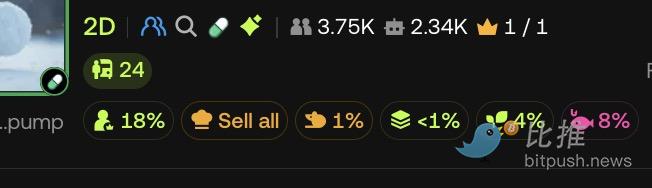
If the structure looks wrong, I abandon it immediately. I won't look at the narrative, won't open Twitter, won't "give it another chance." Most tokens die at this stage, and it's here that money is saved. There's no complex analysis in this step. You just need to look at the green and orange labels. For example: if you see over 60% are phishing wallets, you should immediately know — this is a scam, no need to look further. The same goes for bundles. If a token passes this filter, I throw the CA directly into Telegram. Not to ask others what they think, but to confirm: whether this contract has been noticed by anyone else. I'm in many groups — European, Chinese — but I only use them as information databases. If the CA isn't found anywhere, I skip it directly. I'm in enough high-quality degen groups to be sure: if a contract has potential, it will have been posted in at least some group. Even if there are only a few results, even if no one is talking, it's enough. It means it has attracted some attention.
Narrative, KOLs, whether the story "can spread"
Only at this step do I open Twitter. I don't look at opinions or comments. I only care about one thing: whether this token fits into a larger trend, and whether it has the potential to become the core token of a narrative, not just one among many. Capital doesn't like to be分散, it always looks for a leader. At this stage, I use @frontrunpro. I check if any KOLs or smart wallets are following the project, or are already in the community. I don't care if they've bought. For me, what's more important is: whether they might discuss it publicly in the future. I also check one thing: whether the project has changed its name on Twitter. If it has, it's an immediate skip for me—this has too often turned out to be a scam.
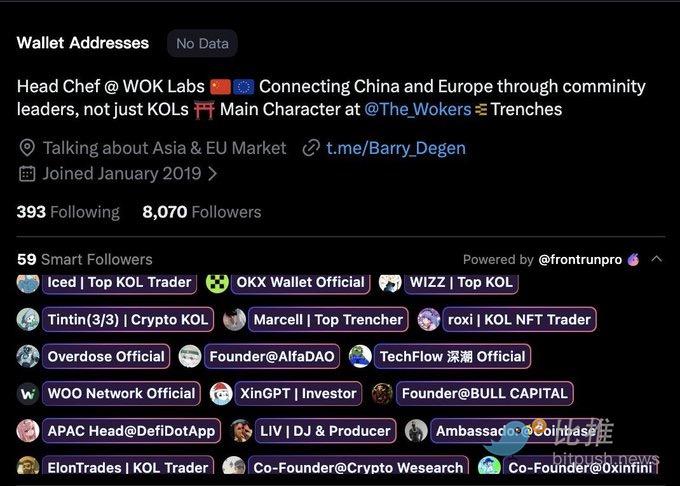
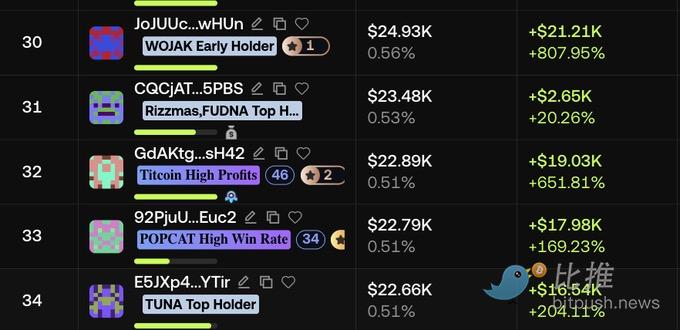
If everything is still fine up to here, I start looking deeper into the holdings. I check the Top 100 and use tools that show wallet labels, mainly Frontrun and @MemeRadar_sol.
I also use some private tools. These tools together form a system that allows me to avoid doing full on-chain analysis. I understand it as: compressing time, not replicating others' operations.
Charts are for confirmation, not for impulse.
Charts are for confirmation, not for impulse. Price charts are always the final step. I'm not looking for the perfect entry. I'm just confirming: if the narrative really develops, whether the current position is reasonable.
From experience, my best ROI entries are often in the $1M–$3M market cap range.
At extremely low market caps like $200–300K, tokens rarely move in a way I can truly participate in; while at higher market caps, the possibility of a big move actually starts to appear.
If I decide to enter, I buy directly through OKX Wallet. Using the BARRY code, you can get lower fees, and you can also join my group @The_Wokers, where I share all my trades. I recently also wrote a piece about how: by using OKX, I'm actually "making extra money." I pay fees there, but the rewards I get back from OKX are often several times the fees. So honestly, I've never quite understood why people still use tools like Banana, Maestro, or Padre these days.
After entering, I immediately stop staring at the price and instead focus on capital flow. For me, the most important thing is wallet clusters, because truly large players almost never operate with just one address. If I see calm, orderly accumulation, I let the position run. If coordinated distribution starts to appear, I choose to take profits, or exit directly.
Wallet Clusters: It changed me from constantly staring at prices like before
After I establish a position, I no longer look at the charts. At that stage, the price is less important to me because it can often be misleading. I focus on capital flow — specifically, wallet clusters. And this is where most people are still stuck at another level: they only look at individual addresses—who bought, who sold, whether a certain wallet has rugpulled. The problem is: large players almost never operate with just one wallet. Anyone managing larger sums, or with experience, will split their positions across multiple addresses.
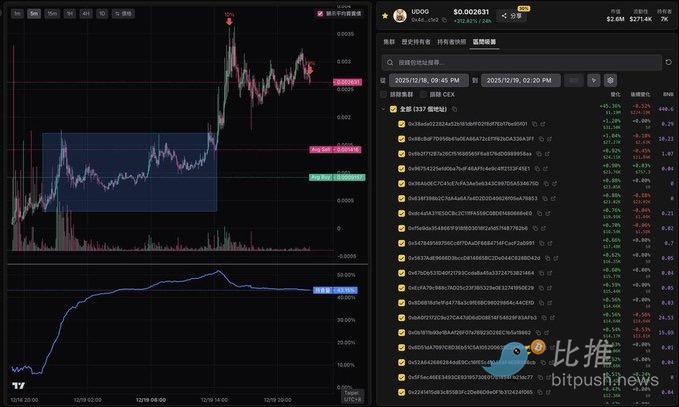
The real problem is right here: a single wallet holds almost no informational value for me. What I truly care about is a group of addresses that are interconnected and behave highly consistently—whether they buy at the same time, sell at the same time, build positions in phases. These signals only start to become important when you move beyond the "single wallet perspective."
For this, I use wallet cluster analysis tools, including @kryptogo_. And right here, there's a crucial distinction many don't understand. Bubble Maps primarily focus on fund flow relationships between wallets. This is useful, but also limited. KryptoGO goes further by analyzing: the fund connections between wallets, and their behavioral patterns over time.
It can identify: coordinated trading, similar entry/exit times, bundled buying, and recurring patterns—all pointing to the fact that multiple addresses are operating as a single entity. Because of this, I can not only see "who is connected to whom,"
more importantly, I can see: how a cluster acts as a whole. This makes a huge difference during holding.
If I see the entire cluster is still accumulating, or just holding calmly, I have no reason to rush. But if I see synchronized distribution starting to appear—even if the price hasn't reacted yet, for me, this is already a very clear risk signal. In this case, I'd rather take profits early, or exit promptly, than wait for the charts to "confirm" something capital has already done. This is one reason I no longer react impulsively to price fluctuations. Price can lie, but clusters almost never.
Case Analysis: What this process looks like in real trades
To prevent the content from remaining purely theoretical, the best way is to illustrate with concrete cases.
Two cases, in particular, exemplify my method: SNOWBALL and UDOG. Not because they are "perfect," but because they clearly show: where this process can give you an advantage, and even with a correct process, the market can still hurt you.
I found SNOWBALL entirely through the process described earlier. Not through KOL signals, not through someone shilling, not luck. It appeared on OKX's radar because it met clear criteria: solid volume, reasonable market cap, and complete migration. Even at that stage, it was clear: it wasn't just random garbage.
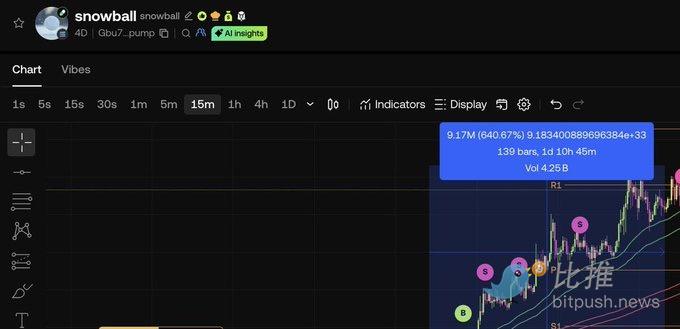
The holding structure looked very healthy. No aggressive bundles, no excessive concentration of new wallets.
Telegram gave me the first confirmation: this contract wasn't just on my screen alone.
And Twitter revealed something more important: the narrative was clear, simple, and extremely easy to retell.
At that moment, I made the key judgment: if this trend really unfolded, SNOWBALL had a great chance to become the core token of this narrative.
And this was the most important decision. As the narrative developed, more and more tokens around the same theme appeared, like YETI, FIREBALL. Many tried to catch them as the "next x100," but from the start, I only saw them as auxiliary signals. If new tokens are constantly being created around a core narrative, it often means: the main token is doing something right. Capital will eventually flow back to the leader.
Because of this, I didn't split my position across multiple targets, but focused only on one core trade. In this case, SNOWBALL offered the best risk-reward ratio and the purest narrative exposure. Everything else was just background noise.
UDOG — When the plan was right, but the timing was a day late
Conversely, UDOG is a good counterexample, showing: even with a completely correct process, it doesn't guarantee a perfect outcome. I found this token early, entering at around a $700K market cap. From a narrative and structural perspective, the setup was valid. There was an ATH, and real paper profits, but I didn't close the position when the market was "feeding" me.
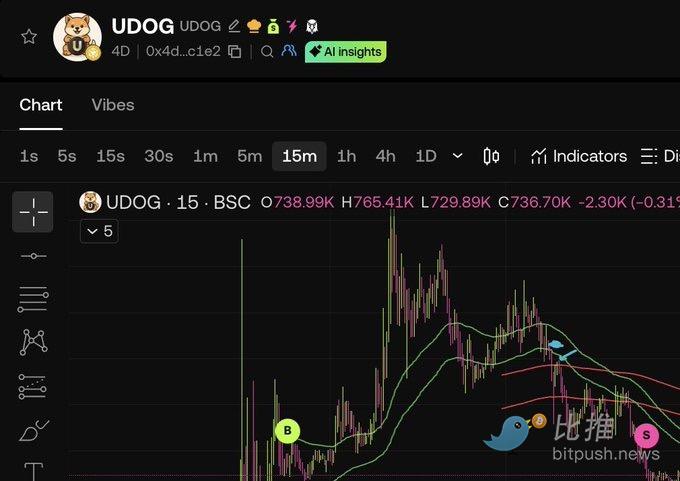
This is a very typical situation: the plan was right, but the timing was off by just one day. The market didn't provide the next push, momentum began to fade. Ultimately, I chose to exit at breakeven.
This is very important: I don't see it as a failure. I didn't违背 the plan, didn't panic, didn't get forced to割肉 at –40%. I just misjudged the timing of the next catalyst. These things happen, and will definitely happen again. For me, failure is not missing the maximum profit. Failure is: knowing capital has made its move, but holding onto the position because "maybe it will bounce back."
Why are these cases more important than the results themselves?
These two examples clearly illustrate why I focus on the process, not the outcome of a single trade. SNOWBALL showed: the value of betting on the narrative leader and ignoring the subsequent copycats. UDOG reminded me: a great starting point doesn't always have a perfect ending, but that doesn't mean it was a bad decision. As long as you stick to the process, the market will reward you eventually. If you start improvising mid-process, even the best system can't save you.
This article details how I operated during the last period focused on trading meme coins, and provides additional cases for each type of开局.
When the chain says "go", but the charts look a mess
This is the moment where most people truly get stuck. I struggled at this stage for a long time myself. On one hand, on-chain data starts to look reasonable: holding structure improves, cluster behavior is calm, narrative potential emerges. On the other hand, the charts tell a completely different story: no push, price moving sideways, hours of accumulation with no reaction.
Then the familiar question arises: Will the market really catch onto this narrative?
At such moments, it's easy to fall into one of two extremes: either enter too early because "on-chain is good," or be too scared to enter at all because the charts look terrible.
I struggled for a long time until I truly understood one thing: I don't need to catch the bottom.
I constantly remind myself of a principle: I have time.
If it pumps without me, let it pump. If it goes to zero, even better — I wasn't in it anyway. The most important thing is to stick to my own rules, not to prove anything to the market.
Why don't I "guess" my entries? I'm not a technical trader, never have been. I don't read charts like a classic TA master, nor do I try to predict every fluctuation—although I still feel I'm a bit better than others, lol. After交流 with some truly skilled traders who primarily trade BTC for years, I found a common point: they don't guess either. Many of their decisions are based on very simple tools, revolving around moving averages. No complex indicators, no magical patterns. This is the direction I later took. I use five indicators: one related to pivots, four based on SMMA (Smoothed Moving Average). Not to "predict the future," but to confirm: when the market is really starting to react. All these indicators can be added directly in OKX: open Indicators, select SMMA or Pivots, then set the parameters.
I use:
-
SMMA 33 High
-
SMMA 33 Low
-
SMMA 144 High
-
SMMA 144 Low
-
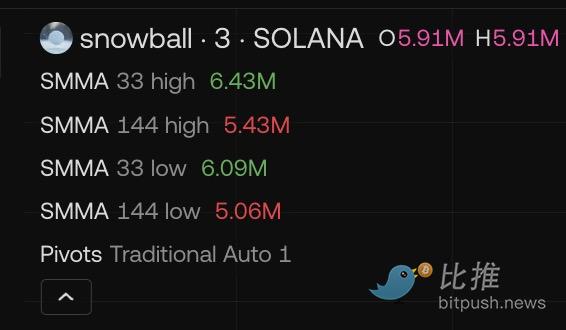
I don't care about moments when the charts look bad but "might bounce back." I care about: when the charts stop looking so bad.
For me, the signal is very straightforward.
I wait for the short-term MA (SMMA 33) to整体站上 the long-term MA (SMMA 144).
In practice, this means: the two green lines must cross above the red line and stably stay above it. Only after that will I consider: the market is starting to accept higher prices. In the SNOWBALL case, this signal gave an entry point around a $420K market cap. The market cap later exceeded $9M. I mentioned $3M earlier because this article continued the next day. Calculating from the "perfect entry," this was over 20x.
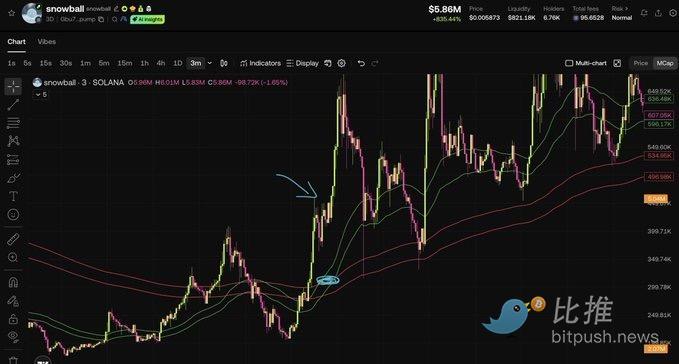
It won't give me the perfect bottom. But it gives me peace of mind.
Timeframe is determined by context, not by whim
If the chart is very fresh, I often switch to very low timeframes: 15 seconds, or 30 seconds. I'm not looking for static accumulation, but for the first real reaction. If the chart has been moving for a while, the trend unfolds over a longer period, I usually use 1–3 minute timeframes.
There is no "golden rule" here.
Everything depends on: how I want to manage the trade, and what my plan is. When exiting, I use the exact same tools and logic.
Case: UDOG and the moment the trend ended
UDOG is a very typical实战 case. At one stage — around a $1.96M market cap, the chart very clearly showed: the trend was ending. The MAs were no longer aligned, momentum明显衰减, the market could no longer push forward.
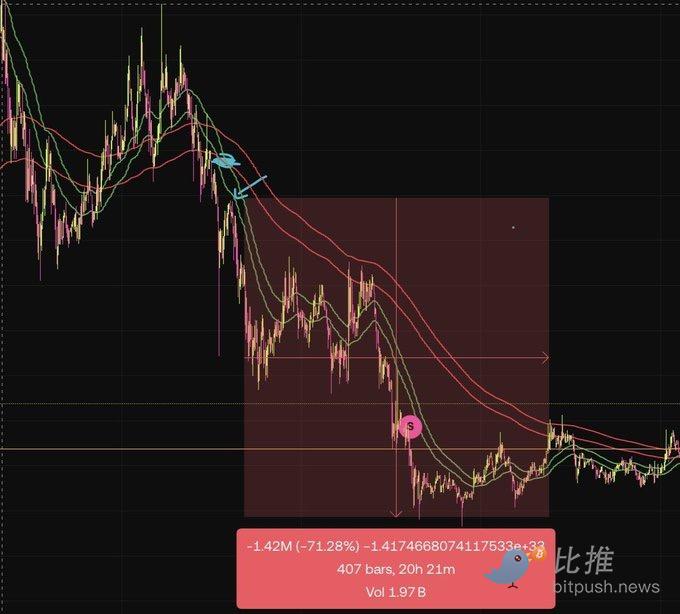
And this is very important: I didn't sell at that time, because I believed in a longer-term narrative wave. This was a conscious decision, based on my premise at the time. I've written about this before, I don't see it as an error in the analytical process, but just a misjudgment of the duration of the momentum.
This also highlights a key point: Tools are not meant to make you always right.
The purpose of tools is to help you clearly understand: where you are positioned and what risk you are taking.
The most important conclusion of this part
You don't need to enter when the charts look terrible.
You don't need to catch the bottom.
You don't need to guarantee you're always on the first pumping candle.
You have time.
If the on-chain logic holds, but the market hasn't confirmed it, waiting is an option, not weakness. Sometimes the market will catch on, sometimes it won't. Your job isn't to guess, but to react when conditions start to align.
Summary: What this article really wants to say
If I had to end the entire article with one sentence, it would be: This is not an article about tokens, but an article about putting yourself in a position to have made decisions before the market gets noisy. The entire process I described—from screening on OKX, to holding structure, reality check on Telegram, narrative judgment on Twitter, KOLs as传播 channels, wallet clusters, and finally charts and entry timing—all serves one purpose: separating signal from noise.
I don't aim to be the fastest. I don't aim to catch the bottom. I don't aim to prove I'm right on Twitter.
My goal is to find that moment:
-
On-chain starts to align,
-
The narrative is reasonable and has扩散 potential,
-
Capital behavior is calm,
-
The charts finally stop "looking bad," even if they aren't yet good-looking.
This approach means I often do nothing. It also means many opportunities will pass me by.
But it also means: when I truly enter, I clearly know why I'm entering, what I'm waiting for, and under what circumstances I will exit.
And that is the most important thing.
The market will always give you new tokens, new narratives, and countless reasons to click buy out of boredom.
Advantage doesn't come from the number of trades, nor from the number of opinions.
Advantage comes from a process you can repeatedly execute before emotions even wake up.
You have time. If something is really going to happen, the market will give you a sign.
Your task is simply to recognize it.
Twitter:https://twitter.com/BitpushNewsCN
Bitpush TG Discussion Group:https://t.me/BitPushCommunity
Bitpush TG Subscription: https://t.me/bitpush