Ethereum Block Space Futures Market ETHGas Aims to Become a Real-Time Execution Layer?

marsbitXuất bản vào 2026-01-03Cập nhật gần nhất vào 2026-01-03

Tóm tắt

Ethereum block space futures market ETHGas has raised $12 million in a funding round led by Polychain Capital, with participation from several other investors. The platform aims to address Ethereum's gas fee volatility by allowing users to lock in future gas costs through futures contracts, making expenses predictable for DApps and L2 solutions. A key feature is its Blockspace auction market, where validators and block builders can auction space in upcoming blocks, ensuring transaction inclusion and execution efficiency. ETHGas ultimately envisions a "Real-Time Ethereum" by guaranteeing transaction execution in subsequent blocks. However, challenges include potential increased costs for retail users due to institutional dominance in auctions, and risks of market manipulation through futures trading. The platform plans to mitigate these issues to avoid undermining its core goals.

Author: Eric, Foresight News

On December 17, the block space futures market ETHGas announced the completion of a $12 million funding round, led by Polychain Capital, with participation from Stake Capital, BlueYard Capital, Lafayette Macro Advisors, SIG DT, and Amber Group. Founder Kevin Lepsoe revealed that ETHGas had completed an undisclosed Pre-Seed funding round of approximately $5 million in mid-2024.

Lepsoe also stated that Ethereum validators, block builders, and relay nodes have committed around $800 million to support market and product development, not in cash investments but by providing liquidity to the ETHGas market in the form of Ethereum block space.

Although the project is defined as a block space futures market, its true vision is to achieve "Real-Time Ethereum."

The Order of Blocks

Ethereum co-founder Vitalik Buterin proposed the concept of a Gas futures market earlier this month, aiming to address the issue of Ethereum Gas volatility. Similar to the logic of commodity futures in traditional markets, locking in future Gas costs through futures would make Gas expenses predictable and controllable.

This would allow DApps to lock in Gas costs before events such as users claiming token airdrops and design activities to subsidize users. L2s could also purchase futures when Gas fees are lower to stabilize the cost of bundling and submitting data to L1, making transaction costs on L2s stable and predictable. This would serve businesses that require pre-calculated costs, such as tokenized U.S. stocks.

According to the documentation, ETHGas will also launch a no-code tool called Open Gas specifically for DApps to help them provide Gas subsidy programs. This tool will allow users to claim the Gas fees they consumed on the ETHGas platform after using a DApp.

Developing a Gas futures market is not particularly challenging, as it essentially requires building a sufficiently liquid on-chain futures trading market. ETHGas's "killer feature" is its block space auction market.
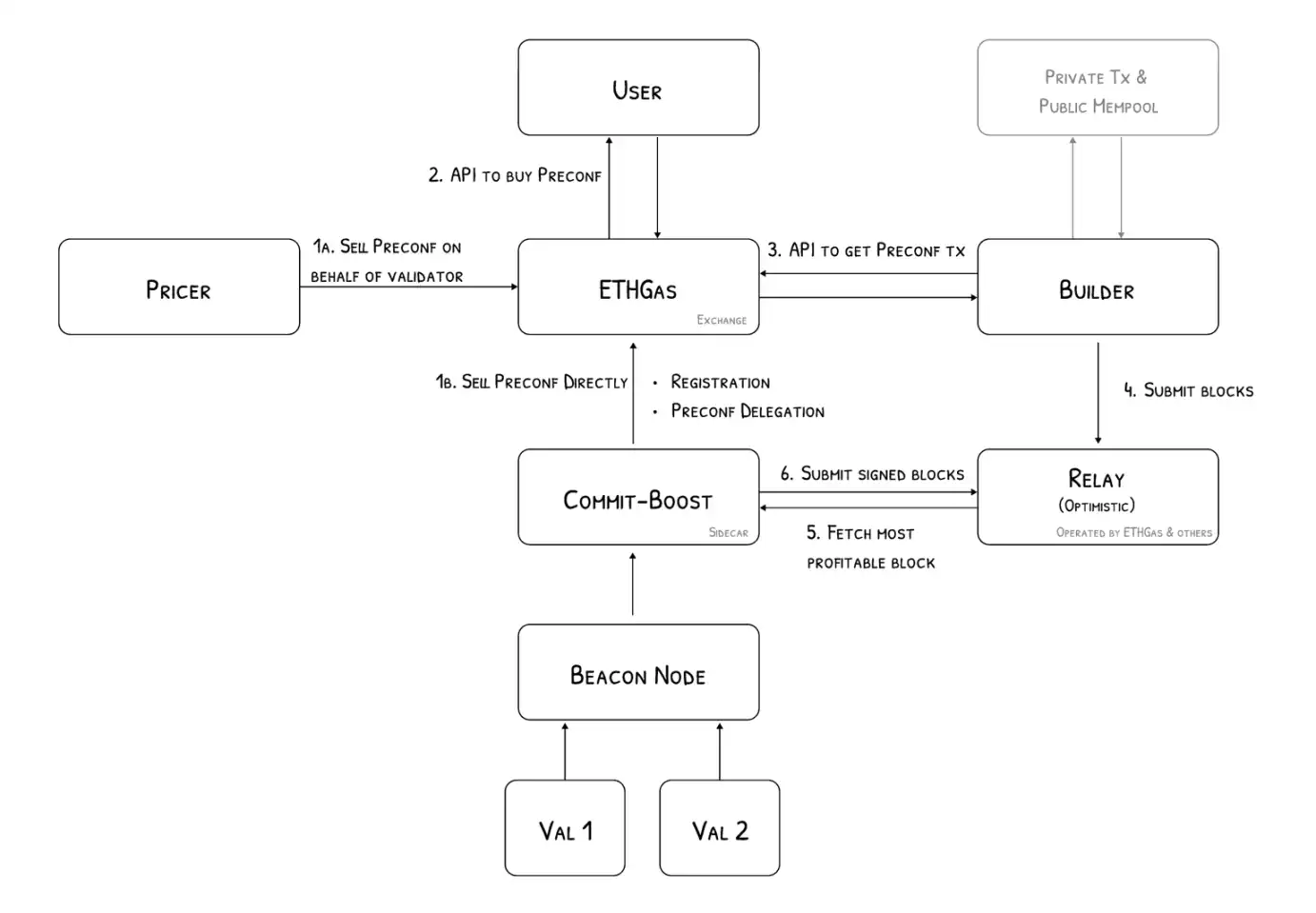
This auction market, named Blockspace, allows Ethereum validators, block builders, and relay nodes to auction space in subsequent blocks, ensuring that bidders' transactions are included in the next block and guaranteeing the execution efficiency of those transactions. Additionally, bidders can even purchase an entire block to include only their own transactions or transactions they provide for others.

Comparing transactions to packages, guaranteeing block inclusion is like ensuring a package is loaded onto a transport plane, while guaranteeing transaction execution is like ensuring the package is delivered to the intended recipient on time. Purchasing an entire block is akin to chartering an entire plane to transport one's packages, but with the option to sublet the extra space to other packages.

ETHGas's ultimate goal is to achieve "real-time transactions" on Ethereum through Blockspace. This "real-time transaction" can only be in quotes because the completion of transactions on the Ethereum mainnet must wait for the block to be finalized. However, if a transaction can be guaranteed to be included in the next block, it can, in a way, be considered "already completed." ETHGas can be understood as an execution layer on top of Ethereum, but how real-time transactions will be reflected on the front end remains to be seen as ETHGas provides answers.

ETHGas aims to create an orderly block space, as opposed to the current system of chaotic bidding for block space with numerous uncontrollable MEV transactions. By offering predictable returns to attract infrastructure operators to join Blockspace and create sufficient liquidity for real-time transactions, the resulting efficiency improvements will attract various DApps. DApps, in turn, will attract users through Open Gas, and users will bring more transaction volume into the ETHGas network, thereby increasing the returns for infrastructure operators and forming a positive cycle.

Challenges Beneath the Ideal Vision

For a DApp about to conduct a token airdrop, it could estimate the number of transactions for claiming the airdrop, pre-book n blocks after a specific time, and provide a Gas subsidy program, thereby achieving a budget-controlled and network-congestion-free token claim event.

Although such visions are ideal, allowing block space to be auctioned may lead to many foreseeable issues.

First, if institutional users can auction block space without restrictions, they might purchase entire blocks in large quantities and resell them to retail users. While this would ensure stable and predictable returns for validators, it could increase transaction costs for retail users. In this scenario, retail users lack the technical capability to compete with institutional users, and even if they could participate in auctions or use futures markets to hedge against rising Gas fees, it would essentially raise their transaction costs.

Additionally, the futures market could become a tool for market manipulation. For example, large players could deliberately create a high volume of on-chain transactions to drive up Gas fees and profit from the futures market, but this could increase transaction costs for other users on the Ethereum mainnet. Moreover, as DApp operators are aware of the specific timing of events that could cause a surge in transactions, they could profit from operations in the futures market in advance, turning the futures market into an arbitrage playground for those with informational advantages and causing unpredictable losses for ordinary users who simply use the market for hedging.

The birth of a new trading market inevitably creates arbitrage opportunities due to information asymmetry, potentially undermining the very problems the market aims to solve. For ETHGas, balancing this issue and preventing a "positive cycle" from turning into a "death spiral" may require some necessary restrictions.


Tiền kỹ thuật số thịnh hành

Câu hỏi Liên quan

QWhat is the main vision of ETHGas, despite being defined as a block space futures market?

AThe main vision of ETHGas is to achieve 'Real-Time Ethereum' by creating an orderly block space and acting as an execution layer on top of Ethereum.

QWho led the $12 million funding round for ETHGas announced on December 17th?

AThe $12 million funding round was led by Polychain Capital.

QWhat is the purpose of the Blockspace auction market introduced by ETHGas?

AThe Blockspace auction market allows validators, block builders, and relay nodes to auction space in future blocks, guaranteeing that a bidder's transaction will be included in the next block and ensuring its efficiency. It can also be used to auction an entire block.

QWhat potential problem does the article identify with allowing unlimited block space auctions?

AUnlimited auctions could allow institutional users to outbid散户 (retail users) and potentially resell block space to them, ultimately increasing transaction costs for ordinary users and creating an unlevel playing field.

QWhat tool is ETHGas developing specifically for DApps, and what is its function?

AETHGas is developing a zero-code tool called Open Gas, which is designed to help DApps provide gas subsidy programs, allowing users to claim the gas fees they spent after using the DApp on the ETHGas platform.

Nội dung Liên quan

Phúc Kiến Tấn Giang, một kỳ lân công nghệ lưu trữ siêu cấp im lặng vươn lên

Những ngày này, khi Trường Tân Công nghệ Hợp Phì lên sàn A, và Trường Giang Tích Trữ Vũ Hán đang trong giai đoạn chuẩn bị IPO, một "kỳ lân siêu cấp" trong lĩnh vực bộ nhớ vẫn lặng lẽ hoạt động tại Tấn Giang, Phúc Kiến - Công ty TNHH Mạch tích hợp Tấn Hoa Phúc Kiến (Phúc Kiến Tấn Hoa). Từng là một trong ba trụ cột sản xuất chip bộ nhớ trong nước cùng với Trường Giang Tích Trữ và Trường Tân Công nghệ, thậm chí có thời điểm được đánh giá cao hơn, nhưng số phận của Tấn Hoa lại không suôn sẻ. Ngay trước khi sản phẩm ra đời, công ty đã bị Bộ Thương mại Mỹ đưa vào danh sách đen và đối mặt với cáo trạng hình sự từ Bộ Tư pháp Mỹ vào năm 2018, khiến dây chuyền sản xuất đình trệ. Phải đến tháng 2/2024, tòa án liên bang Mỹ mới tuyên án vô tội, kết thúc 6 năm vướng vào tranh chấp. Nhân vật then chốt đằng sau Tấn Hoa là Trần Chính Khôn, cựu kỹ sư của Micron. Với khát vọng phát triển công nghệ DRAM tự chủ, ông đã dẫn dắt đội ngũ hợp tác với United Microelectronics Corporation (UMC) của Đài Loan. Dù vấp phải lệnh trừng phạt nghiêm trọng, nhóm của ông vẫn kiên trì tái thiết dây chuyền sản xuất, tối ưu hóa thiết bị trong nước để giảm thiểu sự phụ thuộc vào công nghệ Mỹ. Hiện tại, Tấn Hoa tập trung vào thị trường DRAM chuyên biệt (niche DRAM), với sản phẩm ứng dụng trong TV thông minh, thiết bị mạng và công nghiệp. Năng lực sản xuất ổn định ở mức khoảng 40.000 tấm wafer 12-inch mỗi tháng, dự kiến mở rộng lên 60.000 vào năm 2026. Dù vậy, công ty vẫn nằm trong danh sách đen của Mỹ. Sự tồn tại và phục hồi của Tấn Hoa có sự hậu thuẫn mạnh mẽ từ chính quyền địa phương Tấn Giang - một thành phố vốn nổi tiếng với giày thể thao và thực phẩm. Thành phố này đã mạnh dạn đầu tư vào ngành công nghiệp bán dẫn, coi Tấn Hoa là hạt nhân để xây dựng cụm công nghiệp mạch tích hợp hoàn chỉnh, với tổng vốn đầu tư hàng trăm tỷ nhân dân tệ. Sự kiên định của chính quyền trong việc hỗ trợ Tấn Hoa vượt qua khủng hoảng là minh chứng cho chiến lược phát triển công nghiệp mới đầy tham vọng của Tấn Giang. Dù quy mô và doanh thu hiện tại (khoảng 2 tỷ nhân dân tệ/năm) còn cách xa các đối thủ trong nước, Tấn Hoa đại diện cho một thực tế: một doanh nghiệp từng bị siết chặt vẫn có thể đứng dậy. Trong chu kỳ siêu tăng trưởng mới của ngành bộ nhớ được AI thúc đẩy, Tấn Hoa vẫn giữ được vị trí trên bàn chơi.

marsbit1 giờ trước

Phúc Kiến Tấn Giang, một kỳ lân công nghệ lưu trữ siêu cấp im lặng vươn lên

marsbit1 giờ trước

Giao dịch

Giao ngay

Bài viết Nổi bật

Làm thế nào để Mua O

Chào mừng bạn đến với HTX.com! Chúng tôi đã làm cho mua O1 exchange (O) trở nên đơn giản và thuận tiện. Làm theo hướng dẫn từng bước của chúng tôi để bắt đầu hành trình tiền kỹ thuật số của bạn.Bước 1: Tạo Tài khoản HTX của BạnSử dụng email hoặc số điện thoại của bạn để đăng ký tài khoản miễn phí trên HTX. Trải nghiệm hành trình đăng ký không rắc rối và mở khóa tất cả tính năng. Nhận Tài khoản của tôiBước 2: Truy cập Mua Crypto và Chọn Phương thức Thanh toán của BạnThẻ Tín dụng/Ghi nợ: Sử dụng Visa hoặc Mastercard của bạn để mua O1 exchange (O) ngay lập tức.Số dư: Sử dụng tiền từ số dư tài khoản HTX của bạn để giao dịch liền mạch.Bên thứ ba: Chúng tôi đã thêm những phương thức thanh toán phổ biến như Google Pay và Apple Pay để nâng cao sự tiện lợi.P2P: Giao dịch trực tiếp với người dùng khác trên HTX.Thị trường mua bán phi tập trung (OTC): Chúng tôi cung cấp những dịch vụ được thiết kế riêng và tỷ giá hối đoái cạnh tranh cho nhà giao dịch.Bước 3: Lưu trữ O1 exchange (O) của BạnSau khi mua O1 exchange (O), lưu trữ trong tài khoản HTX của bạn. Ngoài ra, bạn có thể gửi đi nơi khác qua chuyển khoản blockchain hoặc sử dụng để giao dịch những tiền kỹ thuật số khác.Bước 4: Giao dịch O1 exchange (O)Giao dịch O1 exchange (O) dễ dàng trên thị trường giao ngay của HTX. Chỉ cần truy cập vào tài khoản của bạn, chọn cặp giao dịch, thực hiện giao dịch và theo dõi trong thời gian thực. Chúng tôi cung cấp trải nghiệm thân thiện với người dùng cho cả người mới bắt đầu và người giao dịch dày dạn kinh nghiệm.

Tổng lượt xem 652Xuất bản vào 2026.06.19Cập nhật vào 2026.06.29

Làm thế nào để Mua O

Làm thế nào để Mua PROS

Chào mừng bạn đến với HTX.com! Chúng tôi đã làm cho mua Pharos (PROS) trở nên đơn giản và thuận tiện. Làm theo hướng dẫn từng bước của chúng tôi để bắt đầu hành trình tiền kỹ thuật số của bạn.Bước 1: Tạo Tài khoản HTX của BạnSử dụng email hoặc số điện thoại của bạn để đăng ký tài khoản miễn phí trên HTX. Trải nghiệm hành trình đăng ký không rắc rối và mở khóa tất cả tính năng. Nhận Tài khoản của tôiBước 2: Truy cập Mua Crypto và Chọn Phương thức Thanh toán của BạnThẻ Tín dụng/Ghi nợ: Sử dụng Visa hoặc Mastercard của bạn để mua Pharos (PROS) ngay lập tức.Số dư: Sử dụng tiền từ số dư tài khoản HTX của bạn để giao dịch liền mạch.Bên thứ ba: Chúng tôi đã thêm những phương thức thanh toán phổ biến như Google Pay và Apple Pay để nâng cao sự tiện lợi.P2P: Giao dịch trực tiếp với người dùng khác trên HTX.Thị trường mua bán phi tập trung (OTC): Chúng tôi cung cấp những dịch vụ được thiết kế riêng và tỷ giá hối đoái cạnh tranh cho nhà giao dịch.Bước 3: Lưu trữ Pharos (PROS) của BạnSau khi mua Pharos (PROS), lưu trữ trong tài khoản HTX của bạn. Ngoài ra, bạn có thể gửi đi nơi khác qua chuyển khoản blockchain hoặc sử dụng để giao dịch những tiền kỹ thuật số khác.Bước 4: Giao dịch Pharos (PROS)Giao dịch Pharos (PROS) dễ dàng trên thị trường giao ngay của HTX. Chỉ cần truy cập vào tài khoản của bạn, chọn cặp giao dịch, thực hiện giao dịch và theo dõi trong thời gian thực. Chúng tôi cung cấp trải nghiệm thân thiện với người dùng cho cả người mới bắt đầu và người giao dịch dày dạn kinh nghiệm.

Tổng lượt xem 657Xuất bản vào 2026.06.22Cập nhật vào 2026.06.29

Làm thế nào để Mua PROS

VERONA là gì

I. Giới thiệu Dự án VERONA là một blockchain được xây dựng cho mọi người, ở mọi nơi thông qua việc trừu tượng hóa chuỗi. Sử dụng lớp Trừu tượng Hóa Tổng quát, VERONA tự phân biệt mình bằng cách tích hợp các chức năng blockchain phức tạp, chẳng hạn như tài khoản, chữ ký và khả năng tương tác, trực tiếp ở cấp độ giao thức. Cách tiếp cận này cho phép tham gia vào các ứng dụng blockchain mà không cần phải hiểu các công nghệ cơ bản.1) Thông tin cơ bản Tên: VERONA (VERONA)III. Liên kết liên quan Liên kết trang web chính thức: https://xion.burnt.com/ Tài liệu trắng: https://xion.burnt.com/whitepaper.pdf Các trình khám phá: https://explorer.burnt.com/ Mạng xã hội: https://x.com/burnt_xion Lưu ý: Giới thiệu dự án đến từ các tài liệu được công bố hoặc cung cấp bởi đội ngũ dự án chính thức, chỉ để tham khảo và không cấu thành lời khuyên đầu tư. HTX không chịu trách nhiệm cho bất kỳ tổn thất trực tiếp hoặc gián tiếp nào phát sinh.

Tổng lượt xem 653Xuất bản vào 2026.06.22Cập nhật vào 2026.06.22

VERONA là gì

Thảo luận

Chào mừng đến với Cộng đồng HTX. Tại đây, bạn có thể được thông báo về những phát triển nền tảng mới nhất và có quyền truy cập vào thông tin chuyên sâu về thị trường. Ý kiến ​​của người dùng về giá của A (A) được trình bày dưới đây.

活动图片













