Earning Millions Daily in a Sluggish Market: Is Pump.fun's Revenue Real?

marsbitXuất bản vào 2026-03-21Cập nhật gần nhất vào 2026-03-21

Tóm tắt

Despite a perceived market downturn, pump.fun remains a top revenue-generating crypto-native application, ranking fourth in earnings behind only Tether, Circle, and Hyperliquid across various timeframes. Its daily income consistently exceeds one million USD, derived from three primary sources: a 0.95% protocol fee on bonding curve transactions, a token’s "graduation" fees on Pumpswap, and revenue from its acquired multi-chain trading platform, Terminal (formerly Padre). On-chain analysis confirms the bonding curve revenue is authentic, with no evidence of fake transfers or data manipulation. However, questions arise about the organic nature of this activity. While Solana’s daily active addresses range between 1.2-2.2 million, pump.fun sees about 150,000, with roughly 30,000 new tokens deployed daily. Data suggests a significant portion of tokens are launched by a small group of sophisticated deployers, not organic users. Moreover, research indicates that 98.6% of tokens on pump.fun are pump-and-dump schemes, turning the platform into a low-cost, high-efficiency "casino" where deployers profit at the expense of retail investors. Despite pump.fun using nearly all its income to buy back its native token, $PUMP, the price continues to fall due to a lack of buyer confidence and organic demand. The fundamental issue is not revenue authenticity but the platform's role in facilitating a predatory ecosystem, making it unattractive to long-term institutional investment.

Author: BlockBeats

"What other crypto-native applications can still make money?"

When it comes to this question, you might instinctively think—stablecoins, CEXs, Perp DEXs, on-chain Pokémon cards...

And pump.fun, this application that was once infinitely glorious during the meme frenzy and created one of the largest IPOs in cryptocurrency history, is starting to be easily forgotten. Even in some conversations, I heard questions like:

"Is pump.fun still alive? Can they still make money?"

pump.fun not only can still make money, but it remains a top-tier "money printer" among crypto-native applications. Statistics on DefiLlama show that across any time frame—24 hours, 7 days, 30 days, or 1 year—pump.fun's revenue is firmly in 4th place, only behind Tether, Circle, and Hyperliquid.
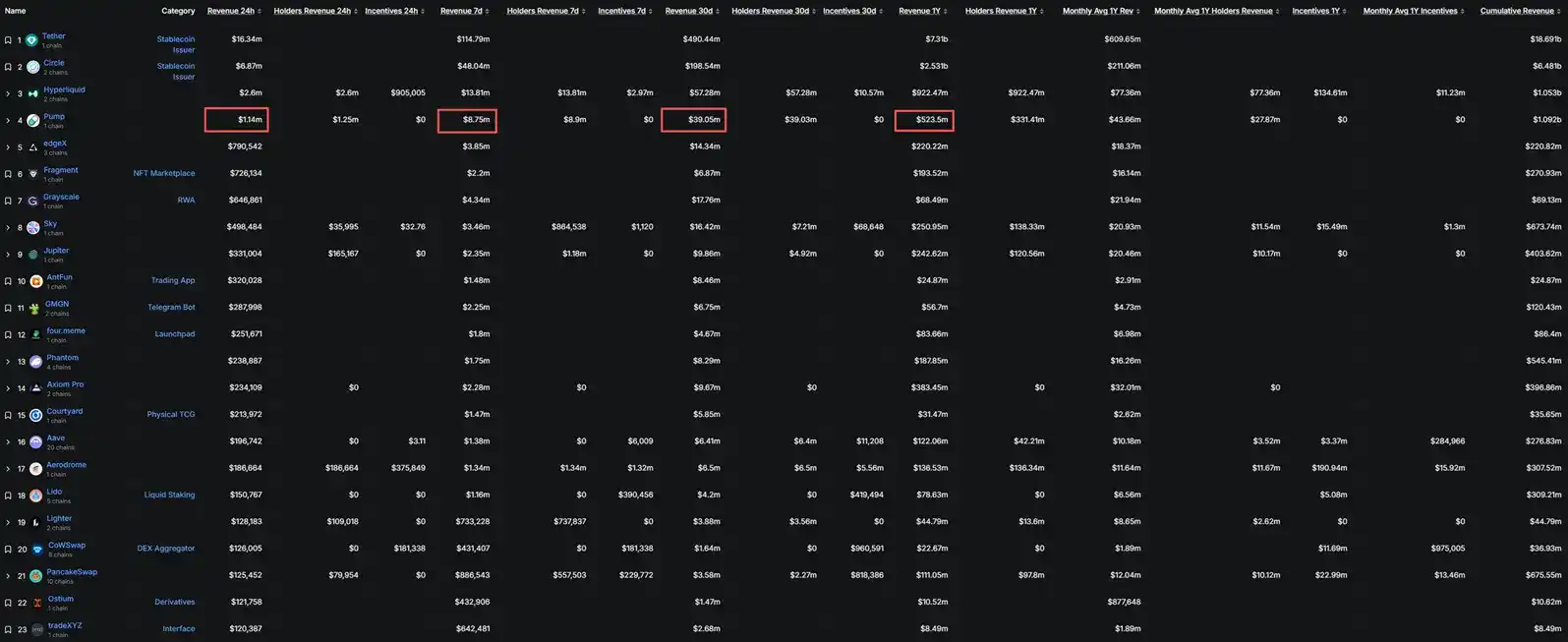
Although various "dog coin hunting" chat groups are冷冷清清, many with not a single message for days, pump.fun's average revenue over the past 7 or 30 days still exceeds one million dollars per day.

Is this real revenue, or is pump.fun faking it?

Is pump.fun's revenue real?

First, according to pump.fun's official revenue dashboard, its current revenue consists of three parts:

- Bonding curve revenue: Transaction fee income before a new token "graduates." pump.fun charges a 0.95% protocol fee on these transactions.

- Pumpswap revenue: For new tokens that have successfully graduated (migrated to the Pumpswap AMM for trading), a 0.93% protocol fee is charged on transactions for tokens with a market cap of 0-420 SOL.

- Terminal (Padre) revenue: pump.fun acquired the trading terminal Padre in October last year and rebranded it as the multi-chain trading platform Terminal. Revenue from this trading platform is now also counted as pump.fun revenue.

- Revenue is net of referral rebates and trading cashback.

For protocol revenue from the bonding curve phase, the Solana address used by pump.fun official to receive this portion of revenue is CebN5WGQ4jvEPvsVU4EoHEpgzq1VV7AbicfhtW4xC9iM. The bonding curve revenue aggregated to this address is hardcoded into the contract. If fake revenue were being created by externally transferring funds to this address, there would necessarily be external addresses directly calling the System Program's Transfer instruction. After analyzing the transactions for this address, we found no evidence of any伪造收入的行为 through simple, external SOL transfers.

This means that the bonding curve revenue确实完全来自于真实合约调用的协议手续费抽成。

DefiLlama's pump.fun bonding curve revenue data is obtained by directly calling pump.fun's official API, which is why we first conducted an on-chain analysis of pump.fun's official bonding curve revenue address. However, DefiLlama's calculations for Pumpswap and Terminal (Padre) revenue are done through Dune SQL queries of on-chain Solana data,完全不依赖 pump.fun 官方的 API,具有极高的链上客观性和不可篡改性。

At this point, we have ruled out the suspicion that pump.fun is faking revenue through "external transfers" or "falsifying data" in a simple and crude manner. However, the possibility remains that they could be generating fake revenue through "wash trading" using bots or internal wallets. Therefore, we must ask further—given the current overall sluggish state of the cryptocurrency market, with meme coin热度更是大幅退潮, is pump.fun's revenue real and organic?

The reasonableness of pump.fun's revenue in the current market environment?

According to data on Token Terminal, during the first quarter of this year, the daily active address count on Solana stabilized between 1.2 million and 2.2 million, while on pump.fun it was approximately 150,000.

Simultaneously, according to data from Dune's pump.fun related statistical dashboard, these 150,000 addresses correspond to approximately 30,000 new token deployments per day.

This means that if all 30,000 new tokens per day were deployed spontaneously by different real users, then about 20% of pump.fun's active users are launching new coins every day. However, according to a paper titled "Predicting the success of new crypto-tokens: the Pump.fun case" published last month by Giulio Marino et al., from September 1, 2025, to October 1, 2025, a total of 655,770 new tokens were deployed on pump.fun, yet the number of addresses deploying tokens was only 243,123.
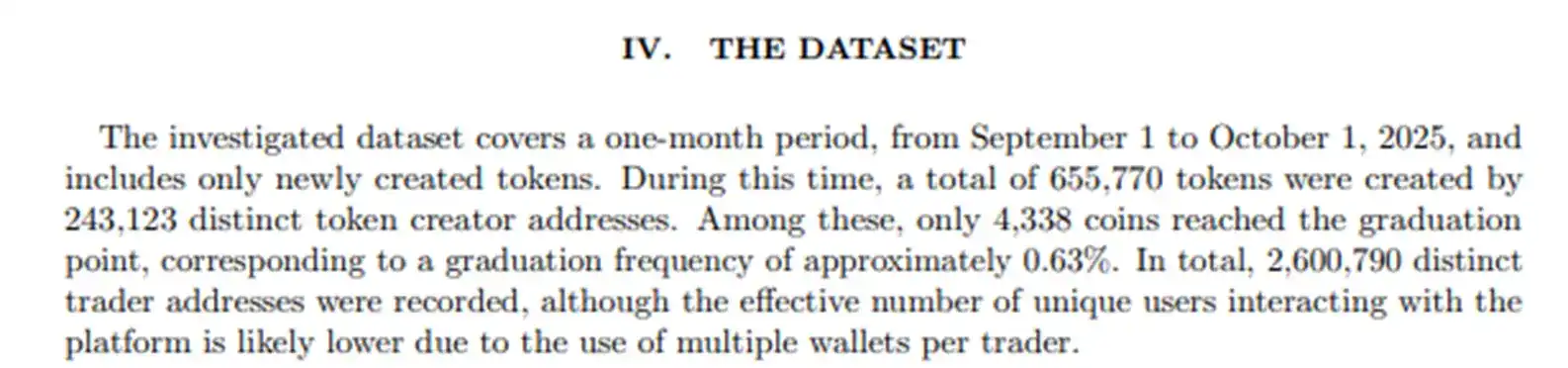
And the current daily number of token deployments is even higher than last September:

Combined with the current market environment, this data is somewhat "counter-intuitive"—on social media, it feels like cryptocurrency is almost finished, yet on pump.fun, so many new tokens are still being deployed every day. Also, the number of active addresses over the past month is about 10% higher than last September.

<极速赛车开奖官网【fifanry.net】img style="max-width:100%;overflow:hidden;" src="https://d1x7dwosqaosdj.cloudfront.net/images/2026-03/1b29f35392d442d583fa39641e3bf542.jpg" alt="">

In pump.fun's daily million-dollar revenue, Pumpswap and Terminal (Padre) still account for a relatively "small portion." Taking the data from March 18 as an example, the revenue from Pumpswap and Terminal (Padre) on that day was approximately $284,000 and $58,000 respectively, while the revenue from the bonding curve was about $795,000, roughly 2.3 times the sum of the former two.

The new token graduation rate has recently even reached more than twice that of last September:
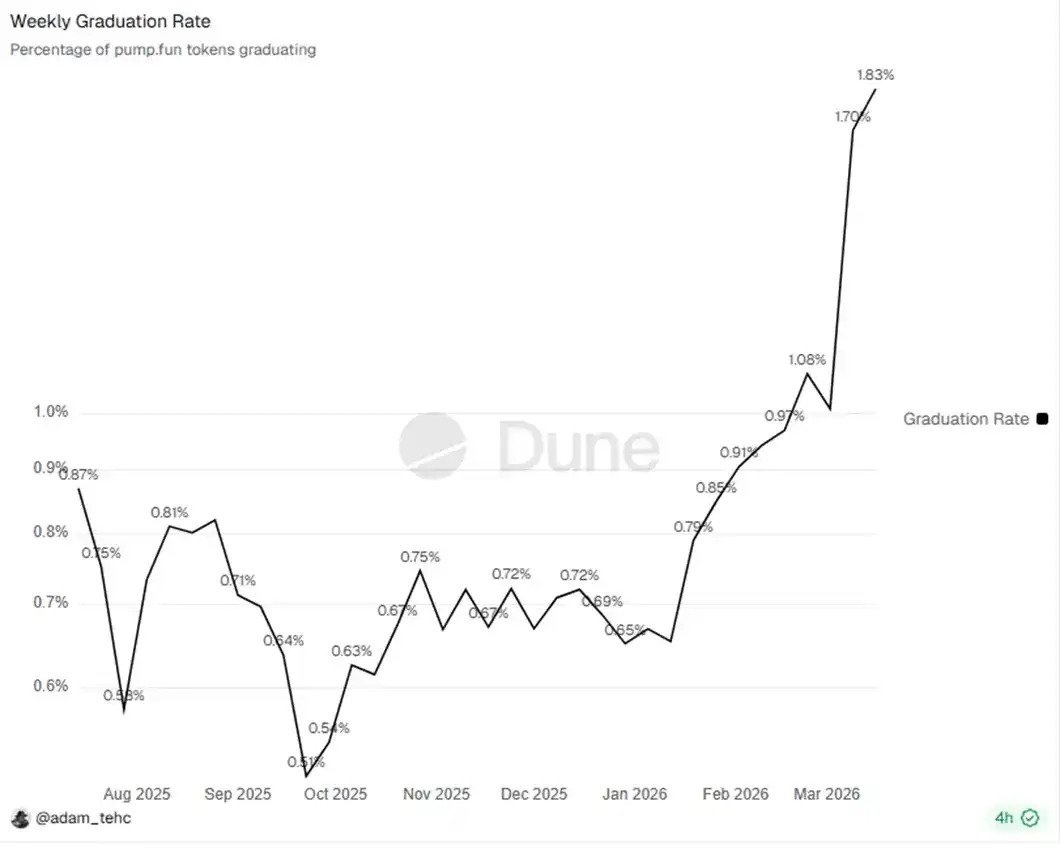
Simultaneously, approximately 26,000 new tokens were deployed on pump.fun that day. To achieve $795,000 in bonding curve revenue, a bonding curve trading volume of $795,000 / 0.95% (the protocol fee rate charged by the bonding curve) ≈ $83,684,200 is required. Averaged across each newly deployed token, each newly deployed token needs to contribute an average of about $3,218 in trading volume before successfully graduating.

If we combine the above data, an average of just over $3,000 in trading volume per new token doesn't sound that difficult; in fact, it seems quite normal, because even in September of last year, when the data was全面落后, pump.fun was still able to achieve this goal. If calculated in SOL terms, they are earning more SOL now than in September last year, it's just that the USD-denominated revenue has decreased.

But at this point, we still have questions: Since last August, pump.fun has been using almost its entire daily revenue to回购 $PUMP. To date, they have repurchased over 10% of the total supply and over 30% of the current circulating supply of $PUMP. Why then does the price of $PUMP keep falling? Although on-chain data shows that the repurchased $PUMP, worth over $300 million, remains untouched in wallets, could it be that they are creating fake revenue through wash trading, "repurchasing" on one hand while secretly selling off through分散的地址?

Where did the $PUMP go?

Let's look at the $PUMP token release schedule:
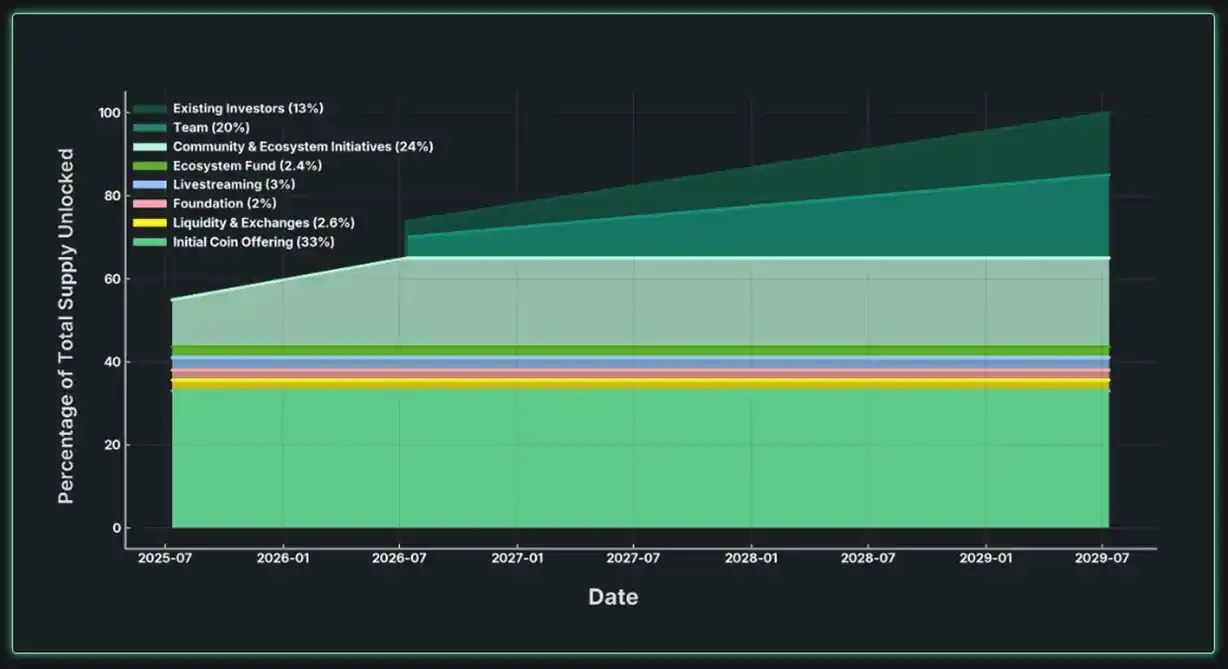
So far, the circulation of $PUMP is as follows:

- ICO: 33%, fully unlocked at TGE.

- Team: 20%, still locked.

- Investors: 13%, still locked.

- LP and Exchanges: 2.6%, fully unlocked at TGE.

- Ecosystem Fund: 2.4%, fully unlocked at TGE.

- Live Streaming Support: 3%, fully unlocked at TGE.

- Foundation: 2%, fully unlocked at TGE.

- Community and Ecosystem Incentives: 24%, approximately 50% unlocked at TGE, the remaining portion unlocks linearly over 1 year. Currently, 65.27% of this portion has been unlocked.

The $PUMP multi-sig custodial wallet with the address Cfq1ts1iFr1eUWWBm8eFxUzm5R3YA3UvMZznwiShbgZt currently holds approximately 36.5% of the total supply of $PUMP.

This does not match the $PUMP token release schedule. What we can明确的是 is that after TGE, all $PUMP was transferred to the multi-sig custodial wallet for distribution. The theoretical maximum transferable amount is only about 58.67% of the total supply (ICO 33% + LP and Exchanges 2.6% + Ecosystem Fund 2.4% + Live Streaming Support 3% + Foundation 2% + Community and Ecosystem Incentives unlocked portion ~15.67%). The $PUMP balance in the multi-sig custodial wallet should not be lower than approximately 41.33%. The difference is about 4.83%.

Where did this 4.83% go? We don't know. We don't even know where the $PUMP for the other parts, which have clearly defined用途 in the description, are located beyond the ICO sale distribution. Although by comparing on-chain data, we did find that approximately 24% of the total supply of $PUMP was transferred in large amounts to various addresses and has remained silent ever since, roughly corresponding to the portions other than the ICO sale distribution, pump.fun official has never disclosed the storage addresses corresponding to the funds for each part of the wallet.

Especially for the community and ecosystem incentives part, the only community and ecosystem incentive activities we can publicly know about are大概只有 the Glass Full Foundation (which bought approximately $1.7 million worth of meme coins within the pump.fun ecosystem), grants of $10,000 each to 6 meme coin communities (totaling $60,000), and a hackathon that funded 12 projects with $25,000 each (totaling $300,000 promised but only 6 winners announced so far).

And yet, this part is already the most clear...

But even with this transparency issue, even if the 4.83% was secretly sold off, pump.fun official's large-scale repurchase of over 10% of the total supply and over 30% of the current circulating supply should be able to offset this selling pressure. Why then is the price performance of $PUMP still languishing?

A possible reason is that $PUMP truly lacks sufficient buy-side demand. In the face of a lack of market recognition, even large-scale repurchases are like mud牛入海 (a Chinese idiom meaning something disappears without a trace).

The Unrecognized "Casino"

When talking about Hyperliquid, we affirm its leading position in Perp DEX and narrative potential. But for pump.fun's meme coin track, even retail investors mostly consider it a scam, unsustainable.

In the earlier part of the article, we acknowledged the authenticity of pump.fun's revenue. Now we need to look at some other data. This data can show that the poor perception of meme coins is not just simple感性厌恶 from retail investors experiencing the剧烈波动 of meme coins, but also creates理性抗拒 among institutional investors.

As early as last April, research by Medallion Analytics showed that over a 180-day statistical period, among approximately 178,000 deployers who launched multiple tokens, 85.3% of them were profitable. Within 180 days, these deployers launched a total of approximately 3.59 million tokens, and the profitable deployers launched about 3.07 million of them, a proportion of about 85.5%.

During the statistical period, the top 10 profitable deployers profited approximately 365,000 SOL, while the 10中等 deployers in terms of profitability could only profit 47.3 SOL, a difference of about 7720 times. For the top deployers, the average interval between new token issuances was only 0.11 hours, while for medium deployers it was as long as 10.96 hours.

Solidus Labs studied the performance of newly deployed tokens on pump.fun between January 2024 and March 2025. The analysis pointed out that a staggering 98.6% of the tokens were pump-and-dump scams.
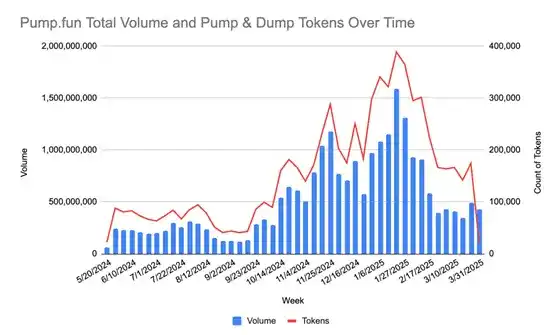
Meme coin issuance has long ceased to be a competition of creativity, but an assembly line for issuing coins and profiting. Top deployers, after making extremely short-cycle rapid profits, can then invest funds into facilities related to automatic coin issuance, making their harvesting speed even faster.

pump.fun has driven the cost of issuing new meme coins on Solana down to $2 or even less, which is indeed a technological advancement. However, they have not guided the meme coin track towards a benign development direction, making retail and institutional investors believe that meme coins are indeed a cultural or even belief-based asset. They tried to broaden the track to直播币, ICM coins, and recently AI Agent coins, but none of these attempts have been successful.

The data is there. The money they make the most is still earned by providing "low-cost harvesting tools," just like a casino taking a cut.

For pump.fun, deployers earn a risk-free 0.95% return for every new coin they issue and for every bit of fake volume they wash trade before the token graduates. If you want your token to get more exposure, you need to wash trade even more volume, providing pump.fun with even more revenue. The funds in this ecosystem are real, the revenue is real, but the ecosystem itself is non-organic, and retail investors are hurt. For institutional investors, such an ecosystem lacks a healthy, sustainable long-term foundation, which is perhaps the fundamental reason for pump.fun's depressed token price.

In the end, we have one more question:

Since pump.fun's repurchases cannot boost the token price, wouldn't using the daily revenue for staking rewards be better than the current repurchase strategy?

Maybe, or maybe they just don't care anymore.

Câu hỏi Liên quan

QIs pump.fun's daily revenue of over a million dollars real, and how is it verified?

AYes, pump.fun's revenue is real and verified through on-chain analysis. The bonding curve revenue is collected via a smart contract address with no external SOL transfers, and the Pumpswap and Terminal(Padre) revenues are calculated from immutable Solana on-chain data via Dune SQL, independent of pump.fun's API.

QWhat are the main sources of pump.fun's revenue?

Apump.fun's revenue comes from three main sources: 0.95% protocol fees from bonding curve transactions before a token graduates, 0.93% protocol fees from trades of graduated tokens on Pumpswap (for tokens with a market cap of 0-420 SOL), and revenue from the Terminal (formerly Padre) multi-chain trading platform acquired in October.

QWhy is the price of $PUMP token performing poorly despite significant buybacks?

AThe $PUMP token price remains low primarily due to a lack of buy-side demand and market recognition. Despite the team buying back over 10% of the total supply (over 30% of the circulating supply), the ecosystem is seen as a non-organic 'casino' for meme coin scams, which discourages institutional and long-term investor interest.

QWhat does the data say about the legitimacy and success rate of tokens launched on pump.fun?

AData from Solidus Labs indicates that 98.6% of tokens launched on pump.fun from January 2024 to March 2025 were pump-and-dump scams. While a small percentage of deployers (largely automated, top-tier ones) are highly profitable, the vast majority of tokens are designed for rapid, short-term exploitation rather than genuine community or cultural value.

QHow does the current activity and token deployment on pump.fun compare to market sentiment?

ADespite a bearish overall market sentiment, on-chain data shows that pump.fun's activity has increased. Daily active addresses are up about 10% compared to September, with approximately 30,000 new tokens deployed daily. However, this high volume is largely driven by automated, profit-focused deployers rather than organic user growth, creating a disparity between on-chain metrics and negative public perception.

Nội dung Liên quan

Lần thứ 38 Trump tuyên bố 'sắp đạt được thỏa thuận', thị trường chứng khoán toàn cầu bùng nổ theo kiểu TACO

Tổng thống Mỹ Donald Trump lần thứ 38 tuyên bố "sắp đạt được thỏa thuận" về căng thẳng với Iran, kích hoạt làn sóng tăng giá "kiểu TACO" trên toàn cầu. Chỉ số chính của Mỹ (Dow Jones, Nasdaq, S&P 500) và châu Á (Nhật Bản, Hàn Quốc) đồng loạt tăng mạnh, trong khi giá dầu giảm. Nguyên nhân được cho là thị trường kỳ vọng vào việc giải quyết xung đột và dữ liệu CPI lõi của Mỹ tháng 5 tuy cao nhưng không vượt kỳ vọng, làm giảm áp lực tăng lãi suất từ Fed. Tuy nhiên, tình hình vẫn bất ổn. Phía Iran phủ nhận có đột phá trong đàm phán. Nhiều tổ chức như Barclays và Bank of America cảnh báo thị trường đang quá nóng và có nguy cơ điều chỉnh sâu, với các tín hiệu như tỷ lệ bán khống tăng cao ở Hàn Quốc. Một thách thức thanh khoản khác là đợt IPO hút vốn khổng lồ của SpaceX, khiến nhà đầu tư có thể bán chứng khoán hiện có để tham gia. Tóm lại, thị trường tài chính toàn cầu đang phản ứng tích cực với các tín hiệu đàm phán, nhưng triển vọng vẫn phụ thuộc vào diễn biến thực tế của xung đột, chính sách tiền tệ và áp lực thanh khoản từ các sự kiện như IPO. Cần thận trọng trước khả năng biến động tiếp tục từ những tuyên bố bất ngờ.

Odaily星球日报4 phút trước

Lần thứ 38 Trump tuyên bố 'sắp đạt được thỏa thuận', thị trường chứng khoán toàn cầu bùng nổ theo kiểu TACO

Odaily星球日报4 phút trước

Suy giảm hệ sinh thái người dùng cá nhân, ZKsync kỳ vọng vào thử nghiệm ngân hàng để phá cục

Bài viết thảo luận về sự thay đổi chiến lược của ZKsync từ việc tập trung vào hệ sinh thái DeFi cho người dùng cá nhân sang hướng đến cung cấp cơ sở hạ tầng tài chính cho các ngân hàng và tổ chức truyền thống. Động thái này diễn ra trong bối cảnh hệ sinh thái DeFi phi tập trung trên ZKsync Era suy giảm mạnh về tổng giá trị bị khóa (TVL) và khối lượng giao dịch, dẫn đến việc các giao thức lớn như Aave rút khỏi mạng lưới. ZKsync đang cạnh tranh trong thị trường tài sản được mã hóa dự kiến đạt hàng chục nghìn tỷ USD bằng cách cung cấp các giải pháp như Prividium và Bank Stack, nhấn mạnh tính riêng tư, kiểm soát tuân thủ và khả năng kết nối với Ethereum. Các ngân hàng như Deutsche Bank và nền tảng Tradable đã triển khai thí điểm. Tuy nhiên, mô hình quản trị phi tập trung của ZKsync, nơi cộng đồng người nắm giữ token có thể bỏ phiếu thay đổi các thông số như phí, tạo ra sự không chắc chắn về quy tắc và chi phí cho các tổ chức - điều mà các mạng riêng hoặc liên minh như của J.P. Morgan hay R3 Corda không có. Bài viết đặt câu hỏi liệu ZKsync có thể thành công trong việc thu hút các tổ chức tài chính truyền thống, vốn thường ưa thích sự kiểm soát và ổn định, hay không. Kết quả của cuộc thử nghiệm này, giữa công nghệ tiên tiến và mô hình quản trị mở, sẽ quyết định tương lai của dự án trong 18 tháng tới.

Foresight News16 phút trước

Suy giảm hệ sinh thái người dùng cá nhân, ZKsync kỳ vọng vào thử nghiệm ngân hàng để phá cục

Foresight News16 phút trước

Cảnh báo về AI đệ quy của Anthropic, công ty mới của Tian Yuandong vừa thực hiện 'bước đầu tiên'

Anthropic gần đây đã công bố bài viết "Khi AI tự xây dựng chính mình", cảnh báo về tương lai của việc AI có thể tự cải thiện một cách đệ quy. Trong bối cảnh này, công ty Recursive Superintelligence do Tian Yandong đồng sáng lập đã công bố bước đầu tiên về nghiên cứu AI tự động, mang tên "First Steps Toward Automated AI Research". Hệ thống này nhằm mục đích tự động hóa vòng lặp nghiên cứu AI truyền thống: đề xuất ý tưởng, viết mã, chạy thử nghiệm, phân tích và học hỏi để quyết định bước tiếp theo. Nó được thử nghiệm trên ba lĩnh vực khác nhau và đều đạt kết quả tốt nhất hiện tại (SOTA): 1. **NanoChat Autoresearch:** Huấn luyện mô hình ngôn ngữ nhỏ với ngân sách tính toán cố định, giảm tổn thất kiểm chứng xuống 0.9109 BPB. 2. **NanoGPT Speedrun:** Rút ngắn thời gian huấn luyện mô hình GPT xuống mức kỷ lục 77,5 giây thông qua các kỹ thuật như tính toán chú ý FP8 và tối ưu kernel GPU. 3. **SOL-ExecBench:** Tối ưu hóa kernel GPU, nâng điểm số SOL lên 0,754, thu hẹp 18% khoảng cách với giới hạn lý thuyết phần cứng. Recursive Superintelligence, với đội ngũ toàn sao và số vốn huy động lớn, theo đuổi sứ mệnh xây dựng hệ thống AI có khả năng tự cải thiện đệ quy. Thành công bước đầu này đánh dấu sự xuất hiện của một mô hình phát triển AI mới, nơi AI đóng vai trò chủ thể trong nghiên cứu. Điều này có thể thay đổi tốc độ và chi phí tiến bộ AI, đồng thời làm dấy lên những thảo luận về sự cần thiết phải điều phối và quản trị toàn cầu, như lời cảnh báo từ Anthropic.

marsbit24 phút trước

Cảnh báo về AI đệ quy của Anthropic, công ty mới của Tian Yuandong vừa thực hiện 'bước đầu tiên'

marsbit24 phút trước

Hướng Dẫn Mua Vàng Đáy: Theo Dõi Lãi Suất, Đừng Chỉ Nhìn Vào Chiến Tranh

**Hướng dẫn Mua Vàng Khi Giảm: Theo Dõi Lãi Suất, Đừng Chỉ Nhìn Vào Chiến Tranh** Cơn sốt vàng hồi tháng 1 đã đạt đỉnh và đảo chiều ngay cả trước khi chiến tranh Mỹ-Iran nổ ra một tháng, chứng tỏ động lực chính là chính sách tiền tệ, không phải xung đột. Việc Cục Dự trữ Liên bang Mỹ (Fed) đề cử chủ tịch có quan điểm diều hâu đã khiến giá vàng lao dốc. Bài học lặp lại trong 4 tháng qua: xung đột đẩy giá dầu lên, kéo theo kỳ vọng lạm phát cao và áp lực Fed thắt chặt chính sách. Vàng không sinh lãi, nên lãi suất càng cao, chi phí cơ hội nắm giữ càng lớn. Kỳ vọng chuyển từ giảm lãi suất sang tăng lãi suất sau chiến tranh đã phá hủy nền tảng của phe mua. Đợt giảm giá này còn mang đặc điểm của việc giảm đòn bẩy toàn thị trường. Các nhà đầu tư buộc phải bán tài sản thanh khoản tốt (như vàng, Bitcoin, thậm chí cổ phiếu Nasdaq) để bù ký quỹ, khiến chúng biến động cùng chiều bất thường. Lịch sử cho thấy đáy của vàng không liên quan đến ngừng bắn, mà liên quan đến điểm ngoặt chính sách (như Fed ngừng tăng lãi suất hoặc chuyển sang nới lỏng). So sánh với các đợt giảm năm 2022 và 2008, đợt giảm hiện tại mới kéo dài 4 tháng. **Các tín hiệu cần theo dõi để xác định điểm đáy tiềm năng:** 1. **Kỳ vọng tăng lãi suất đạt đỉnh:** Theo dõi tín hiệu từ Fed. 2. **Eo biển Hormuz thông trở lại:** Giảm áp lực lạm phát từ giá dầu. 3. **Dòng tiền ETF vàng chuyển từ ròng rút sang ròng mua:** Cho thấy áp lực bán ép đã kết thúc. **Gợi ý cách tiếp cận (quan điểm cá nhân):** Không thể dự đoán chính xác đáy. Có thể cân nhắc phân bổ vốn thành nhiều đợt trong phạm vi mục tiêu giảm từ 4000 đến 3500 USD/ounce, với tổng vốn ban đầu không quá 30% kế hoạch. Chỉ tăng mạnh vị thế khi ít nhất 2 trong 3 tín hiệu trên xuất hiện, chấp nhận đánh đổi một phần lợi nhuận để lấy tính xác định cao hơn. Tóm lại, trong môi trường hiện tại, theo dõi lãi suất và động thái của Fed có ý nghĩa then chốt hơn là chỉ tập trung vào diễn biến chiến sự khi đưa ra quyết định với vàng.

marsbit30 phút trước

Hướng Dẫn Mua Vàng Đáy: Theo Dõi Lãi Suất, Đừng Chỉ Nhìn Vào Chiến Tranh

marsbit30 phút trước

Tổng kết trên chuỗi thời gian gần đây: Sự biến động không có chủ đạo dưới tác động của thị trường chứng khoán Mỹ

Trong bối cảnh thị trường ETH chính chậm lại, các nhà đầu tư "degen" đang quay trở lại Solana. Tuy nhiên, thị trường Solana hiện thiếu một chủ đề chính rõ ràng, có thể được mô tả là sự giằng co giữa "cạnh tranh thu hút sự chú ý" và "sự trở lại của cộng đồng". **Cạnh tranh thu hút sự chú ý (Attention PvP):** Các meme coin như $JOTCHUA và $WORLDCUP trên Solana chứng kiến biến động giá mạnh nhờ vào sự ủng hộ của người nổi tiếng, sự kiện nóng hoặc phân tích của KOL, bất chấp việc chúng có thể thiếu tính "hữu cơ" hoặc cộng đồng thực sự. Trong khi đó, các dự án tương tự trên các chain khác như $PITCH trên Base lại gặp khó khăn. Nền tảng pump.fun gần đây ra mắt tính năng "pump fun GO" cho phép tạo nhiệm vụ trả phí để thu hút sự chú ý, dẫn đến những sự việc gây tranh cãi như việc thưởng SOL cho người xăm hình token lên trán hay ăn côn trùng, khiến thị trường mang tính chất giải trí và đầu cơ cao. **Sự trở lại của cộng đồng:** Mặt khác, một số dự án dựa vào cộng đồng bền vững đang được chú ý. KOL Ansem nhấn mạnh tầm quan trọng của việc có cộng đồng gắn bó lâu dài thay vì chỉ phụ thuộc vào một người nổi tiếng. Các token như $neet (với thông điệp phản đối văn hóa làm việc quá mức), $troll, $buttcoin và $triplet được đề cao nhờ khả năng tồn tại và sự ủng hộ vững chắc từ cộng đồng. Một ví dụ điển hình là $KINS, token của game MMORPG Kintara. Dự án này xây dựng niềm tin thông qua việc cập nhật nội dung game nhất quán, tích hợp các yếu tố cộng đồng và tập trung vào trải nghiệm người chơi thay vì chỉ tập trung vào tài chính. Cách tiếp cận này đã thu hút được một cộng đồng người chơi trung thành và cả sự chú ý của các KOL. Bài viết kết luận với câu hỏi về bản chất thị trường: liệu chúng ta đang tham gia vào một trò chơi xây dựng sự tin tưởng hay một trò chơi lừa dối lẫn nhau, và hy vọng sự suy ngẫm này sẽ dẫn đến một thị trường lành mạnh hơn.

marsbit30 phút trước

Tổng kết trên chuỗi thời gian gần đây: Sự biến động không có chủ đạo dưới tác động của thị trường chứng khoán Mỹ

marsbit30 phút trước

Giao dịch

Giao ngay
Hợp đồng Tương lai
活动图片





