Did Vitalik Buterin Just Kill Ethereum Layer-2s? Here’s What He Said

bitcoinistXuất bản vào 2026-02-05Cập nhật gần nhất vào 2026-02-05

Tóm tắt

Vitalik Buterin is reframing the narrative around Ethereum's layer-2s, arguing that the original vision of L2s as "branded shards" primarily for scaling no longer fits current realities. With low L1 fees and an expected gas limit increase in 2026, he states Ethereum is scaling on its own, reducing the need for L2s solely for capacity. Buterin highlights that many L2s are slow to reach "stage 2" decentralization and some may never intend to, due to technical challenges or regulatory requirements that demand ultimate control. He proposes a spectrum model where L2s offer varying levels of security and trust, rather than uniformly claiming to "scale Ethereum." Buterin advises L2 teams to differentiate through features like specialized execution, privacy, or ultra-low latency, rather than scaling alone. He emphasizes the importance of "stage 1" security for handling ETH or Ethereum-based assets and advocates for a native ZK-EVM precompile to simplify trustless interoperability and synchronous composability. Buterin concludes that while some chains will remain trust-dependent, the focus should be on clear user guarantees and base-layer strength, shifting competition from scaling to proving credible offerings.

Vitalik Buterin is signaling a major reframing of Ethereum’s layer-2 narrative: not the death of rollups, but the end of the idea that L2s are shards whose primary job is scaling the network. With L1 fees now low and gas limit projected to rise sharply in 2026, he argues the rollup-centric roadmap’s original premise no longer fits the reality on the ground.

Buterin opened his X post on Feb. 3 by pointing to two pressures that have been building in parallel: L2s have moved to “stage 2” far more slowly than expected, and Ethereum mainnet is scaling in its own right. In his telling, those trends break the old mental model in both directions.

“Ethereum needs to scale,” he wrote, recapping what he framed as the original thesis. “The definition of ‘Ethereum scaling’ is the existence of large quantities of block space that is backed by the full faith and credit of Ethereum... block space where, if you do things (including with ETH) inside that block space, your activities are guaranteed to be valid, uncensored, unreverted, untouched, as long as Ethereum itself functions. If you create a 10000 TPS EVM where its connection to L1 is mediated by a multisig bridge, then you are not scaling Ethereum.”

The punchline is blunt: “This vision no longer makes sense.” Buterin says L1 doesn’t need L2s to serve as “branded shards” if base-layer capacity is expanding, and he’s increasingly skeptical that many L2s either can or want to meet the security and control expectations that label implies. He pointed to at least one L2 that, in his words, “may never want to go beyond stage 1,” citing not only technical concerns around ZK-EVM safety but also customer-driven regulatory requirements that “require them to have ultimate control.”

Ethereum Layer-2’s Need To Change

That’s not presented as an indictment so much as a categorization shift. If an L2 retains ultimate control, it may still be a valid product for its users, Buterin suggested, but it shouldn’t be marketed as “scaling Ethereum” in the strict sense envisioned by the rollup-centric roadmap. In that context, he argues, “we should stop thinking about L2s as literally being ‘branded shards’, with the social status and responsibilities that this entails.”

Instead, he sketches a spectrum model: some L2s can be tightly backed by ETH’s security guarantees, while others can be looser and more optional depending on user needs. That spectrum framing implicitly makes room for app-specific chains, different trust models, and non-EVM environments—without forcing them into a single “rollup as shard” storyline.

For L2 teams, Buterin’s guidance is straightforward: stop anchoring your identity on scaling alone. If you’re handling ETH or Ethereum-issued assets, he argues “stage 1 at the minimum” matters; otherwise, you’re effectively operating as “just a separate L1 with a bridge.” The real differentiator, in his view, should be features and properties that a larger L1 still won’t provide—whether that’s specialized execution environments, privacy, sequencing characteristics like ultra-low latency, or non-financial use cases.

Buterin says he’s become “more convinced of the value of the native rollup precompile,” especially once Ethereum has enshrined the ZK-EVM proof verification it “need[s] anyway to scale L1.” The idea is a protocol-level precompile that verifies ZK-EVM proofs and is treated as part of Ethereum itself, meaning it would “auto-upgrade along with Ethereum,” and if it shipped with a bug, “Ethereum will hard-fork to fix the bug.”

That last point is the subtext: he wants a path where trustless verification and interoperability are easier to achieve without a “security council,” and where rollups can add custom features while still anchoring their EVM correctness directly to Ethereum. He also tied this direction to the prospect of synchronous composability: transactions that can safely span L1 and L2 liquidity with tight coupling, referencing ongoing research on combining preconfirmations with based rollups and real-time proving.

Buterin’s conclusion leaves room for uncomfortable outcomes. A permissionless ecosystem will produce chains with “trust-dependent, or backdoored, or otherwise insecure” elements, he wrote, calling that “unavoidable.” The job, as he frames it, is to make guarantees legible to users while strengthening Ethereum’s base layer, suggesting that the next phase of L2 competition may be less about who “scales Ethereum,” and more about who can credibly define, and prove, what they’re actually offering.

At press time, ETH traded at $2,256.
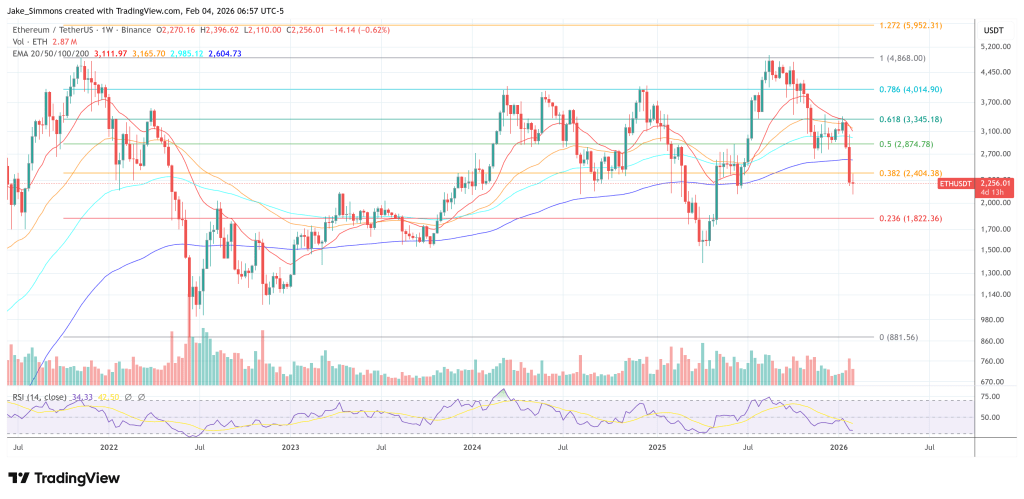
ETH remains below between the 0.382 Fib, 1-week chart | Source: ETHUSDT on TradingView.com

Câu hỏi Liên quan

QWhat is the main shift in Ethereum's layer-2 narrative that Vitalik Buterin is signaling?

AHe is reframing the narrative away from viewing L2s as 'shards' whose primary purpose is scaling, arguing that this vision no longer makes sense given low L1 fees and Ethereum's own scaling progress.

QAccording to Buterin, what is the original definition of 'Ethereum scaling' that he now says is outdated?

AThe original definition was the existence of large quantities of block space backed by the full faith and credit of Ethereum, guaranteeing activities are valid, uncensored, and unreverted as long as Ethereum functions.

QWhat new model does Buterin propose for categorizing Layer-2 solutions?

AHe proposes a spectrum model where some L2s are tightly backed by Ethereum's security, while others can be looser and more optional, making room for different trust models and use cases without forcing them into a single 'rollup as shard' storyline.

QWhat technical solution does Buterin express increased conviction in for the future of rollups?

AHe is more convinced of the value of a 'native rollup precompile,' a protocol-level feature that would verify ZK-EVM proofs and be treated as part of Ethereum itself, auto-upgrading with the main chain.

QWhat does Buterin suggest should be the real differentiator for L2 teams instead of just scaling?

AHe suggests the real differentiator should be features and properties that a larger L1 won't provide, such as specialized execution environments, privacy, ultra-low latency sequencing, or non-financial use cases.

Nội dung Liên quan

Polymarket Bị Kẹt: Bài Kiểm Tra Thực Sự Sau Khi Vượt Qua Giai Đoạn Lưu Lượng Tăng Đột Biến

Polymarket, nền tảng dự đoán thị trường hàng đầu, đang đối mặt với thách thức lớn khi trải nghiệm giao dịch xuống cấp do hạ tầng không theo kịp đà tăng trưởng. Phó chủ tịch kỹ thuật Josh Stevens thừa nhận vấn đề và công bố kế hoạch cải tổ toàn diện, bao gồm: giảm độ trễ dữ liệu, sửa lỗi hủy lệnh, xây dựng lại hệ thống order book (CLOB), nâng cao hiệu suất website, và quan trọng nhất là di chuyển chain (chain migration). Nguyên nhân sâu xa nằm ở việc Polymarket không còn là ứng dụng dự đoán đơn thuần mà đã phát triển thành một nền tảng giao dịch tần suất cao. Polygon, từng là lựa chọn chi phí thấp hoàn hảo, giờ đây trở thành rào cản kỹ thuật. Động thái này ngay lập tức thu hút sự quan tâm của các blockchain khác như Solana, Sui, Algorand... trong khi Polygon nỗ lực giữ chân ứng dụng quan trọng này - nguồn đóng góp phí giao dịch đáng kể cho hệ sinh thái của họ. Bài kiểm tra thực sự của Polymarket không chỉ là chọn chain mới, mà là xây dựng một hệ thống giao dịch đủ mạnh và ổn định để giữ chân người dùng trong giai đoạn tăng trưởng mới, nơi độ tin cậy quan trọng hơn bao giờ hết.

Odaily星球日报04/27 03:21

Polymarket Bị Kẹt: Bài Kiểm Tra Thực Sự Sau Khi Vượt Qua Giai Đoạn Lưu Lượng Tăng Đột Biến

Odaily星球日报04/27 03:21

Điều chỉnh kỳ vọng giảm cho chu kỳ tăng giá tiếp theo của BTC

Tác giả Alex Xu, một nhà đầu tư Bitcoin lâu năm, đã chia sẻ quyết định giảm dần tỷ trọng BTC trong danh mục đầu tư của mình, từ vị thế lớn nhất xuống còn khoảng 30%, và giải thích lý do cho việc điều chỉnh kỳ vọng về đỉnh giá trong chu kỳ bull market tiếp theo. Các lý do chính bao gồm: 1. **Năng lượng tăng trưởng tiềm năng giảm:** Các chu kỳ trước được thúc đẩy bởi việc mở rộng đối tượng đầu tư theo cấp số nhân (từ cá nhân đến tổ chức). Chu kỳ tới cần sự chấp nhận từ các quỹ đầu tư quốc gia hoặc ngân hàng trung ương, điều này khó xảy ra trong 2-3 năm tới. 2. **Chi phí cơ hội cá nhân:** Tìm thấy nhiều cơ hội đầu tư hấp dẫn khác (cổ phiếu công ty) với mức giá hợp lý. 3. **Tác động tiêu cực từ sự thu hẹp của ngành crypto:** Nhiều mô hình Web3 (SocialFi, GameFi...) không thành công, dẫn đến sự thu hẹp của toàn ngành và làm chậm tốc độ tăng trưởng số người nắm giữ BTC. 4. **Áp lực từ nhà mua lớn nhất (MicroStrategy):** Chi phí huy động vốn của MicroStrategy tiếp tục tăng cao (lãi suất 11.5%), có thể làm giảm tốc độ mua vào và gây áp lực bán. 5. **Sự cạnh tranh từ Vàng được token hóa:** Sản phẩm vàng token hóa (tokenized gold) đã thu hẹp khoảng cách về tính dễ chia nhỏ, dễ mang theo và dễ xác minh so với BTC. 6. **Vấn đề ngân sách bảo mật:** Phần thưởng khối giảm sau mỗi lần halving làm trầm trọng thêm vấn đề ngân sách cho bảo mật mạng lưới. Tác giả vẫn giữ một phần BTC đáng kể và sẵn sàng mua lại nếu các lý kiến trên được giải quyết hoặc xuất hiện các yếu tố tích cực mới, với điều kiện giá cả phù hợp.

marsbit04/27 02:46

Điều chỉnh kỳ vọng giảm cho chu kỳ tăng giá tiếp theo của BTC

marsbit04/27 02:46

Giao dịch

Giao ngay
Hợp đồng Tương lai

Bài viết Nổi bật

Làm thế nào để Mua LAYER

Chào mừng bạn đến với HTX.com! Chúng tôi đã làm cho mua Solayer (LAYER) trở nên đơn giản và thuận tiện. Làm theo hướng dẫn từng bước của chúng tôi để bắt đầu hành trình tiền kỹ thuật số của bạn.Bước 1: Tạo Tài khoản HTX của BạnSử dụng email hoặc số điện thoại của bạn để đăng ký tài khoản miễn phí trên HTX. Trải nghiệm hành trình đăng ký không rắc rối và mở khóa tất cả tính năng. Nhận Tài khoản của tôiBước 2: Truy cập Mua Crypto và Chọn Phương thức Thanh toán của BạnThẻ Tín dụng/Ghi nợ: Sử dụng Visa hoặc Mastercard của bạn để mua Solayer (LAYER) ngay lập tức.Số dư: Sử dụng tiền từ số dư tài khoản HTX của bạn để giao dịch liền mạch.Bên thứ ba: Chúng tôi đã thêm những phương thức thanh toán phổ biến như Google Pay và Apple Pay để nâng cao sự tiện lợi.P2P: Giao dịch trực tiếp với người dùng khác trên HTX.Thị trường mua bán phi tập trung (OTC): Chúng tôi cung cấp những dịch vụ được thiết kế riêng và tỷ giá hối đoái cạnh tranh cho nhà giao dịch.Bước 3: Lưu trữ Solayer (LAYER) của BạnSau khi mua Solayer (LAYER), lưu trữ trong tài khoản HTX của bạn. Ngoài ra, bạn có thể gửi đi nơi khác qua chuyển khoản blockchain hoặc sử dụng để giao dịch những tiền kỹ thuật số khác.Bước 4: Giao dịch Solayer (LAYER)Giao dịch Solayer (LAYER) dễ dàng trên thị trường giao ngay của HTX. Chỉ cần truy cập vào tài khoản của bạn, chọn cặp giao dịch, thực hiện giao dịch và theo dõi trong thời gian thực. Chúng tôi cung cấp trải nghiệm thân thiện với người dùng cho cả người mới bắt đầu và người giao dịch dày dạn kinh nghiệm.

Tổng lượt xem 405Xuất bản vào 2025.02.11Cập nhật vào 2025.03.21

Làm thế nào để Mua LAYER

Thảo luận

Chào mừng đến với Cộng đồng HTX. Tại đây, bạn có thể được thông báo về những phát triển nền tảng mới nhất và có quyền truy cập vào thông tin chuyên sâu về thị trường. Ý kiến ​​của người dùng về giá của LAYER (LAYER) được trình bày dưới đây.

活动图片













