Dialogue with a16z Crypto Partner: Privacy Will Become the Most Important 'Moat' in Cryptocurrency

marsbitXuất bản vào 2026-02-02Cập nhật gần nhất vào 2026-02-02

Tóm tắt

In a discussion with a16z Crypto’s Ali Yahya, the argument is made that privacy will become the most critical moat in the cryptocurrency space, driving winner-take-all network effects. As blockchains become increasingly commoditized and performance differences narrow, privacy stands out as a key differentiator. Unlike social media, where users may overlook privacy, financial activities demand confidentiality—individuals and institutions will not tolerate transparent exposure of salaries, transactions, or spending habits. Privacy creates strong user lock-in due to the difficulty of migrating secrets between chains. Moving private assets risks exposing metadata, reducing anonymity set size, and compromising security. Thus, users are likely to remain on chains with the largest anonymity pools, reinforcing network effects. Several technologies enable privacy: zero-knowledge proofs (currently leading), fully homomorphic encryption (still theoretical), multi-party computation (for key management), and trusted execution environments (most practical for performance). Hybrid approaches may emerge. Despite concerns around centralization, privacy chains can remain decentralized if they are open-source, verifiable, and node-distributed. Looking ahead, quantum computing poses a long-term threat but is not an immediate risk, while AI’s pervasive data collection will only heighten the demand for privacy.

Author: a16z crypto

Compiled by: Plain Language Blockchain
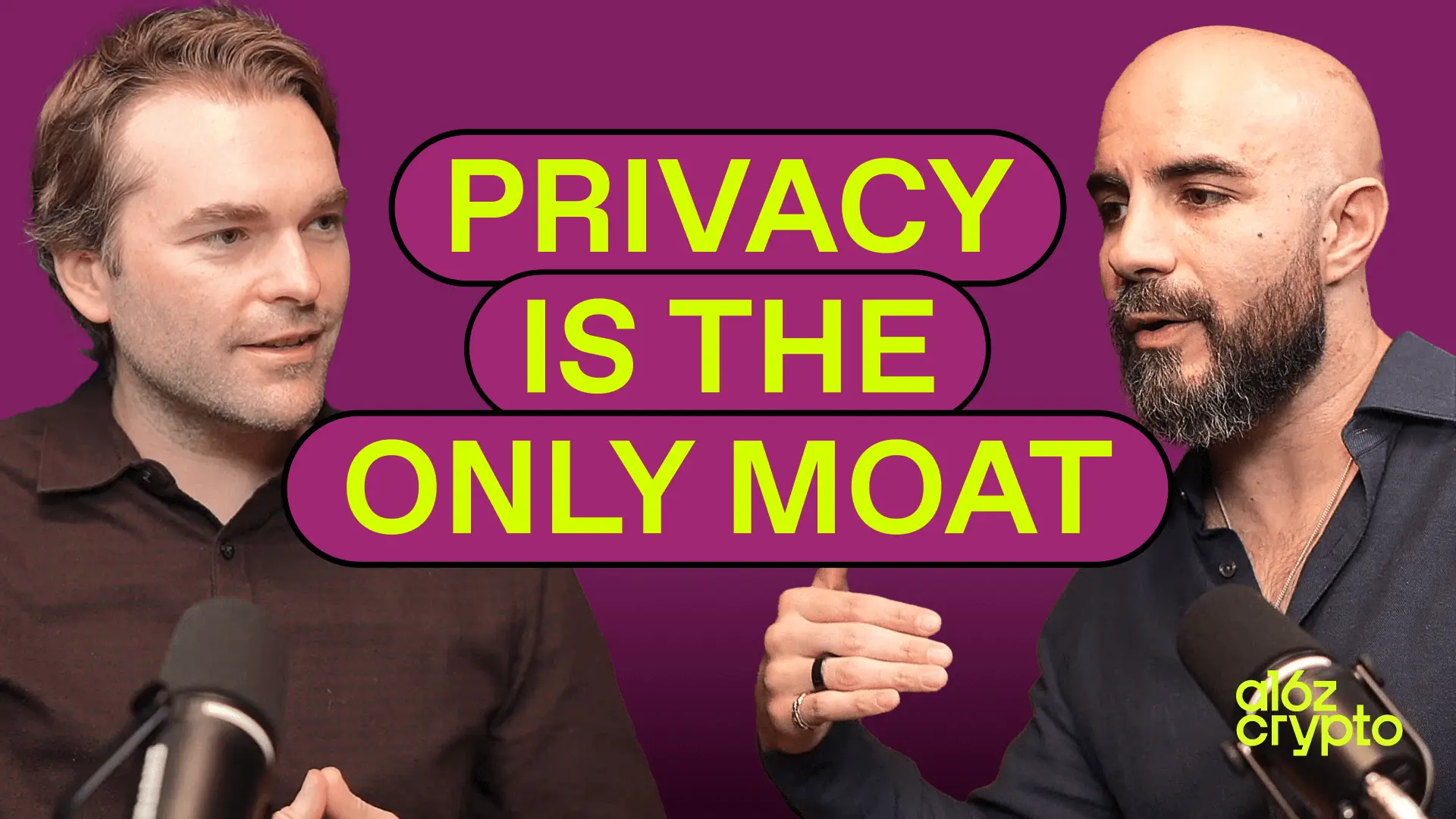
It is often said that users don't truly care about privacy, and in the age of social media, this might be true. But in the financial sector, the rules are completely different. A16Z Crypto partner Ali Yahya has made a significant prediction: privacy will become the most important moat in the cryptocurrency space, triggering "winner-take-all" network effects.

Host: Robert Hackett (A16Z Crypto) Guest: Ali Yahya (General Partner, A16Z Crypto)

I. Why is Performance No Longer a Moat?

Host: Ali, you recently expressed a view that "privacy will become the most important moat in cryptocurrency." That's a big conclusion. What makes you so sure?

Ali: This idea stems from my thoughts on the commoditization of "Block Space." There is now an oversupply of high-performance blockchains, coupled with convenient cross-chain solutions, making the block space of various chains functionally very similar.

In this context, mere "high performance" is no longer sufficient for defense. Privacy is a feature that the vast majority of existing public chains lack. More importantly, privacy can create a special kind of "lock-in effect," thereby strengthening network effects.

Host: Current blockchain teams might refute this; for example, Solana and Ethereum have completely different technical trade-offs and roadmaps. How would you respond to those who think "my chain is unique and irreplaceable"?

Ali: I believe that for general-purpose blockchains, performance is just the entry ticket. To stand out, you must possess one of three things: a thriving ecosystem, an unfair distribution advantage (like Coinbase's Base), or a killer application.

Privacy is special because once users join a privacy chain, their willingness to leave decreases significantly due to the fact that "moving secrets" is much more difficult than "moving assets." This stickiness is something transparent public chains currently lack.

II. Do Users Really Care About Privacy?

Host: Many people believe users aren't concerned about privacy—just look at Facebook. What makes you think the situation will be different in the crypto space?

Ali: People might not care about 'like' data, but they absolutely care about financial data.

If cryptocurrency is to go mainstream, privacy is a must. Not only individuals, but businesses and financial institutions absolutely cannot tolerate their payrolls, transaction histories, and asset preferences being monitored in real-time by the whole world. In the context of finance, privacy is a rigid demand.

Host: Can you give a few specific examples? What kind of data do people most want to keep private?

Ali: There are so many. What did you buy on Amazon? What websites did you subscribe to? How much money did you send to which friend? What are your salary, rent, and balance? This information can be easily parsed from your financial activities. Without privacy, it's equivalent to walking down the street with a transparent wallet that everyone can stare into.

III. Why Are "Secrets" Hard to Migrate?

Host: You mentioned a key point: "Secrets are hard to migrate." Is this a technical problem or a social one at its core?

Ali: It's a core technical problem. Privacy systems rely on an "Anonymity Set." Your privacy is secure because your activity is mixed with the activities of thousands of other users.

The larger the anonymity set, the more secure the privacy.

Cross-chain risk: When you move privacy assets from one anonymity zone to another, it generates a lot of metadata leakage (like transaction timing, amount correlation, network layer characteristics).

This creates a situation where users tend to stay on the chain with the largest user base and anonymity set. Because cross-chain is not only troublesome but also risks "identity exposure." This self-reinforcing feedback effect will eventually lead to the market being dominated by only a few large privacy chains.

IV. Technical Path: How to Achieve Privacy?

Host: What technical means do we currently have to realize the vision you described?

Ali: There are mainly four technologies:

Zero-Knowledge Proofs (ZK Proofs): Prove a transaction is valid without revealing its content; currently the fastest progressing.

Fully Homomorphic Encryption (FHE): Allows computation on encrypted data; the most powerful functionally but extremely computationally intensive, still largely theoretical.

Multi-Party Computation (MPC): Multiple parties collaboratively compute without revealing their respective data; often used for key management.

Trusted Execution Environments (TEE): Relies on "isolated areas" provided by hardware manufacturers like Intel or Nvidia for encrypted computation; this is currently the most pragmatic and highest-performance method.

Ali: Actually, we might see a stacking of these technologies. For example, using TEE for performance, with an additional layer of MPC as a defensive barrier, ensuring privacy remains secure even if the hardware is physically compromised.

V. The Conflict Between Decentralization and "Winner-Take-All"

Host: The core spirit of crypto is decentralization and interoperability. If privacy chains present a "winner-take-all" scenario in the future, does this contradict the original intention?

Ali: I don't think so. Decentralization refers to "control" not "fragmentation."

A privacy chain is decentralized as long as it is open-source, its code is verifiable, and its validator nodes are dispersed. This provides developers with a "can't be evil" platform guarantee. Compared to the Web2 era behavior of locking in users by blocking APIs, the lock-in in the crypto privacy space is based on algorithms and security risks; the rules are still fair and neutral.

VI. Future Perspective: Quantum Threats and AI

Host: Looking at the long-term future, couldn't quantum computing break these privacy technologies?

Ali: This is a very real concern. According to assessments from our research team (like Dan Boneh), quantum attackers likely won't be able to break modern cryptography for maybe 15 years. While we should start preparing "quantum-resistant" solutions now, there's no need for excessive panic currently.

Host: One last question, when AI agents start taking over the internet, what kind of collision will happen with your privacy theory?

Ali: In the AI era, each of us lives in a "panopticon," where our every activity provides training data for the next generation of models. As AI becomes omnipresent, the human demand for privacy will only become stronger than it is now.


Câu hỏi Liên quan

QWhy does Ali Yahya believe privacy will become the most important moat in cryptocurrency?

AAli argues that as block space becomes commoditized with many high-performance blockchains and cross-chain solutions, performance alone is no longer a differentiator. Privacy, which is absent in most public blockchains, creates a strong lock-in effect due to the difficulty of moving secrets, thereby reinforcing network effects and leading to a winner-take-all dynamic.

QHow does Ali respond to the argument that users don't care about privacy, citing examples like Facebook?

AHe distinguishes between social data and financial data, stating that while users might not care about social media likes, they absolutely care about financial privacy. For crypto to go mainstream, privacy is a necessity, as individuals, businesses, and institutions cannot tolerate their financial transactions, salaries, and asset preferences being publicly visible.

QWhat is the technical reason why 'secrets are hard to move' between chains?

APrivacy relies on a large 'anonymity set' where user activity is mixed with many others. Moving secrets across chains generates metadata leaks (e.g., transaction timing, amount correlation, network-layer features), which risks exposing a user's identity. This makes users prefer to stay on the chain with the largest anonymity set, creating a self-reinforcing feedback loop.

QWhat are the four main technical approaches to achieving privacy in crypto mentioned by Ali?

AThe four approaches are: 1) Zero-Knowledge Proofs (ZK Proofs) for proving transaction validity without revealing content; 2) Fully Homomorphic Encryption (FHE) for computing on encrypted data; 3) Multi-Party Computation (MPC) for collaborative computation without exposing individual data; and 4) Trusted Execution Environments (TEE) which use hardware-secured isolated areas for encrypted computation.

QHow does Ali reconcile the 'winner-take-all' potential of privacy chains with the crypto ethos of decentralization?

AHe argues that decentralization is about control, not fragmentation. A privacy chain can be decentralized if it is open-source, code-verifiable, and has a dispersed set of validator nodes, providing a 'can't be evil' platform guarantee. The lock-in effect is based on algorithmic and security risks, which are fair and neutral, unlike Web2 practices of locking users in by blocking APIs.

Nội dung Liên quan

Việc Giảm Mạnh STRC Của Strategy Cho Thấy Rủi Ro Đằng Sau Các Sản Phẩm Tín Dụng Liên Kết Bitcoin

Việc cổ phiếu ưu đãi STRC của Strategy (công ty mẹ của MicroStrategy) giao dịch giảm mạnh dưới mệnh giá 100 USD đã làm nổi bật rủi ro đằng sau các sản phẩm tín dụng gắn với Bitcoin. Dù CEO Matt Cole mô tả đây là đợt "thanh lọc đòn bẩy" do bán ép chứ không phải sự kiện vỡ nợ cơ bản, sự sụt giảm vẫn cho thấy mức độ nhanh chóng mà đòn bẩy có thể làm lộ ra điểm yếu trong các công cụ liên quan đến chiến lược kho bạc Bitcoin. Sự kiện này nhấn mạnh rằng các sản phẩm tín dụng Bitcoin mang rủi ro khác biệt so với nắm giữ BTC trực tiếp hoặc cổ phiếu phổ thông, đặc biệt khi nhà đầu tư sử dụng vay mượn. Nó cũng phản ánh sự phức tạp ngày càng tăng của thị trường tài chính hóa các kho bạc Bitcoin, nơi sự tương tác giữa cổ phiếu ưu đãi, cam kết cổ tức, đòn bẩy và biến động giá Bitcoin có thể dẫn đến bán ép trong điều kiện thanh khoản căng thẳng. Bài học chính là một lời cảnh báo về rủi ro đòn bẩy và tính dễ tổn thương trong cấu trúc tài chính phức tạp, hơn là bằng chứng về khả năng trả nợ của công ty phát hành.

bitcoinist3 giờ trước

Việc Giảm Mạnh STRC Của Strategy Cho Thấy Rủi Ro Đằng Sau Các Sản Phẩm Tín Dụng Liên Kết Bitcoin

bitcoinist3 giờ trước

Tòa Án Tối Cao Australia Trao Thắng Lợi Lớn Cho ASIC Trong Vụ Án Sản Phẩm Yield Tiền Mã Hóa Block Earner

Tòa án Tối cao Úc đã phán quyết nhất trí ủng hộ Ủy ban Chứng khoán và Đầu tư Úc (ASIC) trong vụ kiện chống lại công ty Block Earner. Tòa án xác định sản phẩm "Earner" cố định lợi suất lịch sử của Block Earner là một sản phẩm tài chính và phái sinh, do đó yêu cầu công ty phải có Giấy phép Dịch vụ Tài chính Úc để cung cấp sản phẩm này. Vụ việc giờ sẽ được chuyển lại cho Tòa án Liên bang Toàn thể để xác định hình phạt. Phán quyết này rất quan trọng vì nó áp dụng luật dịch vụ tài chính truyền thống của Úc vào một sản phẩm tiền mã hóa hứa hẹn lợi suất. Nó thiết lập một tiền lệ rõ ràng rằng các sản phẩm cung cấp lợi nhuận có cấu trúc hoặc có đặc điểm kinh tế giống phái sinh có thể phải đáp ứng các yêu cầu cấp phép, bất kể được gắn nhãn là gì. Mặc dù sản phẩm "Earner" cụ thể này không còn được cung cấp, phán quyết cung cấp cho ASIC cơ sở pháp lý vững chắc cho các hành động tương tự trong tương lai, phù hợp với xu hướng toàn cầu của các cơ quan quản lý trong việc đưa các sản phẩm tiền mã hóa vào khuôn khổ quy định hiện hành. Đối với các công ty tiền mã hóa, bài học là cần xem xét kỹ lưỡng bản chất kinh tế của sản phẩm. Đối với người tiêu dùng, phán quyết nhắc nhở rằng các sản phẩm sinh lợi tiềm ẩn rủi ro và khác biệt so với việc nắm giữ tiền mã hóa thông thường. Phán quyết này vạch ra một ranh giới quy định rõ ràng hơn cho ngành công nghiệp tiền mã hóa tại Úc.

bitcoinist6 giờ trước

Tòa Án Tối Cao Australia Trao Thắng Lợi Lớn Cho ASIC Trong Vụ Án Sản Phẩm Yield Tiền Mã Hóa Block Earner

bitcoinist6 giờ trước

Blockchain.com Mở Rộng Truy Cập Cổ Phiếu Token Hóa Thông Qua Ondo Finance

Blockchain.com đã mở rộng khả năng tiếp cận cổ phiếu và ETF được mã hóa (tokenized) của Hoa Kỳ thông qua ví tiền điện tử của mình, nhờ vào quan hệ đối tác với Ondo Finance. Động thái này mang các tài sản trong thế giới thực được quản lý vào giao diện quen thuộc dành cho người dùng tiền điện tử đủ điều kiện, cho phép họ nắm giữ các sản phẩm truyền thống như cổ phiếu bên cạnh stablecoin và công cụ DeFi. Ondo Finance, một tên tuổi nổi bật trong thị trường tài sản thực được mã hóa (RWA), đóng vai trò trung tâm bằng cách cung cấp các sản phẩm tài chính quen thuộc dưới dạng token. Sự hợp tác này giải quyết thách thức về phân phối, đưa các tài sản được mã hóa trực tiếp đến người dùng ví tiền điện tử hiện có. Một khía cạnh quan trọng là mục tiêu phục vụ người dùng bên ngoài Hoa Kỳ, nơi việc tiếp cận thị trường vốn Mỹ có thể bị hạn chế. Giải pháp này cung cấp một lựa chọn thay thế mang tính bản địa hóa cho tiền điện tử, tích hợp vào cơ sở hạ tầng tài chính mà người dùng toàn cầu đã quen thuộc. Bối cảnh thị trường RWA đang trở nên cạnh tranh hơn, với nhiều nền tảng tranh giành để trở thành cổng kết nối chính cho tài sản truyền thống được mã hóa. Blockchain.com và Ondo đặt cược rằng việc tích hợp liền mạch vào ví tiền điện tử có thể cung cấp trải nghiệm đơn giản và đáng tin cậy, giúp thu hẹp khoảng cách so với các sản phẩm môi giới truyền thống.

bitcoinist8 giờ trước

Blockchain.com Mở Rộng Truy Cập Cổ Phiếu Token Hóa Thông Qua Ondo Finance

bitcoinist8 giờ trước

CPU trở lại bàn đàm phán, một vở kịch "thăng tiến" trị giá 1700 tỷ USD bắt đầu

CPU đang trở lại trung tâm sân khấu trong kỷ nguyên AI, dẫn dắt một cơ hội thị trường trị giá 1700 tỷ USD vào năm 2030. Việc chuyển dịch từ huấn luyện sang suy luận (inference) và AI Agent đã làm thay đổi hoàn toàn vai trò của CPU. Trong các tác vụ Agent phức tạp, CPU hiện đảm nhận hơn 70% khối lượng công việc, xử lý luồng điều khiển, gọi công cụ và quản lý bộ nhớ (KV Cache). Tỷ lệ phối hợp GPU:CPU đang thu hẹp từ 1:8 xuống khoảng 1:4, thậm chí 1:1 trong một số trường hợp. Nhu cầu này dẫn đến việc thiếu hụt nguồn cung và lần tăng giá đầu tiên sau hơn một thập kỷ cho server CPU của Intel và AMD, với mức tăng 10-15%. Thị trường CPU server dự kiến tăng từ khoảng 300 tỷ USD năm 2025 lên 1700 tỷ USD vào năm 2030, được thúc đẩy bởi ba phân khúc: điện toán đám mây truyền thống, CPU head-node cho cụm AI và CPU node độc lập cho Agent – một thị trường hoàn toàn mới. NVIDIA cũng đã tham gia cuộc chơi với CPU Vera dựa trên kiến trúc ARM, nhấn mạnh tầm quan trọng chiến lược của CPU. Tại Trung Quốc, các công ty như Hygon (Hải Quang) và Huawei đang nắm bắt cơ hội từ làn sóng nhu cầu này và chương trình thay thế nhập khẩu (xinchuang), với hệ sinh thái phần mềm đang trưởng thành nhanh chóng.

marsbit8 giờ trước

CPU trở lại bàn đàm phán, một vở kịch "thăng tiến" trị giá 1700 tỷ USD bắt đầu

marsbit8 giờ trước

TechFlow Tình Báo: Giám đốc AI của AMD công khai chỉ trích Claude Code 'ngày càng ngốc nghếch và lười biếng', Trump tuyên bố eo biển Hormuz sẽ ngừng bắn toàn diện nhưng vẫn còn 80 quả thủy lôi chờ dọn

TechFlow Intelligence: Tóm tắt tin tức công nghệ & tài chính ngày... * **AI & Mô hình lớn:** Giám đốc AI của AMD chỉ trích Claude Code trở nên "kém thông minh và lười biếng". Z.AI (Trung Quốc) ra mắt GLM-5.2, tuyên bố ngang bằng Claude Opus mà không dùng chip NVIDIA. SK Telecom (Hàn Quốc) bị điều tra về chuyển giao công nghệ với Anthropic. DeepSeek gây sốt trên Zhihu với tính năng đa phương tiện mới. Gemini bị chỉ trích trên Reddit vì đưa lời khuyên sai trong tình huống lừa đảo. * **Chip & Phần cứng:** MIT tự viết hệ điều hành để nghiên cứu chip. Mỹ cáo buộc máy quang khắc EUV tối tân của ASML có thể đã tới Trung Quốc, ASML phủ nhận. Amazon đàm phán bán chip AI tự thiết kế ra bên ngoài. iPhone phiên bản kỷ niệm 20 năm của Apple dự kiến dùng quy trình N2P độc quyền từ TSMC. * **An ninh & Công ty:** Phát hiện 10.000 kho GitHub phân phối phần mềm độc hại. Apple vá lỗ hổng nghe lén nghiêm trọng trên tai nghe Beats. Nhiều kỹ sư Amazon bị điều tra nội bộ vì chỉ trích việc mở rộng trung tâm dữ liệu AI. Microsoft và Amazon có thể đối mặt với điều tra chống độc quyền khắt khe từ EU. * **Web3 / Crypto:** 0G Labs đạt cột mốc 100 tỷ token suy luận AI phi tập trung. Sàn Hàn Quốc Bithumb niêm yết RE, trong khi Upbit hủy niêm yết KERNEL. * **Thị trường & Địa chính trị:** Cổ phiếu bán dẫn Mỹ tăng mạnh, Intel tăng 10.6%, trong khi SpaceX giảm. Eo biển Hormuz chính thức mở cửa theo thỏa thuận Mỹ-Iran, nhưng hiệp hội vận tải dầu cảnh báo vẫn còn khoảng 80 quả thủy lôi trong luồng chính. Gần 80 tàu chở dầu chờ tín hiệu an toàn để xuất phát. Iran hoãn chuyến công du tới Thụy Sĩ, làm dấy lên nghi ngờ về tiến trình hòa bình.

marsbit8 giờ trước

TechFlow Tình Báo: Giám đốc AI của AMD công khai chỉ trích Claude Code 'ngày càng ngốc nghếch và lười biếng', Trump tuyên bố eo biển Hormuz sẽ ngừng bắn toàn diện nhưng vẫn còn 80 quả thủy lôi chờ dọn

marsbit8 giờ trước

Giao dịch

Giao ngay
Hợp đồng Tương lai
活动图片