Contract Audit Passed, Thermometer Did Not: Polymarket's 'Physical Vulnerability' Moment

marsbitXuất bản vào 2026-04-23Cập nhật gần nhất vào 2026-04-23

Tóm tắt

According to reports, an individual manipulated temperature sensors at Paris Charles de Gaulle Airport (LFPG) on April 6th and 15th, causing brief, anomalous spikes of over 3°C. These events were allegedly orchestrated to profit from corresponding low-probability bets on the prediction market Polymarket, turning a small investment into approximately $34,000. The French national meteorological service, Météo-France, filed a criminal lawsuit after discovering signs of physical tampering. The attack required minimal technical skill; the perpetrator reportedly used a battery-powered hairdryer to briefly heat the publicly accessible sensor. Polymarket’s market for Paris temperature settles based on the day's highest recorded temperature from a data chain that runs from the physical sensor to Météo-France, to Weather Underground, and finally to its smart contract. In response, Polymarket did not void the profits or make an official statement. It silently changed the data source for its Paris market from LFPG to Le Bourget Airport (LFPB), a location with similarly unprotected sensors. This incident highlights a critical vulnerability: while the smart contracts are audited and secure, the physical data sources feeding them remain exposed and easy to manipulate.

Original Author: Sanqing, Foresight News

According to French media Le Monde, on April 6th and 15th, the meteorological sensors at Paris Charles de Gaulle Airport experienced two anomalies. The temperature surged by more than 3°C within minutes before quickly returning to normal, as if nothing had happened. Behind each anomaly, someone had placed bets on the corresponding low-probability temperature range on Polymarket in advance. From a principal of just tens of dollars, they collectively walked away with approximately $34,000 from these two incidents. The account that placed the first bet was created just two days before the anomaly occurred.
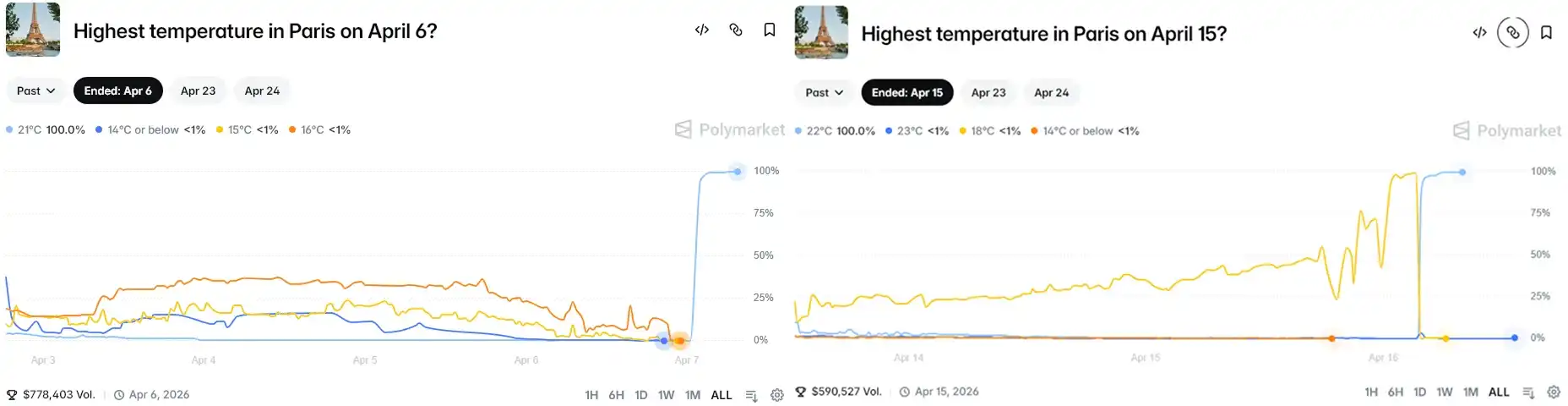
Météo-France subsequently conducted a physical inspection of the sensors and found signs of human intervention. They filed a criminal complaint with the Charles de Gaulle Airport Gendarmerie, with the charge being "interfering with an automated data processing system." According to an analysis in an AR15 forum post, based on Article 323-2 of the French Penal Code, and because Météo-France is a public institution, the related charges could carry a maximum penalty of 7 years imprisonment and a fine of 300,000 euros.

The Technical Sophistication of This Scam Is Approximately Zero

The settlement chain for Polymarket's Paris temperature market is as follows: Physical Sensor → Météo-France → Weather Underground → Polymarket Contract.

On this chain, the smart contract part is audited, data transmission is automated, and Weather Underground's data scraping is real-time. The only weak point is at the very beginning: a thermometer standing by the airport roadside, without fencing, without cameras, accessible to anyone who walks by.

All the attacker needed was a battery-powered heat gun/hairdryer.

Polymarket bases its settlement on the day's maximum temperature. This means that creating one brief temperature peak is enough to rewrite the official record for the day.

Acting in the evening or at night is more ideal, as the daytime high has usually already passed, making subsequent readings more likely to become the new record. Therefore, the suspect chose 7 PM on April 6th and 9:30 PM on April 15th.

The operational procedure was likely: buy the low-probability option in advance, walk to the sensor at night, turn on the heat gun, wait for the reading to cross the target temperature, stop, leave, and wait for on-chain settlement.

The entire operation required no technical skill whatsoever, just some understanding of the settlement mechanism and a willingness to walk to the edge of the airport.

Polymarket's Response: Quietly Swapped the Thermometer

Polymarket has not issued any official statement regarding this incident. The only thing it did was change the settlement data source for the Paris temperature market from Charles de Gaulle Airport (LFPG) to Le Bourget Airport (LFPB).
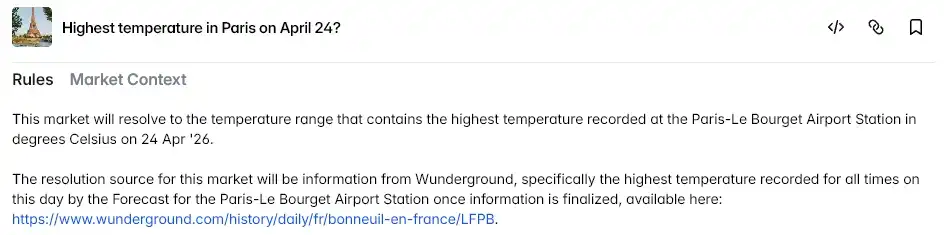
The profits from the two accounts were not revoked; the market settled normally according to the on-chain records.

The sensor at Le Bourget Airport is also placed outdoors, similarly without physical protection. They changed the address, but the problem remains entirely unchanged.

This is not Polymarket's first controversy. In October 2024, a French trader was accused of manipulating Trump election odds using 4 linked accounts, reportedly profiting $85 million; in March 2025, a whale used 5 million tokens to forcibly push through a UMA governance vote, settling a controversial market with a "Yes" outcome, involving $7 million; in January and March 2026, anomalous bets appeared in markets related to Venezuela and Iran respectively, with the latter already drawing attention from the US Congress...

Previous incidents at least required millions of dollars in capital or governance tokens; this time the cost was just a heat gun.

The Contract Was Audited, The Thermometer Was Not

This story has an absurd sense of humor. A prediction market running on the blockchain, touting decentralization and immutability, was thoroughly exploited twice by a battery-powered heat gun. Cryptography was of no help in this matter because it never verifies whether the input data is real.

Polymarket currently has 173 active weather markets. The settlement basis for most of these markets is a single physical sensor in some location.
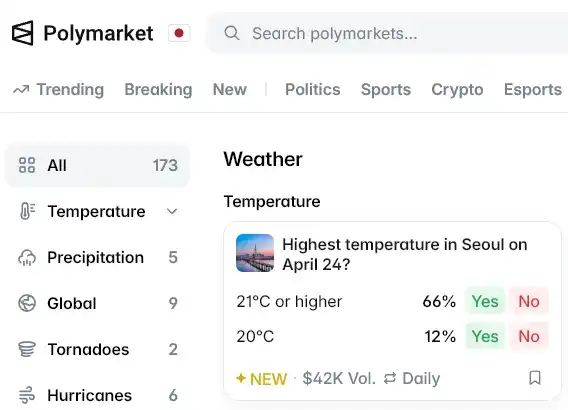
When a sensor is used as a meteorological tool, its credibility comes from the fact that no one has a motive to tamper with it. Polymarket gave it a new incentive structure but provided no new physical protection.

The Météo-France thermometer dutifully recorded the temperature it sensed. It just didn't know it had become a financial settlement terminal.


Câu hỏi Liên quan

QWhat was the key vulnerability exploited in the Polymarket Paris temperature market incident?

AThe physical vulnerability of the meteorological sensor at Charles de Gaulle Airport, which was unprotected and could be easily manipulated with a simple tool like a battery-powered hairdryer.

QHow did the attackers profit from manipulating the temperature sensor?

AThey placed bets on low-probability temperature ranges on Polymarket just before artificially spiking the temperature, turning a small investment of tens of dollars into approximately $34,000 in profits across two incidents.

QWhat was Polymarket's response to the temperature manipulation incidents?

APolymarket did not issue an official statement or reverse the profits. They silently changed the data source for the Paris temperature market from Charles de Gaulle Airport (LFPG) to Le Bourget Airport (LFPB), which had the same physical vulnerability.

QWhat legal consequences might the perpetrators face according to the article?

AUnder French law, specifically Article 323-2, and because Météo-France is a public institution, the charges for interfering with an automated data processing system could result in up to 7 years in prison and a €300,000 fine.

QWhat does the incident reveal about the limitations of blockchain-based prediction markets like Polymarket?

AIt highlights that while smart contracts are audited and the blockchain is secure, the system remains vulnerable if the real-world data inputs (oracles) are not physically secure and can be easily manipulated, undermining the integrity of the market.

Nội dung Liên quan

Với giá 100.000 đô la mỗi tháng: Truth Social bán quyền truy cập bài đăng của Trump cho các công ty đầu tư

Trump Media and Technology Group (TMTG) đã ra mắt dịch vụ Truth API từ ngày 1/8/2026. Đây là kênh dữ liệu có phí cung cấp cho các khách hàng tổ chức, chủ yếu là các công ty đầu tư và giao dịch tần suất cao, quyền truy cập thời gian thực đến các bài đăng từ những tài khoản có ảnh hưởng nhất trên nền tảng Truth Social, bao gồm cả cựu Tổng thống Donald Trump. Theo các nguồn tin, gói dịch vụ này có giá lên tới 100.000 USD một tháng, với mức giảm giá xuống 60.000 USD/tháng cho hợp đồng ba năm. TMTG tuyên bố đây là một phần trong chiến lược tạo ra nguồn thu ổn định và lợi nhuận cao từ tài sản của công ty. Tuy nhiên, sáng kiến này đã vấp phải chỉ trích từ các nhà lập pháp cả hai đảng. Các Thượng nghị sĩ Dân chủ Elizabeth Warren và Adam Schiff đã yêu cầu Ủy ban Chứng khoán Mỹ (SEC) điều tra xem liệu việc bán quyền truy cập ưu tiên đến các bài đăng của tổng thống có vi phạm luật hay không. Thượng nghị sĩ Cộng hòa Bill Cassidy cũng chỉ trích đây là hành vi bán quyền truy cập đặc quyền không thể chấp nhận được. Phân tích AI trong bài báo cảnh báo về rủi ro tiềm ẩn, so sánh với sự kiện năm 2013 khi thị trường chứng khoán sụt giảm nhanh chóng do tin tức giả mạo. Việc biến tài khoản tổng thống thành một nút tín hiệu thị trường với độ trễ mili giây có thể tạo ra mục tiêu cho tin tặc hoặc thao túng, và đặt ra câu hỏi về trách nhiệm nếu thông tin sai lệch được phát tán qua kênh này.

cryptonews.ru1 giờ trước

Với giá 100.000 đô la mỗi tháng: Truth Social bán quyền truy cập bài đăng của Trump cho các công ty đầu tư

cryptonews.ru1 giờ trước

Các giao dịch rút Bitcoin tiếp tục: 8 năm lưu trữ trong ví lạnh Coldcard kết thúc bằng số không

Ví phần cứng Coldcard bị xâm phạm, dẫn đến làn sóng rút tiền mới từ các thiết bị dễ bị tấn công. Theo Galaxy Research, tổng số tiền bị đánh cắp đã lên tới 1.367,05 BTC (khoảng 88,6 triệu USD). Vấn đề không nằm ở phần mềm cập nhật, mà ở seed phrase (cụm từ khôi phục) được tạo từ tháng 3/2021 do lỗi lập trình, khiến chúng dễ bị dò tìm. Lỗi này xảy ra khi thiết bị chuyển từ bộ tạo số ngẫu nhiên phần cứng sang bộ tạo phần mềm Yasmarang, được khởi tạo bằng dữ liệu có thể dự đoán được. Người dùng các model Mk2-Mk5 và Q với phiên bản phần mềm nhất định cần tạo seed phrase mới trên bản cập nhật đã sửa và chuyển tài sản sang đó để bảo vệ. Câu chuyện đau lòng của một nhà đầu tư 39 tuổi đã mất 2 BTC (130.000 USD) tích góp suốt 8 năm trong vài phút, dù áp dụng chiến lược "mua và giữ trong ví lạnh" thận trọng. Anh mua Bitcoin như một lá chắn chống siêu lạm phát và kế hoạch nghỉ hưu sớm, nhưng lỗ hổng đã phá hỏng mọi thứ. Sự việc nhấn mạnh rằng lưu trữ offline không tự động đảm bảo an toàn, và cộng đồng hy vọng nhà sản xuất có thể tìm cách khắc phục, hoàn trả tài sản cho người dùng.

cryptonews.ru3 giờ trước

Các giao dịch rút Bitcoin tiếp tục: 8 năm lưu trữ trong ví lạnh Coldcard kết thúc bằng số không

cryptonews.ru3 giờ trước

Giao dịch

Giao ngay
活动图片




