Anthropic's Seventy-Two-Hour Identity Crisis

marsbitXuất bản vào 2026-02-27Cập nhật gần nhất vào 2026-02-27

Tóm tắt

Over a critical 72-hour period, AI company Anthropic faced a severe identity crisis as it navigated intense pressure from the U.S. Pentagon, public accusations from Elon Musk, and a major shift in its own safety policies. The Pentagon issued an ultimatum: lift restrictions on military use of its AI model Claude—including for autonomous weapons and domestic surveillance—by Friday at 5:01 PM, or lose a $200 million contract and face potential blacklisting. Simultaneously, Anthropic released its Responsible Scaling Policy (RSP) 3.0, removing its core commitment to pause training if safety couldn't be assured. Elon Musk publicly accused Anthropic of large-scale training data theft, referencing a $1.5 billion settlement over copyrighted material. The company also accused three Chinese AI firms of “industrial-scale distillation attacks” via its public API, framing it as a national security threat—a move widely seen as hypocritical. Amid a $380 billion valuation and rapid growth, Anthropic’s founding narrative—building powerful AI more responsibly than competitors—began to unravel. Its balancing act between safety branding and commercial and government pressures reached a breaking point. The company’s identity, once defined by its ethical differentiation, now appears to be converging with the rest of the industry.

Written by: Ada, Shenchao TechFlow

February 24th, Tuesday. Washington, The Pentagon.

Anthropic CEO Dario Amodei sat across from Defense Secretary Pete Hegseth. According to multiple media outlets including NPR and CNN citing informed sources, the atmosphere of the meeting was "polite," but the content was anything but.

Hegseth gave him an ultimatum: By 5:01 PM on Friday, lift the restrictions on the military use of Claude, allowing the Pentagon to use it for "all lawful purposes," including autonomous weapons targeting and domestic mass surveillance.

Otherwise, cancel the $200 million contract. Initiate the Defense Production Act for compulsory requisition. Designate Anthropic as a "supply chain risk," which is equivalent to blacklisting it alongside hostile entities like Russia and China.

On the same day, Anthropic released the third version of its "Responsible Scaling Policy" (RSP 3.0), quietly deleting the company's most core commitment since its founding: if safety measures cannot be guaranteed to be in place, do not train more powerful models.

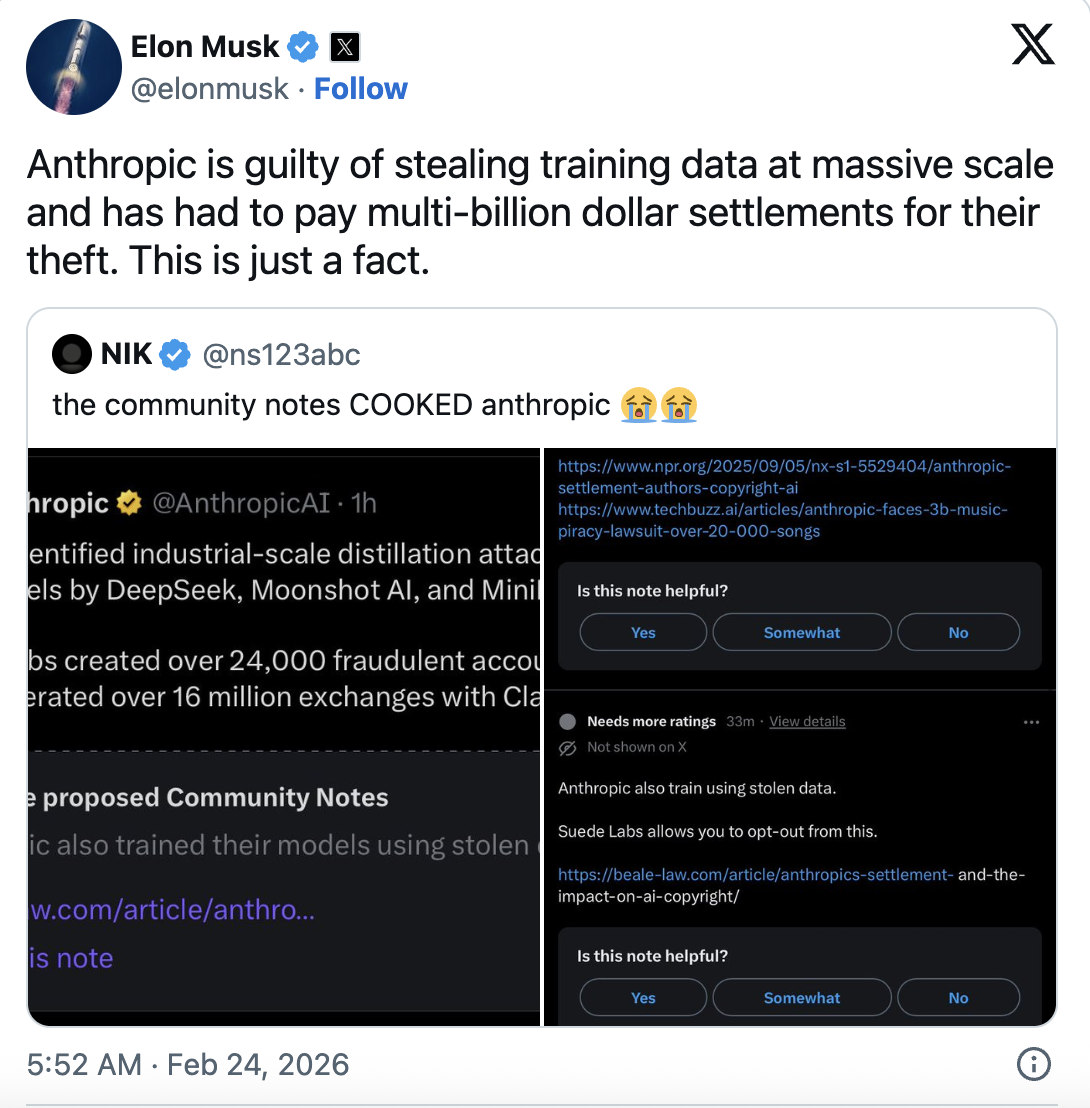
Also on the same day, Elon Musk posted on X: "Anthropic massively stole training data. This is a fact." Simultaneously, a Community Note on X added a report that Anthropic paid a $1.5 billion settlement for using pirated books to train Claude.

Within seventy-two hours, this AI company that claims to have a "soul" simultaneously played three roles: safety martyr, intellectual property thief, and Pentagon turncoat.

Which one is real?

Perhaps all of them.

The Pentagon's "Comply or Get Out"

The first layer of the story is simple.

Anthropic was the first AI company to gain classified-level access from the U.S. Department of Defense. The contract, with a ceiling of $200 million, was secured last summer. OpenAI, Google, and xAI subsequently secured contracts of similar scale.

According to Al Jazeera, Claude was used in a U.S. military operation this past January. The report stated the operation involved the kidnapping of Venezuelan President Maduro.

But Anthropic drew two red lines: no support for fully autonomous weapons targeting, and no support for mass surveillance of U.S. citizens. Anthropic believes AI's reliability is insufficient for weapon control, and there are currently no laws or regulations governing the use of AI in mass surveillance.

The Pentagon wasn't buying it.

White House AI advisor David Sacks publicly accused Anthropic on X last October of "using fear as a weapon, engaging in regulatory capture."

Competitors have already knelt. OpenAI, Google, and xAI have all agreed to let the military use their AI for "all lawful scenarios." Musk's Grok was just approved for entry into classified systems this week.

Anthropic is the last one standing.

As of publication, Anthropic stated in its latest announcement that it does not intend to concede. But the Friday 5:01 PM deadline is looming.

An anonymous former liaison between the Justice Department and the Defense Department expressed confusion to CNN: "How can you simultaneously declare a company a 'supply chain risk' and force that company to work for your military?"

Good question, but it's not within the Pentagon's consideration. They care that if Anthropic doesn't comply, they will resort to compulsory measures, or, Anthropic becomes a Washington outcast.

"Distillation Attack": A Slap-in-the-Face Accusation

On February 23rd, Anthropic published a fiercely worded blog post accusing three Chinese AI companies of carrying out an "industrial-scale distillation attack" on Claude.

The defendants are DeepSeek, Moonshot AI, and MiniMax.

Anthropic accused them of using 24,000 fake accounts to initiate over 16 million interactions with Claude, specifically extracting its core capabilities in agent reasoning, tool use, and programming.

Anthropic framed this as a national security threat, claiming that distilled models are "unlikely to retain safety guardrails" and could be used by authoritarian governments for cyber attacks, disinformation, and mass surveillance.

The narrative was perfect, the timing was perfect.

It came just after the Trump administration had recently relaxed chip export controls to China, just when Anthropic needed ammunition for its lobbying stance on chip export controls.

But Musk fired a shot: "Anthropic massively stole training data and paid billions in settlements for it. This is a fact."
Tory Green, co-founder of AI infrastructure company IO.Net, stated: "You train your models on data from the entire web, and when others learn from you using your public API, it's called a 'distillation attack'?"

Anthropic calls distillation an "attack," but it's commonplace in the AI industry. OpenAI uses it to compress GPT-4, Google uses it to optimize Gemini, even Anthropic itself does it. The only difference is, this time they were the ones being distilled.

As Singapore's Nanyang Technological University AI professor Erik Cambria told CNBC: "The boundary between legitimate use and malicious exploitation is often blurry."

Even more ironic, Anthropic just paid a $1.5 billion settlement for using pirated books to train Claude. It trains its models on data from the entire web, then accuses others of learning from it using its public API. This isn't double standards, it's triple standards.

Anthropic wanted to play the victim, but got exposed as the defendant.

Dismantling the Safety Commitment: RSP 3.0

On the same day as the Pentagon standoff and the Silicon Valley spat, Anthropic released the third version of its Responsible Scaling Policy.

Anthropic Chief Scientist Jared Kaplan told media in an interview: "We felt that stopping AI model training doesn't help anyone. In the context of rapid AI development, unilaterally making commitments... while competitors are full steam ahead, it doesn't make sense."

In other words, others aren't playing by the rules, so we're dropping the act too.

The core of RSP 1.0 and 2.0 was a hard commitment to pause training if model capabilities exceeded the coverage of safety measures. This commitment gave Anthropic a unique reputation in the AI safety community.

But 3.0 deleted it.

It was replaced with a more "flexible" framework, separating safety measures Anthropic can implement itself from safety recommendations requiring industry-wide collaboration into two tracks. A risk report is issued every 3-6 months. External experts review it.

Sounds responsible?

Independent reviewer Chris Painter from the non-profit METR, after seeing an early draft of the policy, stated: "This indicates Anthropic believes it needs to enter 'triage mode' because methods for assessing and mitigating risk can't keep up with the pace of capability growth. This is more evidence that society is unprepared for AI's potential catastrophic risks."

According to TIME, Anthropic spent nearly a year internally debating this rewrite, with CEO Amodei and the board unanimously approving it. The official line is that the original policy was designed to drive industry consensus, but the industry simply didn't follow. The Trump administration has taken a laissez-faire approach to AI development, even attempting to repeal state-level regulations. Federal AI law is a distant prospect. While a global governance framework seemed possible in 2023, three years later, that door has clearly closed.

An anonymous researcher long focused on AI governance put it more bluntly: "The RSP was Anthropic's most valuable brand asset. Deleting the training pause commitment is like an organic food company quietly tearing the 'organic' label off its packaging and then telling you their testing is now more transparent."

Identity Fracture Under a $380 Billion Valuation

In early February, Anthropic completed a $30 billion financing round at a $380 billion valuation, with Amazon as the anchor investor. Since its founding, it has achieved $14 billion in annualized revenue. Over the past three years, this figure has grown more than 10x each year.

Simultaneously, the Pentagon threatens to blacklist it. Musk publicly accuses it of data theft. Its own core safety commitment is deleted. Anthropic's AI safety lead, Mrinank Sharma, resigned and wrote on X: "The world is in danger."

Contradiction?

Perhaps contradiction is in Anthropic's DNA.

The company was founded by former OpenAI executives because they were concerned OpenAI was moving too fast on safety. Then they built a company themselves, building more powerful models at an even faster pace, while telling the world how dangerous these models are.

The business model can be summarized in one sentence: we are more afraid of AI than anyone else, so you should pay us to build it.

This narrative worked perfectly in 2023-2024. AI safety was a hot word in Washington, and Anthropic was the most popular lobbyist.

In 2026, the wind has changed.

"Woke AI" has become an attack label, state-level AI regulation bills are being blocked by the White House, and the California SB 53 supported by Anthropic was signed into law, but the federal level is a wasteland.

Anthropic's safety card is sliding from a "differentiating advantage" to a "political liability."

Anthropic is performing a complex balancing act. It needs to be "safe" enough to maintain its brand, yet "flexible" enough to avoid being abandoned by the market and the government. The problem is, the tolerance space on both ends is shrinking.

How Much is the Safety Narrative Still Worth?

Look at all three events together, and the picture becomes clear.

Accusing Chinese companies of distilling Claude is to strengthen the lobbying narrative for chip export controls. Deleting the safety pause commitment is to avoid falling behind in the arms race. Refusing the Pentagon's autonomous weapons demand is to preserve the last layer of moral clothing.

Each step has its logic, but the steps contradict each other.

You can't simultaneously claim that Chinese companies "distilling" your model threatens national security, while deleting the commitment that prevents your own model from going out of control. If the model is truly that dangerous, you should be more cautious, not more aggressive.

Unless you are Anthropic.

In the AI industry, identity is not defined by your statements, but by your balance sheet. Anthropic's "safety" narrative is essentially a brand premium.

In the early days of the AI arms race, this premium was valuable. Investors were willing to pay a higher valuation for "responsible AI," the government was willing to give the green light to "trustworthy AI," and customers were willing to pay for "safer AI."

But in 2026, this premium is evaporating.

Anthropic now faces not a multiple-choice question of "whether to compromise," but a sequencing problem of "who to compromise with first." Compromise with the Pentagon, brand damaged. Compromise with competitors, safety承诺废弃 (safety commitment废弃 - commitment abandoned). Compromise with investors, both have to give.

At 5:01 PM on Friday, Anthropic will deliver its answer.

But whatever the answer is, one thing is already certain: the Anthropic that once stood on "we're not like OpenAI" is becoming like everyone else.

The endpoint of an identity crisis is often the disappearance of identity.

Câu hỏi Liên quan

QWhat was the ultimatum given to Anthropic by the Pentagon, and what were the consequences of non-compliance?

AThe Pentagon gave Anthropic an ultimatum to remove restrictions on Claude's military use, allowing it to be used for 'all legitimate purposes,' including autonomous weapons targeting and domestic mass surveillance, by Friday at 5:01 PM. Failure to comply would result in the cancellation of a $200 million contract, the initiation of the Defense Production Act to force conscription, and the company being labeled a 'supply chain risk,' effectively blacklisting it alongside hostile entities like Russia and China.

QWhat significant change did Anthropic make to its Responsible Scaling Policy (RSP) 3.0, and why was it controversial?

AAnthropic removed the core commitment from its Responsible Scaling Policy (RSP) 3.0 that promised to halt training more powerful models if safety measures could not be guaranteed. This was controversial because it abandoned a foundational principle that had defined the company's identity and was seen as a move to prioritize competition over safety, especially as industry rivals advanced without similar restraints.

QWhat accusation did Elon Musk make against Anthropic, and how did it relate to the company's own claims about 'distillation attacks'?

AElon Musk accused Anthropic of 'massive theft of training data,' referencing reports that the company paid $1.5 billion in settlements for using pirated books to train Claude. This accusation undermined Anthropic's own claims of being a victim of 'industrial-scale distillation attacks' by Chinese AI firms, highlighting hypocrisy as Anthropic used scraped data for training while condemning others for learning from its public API.

QHow did Anthropic's business model and narrative shift between 2023 and 2026, according to the article?

AAnthropic's business model initially relied on a narrative of being more cautious and responsible than competitors like OpenAI, arguing that AI was dangerous and required safety measures. By 2026, this narrative became a political liability as regulatory momentum stalled and competition intensified. The company began compromising its safety promises to remain competitive, shifting from a 'differentiated advantage' to a potential 'political negative asset.'

QWhat broader implication does the article suggest about Anthropic's identity crisis and the AI industry?

AThe article suggests that Anthropic's identity crisis reflects a broader industry trend where ethical commitments are compromised under commercial and governmental pressures. Anthropic's attempts to balance safety branding with market demands led to contradictory actions, ultimately eroding its unique identity. The conclusion is that in the AI arms race, corporate identity defined by safety narratives is increasingly replaced by pragmatic alignment with power and profit, leading to a loss of distinctiveness.

Nội dung Liên quan

Giao dịch

Giao ngay
Hợp đồng Tương lai

Bài viết Nổi bật

AGENT S là gì

Agent S: Tương Lai của Tương Tác Tự Động trong Web3 Giới thiệu Trong bối cảnh không ngừng phát triển của Web3 và tiền điện tử, các đổi mới đang liên tục định nghĩa lại cách mà cá nhân tương tác với các nền tảng kỹ thuật số. Một dự án tiên phong như vậy, Agent S, hứa hẹn sẽ cách mạng hóa tương tác giữa con người và máy tính thông qua khung tác nhân mở của nó. Bằng cách mở đường cho các tương tác tự động, Agent S nhằm đơn giản hóa các nhiệm vụ phức tạp, cung cấp các ứng dụng chuyển đổi trong trí tuệ nhân tạo (AI). Cuộc khám phá chi tiết này sẽ đi sâu vào những phức tạp của dự án, các tính năng độc đáo của nó và những tác động đối với lĩnh vực tiền điện tử. Agent S là gì? Agent S đứng vững như một khung tác nhân mở đột phá, được thiết kế đặc biệt để giải quyết ba thách thức cơ bản trong việc tự động hóa các nhiệm vụ máy tính: Thu thập Kiến thức Cụ thể theo Miền: Khung này học một cách thông minh từ nhiều nguồn kiến thức bên ngoài và kinh nghiệm nội bộ. Cách tiếp cận kép này giúp nó xây dựng một kho lưu trữ phong phú về kiến thức cụ thể theo miền, nâng cao hiệu suất của nó trong việc thực hiện nhiệm vụ. Lập Kế Hoạch Qua Các Tầm Nhìn Nhiệm Vụ Dài Hạn: Agent S sử dụng lập kế hoạch phân cấp tăng cường kinh nghiệm, một cách tiếp cận chiến lược giúp phân chia và thực hiện các nhiệm vụ phức tạp một cách hiệu quả. Tính năng này nâng cao đáng kể khả năng quản lý nhiều nhiệm vụ con một cách hiệu quả và hiệu suất. Xử Lý Các Giao Diện Động, Không Đều: Dự án giới thiệu Giao Diện Tác Nhân-Máy Tính (ACI), một giải pháp đổi mới giúp nâng cao tương tác giữa các tác nhân và người dùng. Sử dụng các Mô Hình Ngôn Ngữ Lớn Đa Phương Thức (MLLMs), Agent S có thể điều hướng và thao tác các giao diện người dùng đồ họa đa dạng một cách liền mạch. Thông qua những tính năng tiên phong này, Agent S cung cấp một khung vững chắc giải quyết các phức tạp liên quan đến việc tự động hóa tương tác giữa con người với máy móc, mở ra nhiều ứng dụng trong AI và hơn thế nữa. Ai là Người Tạo ra Agent S? Mặc dù khái niệm về Agent S là hoàn toàn đổi mới, thông tin cụ thể về người sáng lập vẫn còn mơ hồ. Người sáng lập hiện vẫn chưa được biết đến, điều này làm nổi bật giai đoạn sơ khai của dự án hoặc sự lựa chọn chiến lược để giữ kín các thành viên sáng lập. Bất chấp sự ẩn danh, sự chú ý vẫn tập trung vào khả năng và tiềm năng của khung này. Ai là Các Nhà Đầu Tư của Agent S? Vì Agent S còn tương đối mới trong hệ sinh thái mã hóa, thông tin chi tiết về các nhà đầu tư và những người tài trợ tài chính của nó không được ghi chép rõ ràng. Sự thiếu vắng thông tin công khai về các nền tảng đầu tư hoặc tổ chức hỗ trợ dự án dấy lên câu hỏi về cấu trúc tài trợ và lộ trình phát triển của nó. Hiểu biết về sự hỗ trợ là rất quan trọng để đánh giá tính bền vững và tác động tiềm năng của dự án. Agent S Hoạt Động Như Thế Nào? Tại cốt lõi của Agent S là công nghệ tiên tiến cho phép nó hoạt động hiệu quả trong nhiều bối cảnh khác nhau. Mô hình hoạt động của nó được xây dựng xung quanh một số tính năng chính: Tương Tác Giống Như Con Người: Khung này cung cấp lập kế hoạch AI tiên tiến, cố gắng làm cho các tương tác với máy tính trở nên trực quan hơn. Bằng cách bắt chước hành vi của con người trong việc thực hiện nhiệm vụ, nó hứa hẹn nâng cao trải nghiệm người dùng. Ký Ức Tường Thuật: Được sử dụng để tận dụng các trải nghiệm cấp cao, Agent S sử dụng ký ức tường thuật để theo dõi lịch sử nhiệm vụ, từ đó nâng cao quy trình ra quyết định của nó. Ký Ức Tình Huống: Tính năng này cung cấp cho người dùng hướng dẫn từng bước, cho phép khung này cung cấp hỗ trợ theo ngữ cảnh khi các nhiệm vụ diễn ra. Hỗ Trợ OpenACI: Với khả năng chạy cục bộ, Agent S cho phép người dùng duy trì quyền kiểm soát đối với các tương tác và quy trình làm việc của họ, phù hợp với tinh thần phi tập trung của Web3. Tích Hợp Dễ Dàng với Các API Bên Ngoài: Tính linh hoạt và khả năng tương thích với nhiều nền tảng AI khác nhau đảm bảo rằng Agent S có thể hòa nhập liền mạch vào các hệ sinh thái công nghệ hiện có, làm cho nó trở thành lựa chọn hấp dẫn cho các nhà phát triển và tổ chức. Những chức năng này cùng nhau góp phần vào vị trí độc đáo của Agent S trong không gian tiền điện tử, khi nó tự động hóa các nhiệm vụ phức tạp, nhiều bước với sự can thiệp tối thiểu của con người. Khi dự án phát triển, các ứng dụng tiềm năng của nó trong Web3 có thể định nghĩa lại cách mà các tương tác kỹ thuật số diễn ra. Thời Gian Phát Triển của Agent S Sự phát triển và các cột mốc của Agent S có thể được tóm tắt trong một dòng thời gian nêu bật các sự kiện quan trọng của nó: 27 tháng 9, 2024: Khái niệm về Agent S được ra mắt trong một bài nghiên cứu toàn diện mang tên “Một Khung Tác Nhân Mở Sử Dụng Máy Tính Như Một Con Người,” trình bày nền tảng cho dự án. 10 tháng 10, 2024: Bài nghiên cứu được công bố công khai trên arXiv, cung cấp một cái nhìn sâu sắc về khung và đánh giá hiệu suất của nó dựa trên tiêu chuẩn OSWorld. 12 tháng 10, 2024: Một video trình bày được phát hành, cung cấp cái nhìn trực quan về khả năng và tính năng của Agent S, thu hút thêm sự quan tâm từ người dùng và nhà đầu tư tiềm năng. Những dấu mốc trong dòng thời gian không chỉ minh họa sự tiến bộ của Agent S mà còn chỉ ra cam kết của nó đối với sự minh bạch và sự tham gia của cộng đồng. Những Điểm Chính Về Agent S Khi khung Agent S tiếp tục phát triển, một số thuộc tính chính nổi bật, nhấn mạnh tính đổi mới và tiềm năng của nó: Khung Đổi Mới: Được thiết kế để cung cấp cách sử dụng máy tính trực quan giống như tương tác của con người, Agent S mang đến một cách tiếp cận mới cho việc tự động hóa nhiệm vụ. Tương Tác Tự Động: Khả năng tương tác tự động với máy tính thông qua GUI đánh dấu một bước tiến tới các giải pháp tính toán thông minh và hiệu quả hơn. Tự Động Hóa Nhiệm Vụ Phức Tạp: Với phương pháp mạnh mẽ của nó, nó có thể tự động hóa các nhiệm vụ phức tạp, nhiều bước, làm cho các quy trình nhanh hơn và ít sai sót hơn. Cải Tiến Liên Tục: Các cơ chế học tập cho phép Agent S cải thiện từ các trải nghiệm trước đó, liên tục nâng cao hiệu suất và hiệu quả của nó. Tính Linh Hoạt: Khả năng thích ứng của nó trên các môi trường hoạt động khác nhau như OSWorld và WindowsAgentArena đảm bảo rằng nó có thể phục vụ một loạt các ứng dụng rộng rãi. Khi Agent S định vị mình trong bối cảnh Web3 và tiền điện tử, tiềm năng của nó để nâng cao khả năng tương tác và tự động hóa quy trình đánh dấu một bước tiến quan trọng trong công nghệ AI. Thông qua khung đổi mới của mình, Agent S minh họa cho tương lai của các tương tác kỹ thuật số, hứa hẹn một trải nghiệm liền mạch và hiệu quả hơn cho người dùng trên nhiều ngành công nghiệp khác nhau. Kết luận Agent S đại diện cho một bước nhảy vọt táo bạo trong sự kết hợp giữa AI và Web3, với khả năng định nghĩa lại cách chúng ta tương tác với công nghệ. Mặc dù vẫn còn ở giai đoạn đầu, những khả năng cho ứng dụng của nó là rộng lớn và hấp dẫn. Thông qua khung toàn diện của mình giải quyết các thách thức quan trọng, Agent S nhằm đưa các tương tác tự động lên hàng đầu trong trải nghiệm kỹ thuật số. Khi chúng ta tiến sâu hơn vào các lĩnh vực tiền điện tử và phi tập trung, các dự án như Agent S chắc chắn sẽ đóng một vai trò quan trọng trong việc định hình tương lai của công nghệ và sự hợp tác giữa con người với máy tính.

Tổng lượt xem 630Xuất bản vào 2025.01.14Cập nhật vào 2025.01.14

AGENT S là gì

Làm thế nào để Mua S

Chào mừng bạn đến với HTX.com! Chúng tôi đã làm cho mua Sonic (S) trở nên đơn giản và thuận tiện. Làm theo hướng dẫn từng bước của chúng tôi để bắt đầu hành trình tiền kỹ thuật số của bạn.Bước 1: Tạo Tài khoản HTX của BạnSử dụng email hoặc số điện thoại của bạn để đăng ký tài khoản miễn phí trên HTX. Trải nghiệm hành trình đăng ký không rắc rối và mở khóa tất cả tính năng. Nhận Tài khoản của tôiBước 2: Truy cập Mua Crypto và Chọn Phương thức Thanh toán của BạnThẻ Tín dụng/Ghi nợ: Sử dụng Visa hoặc Mastercard của bạn để mua Sonic (S) ngay lập tức.Số dư: Sử dụng tiền từ số dư tài khoản HTX của bạn để giao dịch liền mạch.Bên thứ ba: Chúng tôi đã thêm những phương thức thanh toán phổ biến như Google Pay và Apple Pay để nâng cao sự tiện lợi.P2P: Giao dịch trực tiếp với người dùng khác trên HTX.Thị trường mua bán phi tập trung (OTC): Chúng tôi cung cấp những dịch vụ được thiết kế riêng và tỷ giá hối đoái cạnh tranh cho nhà giao dịch.Bước 3: Lưu trữ Sonic (S) của BạnSau khi mua Sonic (S), lưu trữ trong tài khoản HTX của bạn. Ngoài ra, bạn có thể gửi đi nơi khác qua chuyển khoản blockchain hoặc sử dụng để giao dịch những tiền kỹ thuật số khác.Bước 4: Giao dịch Sonic (S)Giao dịch Sonic (S) dễ dàng trên thị trường giao ngay của HTX. Chỉ cần truy cập vào tài khoản của bạn, chọn cặp giao dịch, thực hiện giao dịch và theo dõi trong thời gian thực. Chúng tôi cung cấp trải nghiệm thân thiện với người dùng cho cả người mới bắt đầu và người giao dịch dày dạn kinh nghiệm.

Tổng lượt xem 1.3kXuất bản vào 2025.01.15Cập nhật vào 2025.03.21

Làm thế nào để Mua S

Thảo luận

Chào mừng đến với Cộng đồng HTX. Tại đây, bạn có thể được thông báo về những phát triển nền tảng mới nhất và có quyền truy cập vào thông tin chuyên sâu về thị trường. Ý kiến ​​của người dùng về giá của S (S) được trình bày dưới đây.

活动图片