An Internal Memo Exposes OpenAI's Most Real Anxieties and Ambitions

marsbitXuất bản vào 2026-04-14Cập nhật gần nhất vào 2026-04-14

Tóm tắt

An internal memo from OpenAI's Chief Revenue Officer, Denise Dresser, reveals the company's strategic priorities and competitive anxieties as the enterprise AI market matures. The document outlines a shift from competing solely on model capability to winning on integration, platform strategy, and becoming "hardest to replace." Key priorities for Q2 include: the model layer, the agent platform, expanding market reach via Amazon, selling the full tech stack, and controlling deployment. The goal is to evolve from a point solution to an enterprise AI "operating system" by deeply embedding into customer workflows, creating switching costs, and securing multi-year, nine-figure deals. The memo contains a direct and unusually sharp critique of rival Anthropic, accusing it of building a narrative on "fear" and "restriction," suffering from compute shortages leading to user experience issues, and overstating its annualized revenue by $8 billion due to accounting methods. This public criticism is seen as a calculated move for investor narratives, internal mobilization, and external signaling. For the Chinese AI market, the memo highlights a gap in competition stages. While domestic players still focus on benchmarks and price wars, the next phase will be won on deployment, platform integration, and ecosystem. It also underscores the critical importance of data sovereignty and trust, suggesting that compliant, auditable, on-premise solutions could be a major differentiator in regulated...

By | Emphasizing Next

Throughout history, so-called "all-staff letters" have always been meant for external audiences.

Last weekend, a strategic memo from OpenAI's Chief Revenue Officer, Denise Dresser, sent to all employees, was exposed by the foreign media outlet "The Verge". Four pages, five priorities, and a rather scathing analysis of competitors.

This is not just an internal mobilization order; it更像是一次经过精心设计的对外信号释放。有策略地攻击竞争对手,有意地传递市场叙事,顺带给内部团队打一针鸡血。

01 "Capability Alone Is No Longer Enough"

The tone set at the beginning of the memo is intriguing. Dresser writes that enterprise AI is entering a "more mature phase," and what customers want is no longer just how smart the model is, but fit. Specifically, whether AI can truly integrate into their workflows, knowledge systems, and daily operations.

Over the past two years, OpenAI has swept the market with the capability advantages of the GPT series. But the era of competing on basic model capabilities is ending. As the capability gap between all major players narrows rapidly, the marginal utility of the "our model is the strongest" card is diminishing.

The procurement logic of enterprise customers is beginning to return to the classic path of To B software. They are more concerned with "whether this AI can truly run, run stably, and run long-term within my organization."

This is a sign of market maturity and a strategic shift in focus that OpenAI must complete.

02 Five Priorities

The memo lists five Q2 priorities: Win the model layer, win the agent platform, expand the market with Amazon, sell the full technology stack, and master deployment rights.
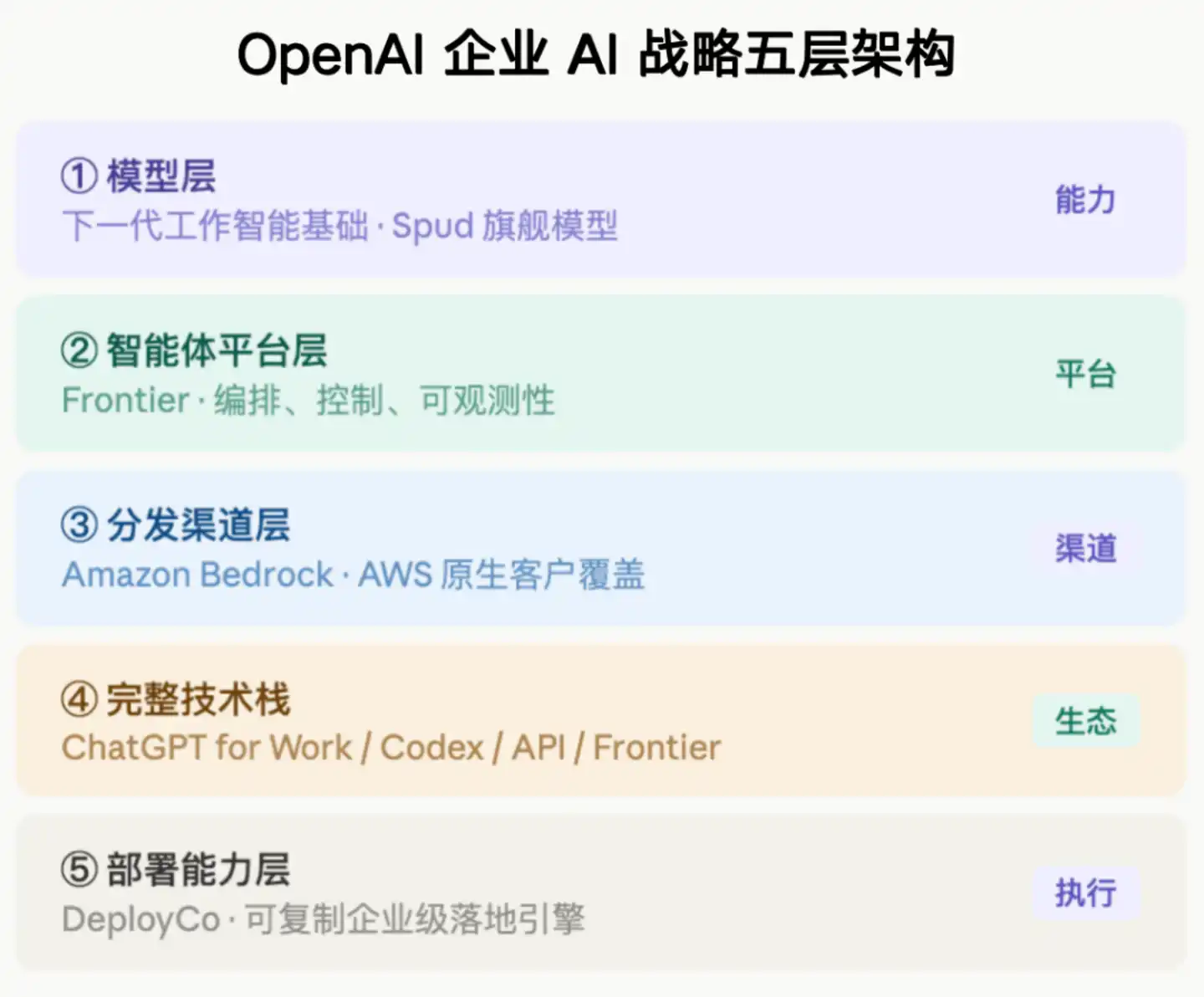
At first glance, these are five lines, but they point to the same goal: transitioning from the "most usable AI" to the "hardest to replace AI".

This is a typical platform transformation logic. Single-point products compete on performance; platforms compete on ecosystem and switching costs. One sentence in the memo is quite blunt: As customers connect more workflows to this system, "OpenAI will become harder to replace and will be more at the core of work."

OpenAI wants to be the operating system for enterprise AI. Just like Microsoft made Windows the underlying layer of all enterprise IT infrastructure. The word Dresser repeatedly emphasizes in the text is "platform." She says customers want a platform, not point solutions. ChatGPT for Work is the entry point for knowledge work, Codex is for the developer side, API is the integration engine, Frontier is the agent orchestration layer, and Amazon runtime is the production-grade stateful runtime. Five products, five entry points; theoretically, customers entering through any door will eventually be guided into the complete ecosystem.

The problem is, the story of a "platform company" sounds good, but few have truly succeeded historically. Platforms require network effects, switching costs, and ecosystem lock-in—things not built by a memo alone.

The memo mentions that "multi-year, multi-product, nine-figure deals are increasing." Nine figures means at least one hundred million dollars. The increase in such deals indicates that enterprise customers' bets on OpenAI are no longer at the "try it out" level but involve real strategic binding.

03 The Passage Attacking Anthropic

There is a passage in the memo that directly names Anthropic, with quite strong wording. It says their narrative is built on "fear, restrictions, and the notion that a select few should control AI"; it says their strategic mistakes in computing power are already reflected in the product—customers are experiencing rate limiting, low availability, and unstable performance; the most重磅的一条说Anthropic对外宣称的$300亿年化营收被高估了$80亿,因为他们把与Amazon和Google的收入分成按“总额”而非“净额”计入。

This practice of directly naming competitors is indeed rare in Chinese corporate culture. Executives of domestic giants, when expressing themselves externally, usually use迂回措辞 like "some players in the industry" or "certain products." Directly naming and criticizing with specific figures would be considered too aggressive in the domestic context and could easily trigger public backlash.

But in Silicon Valley, this is a normal operation,背后有几重逻辑。

First, the need for investor narratives. A company valued at tens of billions of dollars will be questioned if it cannot clearly explain why it is a better bet than its competitors. Pointing out specific weaknesses of competitors is an effective way to signal "we have底气" to the outside world.

Second, the need for internal mobilization. The audience of the memo is all employees. Specific comparisons like "their computing power is insufficient, customers have felt the rate limiting" are much more effective than preaching big道理, allowing the sales team to have something concrete to say in the next client meeting.

Third, this memo was likely expected to be leaked. Dresser couldn't have not known that in a company of several hundred people, a four-page strategic document would eventually appear in the media. "External messaging" itself might have been the purpose: to let the market know that we believe Anthropic's $30 billion figure is inflated, we have evidence, welcome verification.

That financial accusation deserves separate mention. The core of the argument that Anthropic's annualized revenue is overestimated by $8 billion is a dispute over accounting standards: should revenue sharing be accounted for on a gross or net basis? There is no absolute right or wrong on this issue, but if Anthropic确实 uses gross numbers in external宣传, there is a misleading component. Such disputes are often amplified before a company goes public; if Anthropic推进IPO later, investor due diligence will scrutinize this area carefully.

04 Insights for the Chinese Market

The value of this memo for China's AI industry lies in its clear depiction of what the next battlefield for enterprise AI competition looks like.

The first dimension: The gap in competition stages.

The competition among domestic large models currently mainly remains at the stage of "running leaderboards, comparing parameters, and price wars." This document reveals the next stage of competition dimensions, moving from capability competition to deployment competition, platform competition, and ecosystem competition. Whoever can help enterprise customers achieve replicable, scaled deployment the fastest, whose products can be most deeply embedded into customers' actual workflows, will truly win the enterprise market.

Dresser specifically mentioned DeployCo in the memo, a deployment engine专门负责帮企业落地AI. This is almost a blank slate in China. Many domestic AI companies sell a model API or a set of platforms, but the task of "helping customers truly use it and make it" has not been done systematically by any company. Many enterprise AI projects stall at the POC (Proof of Concept) stage and cannot scale, essentially due to this deployment capability gap.

Domestically, the closest to this logic might be Alibaba's DingTalk + Tongyi combination (embedding directly into enterprise workflows through DingTalk), and Huawei's overall IT solution capabilities on the government and enterprise side. But overall, the "enterprise deployment capability" and "platform ecosystem construction" of domestic AI products still have considerable room for improvement.

The second dimension: The particularity of data sovereignty and trust.

A word反复强调 in the memo is "trust." Enterprises need systems that are trustworthy, reliable, and sustainable to build upon. A large number of domestic enterprises, especially in fields like finance, government affairs, and healthcare, are far more sensitive to data sovereignty than the欧美市场. Transmitting data to third-party cloud services itself is a policy red line.

The model established through OpenAI's cooperation with Amazon, "running within the customer's own AWS environment, within the existing governance framework," is precisely responding to this concern. This provides an idea for domestic AI vendors: if they can differentiate themselves in the direction of "true private deployment, auditable data pipelines, and compliant industry solutions," it might have more commercial value than "my model is smarter than yours." Because in highly regulated industries, the ability to land compliantly is itself a barrier.

05 Finally: A Signal Worth Heeding

There is a sentence in the memo: "The opportunity ahead is enormous, and our biggest constraint right now is not demand, but capacity."

This situation is almost the reverse in China. The dilemma faced by many domestic AI companies is "having computing power, models, technology, but找不到愿意真正付费的企业客户". The chasm between "customers are willing to try" and "customers are willing to make multi-year, large-scale payments" is the real沟壑 that the domestic enterprise AI market needs to cross.

When OpenAI says "the biggest constraint is capacity," domestic peers might need to ask themselves: What is our biggest constraint? Is it technology? The product? Sales capability? Or the confidence and willingness of the entire market to invest in AI commercialization?

Câu hỏi Liên quan

QWhat are the five key priorities outlined in the internal memo from OpenAI's Chief Revenue Officer?

AThe five key priorities are: win the model layer, win the agent platform, expand the market with Amazon, sell the full technology stack, and control deployment.

QAccording to the memo, what is the main shift in enterprise AI customer demands that OpenAI must address?

AEnterprise customers are no longer just focused on model intelligence but on adaptability—how well AI can be integrated into their workflows, knowledge systems, and daily operations.

QHow does the memo characterize OpenAI's strategic goal beyond being the 'best AI'?

AThe strategic goal is to transition from being the 'best AI' to becoming the 'hardest to replace AI' by building an ecosystem with high switching costs and platform lock-in.

QWhat specific criticism did the memo level against Anthropic, and what was the financial allegation?

AThe memo criticized Anthropic's narrative as based on 'fear, restrictions, and the idea that a few elites should control AI,' and alleged that their claimed $30 billion annualized revenue was overestimated by $8 billion due to accounting practices using gross instead of net figures for revenue sharing.

QWhat key challenge does the memo highlight for the Chinese AI market compared to OpenAI's situation?

AWhile OpenAI's main constraint is 'capacity' (meeting demand), the Chinese AI industry faces a reverse challenge: finding enterprise customers willing to make long-term, large-scale payments, despite having ample compute and technology.

Nội dung Liên quan

Microsoft Xác Định Phần Mềm Độc Hại Mới Nhắm Vào Địa Chỉ Ví Và Khóa Riêng Tư

Vào tháng 2/2026, Microsoft đã phát hiện một chiến dịch mã độc nhắm mục tiêu vào người dùng tiền điện tử, được đặt tên là Trojan/CryptoBandits.A. Mã độc này lây lan chủ yếu qua các file shortcut .lnk độc hại trên ổ USB. Sau khi xâm nhập hệ thống, phần mềm độc hại hoạt động như một "crypto clipper". Nó liên tục theo dõi nội dung clipboard để tìm kiếm các cụm từ khôi phục ví (12 hoặc 24 từ), khóa cá nhân Bitcoin/Ethereum và địa chỉ ví. Khi phát hiện, nó sẽ thay thế địa chỉ ví người dùng sao chép bằng địa chỉ do kẻ tấn công kiểm soát, đánh cắp tiền. Ngoài ra, mã độc còn chụp màn hình, thực thi lệnh từ xa và duy trì quyền truy cập qua các tác vụ đã lên lịch. Điểm đáng chú ý là mã độc không cần máy chủ điều khiển trực tiếp mà sử dụng Windows Script Host, ActiveX và một proxy Tor ẩn để giao tiếp. Microsoft khuyến nghị các tổ chức vô hiệu hóa tính năng auto-run, hạn chế script từ USB và giám sát các hành vi đáng ngờ như hoạt động proxy localhost:9050, theo dõi clipboard hay chụp màn hình bằng PowerShell. Chiến dịch này cho thấy mối đe dọa ngày càng tinh vi đối với lĩnh vực tiền điện tử.

TheNewsCrypto5 phút trước

Microsoft Xác Định Phần Mềm Độc Hại Mới Nhắm Vào Địa Chỉ Ví Và Khóa Riêng Tư

TheNewsCrypto5 phút trước

Không có đội ngũ bán hàng vẫn thu về 20 triệu đô la, AI nhân viên Viktor dựa vào điều gì để chinh phục 30.000 doanh nghiệp?

AI nhân viên Viktor đạt doanh thu 20 triệu USD/năm với hơn 30.000 doanh nghiệp mà không cần đội ngũ bán hàng, bằng cách nào? Sản phẩm "Tier 3 AI Coworker" này, do đội ngũ từ DeepMind phát triển, hoạt động như một nhân viên kỹ thuật số. Người dùng chỉ cần đề cập @Viktor trong Slack hoặc Teams và yêu cầu bằng ngôn ngữ tự nhiên (ví dụ: tạo báo cáo bán hàng), nó sẽ tự động truy cập CRM, tạo biểu đồ và gửi kết quả. Ngoài phản hồi, Viktor còn tự động kích hoạt tác vụ như đối chiếu sổ sách ban đêm hay tổng hợp dữ liệu từ nhiều công cụ để làm PowerPoint. Thành công của Viktor đến từ mô hình PLG (Product-Led Growth) thuần túy. Thay vì bán theo số ghế, họ tính phí theo tín dụng hoặc nhiệm vụ, giúp giảm chi phí thử nghiệm. Người dùng có 100 USD miễn phí để trải nghiệm, từ đó lan truyền tự nhiên trong nội bộ. Viktor phá vỡ rào cản "kỹ thuật nhắc lệnh" (prompt engineering) bằng cách chuyển từ hỗ trợ soạn thảo sang thực thi đầu-cuối. Tuy nhiên, cơ chế ra quyết định tự động cũng tiềm ẩn rủi ro khi hiểu sai yêu cầu mơ hồ. Sản phẩm đang chuyển từ Slack sang Microsoft Teams (3.2 tỷ người dùng), đối mặt với thách thức tuân thủ và kiểm soát của bộ phận IT tại các tập đoàn lớn. Rào cản chính là cân bằng giữa tự động hóa hoàn toàn và kiểm soát rủi ro (như ghi sai dữ liệu), đòi hỏi khung quản trị chặt chẽ về quyền hạn, nhật ký kiểm toán để xây dựng lòng tin.

marsbit41 phút trước

Không có đội ngũ bán hàng vẫn thu về 20 triệu đô la, AI nhân viên Viktor dựa vào điều gì để chinh phục 30.000 doanh nghiệp?

marsbit41 phút trước

Phương án mua lại Manus hé lộ: Bên đầu tư Trung Quốc dự kiến bỏ ra 2 tỷ USD mua lại cổ phần, lộ trình IPO tại Hồng Kông dần sáng tỏ

Bài báo ngày 18/6 từ The Information tiết lộ, các nhà đầu tư Trung Quốc ban đầu của Manus, bao gồm Tencent, Sequoia China và ZhenFund, có kế hoạch mua lại công ty từ Meta với giá 20 tỷ USD, bằng đúng số tiền Meta đã chi trả vào tháng 12 năm ngoái. Động thái này là phản ứng trực tiếp sau khi cơ quan chức năng Trung Quốc vào tháng 4 ra lệnh dừng thương vụ mua lại do lo ngại an ninh. Theo kế hoạch, Manus sẽ được tái cấu trúc thành một doanh nghiệp liên doanh trong nước để đáp ứng các quy định và mở đường cho một đợt IPO tiềm năng tại Hong Kong. Các nhà đầu tư Trung Quốc dự kiến sẽ tăng vốn bằng USD. Benchmark, một nhà đầu tư khác, sẽ không tham gia mua lại, dẫn đến việc cổ phần của Manus tập trung nhiều hơn vào tay các quỹ Trung Quốc. Manus đã chứng kiến tốc độ tăng trưởng doanh thu ấn tượng, từ mức 1 tỷ USD khi bị mua lại lên 4-5 tỷ USD hiện tại, củng cố niềm tin của các nhà đầu tư vào việc mua lại theo giá cũ. Các điều khoản chi tiết như tỷ lệ góp vốn và cơ cấu công ty liên doanh vẫn đang được đàm phán. Kịch bản "mua lại + liên doanh + IPO tại Hong Kong" này có thể trở thành một khuôn mẫu tham khảo cho các startup AI Trung Quốc trong các thương vụ M&A xuyên biên giới.

marsbit1 giờ trước

Phương án mua lại Manus hé lộ: Bên đầu tư Trung Quốc dự kiến bỏ ra 2 tỷ USD mua lại cổ phần, lộ trình IPO tại Hồng Kông dần sáng tỏ

marsbit1 giờ trước

STRC Mất Neo 11%, "Động Cơ Vĩnh Cửu" Của Strategy Còn Quay Được Không?

STRC, cổ phiếu ưu đãi của MicroStrategy, đang trải qua tình trạng "mất neo" kéo dài, với mức chiết khấu so với mệnh giá mục tiêu 100 USD đã vượt quá 11%. Đây là một thách thức nghiêm trọng đối với mô hình "bánh đà vốn" cốt lõi của công ty, vốn dựa vào việc phát hành liên tục STRC ở mức giá gần 100 USD để huy động vốn mua Bitcoin mà không làm loãng cổ phiếu phổ thông. Nguyên nhân của đợt mất giá này vượt ra ngoài các yếu tố kỹ thuật như thanh lý đòn bẩy. Thị trường đang định giá lại rủi ro về cấu trúc vốn của MicroStrategy. Mối lo ngại chính tập trung vào khả năng thanh khoản: với nghĩa vụ trả cổ tức ưu đãi hàng năm lên tới 1,7 tỷ USD, liệu công ty có phải bán Bitcoin nếu việc huy động vốn qua STRC bị tắc nghẽn? Việc MicroStrategy bán một lượng nhỏ Bitcoin gần đây, dù được gọi là "kiểm tra độ nhạy", đã làm dấy lên nghi ngờ về cam kết nắm giữ dài hạn trước đây. Nếu STRC tiếp tục giao dịch ở mức chiết khấu sâu, khả năng huy động vốn chủ chốt của MicroStrategy sẽ suy yếu. Trong bối cảnh dự trữ tiền mặt đang cạn kiệt, điều này có thể buộc công ty phải bán Bitcoin để đáp ứng nghĩa vụ cổ tức, từ đó đảo ngược vai trò là người mua biên lớn trên thị trường và gây áp lực giảm giá đáng kể lên Bitcoin.

链捕手1 giờ trước

STRC Mất Neo 11%, "Động Cơ Vĩnh Cửu" Của Strategy Còn Quay Được Không?

链捕手1 giờ trước

Giao dịch

Giao ngay
Hợp đồng Tương lai
活动图片