AI Read '1984' and Decided to Ban It

marsbitXuất bản vào 2026-03-27Cập nhật gần nhất vào 2026-03-27

Tóm tắt

A UK secondary school in Manchester used AI to review its library, resulting in a list of 193 books recommended for removal—including George Orwell’s *1984*—due to themes like torture, violence, and sexual coercion. The librarian who resisted the AI’s recommendations was forced to resign after the school reported her for violating child safety procedures. The school later admitted the decisions were AI-generated but deemed them “broadly accurate.” In the same week, Wikipedia voted to ban the use of AI for generating or rewriting content, citing concerns over factual accuracy, the risk of AI “poisoning” its own training data, and the inability of human editors to verify AI-generated content at scale. Meanwhile, OpenAI indefinitely delayed the release of an “adult mode” for ChatGPT, which would have allowed age-verified users to engage in erotic conversations. Internal advisors warned of risks including unhealthy emotional dependency and minors bypassing verification. These events highlight a growing tension: AI can produce content faster than humans can evaluate it, leading institutions to adopt quick—often poorly considered—solutions. The lack of coherent global standards and the widening gap between AI output and human oversight raise urgent questions about who should control what AI decides—and who is accountable when it gets it wrong.

Author: Curry, Deep Tide TechFlow

Last week, a secondary school in Manchester, UK, used AI to review its library.

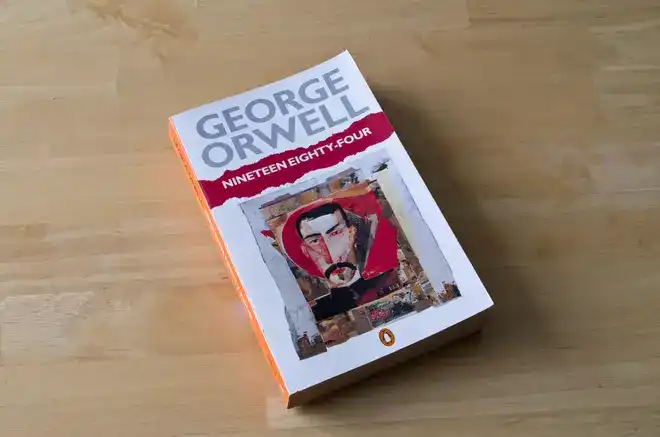
AI generated a list of 193 books to be removed, each with a reason. George Orwell's "1984" was prominently included, with the reason being "contains themes of torture, violence, and sexual coercion."

"1984" depicts a world where the government monitors everything, rewrites history, and decides what citizens can and cannot see. Now, AI has done the same for a school, and it may not even understand what it is saying.

The school librarian found it unreasonable and refused to fully implement the recommendations given by AI.
The school then launched an internal investigation against her on the grounds of "child safety," accusing her of introducing inappropriate books to the library and reported her to the local government. She took sick leave due to pressure and eventually resigned.

Absurdly, the local government's investigation concluded that she had indeed violated child safety procedures, and the complaint was upheld.

Caroline Roche, chair of the UK School Library Association, said this conclusion means she can no longer work in any school.

The person who resisted AI's judgment lost her job, while those who signed off on AI's judgment faced no consequences.

Subsequently, the school admitted in internal documents that all classifications and reasons were generated by AI, stating: "Although the classification was generated by AI, we believe it is generally accurate."

A school handed over the judgment of "what books are suitable for students" to AI. AI returned an answer it did not understand, and a human administrator stamped it without even looking closely.

After this incident was exposed by the UK free speech organization Index on Censorship, the issues raised extended far beyond a school's bookshelf:

When AI starts deciding for humans what content is appropriate and what is dangerous, who judges whether AI's judgment is correct?

Wikipedia Closes Its Doors to AI

In the same week, another institution answered this question with action.

While the school let AI decide what people can read, the world's largest online encyclopedia, Wikipedia, made the opposite choice: not letting AI decide what the encyclopedia writes.

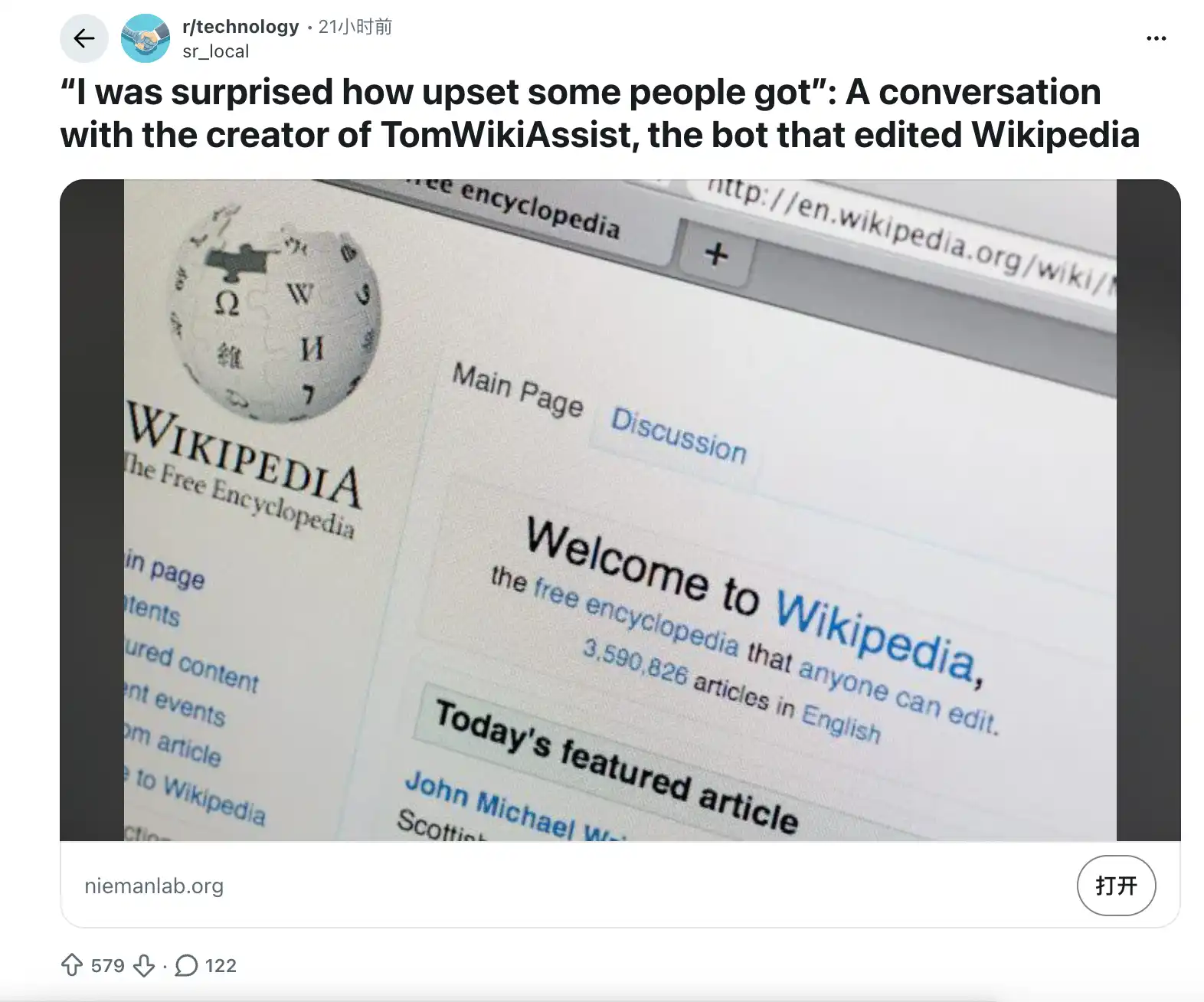
In the same week, English Wikipedia formally passed a new policy prohibiting the use of large language models to generate or rewrite entry content. The vote was 44 in favor and 2 against.

The direct cause was an AI account called TomWikiAssist. In early March this year, this account autonomously created and edited multiple entries on Wikipedia, which were urgently addressed after being discovered by the community.

It takes AI only a few seconds to write an entry, but volunteers spend hours verifying the facts, sources, and wording of an AI-generated entry for accuracy.
The Wikipedia editing community has only so many people. If AI can mass-produce content indefinitely, human editors simply cannot review it all.

This is not even the most troublesome part. Wikipedia is one of the most important training data sources for global AI models. AI learns knowledge from Wikipedia and then uses what it has learned to write new Wikipedia entries, which are then ingested by the next generation of AI models for further training.

Once AI-generated misinformation mixes in, it will continuously amplified in this cycle, becoming a matryoshka doll-style AI poisoning:

AI pollutes training data, and training data pollutes AI.

However, Wikipedia's policy also leaves two openings for AI: editors can use AI to polish their own writing or use AI to assist with translation. But the policy specifically warns that AI may "go beyond your request, change the meaning of the text, and make it inconsistent with the cited sources."

Human writers make mistakes, and Wikipedia has relied on community collaboration to correct them for over twenty years. AI makes mistakes differently; it fabricates things that look more real than the truth and can be produced in bulk.

A school trusted AI's judgment and lost a librarian. Wikipedia chose not to trust and simply closed the door.

But what if even the creators of AI are starting to lose faith?

The Creators of AI Are Themselves Afraid

While external institutions are closing doors to AI, AI companies are also pulling back.

In the same week, OpenAI indefinitely shelved ChatGPT's "adult mode." This feature was originally planned for release last December, allowing age-verified adult users to engage in erotic conversations with ChatGPT.

CEO Sam Altman personally announced it last October, stating the goal was to "treat adult users like adults."

After being postponed three times, it was directly canceled.

According to the British "Financial Times," OpenAI's internal health advisory committee unanimously opposed this feature. The advisors' concerns were specific: users would develop unhealthy emotional dependencies on AI, and minors would inevitably find ways to bypass age verification.

One advisor put it more directly: without significant improvements, this thing could become a "sexy suicide coach."

The error rate of the age verification system exceeds 10%. Based on ChatGPT's weekly active user base of 800 million, 10% means tens of millions of people could be misclassified.

Adult mode is not the only product cut this month. AI video tool Sora and ChatGPT's built-in instant checkout feature were also taken offline around the same time. Altman said the company is focusing on its core business and cutting "side tasks."

But OpenAI is simultaneously preparing for an IPO.

A company sprinting towards an上市,密集 cutting functions that may cause controversy, this move might more accurately be called risk aversion than focus.

Five months ago, Altman was still saying to treat users like adults. Five months later, he found that his own company still hasn't figured out what AI can let users touch and what it cannot.

Even the creators of AI themselves have no answer. So who should draw this line?

The Uncatchable Speed Gap

Put these three things together, and it's easy to draw a core conclusion:

The speed at which AI produces content and the speed at which humans review content are no longer on the same scale.

The choice of that school in Manchester is easy to understand in this context. How long would it take for a librarian to read all 193 books and make a judgment? Let AI run through them: a few minutes.

The principal chose the few-minute solution. Do you really think he trusted AI's judgment? I think it's more because he didn't want to spend the time.

This is an economic problem. The cost of generation approaches zero, while the cost of review is entirely borne by humans.

Therefore, every institution affected by AI is forced to respond in the most粗暴 way: Wikipedia直接禁止, OpenAI直接砍产品线. None of the solutions are the result of careful consideration; they are all stopgap measures implemented before there's time to think clearly.

"Block it first and talk later" is becoming the norm.

AI capabilities iterate every few months, while discussions about what content AI can touch don't even have a decent international framework. Each institution only manages the line in its own yard. The lines contradict each other, and no one coordinates them.

AI's speed is still accelerating. The number of reviewers won't increase. This scissors gap will only widen until one day something far more serious than banning "1984" happens.

By then, drawing lines might be too late.

Câu hỏi Liên quan

QWhy was George Orwell's book '1984' banned by the AI in the Manchester school case?

AThe AI recommended banning '1984' due to its 'themes of torture, violence, and sexual coercion.'

QWhat was the consequence for the librarian who resisted the AI's book removal suggestions?

AThe librarian was subjected to an internal investigation, pressured into taking sick leave, and ultimately resigned. She was also reported to local authorities and deemed to have violated child safety procedures, effectively ending her career in schools.

QWhat action did Wikipedia take regarding AI-generated content, and why?

AWikipedia officially banned the use of large language models to generate or rewrite article content. This decision was made because AI can produce content rapidly, making it difficult for human volunteers to verify facts and sources, and it risks creating a feedback loop where AI pollutes its own training data.

QWhy did OpenAI decide to cancel its planned 'adult mode' for ChatGPT?

AOpenAI canceled the 'adult mode' due to concerns from its internal health advisory board, which warned about users developing unhealthy emotional dependencies on the AI and the risk of minors bypassing age verification. The error rate of the age verification system was also a significant factor.

QWhat is the core issue highlighted by the three events in the article regarding AI and content moderation?

AThe core issue is the significant speed disparity between AI's ability to generate content and humanity's capacity to审核 it. This creates a situation where institutions are forced to make hasty, often poorly considered decisions—such as outright bans or canceling features—because they lack the resources or time to properly evaluate AI's output, and there is no comprehensive international framework to guide these decisions.

Nội dung Liên quan

«Cưa mùa hè» tiếp tục: Phá vỡ $67,000 sẽ là khởi đầu cho đà tăng của Bitcoin

Giá Bitcoin giảm xuống 62.217 USD vào ngày 1/8, tiếp tục giai đoạn củng cố trong phạm vi 58.000 - 67.000 USD kể từ đầu tháng 6. Thị trường đang chia rẽ về hướng đi tiếp theo. Các nhà phân tích kỹ thuật chỉ ra hai kịch bản chính. Một số, như Crypto Candy và Jelle, dự báo khả năng giảm về vùng 60.000 USD nếu giá không vượt lên trên 66.000 USD, đồng thời mô tả thị trường đang trong giai đoạn "củng cát mùa hè" kéo dài. Ngược lại, những người khác như Daan Crypto Trades và Roman nhấn mạnh rằng việc phá vỡ mốc 67.000 USD với khối lượng giao dịch đủ mạnh có thể mở đường cho đợt tăng mạnh lên vùng 70.000 - 80.000 USD. Về góc nhìn dài hạn, nhà phân tích Gert van Lagen xem đây là giai đoạn tích lũy, với Bitcoin đang thử nghiệm đường viền cổ của mô hình "cốc và tay cầm" hình thành suốt 7 năm. Ông cũng lưu ý rằng các nhà đầu tư nắm giữ dài hạn vẫn kiên định, không chịu bán tháo. Tóm lại, thị trường Bitcoin đang trong thời kỳ tích lũy quan trọng, với hai mức giá then chốt là 60.000 USD và 67.000 USD. Việc phá vỡ một trong hai mức này sẽ định hình xu hướng chính tiếp theo.

cryptonews.ru31 phút trước

«Cưa mùa hè» tiếp tục: Phá vỡ $67,000 sẽ là khởi đầu cho đà tăng của Bitcoin

cryptonews.ru31 phút trước

Tuần tới cần chú ý|Đạo luật CLARITY dự kiến được biểu quyết tại Thượng viện; SpaceX, Circle công bố báo cáo tài chính (3.8-9.8)

**Tóm tắt các sự kiện quan trọng từ ngày 3 đến 9 tháng 8:** **Tuần tới sẽ có nhiều sự kiện đáng chú ý trong lĩnh vực tiền điện tử và công nghệ:** * **Pháp luật & Quy định:** Dự luật CLARITY Act, nhằm thiết lập khung quy định liên bang cho tiền điện tử, có khả năng được đưa ra biểu quyết toàn thể tại Thượng viện Mỹ vào tuần tới. Các nhà đàm phán cần đạt được 60 phiếu ủng hộ trước ngày 7/8. * **Báo cáo tài chính:** Nhiều công ty lớn sẽ công bố báo cáo tài chính quý II/2026, bao gồm **SpaceX (ngày 4/8)**, công ty khai thác Bitcoin **Hut 8 (ngày 4/8)**, **Circle (ngày 5/8)** và công ty khai thác liên quan đến gia đình Trump là **American Bitcoin (ngày 3/8)**. * **Sự kiện SpaceX:** Bên cạnh báo cáo tài chính, cổ phiếu của SpaceX sẽ bắt đầu được mở khóa từ ngày 6/8, với đợt đầu tiên có thể lên tới 12% tổng số cổ phiếu. * **Dữ liệu kinh tế:** Báo cáo việc làm phi nông nghiệp (Non-Farm) quan trọng của Mỹ cho tháng 7 sẽ được công bố vào ngày 7/8. * **Cập nhật công nghệ:** * **XRP Ledger:** Phiên bản mới xrpld 3.3.0 với 5 tính năng mới dự kiến phát hành vào tuần tới. * **Grok:** Elon Musk thông báo Grok 4.6 dự kiến ra mắt vào khoảng ngày 7/8. * **Bitcoin:** Việc gửi tín hiệu bắt buộc cho BIP-110 sẽ bắt đầu vào khoảng ngày 8/8. * **Ngừng hoạt động:** Một số dịch vụ tiền điện tử sẽ ngừng hoạt động vào ngày 3/8, bao gồm công cụ theo dõi danh mục DeFi **Zapper** và ví **Ctrl Wallet**. * **Niêm yết & Hủy niêm yết:** Sàn Upbit Hàn Quốc sẽ hủy niêm yết token AQT và AERGO từ ngày 3/8. Trong khi đó, công ty robot **宇树科技 (Unitree Robotics)** sẽ tiến hành thăm dò giá ban đầu cho đợt IPO trên STAR Market vào ngày 5/8.

marsbit1 giờ trước

Tuần tới cần chú ý|Đạo luật CLARITY dự kiến được biểu quyết tại Thượng viện; SpaceX, Circle công bố báo cáo tài chính (3.8-9.8)

marsbit1 giờ trước

Cổ phiếu giảm mạnh hơn cả tiền điện tử, tiền đã đi đâu?

Tác giả: Cathy, Baihua Blockchain Vào ngày 28 và 29 tháng 7, chỉ số Kospi của Hàn Quốc hai ngày liên tiếp kích hoạt cơ chế ngắt mạch (circuit breaker), một sự kiện chưa từng có trong lịch sử. Cổ phiếu bán dẫn toàn cầu lao dốc, đặc biệt là SK Hynix – cổ phiếu trọng số lớn nhất, giảm khoảng 23% sau hai ngày. Điều trớ trêu là, trong khi thị trường chứng khoán biến động dữ dội như tiền mã hóa, Bitcoin lại thể hiện sự ổn định tương đối, phục hồi gần 15% từ mức thấp tháng 7. Bài viết phân tích rằng đợt sụt giảm này không phải là sự hoảng loạn toàn thị trường, mà là một cuộc "giải tỏa đòn bẩy cưỡng chế" nhắm vào các giao dịch đầu cơ tập trung nhất, như lĩnh vực bán dẫn và AI. Các yếu tố thúc đẩy bao gồm báo cáo lợi nhuận không đạt kỳ vọng của SK Hynix, sự cạnh tranh tiềm tàng từ Trung Quốc, và việc Ngân hàng Nhật Bản tăng lãi suất khiến các khoản đầu tư mang theo (carry trade) bằng Yên phải thoái vốn. Vậy tiền từ thị trường chứng khoán có chảy vào Bitcoin không? Câu trả lời là không. Bitcoin "kháng sụt giảm" vì nó đã trải qua đợt bán tháo lớn vào tháng 5 và tháng 6, với dòng tiền ròng rút kỷ lục khỏi các ETF Bitcoin Mỹ. Tiền thực sự đã chảy vào tài sản an toàn truyền thống như vàng, với hệ số tương quan giữa Bitcoin và vàng giảm xuống mức rất thấp. Điều này cho thấy Bitcoin hiện được coi là tài sản mạo hiểm để tìm kiếm lợi nhuận, chứ không phải nơi trú ẩn an toàn. Bài viết kết luận rằng để dòng tiền thực sự quay trở lại với Bitcoin, cần ba điều kiện: áp lực thanh khoản toàn cầu giảm bớt, Fed cắt giảm lãi suất mà không gây ra suy thoái, và Đạo luật CLARITY được thông qua để giải tỏa lo ngại về quy định. Mặc dù tiền chưa chảy vào, Bitcoin đã tự định vị mình như một tài sản có tương quan thấp với Nasdaq, một đặc điểm mà các tổ chức có thể tìm kiếm để đa dạng hóa danh mục đầu tư sau cú sốc AI.

marsbit1 giờ trước

Cổ phiếu giảm mạnh hơn cả tiền điện tử, tiền đã đi đâu?

marsbit1 giờ trước

Đối thoại với Ray Dalio: Chúng ta đang ở trong bong bóng AI, 1% danh mục đầu tư của tôi là Bitcoin

Ray Dalio, người sáng lập Bridgewater Associates, trong một cuộc phỏng vấn đã chỉ ra rằng thế giới hiện tại đang trong một "AI bubble" (bong bóng AI) cổ điển, với giá tài sản tăng vọt và đầu cơ quá mức. Ông cảnh báo bong bóng có thể vỡ do lãi suất tăng, nguồn cung cổ phiếu dư thừa hoặc khi nhà đầu tư cần tiền mặt trả nợ, dẫn đến suy thoái kinh tế. Đồng thời, Dalio mô tả một "chu kỳ lớn" kéo dài khoảng 80 năm, bao gồm ba động lực chồng chéo: khoảng cách giàu nghèo và xung đột nội bộ, thâm hụt ngân sách chính phủ khổng lồ và thay đổi địa chính trị. Ông nhấn mạnh rằng Mỹ và Anh đang đối mặt với những thách thức trong giai đoạn suy yếu này. Để bảo vệ của cải, Dalio khuyến nghị đa dạng hóa danh mục đầu tư với cổ phiếu, vàng, trái phiếu, bất động sản thay vì chỉ giữ tiền mặt. Ông tiết lộ khoảng 1% danh mục của mình là Bitcoin, nhưng vẫn ưa chuộng vàng vật chất hơn do tính ổn định và vai trò tiền tệ dự trữ. Về tác động của AI, Dalio cho rằng nó không chỉ thay thế lao động chân tay mà còn cả tư duy, làm trầm trọng thêm bất bình đẳng thu nhập. Con người cần phát huy trí tuệ cảm xúc và trực giác - những thứ AI chưa có - và học cách hợp tác với AI. Cuối cùng, ông phân tích những rủi ro của thuế tài sản và xu hướng thế giới có thể trở nên "khu vực hóa" hơn, với các khối như châu Mỹ và châu Á - Thái Bình Dương, trong bối cảnh sự thống trị toàn cầu của Mỹ đang suy yếu.

marsbit5 giờ trước

Đối thoại với Ray Dalio: Chúng ta đang ở trong bong bóng AI, 1% danh mục đầu tư của tôi là Bitcoin

marsbit5 giờ trước

Giao dịch

Giao ngay
活动图片





