After Falsifying Revenue, Why Did This CEO Choose a 'No Pants' Response?

比推Xuất bản vào 2026-03-11Cập nhật gần nhất vào 2026-03-11

Tóm tắt

CEO Roy Lee, founder of AI startup Cluely, responded to accusations of inflating revenue figures not with a traditional apology, but with a deliberately absurd video performance. After being accused of falsely claiming $7M in annual recurring revenue in a TechCrunch interview, Lee first admitted to casually providing the number, then released a video where he appeared professionally dressed from the waist up—only to stand up and reveal he was not wearing pants. The company, which began by creating an AI-powered interview cheating tool and was co-founded after Lee was expelled from Columbia University, has consistently leveraged controversy as a core growth strategy. Rather than mitigating the scandal, Lee turned it into a viral moment, echoing a broader trend in tech and crypto where attention itself is monetized. Major investor a16z has backed Cluely, with partners arguing that in an era of commoditized AI models, viral storytelling and public attention are the new moats. Lee’s response exemplifies how some founders now treat controversy not as risk, but as fuel for growth.

Author: DingDang

Original Title: CEO Uses Humor to Respond to Crisis, AI Entrepreneurs Steal Crypto's Marketing Playbook


In most startups, if exposed for 'falsifying revenue,' it would likely lead to a PR crisis—issuing a statement, explaining the misunderstanding, correcting data metrics, apologizing, and then steering the conversation back to product or business growth.

But Cluely's CEO Roy Lee clearly had no intention of doing that.

A Company That Started with a 'Cheating Tool'

Cluely was founded in 2025, and its initial product came from a project called Interview Coder, developed by Roy Lee and his college roommate Neel. This was a tool that used AI to help users cheat in LeetCode interviews. Due to this project, both were eventually expelled from Columbia University.

For most people, being expelled from school would be a black mark to cover up. But Roy Lee turned this incident into a marketing opportunity, even a 'turning point in life.'

Cluely's initial product slogan was: 'Cheat on Everything.' It wasn't until November 2025 that Cluely began shifting its product narrative from a 'cheating tool' to an AI note-taking assistant, such as using AI to automatically organize meeting content, optimize collaboration efficiency, and even modify attendees' expressions to hide distractions. But no matter how the product evolved, the company, or rather, its CEO, never shook off a very distinct vibe: it almost grew through controversy.

And the ensuing storm, in a way, continued down this path.

A Farce Triggered by 'Falsified Revenue'

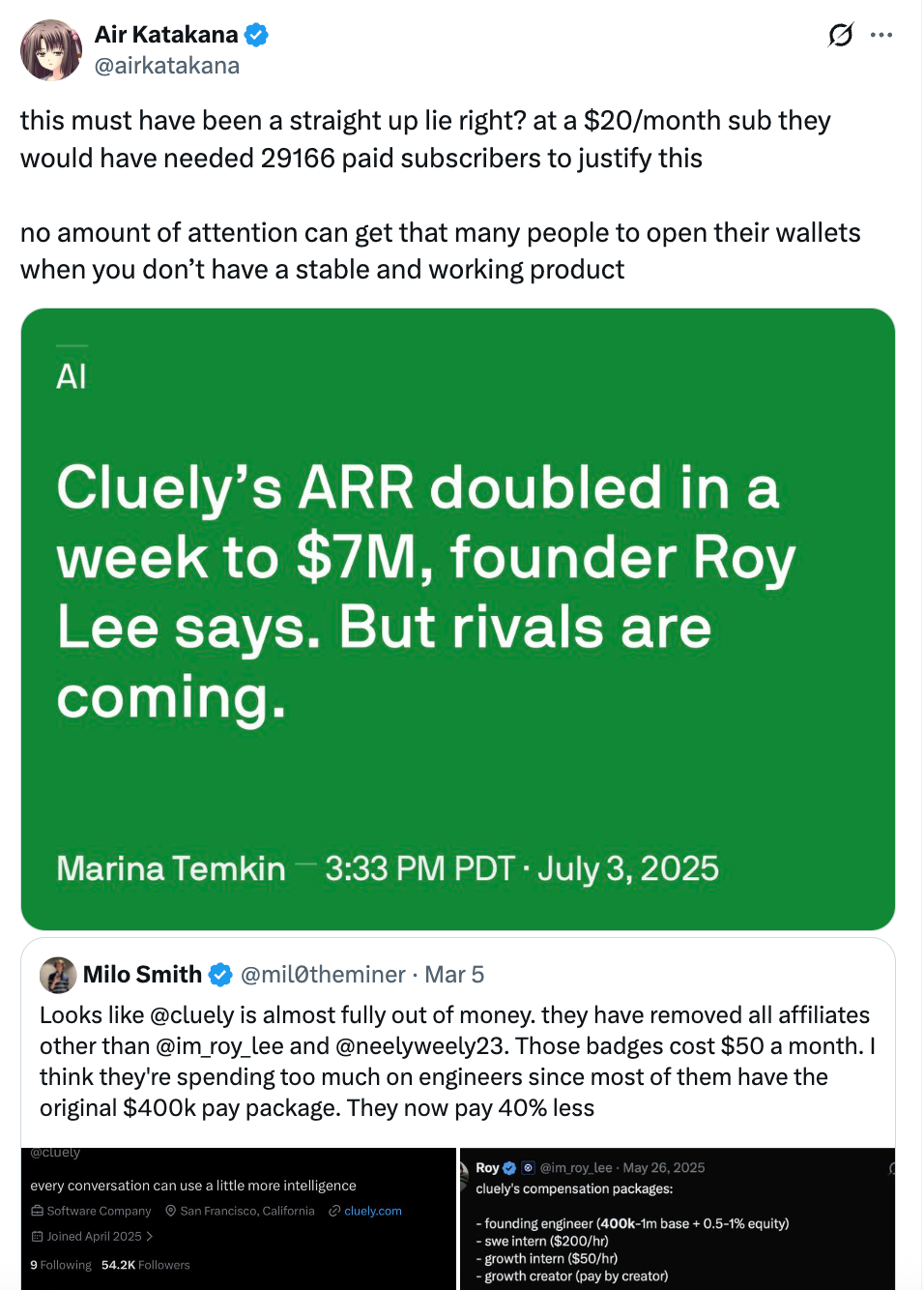
The incident began when someone dug up a July 2025 report by TechCrunch. The article mentioned that Cluely's Annual Recurring Revenue (ARR) had doubled in a week, reaching $7 million. This data was questioned as fraudulent.
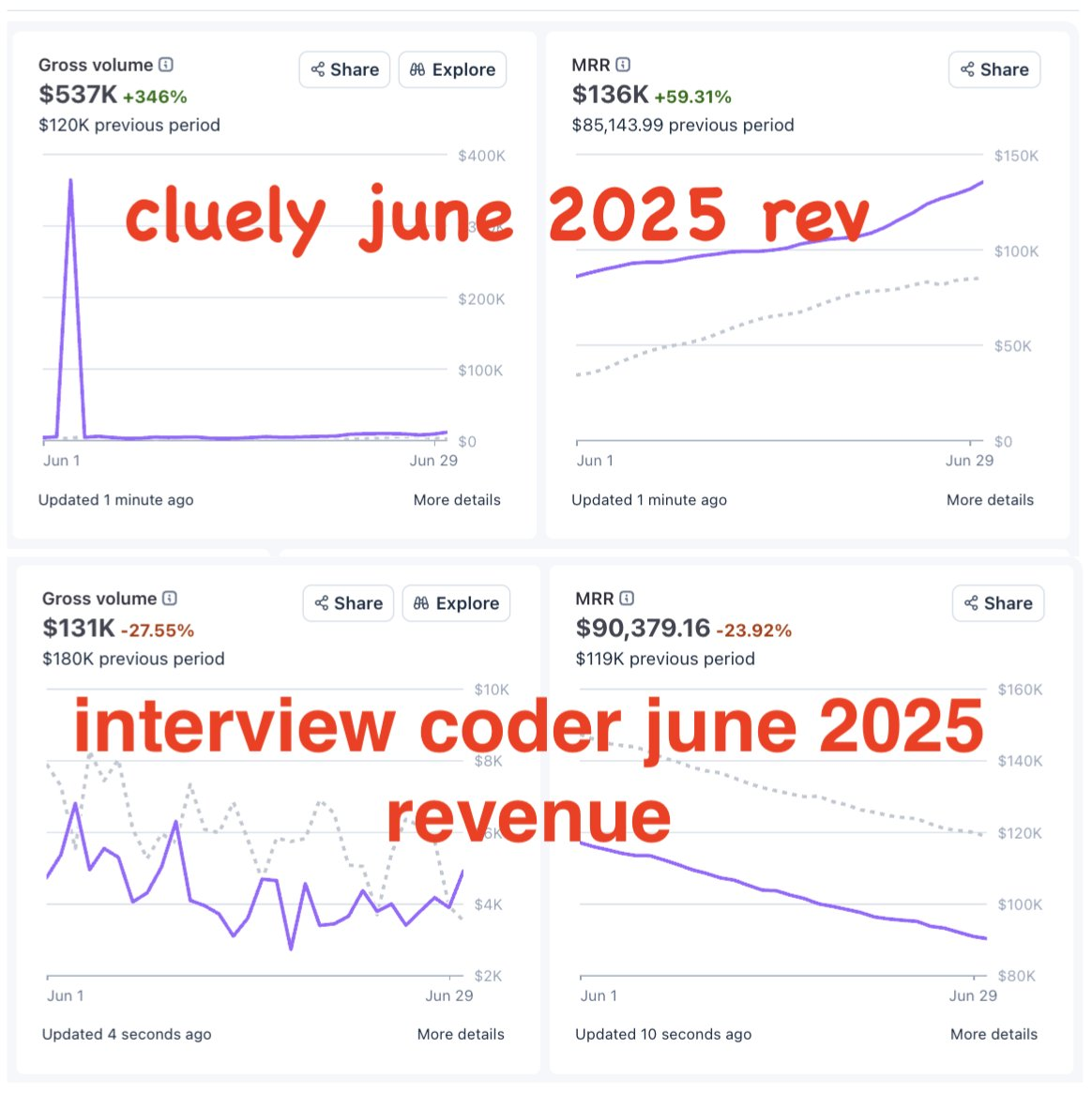
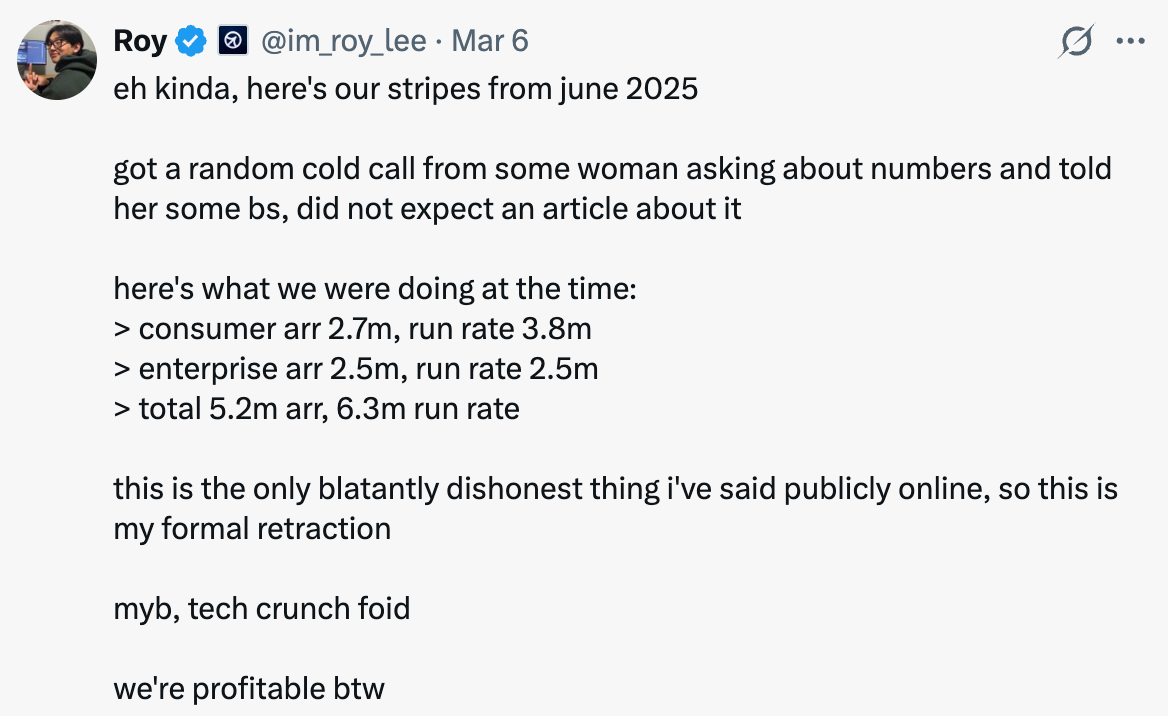
Facing the质疑, Cluely CEO Roy Lee was quite candid. He quickly posted to admit that he had casually mentioned the number when a reporter called him, not expecting it to be included in a formal article. Seemingly to prove it wasn't an intentional exaggeration, he also posted Cluely's actual data from June 2025: consumer business annual revenue of $2.7 million and enterprise business annual revenue of $2.5 million, totaling $5.2 million.

Up to this point, there was nothing sensational, and the explanation was plausible.
But on the same day, TechCrunch reporter Julie Bort published a rebuttal to Roy's claim. She stated that the interview was arranged proactively by Cluely's PR team, was documented, and was not a casual chat.

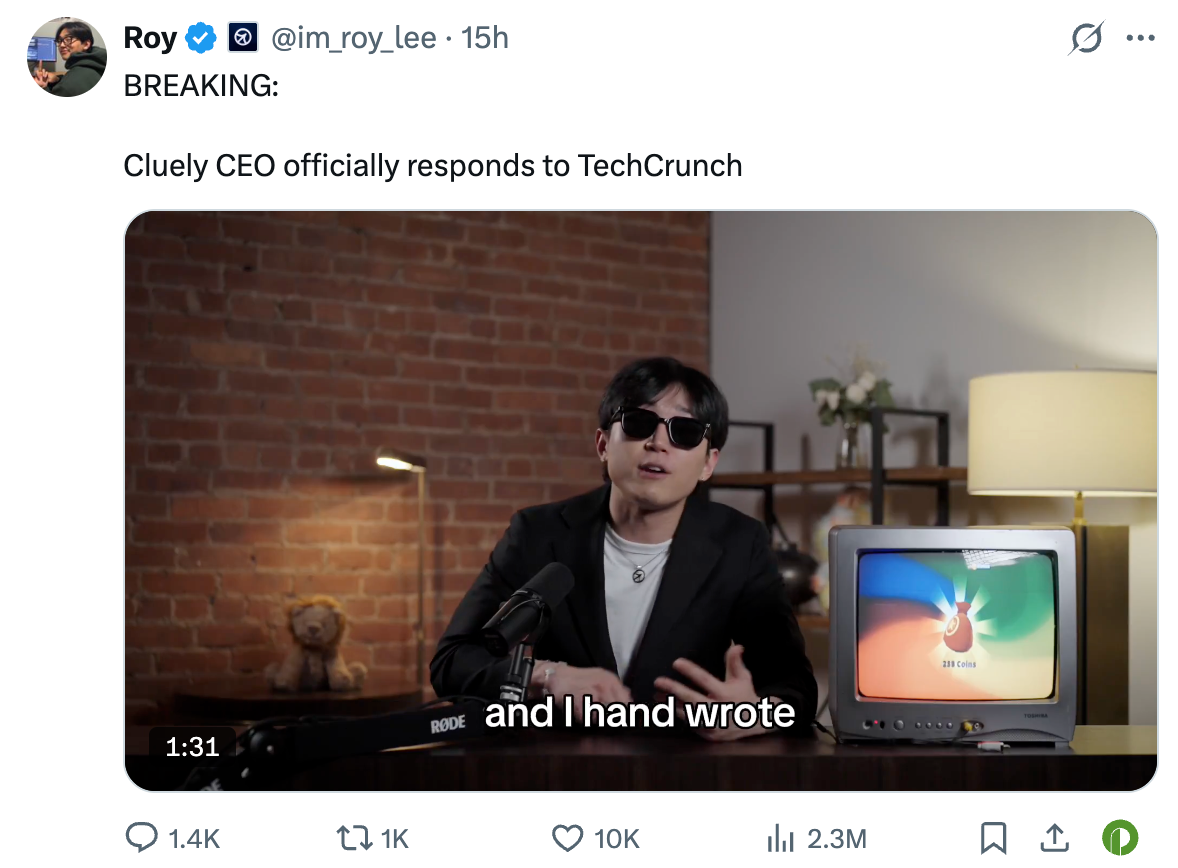
Roy Lee didn't continue with a written explanation but chose a more dramatic way to respond. He released a video with the caption, 'Breaking News: Cluely CEO Officially Responds to TechCrunch.'

In the video, he sat in front of the camera wearing sunglasses and a suit, with a microphone on the desk, looking as if he was about to make a serious statement. But the setting wasn't an office; it looked more like a living room, with an old desktop computer next to him playing Subway Surfers—a classic time-wasting game. Roy's response was also completely informal, more like a self-deprecating performance, mixed with self-mockery and bragging, his tone reminiscent of a rapper freestyling.

Even more absurdly, at the end of the video, he stood up from behind the desk, revealing that this CEO, formal from the waist up, was wearing no pants......
Thus, a crisis PR situation originally about 'falsified revenue' was handled as a traffic-grabbing, self-mocking performance.

What a16z Is Betting On Is Actually the Attention Economy

The capital market doesn't seem to mind this kind of performative founder personality either. In June 2025, Cluely announced the completion of a $15 million Series A funding round, with participating institutions including the renowned venture capital firm Andreessen Horowitz (a16z). Its partner Bryan Kim once mentioned on a podcast: In the AI era, the traditional 'artisan product + slow growth' model is no longer sufficient; viral spread itself is part of the product.

What he considers the 'new AI startup template' is that in an era where model capabilities are increasingly commoditized, attention itself is becoming a key resource. Whoever can capture user attention first may build a new moat.

From the 'cheating controversy' of Interview Coder, to the entrepreneurial story of being expelled from Columbia, to this absurd 'response video,' Roy Lee's entire personal brand has been built along this path: controversy itself is the content for propagation. This might also explain why a16z chose to invest in Cluely, to invest in Roy Lee.

When Controversy Becomes a Growth Strategy

In past entrepreneurial narratives, growth typically came from product capability, technological barriers, and business models. But in today's internet environment, another resource is becoming increasingly important—attention.

This logic has actually been proven in the crypto industry long ago. Many crypto projects capture user attention by creating topics, controversies, or even dramatic events, and then convert this traffic into product growth or commercial value, especially with the rise of Memes—pure propagation, no (traditional) product.

In a way, Roy Lee's response video is a classic case of this logic: when negative news emerges, rather than trying to suppress the controversy, repackage the controversy itself as传播 content.

Evidently, in the current internet environment, attention is often more valuable than explaining the truth.


Twitter:https://twitter.com/BitpushNewsCN

Bitpush TG Discussion Group:https://t.me/BitPushCommunity

Bitpush TG Subscription: https://t.me/bitpush

Original link:https://www.bitpush.news/articles/7618818

Câu hỏi Liên quan

QWhat was the initial product developed by Cluely's CEO and co-founder, and what was the consequence of its creation?

AThe initial product was Interview Coder, an AI tool designed to help users cheat on LeetCode coding interviews. As a result, both Roy Lee and his roommate were expelled from Columbia University.

QHow did Cluely's CEO, Roy Lee, respond to the allegations of falsifying revenue reported by TechCrunch?

ARoy Lee first admitted in a post that he had casually provided the number during a call with a journalist without expecting it to be published. He then released a satirical video response where he appeared professionally dressed from the waist up but was not wearing pants, turning the crisis into a performance to attract attention.

QWhich prominent venture capital firm invested in Cluely's Series A funding round, and what was their stated reasoning for such investments in the AI era?

AAndreessen Horowitz (a16z) participated in Cluely's $15 million Series A funding round. Their partner, Bryan Kim, stated that in the AI era, viral marketing itself is part of the product, and capturing user attention is a critical resource for building a moat.

QAccording to the article, what is the 'new AI startup template' that Cluely's strategy exemplifies?

AThe 'new AI startup template' is one where, in an era of increasingly commoditized model capabilities, attention itself becomes a key resource. The strategy involves generating controversy and using viral, dramatic events to capture user attention and drive growth, rather than relying solely on traditional product capability or technological barriers.

QHow did the company's product narrative evolve from its origins to late 2025?

AOriginally promoted with the slogan 'Cheat on Everything' as a tool for cheating, the company began shifting its product narrative in November 2025 towards an AI note-taking assistant. This new focus included features like automatically organizing meeting content, improving collaboration efficiency, and even modifying attendees' expressions to hide distraction.

Nội dung Liên quan

Các nhà đầu tư XRP có lời trở lại, nhưng cầu Spot đã biến mất: Liệu $1.10 có giữ được?

Cấu trúc thị trường gần đây của XRP đang gửi đi những tín hiệu trái chiều khi hoạt động dịch chuyển khỏi giao dịch Spot sang thị trường phái sinh. Giá củng cố trong khoảng $1.086 và $1.113 bất chấp khối lượng giao dịch giảm dần, cho thấy chưa bên mua hay bên bán nắm lợi thế quyết định. Điều đáng chú ý là Mở Interest (OI) cho XRP lại tăng khoảng 5.9% lên 423.8 triệu XRP, và tỷ lệ đòn bẩy ước tính tăng lên 0.162. Sự phân kỳ này quan trọng vì phái sinh có thể duy trì vị thế mà không cần thêm vốn mới vào thị trường. Trong khi dòng tiền vào/ra thị trường Spot sụp đổ ~99%, các nhà giao dịch sử dụng đòn bẩy ngày càng trở thành lực lượng chi phối chính trong việc định giá XRP, giải thích cho sự củng cố giá. Tuy nhiên, nếu nhu cầu Spot không quay trở lại để xác nhận các vị thế này, mức đòn bẩy ngày càng tăng khiến XRP dễ bị tổn thương trước một đợt thanh lý mạnh nếu tâm lý đột ngột thay đổi. Về khía cạnh tích cực, các nhà nắm giữ ngắn hạn (STH) của XRP cuối cùng đã quay trở lại trạng thái có lãi khi chỉ số MVRV 30 ngày vượt lên mức trung tính, đạt 1.03. Sự cải thiện này tương đồng với xu hướng phục hồi tâm lý nhà đầu tư trên các tài sản vốn hóa lớn khác như Bitcoin, Ethereum. Tuy nhiên, sự thay đổi về khả năng sinh lời này cũng làm thay đổi cấu trúc động lực trên thị trường. Khi ngày càng nhiều người nắm giữ ngắn hạn thoát khỏi các khoản lỗ tiềm ẩn, áp lực giữ tài sản thường nhường chỗ cho xu hướng muốn chốt lời. Mặc dù altcoin này vẫn nằm dưới vùng bán lịch sử, hành động giá ngày càng khó duy trì do thiếu nhu cầu mới và khả năng xuất hiện áp lực chốt lời. Tóm lại, trong khi các nhà nắm giữ XRP đã có lãi trở lại, đợt tăng giá chủ yếu được thúc đẩy bởi đòn bẩy trên thị trường phái sinh hơn là nhu cầu Spot thực tế. Mức hỗ trợ $1.10 đang gặp rủi ro khi áp lực chốt lời gia tăng và những nghi ngờ về tính bền vững của xu hướng hiện tại ngày càng lớn.

ambcrypto41 phút trước

Các nhà đầu tư XRP có lời trở lại, nhưng cầu Spot đã biến mất: Liệu $1.10 có giữ được?

ambcrypto41 phút trước

Kalshi tuyên bố kháng cáo sau khi thẩm phán Washington cho rằng thị trường dự đoán có khả năng vi phạm luật cờ bạc của tiểu bang

Kalshi tuyên bố sẽ kháng cáo sau khi một thẩm phán tại Washington ra lệnh cấm sơ bộ, xác định rằng nền tảng giao dịch dự đoán này có khả năng vi phạm luật cờ bạc và bảo vệ người tiêu dùng của tiểu bang. Văn phòng Tổng chưởng lý Washington cho rằng Kalshi hoạt động như một doanh nghiệp cá cược trực tuyến bất hợp pháp, cho phép người dùng đặt cược vào nhiều sự kiện từ thể thao đến bầu cử. Kalshi phản đối phán quyết, khẳng định thị trường dự đoán thuộc thẩm quyền quản lý độc quyền của Ủy ban Giao dịch Hàng hóa Tương lai (CFTC) theo Đạo luật Trao đổi Hàng hóa, và các tiểu bang không có quyền điều chỉnh. Tuy nhiên, tòa án Washington nhận định đạo luật liên bang không có hiệu lực áp đảo luật cờ bạc của tiểu bang trong trường hợp này. Vụ việc có thể tạo tiền lệ quan trọng cho việc giám sát các thị trường dự đoán trên toàn quốc, làm rõ sự cạnh tranh thẩm quyền giữa cơ quan liên bang và luật cờ bạc của các tiểu bang. Lệnh cấm chính thức dự kiến được ban hành vào ngày 5/8.

ambcrypto1 giờ trước

Kalshi tuyên bố kháng cáo sau khi thẩm phán Washington cho rằng thị trường dự đoán có khả năng vi phạm luật cờ bạc của tiểu bang

ambcrypto1 giờ trước

Thiết lập 70K USD của Bitcoin đã ở đây dù nhu cầu Spot yếu – Đây là cách!

Thị trường đang cho thấy Bitcoin có thể phải đối mặt với nhiều biến động hơn. Báo cáo từ Glassnode chỉ ra rằng đã có hoạt động chốt lời mạnh quanh mức 65.000 USD, trong khi áp lực bán gia tăng. Nhu cầu mua spot, dù phục hồi vào đầu tháng 7, hiện đã suy yếu trở lại, làm dấy lên lo ngại về nguy cơ xảy ra sự kiện thanh lý các vị thế mua (long liquidation) nếu thiếu lực mua mới. Tuy nhiên, dữ liệu phái sinh cho thấy các vị thế mua kỳ vọng giá lên (bullish positioning) và đòn bẩy đang gia tăng trở lại, với tỷ lệ funding rate dương tăng hơn 20% trong vòng chưa đầy 72 giờ. Điều này có thể khiến Bitcoin dễ bị tổn thương trước một đợt điều chỉnh mạnh nếu nhu cầu spot vẫn yếu. Một yếu tố tích cực nổi bật là hành vi của cá voi Bitcoin. Trong 60 ngày qua, họ đã tích lũy 66.700 BTC bất chấp đợt điều chỉnh giảm gần 25%, trong khi các nhà đầu tư cỡ trung bình lại bán ra. Hành động này báo hiệu sự chuyển giao cổ phiếu từ tay những người nắm giữ ngắn hạn (STH) sang tay những người nắm giữ dài hạn (LTH) kiên định hơn, một dấu hiệu thường xuất hiện trước một xu hướng tăng bền vững. Do đó, dù nhu cầu spot yếu, cấu trúc thị trường hiện tại—với sự tích lũy của cá voi và định vị phái sinh—có khả năng hỗ trợ Bitcoin hướng tới mốc 70.000 USD, thay vì tạo ra một cái bẫy tăng giá (bull trap).

ambcrypto1 giờ trước

Thiết lập 70K USD của Bitcoin đã ở đây dù nhu cầu Spot yếu – Đây là cách!

ambcrypto1 giờ trước

Giao dịch

Giao ngay
活动图片