A Century-Long Journey of an Egg: From Wall Street to Polymarket

marsbitXuất bản vào 2026-03-02Cập nhật gần nhất vào 2026-03-02

Tóm tắt

The article traces the historical journey of egg futures, once one of the most active commodities traded on Wall Street. Beginning at the Chicago Butter and Egg Board (which later became the CME), egg futures were highly active in the early 20th century. However, by the 1980s, industrial farming and improved supply chains reduced price volatility, leading to the decline of egg futures trading in traditional markets. In 2013, China’s Dalian Commodity Exchange revived egg futures due to market volatility. More recently, egg price speculation has moved to Polymarket, a prediction market platform. One trader, "xcnstrategy," reportedly earned significant profits by shorting egg price intervals, likely leveraging expertise in commodity markets or agriculture. The piece highlights a broader trend: crypto and prediction markets like Polymarket and Hyperliquid are increasingly serving as 24/7 trading venues for traditional assets—including oil, gold, and forex—especially during periods when conventional markets are closed. This was evident during recent U.S.-Iran tensions when traders used these platforms to hedge and price assets amid traditional market closures. The evolution reflects an ongoing shift in price discovery power from established exchanges to decentralized, always-on crypto markets—echoing the original purpose of futures markets: to manage risk and determine prices.

"We went from eggs to yen"—this financial reminiscence from CME legend Leo Melamed bears witness to a time when eggs were once one of the world's most active futures products.

In the first half of the 20th century, egg futures were among the hottest trading instruments in Chicago. Trading volume in some years was second only to grain varieties, and there were even instances where futures trading far exceeded the volume of physical circulation.

The predecessor of the Chicago Mercantile Exchange (CME), the world's largest derivatives market, was called the "Chicago Butter and Egg Board." This was the foundation of what would later become a derivatives empire, and as the name implies, the exchange initially traded only two things: butter and eggs.

After the 1970s, the U.S. egg-laying industry rapidly industrialized, cold chains matured, and price fluctuations were gradually "smoothed out." As uncertainty began to fade, the noise in the trading pits quieted down. In 1982, egg futures officially exited the Chicago Mercantile Exchange. It didn’t collapse dramatically; rather, it was as if the times quietly turned off the lights.

In 2013, the Dalian Commodity Exchange in mainland China reignited this product. At that time, mainland China's egg-laying industry was still highly fragmented, with sharp price fluctuations, making hedging needs real and urgent.

Egg futures trading did not disappear; it merely migrated. And today, this migration has taken another step forward. The venue for trading egg prices has moved to Polymarket.
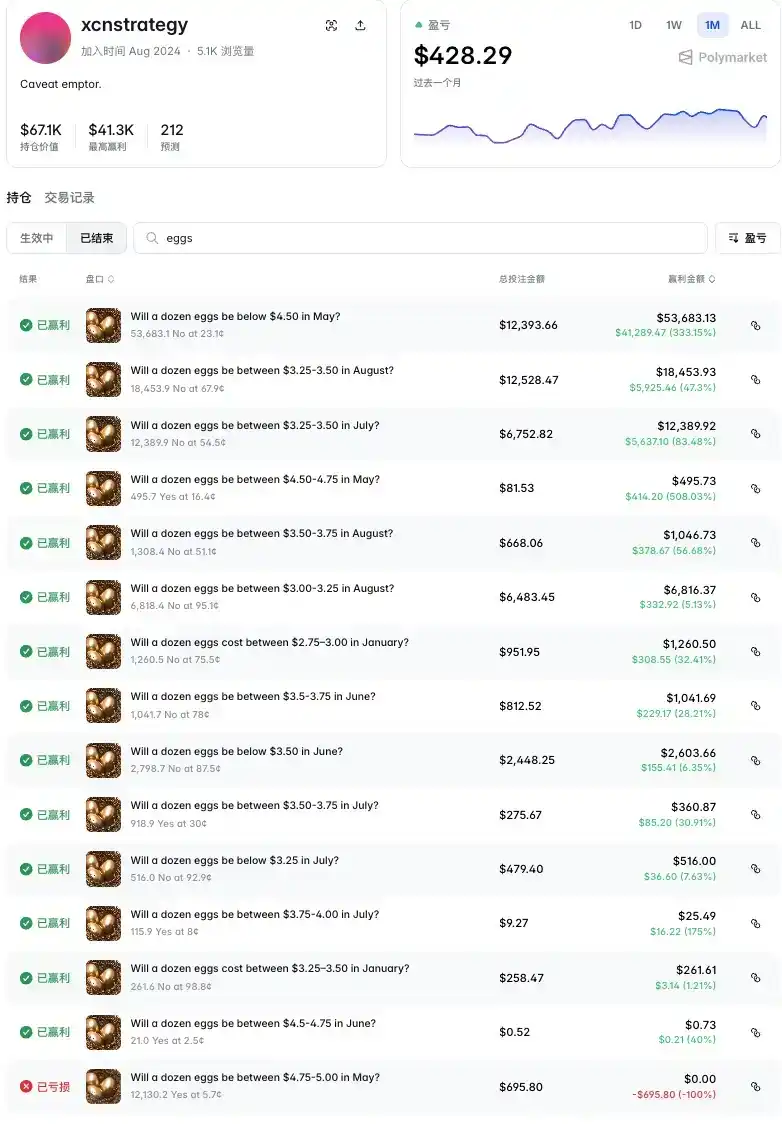
A trader with the ID "xcnstrategy" established positions in multiple expiration months—January, May, June, July, and August—for egg price predictions. The vast majority of these trades were shorting the "Yes" for certain price ranges, meaning betting that eggs would not reach certain price levels. The total betting amount was $44,800, with nearly $100,000 in profits. Out of 15 trades, all but the first were profitable.

The most recent trade was also the most profitable: a $12,393 bet on "No" for "a dozen eggs in May below $4.50," yielding a profit of $41,289 (+333%).

Speculations about xcnstrategy’s true identity, aside from possibly being an "egg enthusiast," include many who believe he is likely someone with a commodities market background or agricultural data research capabilities, analyzing that the U.S. avian flu-induced egg price surge starting in 2025 was a short-term phenomenon and that the market overestimated the probability of sustained high prices. Others think he is an industry insider in the egg supply chain, hedging against the volatility inherent in the industry.
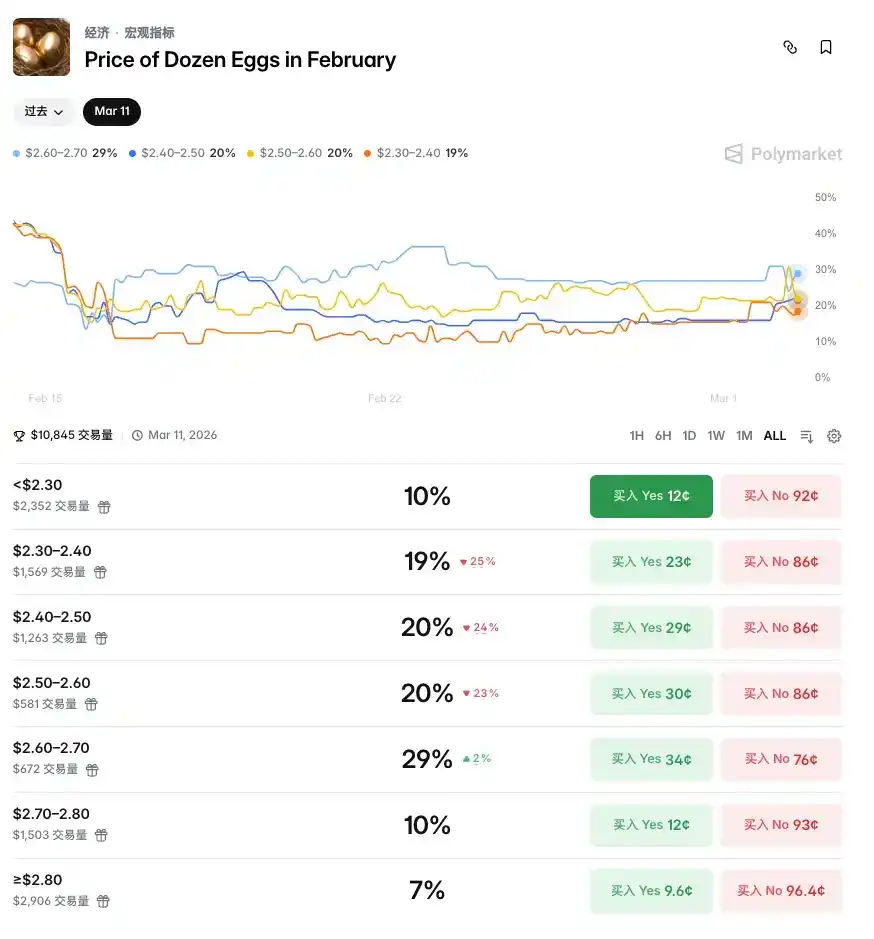
Eggs are just one example. The traditional asset标的 available for trading on Polymarket are far more diverse than one might imagine: from crude oil (CL), gold (GC), silver (SI), and other commodities to various foreign exchange rates and housing data—all can be found as markets on Polymarket.
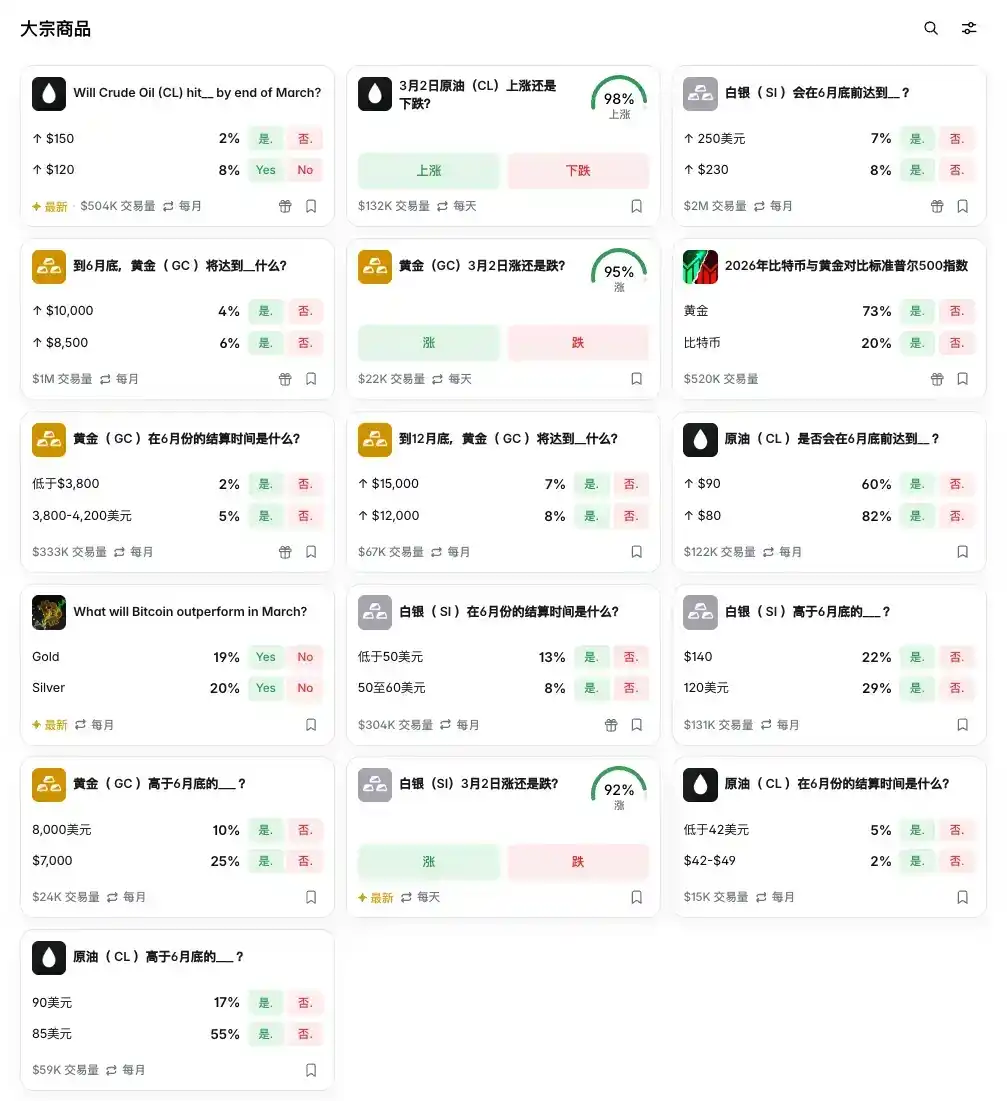
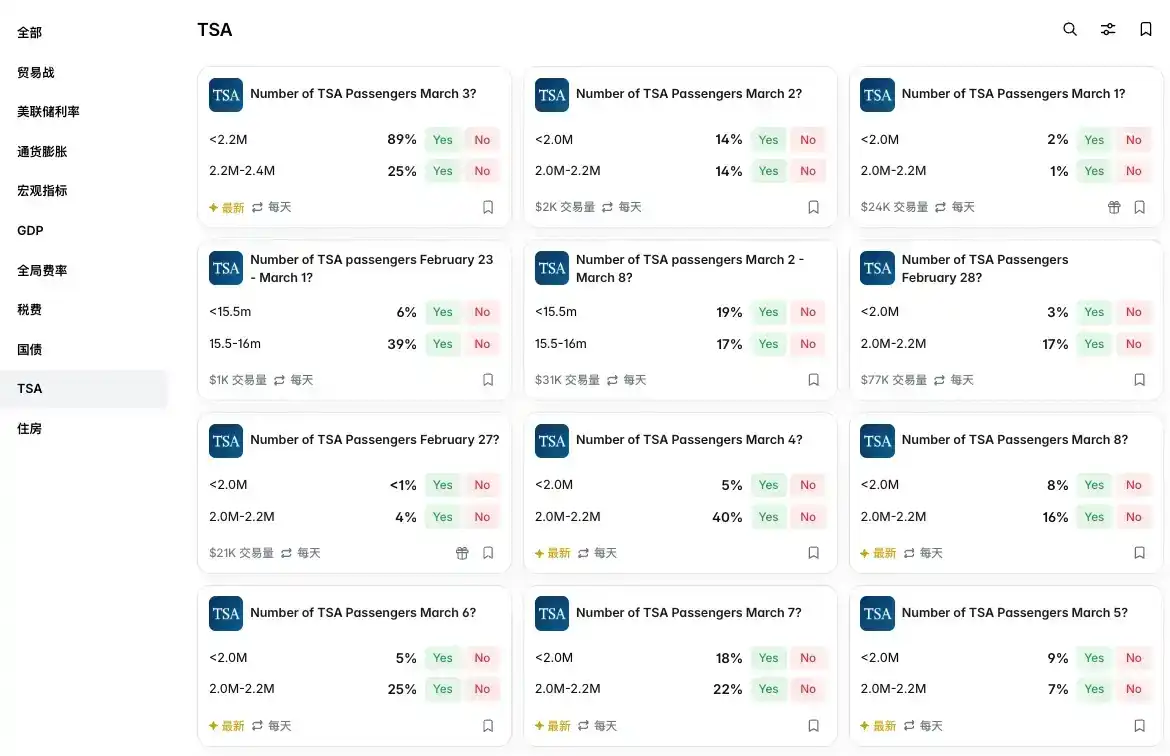
Operating 24/7 without closing is one of the biggest advantages of trading such markets on Polymarket. This advantage is particularly evident during traditional financial market closures, as seen with the U.S.-Iran conflict escalation last weekend.

In this regard, Hyperliquid shares the same advantage. The perpetual contracts on Hyperliquid, linked to crude oil and gold, have no expiration dates and run continuously, 24/7.

This leads to an increasingly hard-to-ignore phenomenon: the crypto market is quietly taking on the price discovery function of traditional financial markets, especially when the latter are closed.

Traditional futures markets have fixed trading hours; CME's crude oil and gold contracts close on weekends, and foreign exchange markets see liquidity dry up late at night. This means that when geopolitical shocks erupt after Friday's close, participants are left in the dark—unable to hedge, express views, or price assets.

Last weekend's U.S.-Iran conflict escalation is the latest validation. According to Bloomberg, around the time the conflict broke out, a large number of traders flocked to Hyperliquid to trade perpetual contracts linked to crude oil and gold to hedge against the geopolitical shock—while traditional markets were shut, crypto derivatives markets were the only place with the lights on. Investment firm executive Avi Felman had previously predicted that "Hyperliquid will become indispensable for fund managers because it’s 24/7." This judgment was concretely validated during this conflict.

At the same time, gold tokenization is accelerating another logic: when gold exists in the form of on-chain tokens and is continuously priced in decentralized markets, it no longer needs to wait for the London Metal Exchange or CME to open. To some extent, the tokenized gold market is acting as a "shadow pre-market" for traditional gold markets, pricing gold over the weekend and allowing price discovery to occur before traditional markets open.

In 2020, then the world's second-largest trading platform, FTX, launched tokenized stocks, allowing platform users to trade Tesla and NVIDIA shares with stablecoins. The idea was to capture pricing power—when U.S. stocks were closed, FTX's Tesla tokens could fill the market void, allowing users to trade Tesla stock when the company announced new models on Saturday, thereby influencing Nasdaq's Monday opening.

Unfortunately, due to liquidity issues, the pricing effect ultimately did not materialize. Six years later, tokenization has come full circle back to this vision. Today, Polymarket and Hyperliquid are viewed not merely as cryptocurrency trading platforms. Polymarket is already officially recognized as a public opinion polling agency and information exchange hub, while Hyperliquid is seen as a new type of full-asset trading platform.

Price discovery power has always been one of the core powers in financial infrastructure.

Back in the day, Chicago butter and egg merchants established the CME because they needed a venue to discover prices and transfer risks. Over a hundred years later, the same logic is replaying on-chain, only the medium has changed.

You might think the market is trading eggs, but in reality, the market is fighting for pricing power.


Câu hỏi Liên quan

QWhat was the original name of the Chicago Mercantile Exchange (CME) and what products did it initially trade?

AThe original name was the Chicago Butter and Egg Board, and it initially traded only two products: butter and eggs.

QWhy did the trading of egg futures decline and eventually cease on the CME in 1982?

AThe decline was due to the rapid industrialization of the U.S. egg-laying industry and the maturation of the cold chain, which smoothed out price volatility, reducing the uncertainty and need for hedging, leading to its quiet discontinuation.

QWhat is the significant advantage of trading assets like eggs, oil, and gold on platforms like Polymarket and Hyperliquid compared to traditional markets?

AThe significant advantage is that they operate 24/7, allowing for continuous trading, price discovery, and risk management even when traditional financial markets are closed, such as during weekends or overnight.

QAccording to the article, how did the recent U.S.-Iran conflict demonstrate the value of crypto derivative markets like Hyperliquid?

AWhen the conflict escalated over a weekend, traditional markets were closed, but traders flocked to Hyperliquid to trade perpetual contracts linked to oil and gold, making it the only available venue to hedge risks and express market views, thus validating its role in pricing during off-hours.

QWhat broader financial function are platforms like Polymarket and Hyperliquid increasingly seen as fulfilling, beyond just trading cryptocurrencies?

AThey are increasingly seen as fulfilling the core financial function of price discovery and acting as information hubs or full-asset trading platforms, effectively competing for pricing power that was traditionally held by established exchanges like the CME.

Nội dung Liên quan

Với giá 100.000 đô la mỗi tháng: Truth Social bán quyền truy cập bài đăng của Trump cho các công ty đầu tư

Trump Media and Technology Group (TMTG) đã ra mắt dịch vụ Truth API từ ngày 1/8/2026. Đây là kênh dữ liệu có phí cung cấp cho các khách hàng tổ chức, chủ yếu là các công ty đầu tư và giao dịch tần suất cao, quyền truy cập thời gian thực đến các bài đăng từ những tài khoản có ảnh hưởng nhất trên nền tảng Truth Social, bao gồm cả cựu Tổng thống Donald Trump. Theo các nguồn tin, gói dịch vụ này có giá lên tới 100.000 USD một tháng, với mức giảm giá xuống 60.000 USD/tháng cho hợp đồng ba năm. TMTG tuyên bố đây là một phần trong chiến lược tạo ra nguồn thu ổn định và lợi nhuận cao từ tài sản của công ty. Tuy nhiên, sáng kiến này đã vấp phải chỉ trích từ các nhà lập pháp cả hai đảng. Các Thượng nghị sĩ Dân chủ Elizabeth Warren và Adam Schiff đã yêu cầu Ủy ban Chứng khoán Mỹ (SEC) điều tra xem liệu việc bán quyền truy cập ưu tiên đến các bài đăng của tổng thống có vi phạm luật hay không. Thượng nghị sĩ Cộng hòa Bill Cassidy cũng chỉ trích đây là hành vi bán quyền truy cập đặc quyền không thể chấp nhận được. Phân tích AI trong bài báo cảnh báo về rủi ro tiềm ẩn, so sánh với sự kiện năm 2013 khi thị trường chứng khoán sụt giảm nhanh chóng do tin tức giả mạo. Việc biến tài khoản tổng thống thành một nút tín hiệu thị trường với độ trễ mili giây có thể tạo ra mục tiêu cho tin tặc hoặc thao túng, và đặt ra câu hỏi về trách nhiệm nếu thông tin sai lệch được phát tán qua kênh này.

cryptonews.ru11 phút trước

Với giá 100.000 đô la mỗi tháng: Truth Social bán quyền truy cập bài đăng của Trump cho các công ty đầu tư

cryptonews.ru11 phút trước

Các giao dịch rút Bitcoin tiếp tục: 8 năm lưu trữ trong ví lạnh Coldcard kết thúc bằng số không

Ví phần cứng Coldcard bị xâm phạm, dẫn đến làn sóng rút tiền mới từ các thiết bị dễ bị tấn công. Theo Galaxy Research, tổng số tiền bị đánh cắp đã lên tới 1.367,05 BTC (khoảng 88,6 triệu USD). Vấn đề không nằm ở phần mềm cập nhật, mà ở seed phrase (cụm từ khôi phục) được tạo từ tháng 3/2021 do lỗi lập trình, khiến chúng dễ bị dò tìm. Lỗi này xảy ra khi thiết bị chuyển từ bộ tạo số ngẫu nhiên phần cứng sang bộ tạo phần mềm Yasmarang, được khởi tạo bằng dữ liệu có thể dự đoán được. Người dùng các model Mk2-Mk5 và Q với phiên bản phần mềm nhất định cần tạo seed phrase mới trên bản cập nhật đã sửa và chuyển tài sản sang đó để bảo vệ. Câu chuyện đau lòng của một nhà đầu tư 39 tuổi đã mất 2 BTC (130.000 USD) tích góp suốt 8 năm trong vài phút, dù áp dụng chiến lược "mua và giữ trong ví lạnh" thận trọng. Anh mua Bitcoin như một lá chắn chống siêu lạm phát và kế hoạch nghỉ hưu sớm, nhưng lỗ hổng đã phá hỏng mọi thứ. Sự việc nhấn mạnh rằng lưu trữ offline không tự động đảm bảo an toàn, và cộng đồng hy vọng nhà sản xuất có thể tìm cách khắc phục, hoàn trả tài sản cho người dùng.

cryptonews.ru1 giờ trước

Các giao dịch rút Bitcoin tiếp tục: 8 năm lưu trữ trong ví lạnh Coldcard kết thúc bằng số không

cryptonews.ru1 giờ trước

Giao dịch

Giao ngay
活动图片




